Eosinophilic esophagitis and celiac disease: how they differ and how each is diagnosed
Short answer
Eosinophilic esophagitis (EoE) and celiac disease are separate conditions: EoE is diagnosed from a biopsy of the esophagus2, celiac disease from blood tests and biopsies of the small intestine12. Studies disagree on whether the two occur together more often than chance21, 24, 26, and an EoE elimination diet that includes wheat is a different step from the gluten-free diet used for celiac disease5, 18.
Part of Related conditions and complications, 16 guides
Key points
- EoE affects the esophagus; celiac disease damages the small intestine1, 11.
- MedlinePlus calls a biopsy of the esophagus the only way to diagnose EoE2. Celiac disease is typically diagnosed with blood tests and small-intestine biopsies12.
- A 2014 systematic review found the available evidence did not support an association between the two, while saying a lack of valid studies prevented ruling one out completely21; in contrast, a 2024 Swedish register study found a 6.6-fold higher risk of later EoE than the general population that disappeared when people with celiac disease were compared with their siblings24.
- NIDDK says doctors do not recommend starting a gluten-free diet before diagnostic testing for celiac disease because the diet can affect test results14. One type of EoE elimination diet removes foods that commonly cause allergies, and the MedlinePlus list includes wheat5.
What each condition is
EoE is a chronic disease of the esophagus, the tube that carries food from the mouth to the stomach. White blood cells called eosinophils build up there, and the damage and inflammation can cause pain, trouble swallowing and food getting stuck1. MedlinePlus says researchers are not certain of the cause and think it is an immune system or allergic reaction to foods or to substances in the environment4.
Celiac disease is a chronic digestive and immune disorder that damages the small intestine, and it is triggered by eating foods containing gluten11. The organ affected and the tests used to confirm each condition differ, as the sections below show.
Do the two occur together more often than chance?
The studies we found do not agree. This table gives each one with its own design, so the figures are not mixed together.
| Study | What it reported |
|---|---|
| 2014 systematic review, 30 studies in the quantitative summary, most with methodological inconsistencies36 | The prevalence of EoE in celiac disease ranged from 0% to 10.7%, and of celiac disease in EoE from 0.16% to 57.1%20. The authors concluded that currently available evidence does not support an association, while a lack of valid studies prevents completely ruling one out21. They documented significant publication bias in favour of short studies reporting positive associations34. |
| 2017 Mayo Clinic cohort of children who had an endoscopy, plus a meta-analysis23 | The risk of EoE was not increased in children with celiac disease compared with those without it23. |
| 2024 Swedish nationwide register study of people with biopsy-verified celiac disease24 | Among 27,338 people with celiac disease and 134,987 matched reference individuals from the general population38, 17 people with celiac disease and 13 reference individuals were diagnosed with EoE during follow-up25. That was a 6.6-fold higher risk than the general population, but compared with their siblings, people with celiac disease were at no increased risk. The authors suggested altered health-seeking behavior or shared genetic or early environmental factors as possible explanations24. |
| 2024 retrospective study at one tertiary care hospital, 148 children with celiac disease26 | 11 of the 148 also had EoE (7.4%)26. The authors concluded this was a higher proportion of EoE than would be expected in the general population37. |
| 2026 study in Naples of 520 children biopsied for suspected celiac disease27 | 14 (2.7%) had confirmed esophageal eosinophilia, and only 2 of those 14 had symptoms27. |
The studies differ in design, in the ages studied and in how they counted, and they reach different answers, so this guide does not give one figure for how often the two occur together.
Symptoms: where the two lists overlap and where they do not
| Symptom | EoE (MedlinePlus) | Celiac disease (NIDDK) |
|---|---|---|
| Trouble swallowing | Listed for older children and adults3 | Not on NIDDK’s symptom lists15 |
| Food getting stuck in the esophagus | Listed for adults3 | Not on NIDDK’s symptom lists15 |
| Reflux that does not get better with medicines | Listed for infants, toddlers, older children and adults3 | Not on NIDDK’s symptom lists15 |
| Abdominal pain | Listed for older children3 | Listed15 |
| Vomiting | Listed for infants, toddlers and older children3 | Nausea or vomiting listed15 |
| Chronic diarrhea | Not on MedlinePlus’s lists3 | Listed15 |
Neither condition is confirmed by symptoms alone. For celiac disease NIDDK says so directly16. For EoE, MedlinePlus says other conditions can have the same symptoms9, that some people who think they have reflux (GERD) may actually have EoE10, and that a biopsy is the only way to make the diagnosis2. For celiac symptoms in more detail, see celiac disease symptoms.
How each is diagnosed
| EoE | Celiac disease | |
|---|---|---|
| What confirms it | A biopsy taken during an upper endoscopy; MedlinePlus calls it the only way to diagnose EoE2 | Doctors typically diagnose it with blood tests and biopsies of the small intestine12 |
| Where the tissue comes from | The esophagus2 | The small intestine, during an upper GI endoscopy13 |
| What the result looks like | A high number of eosinophils in the esophageal samples2. APFED says a count of 15 or more per high-powered microscopic field is highly suggestive of EoE32. The ACG guideline describes EoE as diagnosed with symptoms of esophageal dysfunction and an eosinophil-predominant infiltrate in the esophagus28. | Blood tests can show antibody levels that are often higher than normal in people who have untreated celiac disease17. |
| What blood tests are for | MedlinePlus says blood tests may check for other conditions and, if you have EoE, blood or other tests may check for specific allergies8 | Antibody levels, as above17 |
Both involve an upper endoscopy, but according to these sources the tissue used for each diagnosis comes from a different place2, 13. For the celiac pathway, see how celiac disease is diagnosed, step by step and the celiac blood test.
Wheat, gluten and the order of diet and testing
NIDDK says doctors do not recommend starting a gluten-free diet before diagnostic testing for celiac disease because the diet can affect test results14.
EoE diets work from a different list, set out in the table in the next section. APFED says EoE is often triggered by immune reactions to certain foods, particularly milk and wheat33.
None of the sources read for this guide says how to time celiac testing around an EoE elimination diet. That is a question for the clinician managing the EoE.
The celiac diet and an EoE elimination diet are not the same
| Celiac disease: gluten-free diet | EoE: elimination diet | |
|---|---|---|
| What is removed | Gluten, a protein found naturally in wheat, barley and rye18 | In one type of elimination diet, foods that commonly cause allergies, such as dairy products, egg, wheat, soy, peanuts, tree nuts and fish or shellfish5 |
| What is thought to drive it | Eating gluten triggers the disease11 | Researchers think EoE is an immune or allergic reaction to foods or to substances in the environment4 |
| How it is used | Doctors treat celiac disease by helping people follow a gluten-free diet18 | Certain foods are stopped for several weeks, then added back one at a time, with repeat endoscopies to see whether they are tolerated6 |
| How progress is checked | Follow-up may include antibody blood tests and, in some cases, repeat biopsies to see whether the small intestine has healed19 | Repeat endoscopies6 |
On guideline status, the AGA and the Joint Task Force on Allergy-Immunology Practice Parameters suggest an empiric six-food elimination diet over no treatment, a conditional recommendation based on low-quality evidence30. The same guideline says elimination diets of any type should be used with discretion and for as short a period as is suitable to treat the underlying EoE31. The 2025 ACG guideline lists empiric diet elimination among its recommended treatments29.
For people who have both conditions, the 2014 systematic review found that a gluten-free diet achieved histological remission of EoE in 32.1% of celiac patients (95% confidence interval 14.9 to 52.2%), which the authors said was similar to what is expected for wheat elimination in EoE patients22. In the Naples study, a gluten-free diet brought remission of the esophageal eosinophilia in 5 of 11 cases35. These are small bodies of evidence, not a rule for any individual.
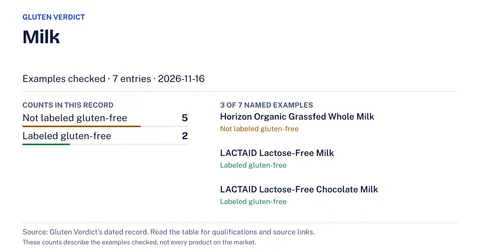
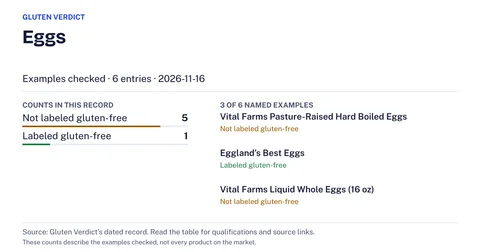
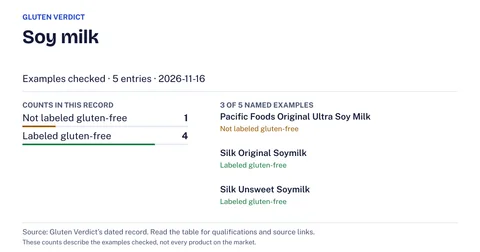
Three of the foods on EoE elimination lists have gluten verdicts here: milk, eggs and soy milk. Those verdicts say whether the food contains gluten. They do not say whether a food belongs in anyone’s EoE diet.
Other EoE treatments, and questions to bring to the specialist
MedlinePlus says there is no cure for EoE and that treatments can manage symptoms and prevent further damage, with medicines and diet as the two main types7. The 2025 ACG guideline lists proton pump inhibitors, topical steroids, empiric diet elimination, a biologic and esophageal dilation as recommended treatments, with feeding therapy used alongside them in children with food aversion or feeding dysfunction29.
Questions that fit either diagnosis, for a conversation with the treating clinician:
- Which biopsy results confirmed each diagnosis, and from which part of the body were they taken?
- Could a planned diet change affect a diagnostic test that is still to come?
- If a food-elimination diet is planned, which foods, for how long, and when is the repeat endoscopy?
- Does the plan for one condition change the plan for the other?
Verdicts in this guide
Questions people ask
Is eosinophilic esophagitis a form of celiac disease?
No. EoE is a chronic disease of the esophagus1. Celiac disease damages the small intestine and is triggered by gluten11.
More in Related conditions and complications
 Celiac disease and bone density: who is scanned, how to read the report and what recovery looks likeWhen guidelines advise a bone density scan in celiac disease, how a T-score or Z-score is read by age, and what published studies show about recovery.
 Lactose intolerance after a celiac diagnosis: why it happens and how long it lastsWhy lactose intolerance can follow a celiac diagnosis, what published studies report about recovery on a gluten-free diet, and how lactose-free milk fits.
 Microscopic colitis and celiac disease: how they overlap and how each is diagnosedWhat microscopic colitis is, why a colon biopsy diagnoses it, what studies report about its overlap with celiac disease, and questions to ask.
 Celiac disease and thyroid disease: how they are linked and which tests the guidelines nameHow often celiac and thyroid disease occur together, which tests guidelines name in each direction, and how to check a thyroid tablet’s label.
 SIBO and celiac disease: how often it is found and what testing showsWhat studies report about SIBO in celiac disease, how breath tests work and where they fall short, and and what else is checked when symptoms persist.
 High liver enzymes and celiac disease: how often, and what else is checkedHow often raised ALT and AST are reported in celiac disease, how often they normalize on a gluten-free diet, and what else gets checked if they do not.
Related guides
 Celiac disease and other autoimmune conditions: which pairings have testing adviceWhich autoimmune conditions are reported with celiac disease, which have testing advice from named bodies, and which do not.
 Celiac Blood Tests: What tTG-IgA, Total IgA, DGP and EMA Each CheckWhat tTG-IgA, total IgA, EMA and DGP check, why total IgA is drawn with tTG-IgA, when back-up tests are used, and why gluten stays in the diet first.
 Celiac disease symptoms in adults: what the sources list and who gets testedDigestive and non-digestive celiac symptoms as NIDDK, ACG and Coeliac UK list them, who guidelines say to test, and why gluten stays in the diet first.
 Celiac disease vs gluten intolerance: three conditions, three diagnosesHow celiac disease, non-celiac gluten sensitivity and wheat allergy differ in mechanism, diagnosis and diet, with a source behind every point.
Sources
- [1, 2, 3, 4, 5, 6, 7, 8, 9, 10] MedlinePlus (US National Library of Medicine, NIH), Eosinophilic Esophagitis, checked Nov 17, 2026.
Read on 2026-11-17: under “What are the symptoms of eosinophilic esophagitis (EoE)?” the page lists, for infants and toddlers, feeding problems, vomiting, poor weight gain and growth, and reflux that does not get better with medicines; for older children, vomiting, abdominal pain, trouble swallowing (especially with solid foods), reflux that does not get better with medicines, and poor appetite; for adults, trouble swallowing (especially with solid foods), food getting stuck in the esophagus, reflux that does not get better with medicines, heartburn, and chest pain. Chronic diarrhea is not on these lists.
- [11] NIDDK (National Institute of Diabetes and Digestive and Kidney Diseases, NIH), Definition & Facts for Celiac Disease, checked Nov 17, 2026.
- [12, 13, 14, 16, 17] NIDDK (National Institute of Diabetes and Digestive and Kidney Diseases, NIH), Diagnosis of Celiac Disease, checked Nov 17, 2026.
- [15] NIDDK (National Institute of Diabetes and Digestive and Kidney Diseases, NIH), Symptoms & Causes of Celiac Disease, checked Nov 17, 2026.
Read on 2026-11-17: the page lists digestive symptoms of celiac disease as bloating, chronic diarrhea, constipation, gas, lactose intolerance, loose, greasy, bulky, bad-smelling stools, nausea or vomiting, and pain in the abdomen, and lists symptoms outside the digestive tract (including dermatitis herpetiformis, fatigue, joint or bone pain, mental health problems, nervous system symptoms, reproductive problems and mouth symptoms). The words “swallow”, “reflux”, “heartburn” and “stuck” do not appear on the page.
- [18, 19] NIDDK (National Institute of Diabetes and Digestive and Kidney Diseases, NIH), Treatment for Celiac Disease, checked Nov 17, 2026.
- [20, 21, 22, 34, 36] PubMed (Aliment Pharmacol Ther, 2014), Systematic review: the association between eosinophilic oesophagitis and coeliac disease, checked Nov 17, 2026.
- [23] PubMed (J Pediatr Gastroenterol Nutr, 2017), The Association Between Celiac Disease and Eosinophilic Esophagitis: Mayo Experience and Meta-analysis of the Literature, checked Nov 17, 2026.
- [24, 25, 38] PubMed (J Allergy Clin Immunol Glob, 2024), Association of celiac disease with eosinophilic esophagitis: Nationwide register-based cohort study with sibling analyses, checked Nov 17, 2026.
- [26, 37] PubMed (Clin Pediatr, 2024), Concurrent Celiac Disease and Eosinophilic Esophagitis in a Pediatric Cohort: More Than a Coincidence, checked Nov 17, 2026.
- [27, 35] PubMed (Eur J Pediatr, 2026), Incidental finding of esophageal eosinophilia in patients investigated for suspected celiac disease: results from a pediatric retrospective study, checked Nov 17, 2026.
- [28, 29] PubMed (Am J Gastroenterol, 2025): American College of Gastroenterology, ACG Clinical Guideline: Diagnosis and Management of Eosinophilic Esophagitis (abstract), checked Nov 17, 2026.
- [30, 31] PubMed Central (Gastroenterology, 2020): AGA Institute and Joint Task Force on Allergy-Immunology Practice Parameters, Clinical Guidelines for the Management of Eosinophilic Esophagitis, checked Nov 17, 2026.
- [32, 33] American Partnership for Eosinophilic Disorders (APFED), Eosinophilic Esophagitis (EoE), checked Nov 17, 2026.