Lactose intolerance after a celiac diagnosis: why it happens and how long it lasts
Short answer
Lactose intolerance can follow celiac disease because the damaged small intestine makes less lactase, the enzyme that digests lactose1, 16. Coeliac UK calls it usually temporary4. Reports on timing differ: a 2021 review says most patients can tolerate lactose one to two months after the mucosa is restored, while one 15-patient study found breath tests normal in 9 of the 14 remaining patients at 12 months17, 20.
Part of Related conditions and complications, 16 guides

Key points
- NIDDK lists lactose intolerance due to damage to the small intestine among the digestive symptoms of celiac disease3.
- NIDDK says lactose intolerance caused by injury to the small intestine is called secondary, and that treating the cause of the injury may let a person tolerate lactose again2.
- Timing differs between reports: a 2021 review says most patients can tolerate lactose one to two months after the mucosa is restored17, while in one 15-patient study, breath tests had normalized in 9 of the remaining 14 patients at 12 months20.
- Lactose intolerance is a digestive problem with lactose, not an immune reaction to milk protein, so it is not a milk allergy8.
- A lactose-free label does not answer the gluten question: LACTAID says most of its products do not contain gluten and names four ice creams that do25.
Why celiac disease can lead to lactose intolerance
Lactase is the enzyme that breaks down lactose, the natural sugar in milk1, 8. When the small intestine makes low levels of lactase, it cannot digest all the lactose a person eats or drinks, and symptoms can follow1.
NIDDK’s celiac disease page lists lactose intolerance due to damage to the small intestine among the digestive symptoms of celiac disease3. A 2021 review says lactose malabsorption commonly presents in celiac disease28, and occurs because lactase is lost from the damaged intestinal villi16. Coeliac UK describes the same picture at diagnosis: the gut lining still carries the damage caused by gluten, which can mean the body does not make enough lactase, the enzyme does not work properly, or lactose cannot be digested29.
In one 1999 study of duodenal biopsies from 26 patients, lactase staining was absent in the nine patients with active celiac disease and present in the 11 control patients with normal tissue24.
This is the pattern NIDDK calls secondary lactose intolerance: it follows an injury to the small intestine, and NIDDK says that if the cause of the injury is treated, a person may be able to tolerate lactose again2.
How long does it last on a gluten-free diet?
Coeliac UK says lactose intolerance is associated with undiagnosed coeliac disease and is usually temporary4, and that once a person follows a gluten-free diet the gut can heal and they may be able to digest lactose again5. It does not give a time. The studies below do, and they do not agree.
| Source | What it covers | What it reports |
|---|---|---|
| 2021 review, Nutrients | A review of nutrition in lactose malabsorption and celiac disease | Once on a gluten-free diet and after the mucosa is restored, most patients can tolerate lactose one to two months later17. |
| Ojetti and others, 2008 | 15 celiac patients with a positive lactose breath test, tested again on a gluten-free diet | Breath test normalized in 1 of 15 patients after 6 months and in 9 of the remaining 14 after 12 months19, 20. |
| Bodé and Gudmand-Høyer, 1988 | 51 adults with biopsy-verified coeliac disease, treated with a gluten-free and low-lactose diet21, 32 | After treatment 12% had a flat lactose tolerance curve22. The authors concluded that in well-treated disease, lactose malabsorption is not commoner than in the general population23. |
Before treatment, the 1988 authors concluded that lactose malabsorption was a clinically important condition in many patients with untreated disease, with more frequent and more watery stools31. Read the table as what these groups showed, not as a schedule for any one person.
Lactose intolerance is not a milk allergy
NIDDK separates the two: lactose intolerance comes from problems digesting lactose, while a milk allergy comes from the immune system’s response to proteins in milk and milk products8. Neither is the same question as whether a dairy food contains gluten, which is answered product by product in the verdicts below.
The symptoms of lactose intolerance are similar to those of coeliac disease, according to Coeliac UK30, and NIDDK names celiac disease among the conditions that can cause symptoms similar to lactose intolerance11.
How lactose intolerance is checked
NIDDK says a doctor may ask a person to stop eating and drinking milk and milk products for a period of time to see whether symptoms go away9. A hydrogen breath test is another option: if breath hydrogen rises and symptoms get worse during the test, the doctor may diagnose lactose intolerance10.
Both NIDDK and Coeliac UK point to calcium. NIDDK says avoiding all milk and milk products may leave a person with less calcium and vitamin D than they need15, and Coeliac UK says not to remove lactose from the diet before speaking with a healthcare professional, as that could reduce calcium intake6.
What the sources say about dairy while symptoms last
NIDDK says most people with lactose intolerance can have some lactose without getting symptoms14. Coeliac UK says yogurts and cheeses, hard and soft, are very low in lactose and can be eaten by most people with lactose intolerance7.
NIDDK describes lactase products as tablets or drops that contain lactase, the enzyme that breaks down lactose13, and says to check with a doctor before using them12. Who needs which amount is a question for a dietitian or doctor, not for this page.
When symptoms continue on a gluten-free diet
The 2021 review reports that lactose intolerance has been frequently reported in celiac patients considered unresponsive to a gluten-free diet. It describes nonresponsive celiac disease as occurring in approximately 20% of celiac patients, with lactose intolerance reported in up to 8% of them18.
Other conditions can cause symptoms similar to those of lactose intolerance11, and this page does not try to say what lies behind any one person’s symptoms. For a different gluten question, see hidden sources of gluten.
Plain dairy and gluten: our verdicts
Lactose and gluten are separate questions, and a dairy food’s gluten status depends on what the maker added. Our verdicts for these foods:
- Milk, plain and flavored
- Cheddar, Parmesan, cottage cheese and cream cheese
- Butter and sour cream
- Yogurt and ice cream, where the flavor and mix-ins decide
Lactose-free milk and LACTAID pills: what LACTAID says about gluten
LACTAID is the one lactose-free brand we read for this guide. Its FAQ says most LACTAID products do not contain gluten, and names the only ones that do: Cookies & Cream, Peanut Butter Chip, Cookie Dough and Salted Caramel ice creams25. Its milk page lists “Gluten Free” among the labels shown for LACTAID milk26. The same FAQ presents LACTAID’s supplement pills and chewable tablets as LACTAID products27; they are not among the four it names.
Product lists change. The package in your hand has the final word, and we did not check other makers’ lactose-free products for this guide.
Verdicts in this guide
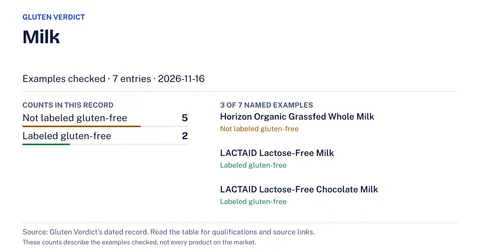 MilkNaturally gluten-freechecked Nov 16, 2026
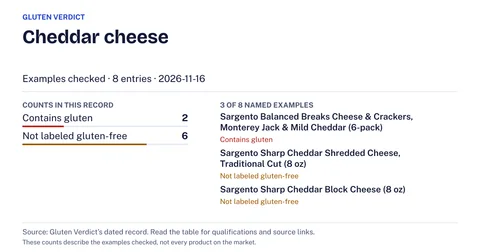 Cheddar cheeseNaturally gluten-free2 of 8 products we checked contain gluten: Sargento Balanced Breaks Cheese & Crackers, Monterey Jack & Mild Cheddar (6-pack) and Farm Rich Breaded Cheddar Cheese Curdschecked Nov 16, 2026
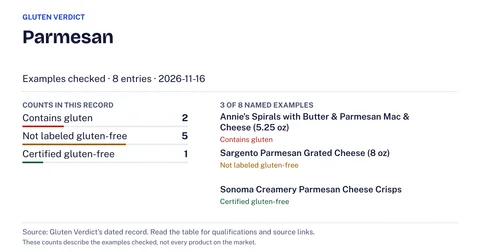 ParmesanNaturally gluten-free2 of 8 products we checked contain gluten: Annie's Spirals with Butter & Parmesan Mac & Cheese (5.25 oz) and Annie's Super! Mac Shells & Parmesan (6 oz)checked Nov 16, 2026
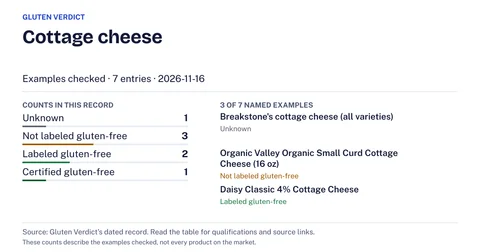 Cottage cheeseNaturally gluten-freechecked Nov 16, 2026
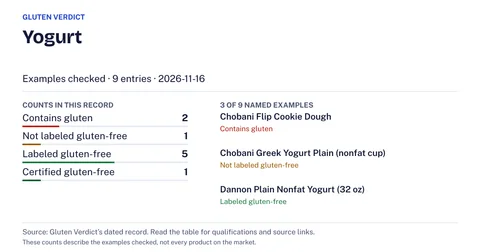 YogurtDepends on the product2 of 9 products we checked contain gluten: Chobani Flip Cookie Dough and Chobani Flip Cookies & Creamchecked Nov 16, 2026
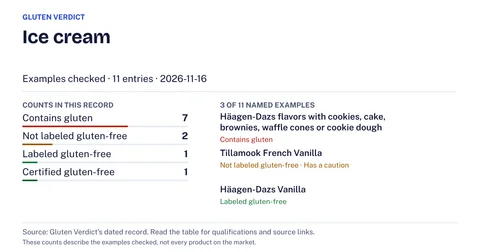 Ice creamDepends on the product7 of 11 products we checked contain glutenchecked Nov 16, 2026
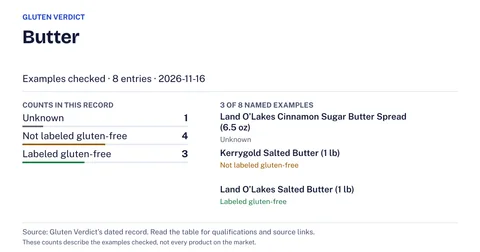 ButterNaturally gluten-freechecked Nov 16, 2026
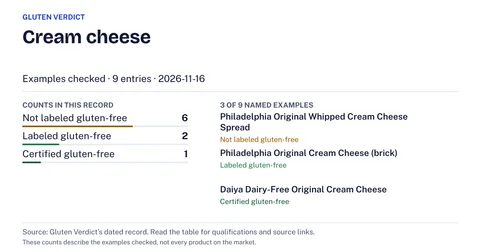 Cream cheeseNaturally gluten-freechecked Nov 16, 2026
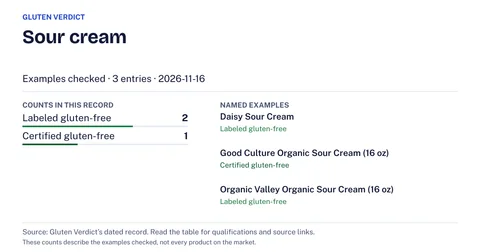 Sour creamNaturally gluten-freechecked Nov 16, 2026
Questions people ask
Is lactose intolerance permanent after a celiac diagnosis?
Coeliac UK says it is usually temporary4. NIDDK says that when lactose intolerance comes from injury to the small intestine and the cause is treated, a person may be able to tolerate lactose again2. Reports of timing differ17, 20.
Is lactose intolerance the same as a milk allergy?
No. NIDDK says lactose intolerance is caused by problems digesting lactose, while milk allergies are caused by the immune system’s response to proteins in milk8.
Is lactose-free milk gluten-free?
For LACTAID, the maker says most of its products do not contain gluten and names four ice creams that do25. Other brands have their own labels; start with our milk verdict.
Can people with celiac disease eat dairy?
Whether a dairy food contains gluten is decided product by product; see the verdicts above. Lactose is a separate matter, and NIDDK says most people with lactose intolerance can have some lactose without getting symptoms14.
More in Related conditions and complications
 Celiac disease and bone density: who is scanned, how to read the report and what recovery looks likeWhen guidelines advise a bone density scan in celiac disease, how a T-score or Z-score is read by age, and what published studies show about recovery.
 Eosinophilic esophagitis and celiac disease: how they differ and how each is diagnosedHow eosinophilic esophagitis and celiac disease differ, what studies report about having both, how each is diagnosed, and how their diets differ.
 Iron deficiency anemia and celiac disease: why it appears and what clinicians checkWhy celiac disease causes iron deficiency anemia, what NICE and ACG say about testing, what decides oral or IV iron, and checking a supplement for gluten.
 SIBO and celiac disease: how often it is found and what testing showsWhat studies report about SIBO in celiac disease, how breath tests work and where they fall short, and and what else is checked when symptoms persist.
 Depression, anxiety and celiac disease: what studies report and when to see a clinicianWhat meta-analyses report about depression and anxiety in celiac disease, what is known about the gut-brain link, and when to contact a clinician.
 Dermatitis herpetiformis: how it is diagnosed and treated, and how other skin conditions link to celiac diseaseWhat NIDDK, Coeliac UK, GIG and published reviews say about dermatitis herpetiformis: the skin biopsy, the diet, dapsone, and weaker skin links.
Related guides
 Gluten-free and dairy-free: how to check a US label for bothUS labels treat milk and gluten under different rules. How to read for both, which makers state both claims, and what to ask when eating out.
 Follow-up testing after a celiac diagnosis: what the guidelines listWhat celiac guidelines and charities list for follow-up: antibody checks, repeat biopsy, nutrient tests, and what is checked if symptoms continue.
 Gluten in medications: what the label, DailyMed and a pharmacist can showFDA’s gluten-free food rule does not cover drugs. Use the ingredient list, DailyMed, the maker and a pharmacist, and know what each can show.
 Where wheat, barley and rye hide in processed food: 15 places to checkFifteen processed foods where wheat, barley or rye turn up, the label step that catches each, and what US allergen law does and does not flag.
Sources
- [1, 2, 8] US National Institute of Diabetes and Digestive and Kidney Diseases (NIDDK), Symptoms & Causes of Lactose Intolerance, checked Nov 17, 2026.
- [3] US National Institute of Diabetes and Digestive and Kidney Diseases (NIDDK), Symptoms & Causes of Celiac Disease, checked Nov 17, 2026.
Read on 2026-11-17: the list headed “Digestive symptoms of celiac disease may include” names bloating, chronic diarrhea, constipation, gas, lactose intolerance due to damage to the small intestine, loose, greasy, bulky, and bad-smelling stools, nausea or vomiting, and pain in the abdomen.
- [4, 5, 6, 7, 29, 30] Coeliac UK, Lactose intolerance, checked Nov 17, 2026.
- [9, 10, 11] US National Institute of Diabetes and Digestive and Kidney Diseases (NIDDK), Diagnosis of Lactose Intolerance, checked Nov 17, 2026.
Read on 2026-11-17: the sentence beginning “Other conditions, such as” names irritable bowel syndrome, celiac disease, inflammatory bowel disease and small bowel bacterial overgrowth as conditions that can cause symptoms similar to those of lactose intolerance.
- [12, 13] US National Institute of Diabetes and Digestive and Kidney Diseases (NIDDK), Treatment for Lactose Intolerance, checked Nov 17, 2026.
- [14, 15] US National Institute of Diabetes and Digestive and Kidney Diseases (NIDDK), Eating, Diet, & Nutrition for Lactose Intolerance, checked Nov 17, 2026.
- [16, 17, 18, 28] Nutrients (Alkalay, 2021), PubMed Central, Nutrition in Patients with Lactose Malabsorption, Celiac Disease, and Related Disorders, checked Nov 17, 2026.
- [19, 20] Scandinavian Journal of Gastroenterology (Ojetti and others, 2008), PubMed, Regression of lactose malabsorption in coeliac patients after receiving a gluten-free diet, checked Nov 17, 2026.
- [21, 22, 23, 31, 32] Scandinavian Journal of Gastroenterology (Bodé and Gudmand-Høyer, 1988), PubMed, Incidence and clinical significance of lactose malabsorption in adult coeliac disease, checked Nov 17, 2026.
- [24] American Journal of Gastroenterology (Srinivasan and others, 1999), PubMed, Lactase enzyme, detected immunohistochemically, is lost in active celiac disease, but unaffected by oats challenge, checked Nov 17, 2026.
- [25, 27] LACTAID (Johnson & Johnson Consumer), LACTAID FAQ, checked Nov 17, 2026.
- [26] LACTAID (Johnson & Johnson Consumer), LACTAID Milk Products, checked Nov 17, 2026.
Read on 2026-11-17: the LACTAID milk products page lists, among the labels shown for its LACTAID milk, “Gluten Free” and “Lactose-Free”.