Celiac disease and bone density: who is scanned, how to read the report and what recovery looks like
Short answer
Celiac disease is linked to low bone density10, and guidelines vary by society on who needs a scan17: the 2025 European guideline recommends a DXA scan after one year on a gluten-free diet for adults with added risk factors18. The report gives a T-score to postmenopausal women and men 50 and older and a Z-score to premenopausal women, men under 50 and children33, 36. NIAMS says to review the result with a doctor, since diagnoses and treatment recommendations also rest on age and other fracture risk factors31.
Part of Related conditions and complications, 16 guides
Key points
- Scan timing differs by source: at diagnosis only with classic malabsorptive symptoms23, one year after starting the diet for newly diagnosed patients21, or one year in for adults with added risk factors in the 2025 European guideline18.
- A T-score is reported for postmenopausal women and men 50 and older; a Z-score for premenopausal women, men under 50 and children33, 36.
- Bone density often improves in the first year on the diet, but recovery is variable and incomplete in many people42.
- Coeliac UK says children who follow the diet do not need testing for osteoporosis52.
- The 2025 European guideline says a low T-score alone, particularly in younger adults, should not automatically trigger drug treatment40.
Why celiac disease can lower bone density
The small intestine is the main place calcium and vitamin D are absorbed, and damage or inflammation there is hypothesized to reduce how much of both the body takes in1. A 2022 review lists the routes researchers have proposed: poor calcium and vitamin D absorption leading to faster bone breakdown, inflammatory signals that favor cells that break bone down, low sex hormones, and low weight and malnutrition2. The Gluten Intolerance Group names the inflammation of celiac disease as another route3.
Timing adds to it. Coeliac UK, a UK charity, says people tend to have lower bone density when first diagnosed because most are diagnosed long after they reach peak bone density in their mid twenties4. It cites research putting the average time from the start of symptoms to diagnosis in adults at 13 years5.
Coeliac UK lists other things that raise the risk of osteoporosis in celiac disease6:
- Late or delayed diagnosis in adult life
- Lapses from the gluten-free diet
- Lactose intolerance
- Being underweight
- Smoking
The 2025 European guideline adds that celiac-related osteoporosis is associated with being underweight, age over 45, the severity of intestinal damage and possibly male sex7.
How common is low bone density, and what does it do to fracture risk?
Figures differ by study and by who was studied. One systematic review pooled eight studies covering 563 premenopausal women and men and reported osteoporosis in 14.4% and osteopenia in 39.6%8. Its authors say the figures are pooled prevalence and call for larger case-control studies that account for confounders9.
The 2025 European guideline reports reduced bone density in over 50% of adults with newly diagnosed celiac disease10, and osteoporosis and osteopenia in approximately 14% and 39% of patients11. Coeliac UK says studies report osteopenia or osteoporosis in 38% to 72% of people at diagnosis12.
A meta-analysis of prospective studies found that celiac disease at baseline was associated with a 30% increase in the risk of any fracture (95% confidence interval 1.14 to 1.50) and a 69% increase in the risk of hip fracture (95% confidence interval 1.10 to 2.59)13. The 2025 guideline says fracture risk in celiac disease varies from 1.3 to 10 times that of the general population14.
Osteoporosis usually gives no warning: NIAMS calls it a “silent” disease with typically no symptoms until a bone breaks15.
Who do guidelines say should have a bone density scan?
NIDDK says that after a celiac diagnosis a doctor may recommend extra testing when you are at risk for complications, and gives a bone mineral density test to check for osteoporosis as an example16. Which adults are advised to have one is where guidance differs. A 2022 review states that “there is no consensus on the timing of DXA” and that guidelines vary by society17.
| Source | What it says |
|---|---|
| European Society for the Study of Coeliac Disease, 2025 update | A baseline DXA scan after 1 year on a gluten-free diet for adults with added risk factors: delayed diagnosis, severe malabsorption or marked weight loss at presentation, a history of fragility fractures, other independent osteoporosis risk factors, or Down syndrome18. For other adults routine baseline scanning is not mandatory, though it may be considered in those approaching midlife (over 35 to 40 years)19 |
| European Society for the Study of Coeliac Disease, earlier guidance (as described in a 2022 review) | Testing at the time of diagnosis in all adult patients20 |
| American Gastroenterological Association (as described in the 2022 review) | Assessment one year after starting the diet in newly diagnosed patients21. The same review also says “The American Society of Gastroenterology does not recommend for or against BMD testing”68 |
| British Society of Gastroenterology (as described in the 2022 review) | Testing after one year on the diet for patients above age 55 or with additional risk factors for osteoporosis22 |
| International Society for Clinical Densitometry (as described in the 2022 review) | Testing at diagnosis only in adults with classic malabsorptive symptoms23 |
| A Canadian position statement (as described in the 2022 review) | Assessment at diagnosis for classic celiac disease; for asymptomatic or subclinical disease, one year after starting the diet24 |
| Coeliac UK (UK charity) | All newly diagnosed adults should have a DEXA scan one year after starting the diet25 |
| Gluten Intolerance Group (US charity) | It is important to consider a bone mineral density test about a year after starting the diet, especially with risk factors such as previous fractures, steroid use, being less active, smoking or heavy drinking26 |
The authors of the 2025 European guideline write of a clear need for high-quality data on when and how often adults with celiac disease should be scanned27. Because guidelines vary by society17, the advice can depend on which guideline is followed. The same guideline says a repeat scan should be considered based on individual risk profile28.
This page reports what each source says. Whether a scan is advised for you is a decision for your clinician.
What a DXA scan measures
The most common bone mineral density test is a central DXA scan. It uses radiation to measure how much calcium and other minerals sit in a specific area of bone, usually the hip and spine, because the bones that break most often are there29. The 2025 European guideline says the radiation exposure from a DXA scan is comparable to only a few days of natural background radiation30.
The number on the report is read together with age and other fracture risk factors, not alone31. The same guideline says the FRAX tool can support individual fracture-risk assessment32.
T-score or Z-score: which one is on your report?
NIAMS says the score reported depends on age and menopause status, and the two scores compare you with different groups33, 34, 36, 37.
| Who gets it | Score | What it compares you with | How NIAMS reads it |
|---|---|---|---|
| A postmenopausal woman, or a man age 50 or older33 | T-score | A healthy young adult, set at 034 | –1 or higher: healthy bone. –1 to –2.5: osteopenia. –2.5 or lower: might have osteoporosis35 |
| A premenopausal woman, a man younger than 50, or a child36 | Z-score | The average for healthy people of your age, ethnicity and sex37 | –2.0 or less: low bone mineral density, which could mean osteoporosis caused by medications or other diseases38 |
Osteopenia is, in NIAMS’s words, a less severe form of low bone mineral density than osteoporosis35. NIAMS also says the risk of broken bones increases by 1.5 to 2 times with each 1-point drop in the T-score39.
A low number does not settle treatment by itself. The 2025 European guideline says a low T-score alone, particularly in younger adults, should not automatically trigger drug treatment, while some older adults with osteopenia may warrant treatment based on overall fracture risk40.
What recovery on a gluten-free diet looks like in published studies
Coeliac UK says bone density will usually improve after starting the diet41. The 2025 European guideline is more guarded: bone density often improves during the first year, but recovery is variable and incomplete in many patients, and fracture risk remains increased compared with the general population42.
| Source | Who was studied | What it reported |
|---|---|---|
| 2022 review (Kondapalli and Walker) | Several studies, summarized | Some studies indicate an average increase of 5%-8% in bone density, mostly in the first one to three years43; the review adds there is wide variability between people44 |
| One 10-year follow-up study (Tovoli et al., 2023) | 107 adults with low bone density at diagnosis | After improving at the first follow-up, T-scores slowly reduced, with no clinically relevant difference between the first and last scan (lumbar spine −2.07 to −2.07; femoral neck −1.37 to −1.55)45 |
| Systematic review (Mosca et al., 2022) | 3 studies, 188 newly diagnosed patients, mostly women46 | Lower bone density than healthy controls; a strict diet may increase it over up to 5 years47 |
Improvement does not always mean return to the level of people without celiac disease: the 2022 review says bone density remains lower than in disease-free controls and increased fracture risk can persist48. The Tovoli authors concluded that adults with osteopenia and no risk factors had substantially stable DXA parameters and fracture risk over 10 years49.
The gut matters too. The 2022 review describes a prospective study of more than 7,000 people with biopsy-proven celiac disease who had a repeat endoscopy: persistent villous atrophy, compared with mucosal healing, was associated with an increased risk of hip fracture50.
Children and young adults
Coeliac UK says a person diagnosed in childhood or the teens who follows the gluten-free diet is likely to have unaffected long-term bone health51, and that children following the diet do not need testing for osteoporosis52. Where a child does have a scan, NIAMS says Z-scores are the ones used for children36.
Young adults diagnosed after childhood are a less-studied group. A systematic review looked for studies of newly diagnosed patients aged 20 to 3553. It found few, and its authors wrote that assessing bone density at diagnosis may be crucial in young women and that whether the results apply to young men is unknown54. They also found a lack of robust evidence that supplements or bone-protecting drugs help in this age group55.
Menopause, men and other causes of bone loss
After menopause
Coeliac UK says women diagnosed after menopause find it more difficult to improve bone density, because there is less oestrogen, which speeds up the loss of bone strength56. The Gluten Intolerance Group says the drop in estrogen during and after menopause speeds up bone loss57.
In men
The 2022 review notes that other studies also found low bone density particularly in men58. In one large study it describes, the one-third radius (a forearm site) was the most frequent site of osteoporosis in men59.
Other drivers
Coeliac UK notes that people on a low-lactose diet can take in less calcium60. NIAMS lists medicines whose long-term use may raise the risk of bone loss, among them glucocorticoids, antiepileptic medicines and proton pump inhibitors61.
The 2025 European guideline advises referral to an osteoporosis specialist when bone loss is unexplained or other conditions complicate management62.
Calcium, vitamin D and the foods on the list
The 2025 European guideline says management of osteopenia includes strict adherence to the gluten-free diet, correction of vitamin D and calcium deficiency, and lifestyle measures such as weight-bearing exercise, stopping smoking and moderating alcohol63. Coeliac UK says that if you cannot get all the calcium you need from food you may need a supplement, and to speak to your doctor64. This page gives no amounts.
Coeliac UK’s table of calcium per serving includes the foods below. The servings and figures are the ones Coeliac UK gives65.
| Food and serving | Calcium listed by Coeliac UK | Our verdict page |
|---|---|---|
| Semi skimmed milk, 200 ml | 244 mg | Milk |
| Cheddar cheese, 30 g | 220 mg | Cheddar cheese |
| Pot of yoghurt, 125 g | 170 mg | Yogurt |
| Calcium enriched milk alternative such as soya or almond milk, 200 ml | 240 mg | Almond milk, soy milk |
Whether a given milk, cheese, yogurt or plant milk carries a gluten-free claim depends on the product and flavor, so each verdict page and the label in your hand decide.
Questions to bring to the appointment
These are questions to ask, not advice about what to do.
- Do I have any of the added risk factors the European guideline lists, and does that change when I should be scanned?18
- Is my report a T-score or a Z-score, and which sites were measured?
- Which blood tests go with the scan? The European guideline names serum calcium, albumin, alkaline phosphatase and 25-hydroxyvitamin D as part of the assessment66.
- If treatment is being considered, is it based on my overall fracture risk and not on the score alone?40
- Do any of my other medicines affect bone?61
- When should the scan be repeated?28
- If drug treatment is discussed, what is it meant to do? Coeliac UK says there are drug treatments that can lower the risk of broken bones in people with osteoporosis, and that the doctor advises and monitors67.
- Do my calcium and vitamin D supplements list any gluten-containing ingredient, and who confirmed it?
Verdicts in this guide
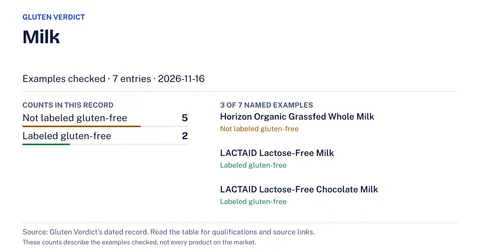 MilkNaturally gluten-freechecked Nov 16, 2026
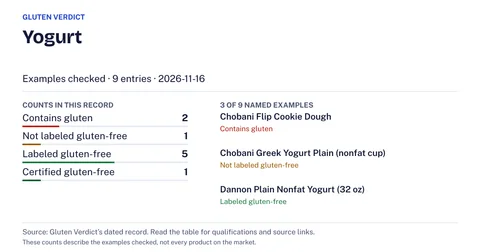 YogurtDepends on the product2 of 9 products we checked contain gluten: Chobani Flip Cookie Dough and Chobani Flip Cookies & Creamchecked Nov 16, 2026
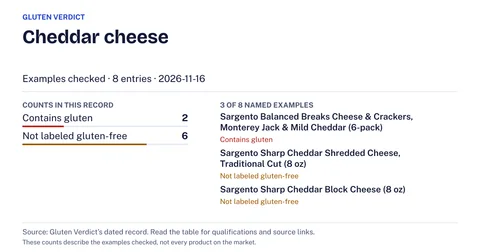 Cheddar cheeseNaturally gluten-free2 of 8 products we checked contain gluten: Sargento Balanced Breaks Cheese & Crackers, Monterey Jack & Mild Cheddar (6-pack) and Farm Rich Breaded Cheddar Cheese Curdschecked Nov 16, 2026
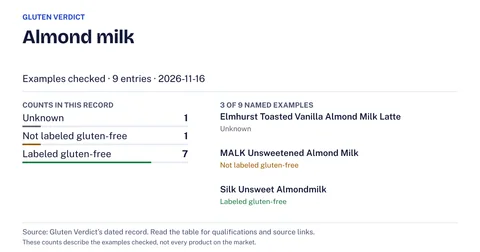 Almond milkNaturally gluten-freechecked Nov 16, 2026
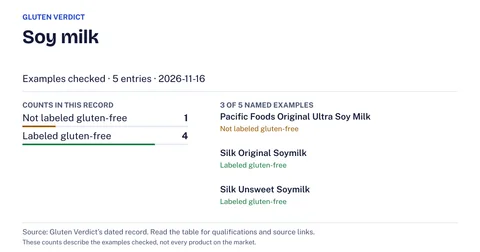 Soy milkNaturally gluten-freechecked Nov 16, 2026
Questions people ask
Does everyone with celiac disease need a bone density scan?
Guidance differs. The 2025 European guideline says routine baseline scanning is not mandatory for adults without added risk factors, though it may be considered in those approaching midlife (over 35 to 40 years)19. Coeliac UK says all newly diagnosed adults should have a scan one year after starting the diet25. Your clinician decides.
Is osteopenia the same as osteoporosis?
No. NIAMS describes osteopenia as a less severe form of low bone mineral density than osteoporosis, with a T-score from –1 to –2.535.
Can a gluten-free diet fully restore bone density?
Not always. Bone density often improves during the first year, but recovery is variable and incomplete in many patients42, and a 2022 review says it remains lower than in controls48.
Is a DXA scan a lot of radiation?
The 2025 European guideline says the exposure is comparable to only a few days of natural background radiation30.
Does a child with celiac disease need a bone scan?
Coeliac UK says there is no need for children to be tested for osteoporosis while they follow the gluten-free diet52.
More in Related conditions and complications
 Lactose intolerance after a celiac diagnosis: why it happens and how long it lastsWhy lactose intolerance can follow a celiac diagnosis, what published studies report about recovery on a gluten-free diet, and how lactose-free milk fits.
 Eosinophilic esophagitis and celiac disease: how they differ and how each is diagnosedHow eosinophilic esophagitis and celiac disease differ, what studies report about having both, how each is diagnosed, and how their diets differ.
 Hair loss and celiac disease: four causes to tell apart and what regrowth looks likeShedding, a nutrient shortfall, thyroid disease and alopecia areata can look alike. What dermatology sources and studies say about each and regrowth.
 Celiac disease complications and cancer risk: how to read the numbersWhat NIDDK, Coeliac UK, a 2025 European guideline and Swedish cohort studies report on celiac disease complications and cancer, relative next to absolute.
 Iron deficiency anemia and celiac disease: why it appears and what clinicians checkWhy celiac disease causes iron deficiency anemia, what NICE and ACG say about testing, what decides oral or IV iron, and checking a supplement for gluten.
 Depression, anxiety and celiac disease: what studies report and when to see a clinicianWhat meta-analyses report about depression and anxiety in celiac disease, what is known about the gut-brain link, and when to contact a clinician.
Related guides
 Follow-up testing after a celiac diagnosis: what the guidelines listWhat celiac guidelines and charities list for follow-up: antibody checks, repeat biopsy, nutrient tests, and what is checked if symptoms continue.
 Gluten in medications: what the label, DailyMed and a pharmacist can showFDA’s gluten-free food rule does not cover drugs. Use the ingredient list, DailyMed, the maker and a pharmacist, and know what each can show.
 Vitamin D with celiac disease: reading a result and checking a supplement for glutenWhat a vitamin D blood result measures, the published reference levels and upper intake level, and how to check a supplement label for gluten.
 Gluten-free and dairy-free: how to check a US label for bothUS labels treat milk and gluten under different rules. How to read for both, which makers state both claims, and what to ask when eating out.
Sources
- [1, 2, 17, 20, 21, 22, 23, 24, 43, 44, 48, 50, 58, 59, 68] Kondapalli and Walker, Archives of Endocrinology and Metabolism (2022), Celiac disease and bone (review), checked Nov 17, 2026.
- [3, 26, 57] Gluten Intolerance Group, Boosting Bone Health in Celiac Disease, checked Nov 17, 2026.
- [4, 5, 6, 12, 25, 41, 51, 52, 56, 60, 64, 65, 67] Coeliac UK, Osteoporosis and Coeliac Disease, checked Nov 17, 2026.
Read on 2026-11-17: the list under “There are also other factors that can make you more at risk of osteoporosis, including:” names late or delayed diagnosis of coeliac disease in adult life, lapses from the gluten free diet, lactose intolerance, being underweight and smoking.
Read on 2026-11-17: the table of calcium per serving lists semi skimmed milk (200ml) at 244mg, Cheddar cheese (30g) at 220mg, a pot of yoghurt (125g) at 170mg, and a calcium enriched milk alternative, e.g. soya milk or almond milk (200ml), at 240mg; the yoghurt and the calcium enriched milk alternative carry an asterisk with the note “Please check your Food and Drink Information for suitable products.”
- [7, 10, 11, 14, 18, 19, 27, 28, 30, 32, 40, 42, 62, 63, 66] European Society for the Study of Coeliac Disease (United European Gastroenterology Journal), ESsCD 2025 Updated Guidelines on the Diagnosis and Management of Coeliac Disease in Adults, Part 2: Management, Follow-Up, and Complex Disease Courses, checked Nov 17, 2026.
- [8, 9] Ganji et al., Nutrition Journal (2019), via PubMed, Prevalence of osteoporosis and osteopenia in men and premenopausal women with celiac disease: a systematic review, checked Nov 17, 2026.
- [13] Heikkila et al., Journal of Clinical Endocrinology and Metabolism (2015), via PubMed, Celiac disease and bone fractures: a systematic review and meta-analysis, checked Nov 17, 2026.
- [15, 61] NIAMS (NIH), Osteoporosis: Overview, Symptoms, and Causes, checked Nov 17, 2026.
Read on 2026-11-17: the list headed “Long-term use of certain medications may make you more likely to develop bone loss and osteoporosis, such as:” names glucocorticoids and adrenocorticotropic hormone, antiepileptic medicines, cancer medications that use hormones to treat breast and prostate cancer, proton pump inhibitors, selective serotonin reuptake inhibitors and thiazolidinediones.
- [16] National Institute of Diabetes and Digestive and Kidney Diseases (NIDDK), Treatment for Celiac Disease, checked Nov 17, 2026.
- [29, 31, 33, 34, 35, 36, 37, 38, 39] NIAMS (NIH), Bone Mineral Density Tests: What the Numbers Mean, checked Nov 17, 2026.
- [45, 49] Tovoli et al., Internal and Emergency Medicine (2023), via PubMed, Evolution of bone densitometry parameters and risk of fracture in coeliac disease: a 10-year perspective, checked Nov 17, 2026.
- [46, 47, 53, 54, 55] Mosca et al., Calcified Tissue International (2022), via PubMed, Newly Diagnosed Celiac Disease and Bone Health in Young Adults: A Systematic Literature Review, checked Nov 17, 2026.