Gluten-free questions, answered with their sources
Short answer
Find your question in the group that fits, then follow the source or the page that goes deeper. Many answers rest on one US rule: on an FDA-regulated food, the voluntary “gluten-free” claim carries a limit: any unavoidable gluten must be under 20 parts per million41, 45.
Part of Newly diagnosed: the first weeks, 8 guides
Key points
- “Gluten-free” on an FDA-regulated food label is voluntary, and a food that carries it must keep unavoidable gluten under 20 ppm45, 41.
- The Contains line covers major allergens: wheat is on the law’s list, barley and rye are not62.
- Meat, poultry and most alcoholic drinks follow USDA and TTB labeling rules, not FDA’s gluten-free rule53.
Gluten and grains
What is gluten?
Gluten is a protein found naturally in wheat, barley and rye1. FDA adds that it also occurs in crossbreeds of those grains2.
Which grains contain gluten?
NIDDK lists wheat and its types (durum, emmer, semolina and spelt), barley, rye, and triticale, a cross between wheat and rye3. The full ingredient-name table is in how to read a food label.
Starting out at home
Which foods are naturally gluten-free?
NIDDK lists meat, fish, fruits, vegetables, rice and potatoes, without additives or some seasonings, as naturally gluten-free28. Our verdicts cover rice, quinoa and buckwheat.
Does gluten-free food cost more?
NIDDK says packaged gluten-free foods tend to cost more than the same foods that have gluten, and that restaurants may charge more for gluten-free versions29.
What is cross-contact?
NIDDK defines it as foods or products that contain gluten coming into contact with gluten-free foods33. It says cross-contact can occur when foods are grown, processed, stored, prepared or served34.
How do I keep gluten-free food apart at home?
NIDDK suggests storing and preparing gluten-free foods separately from other family members’ foods that contain gluten35. Gluten Intolerance Group adds that toasters, strainers and flour sifters should not be shared36.
Labels and shopping
What does “gluten-free” mean on a US label?
FDA’s definition has ingredient conditions and a limit: any unavoidable gluten in the food must be less than 20 parts per million41. The rule applies to “gluten-free” and to “no gluten”, “free of gluten” and “without gluten”42. Our label guide walks through it.
Does “gluten-free” mean zero gluten?
No. FDA says it chose less than 20 ppm because methods scientifically validated to detect gluten reliably below that level were not available when the rule was written43.
Does a gluten-free food have to say so?
No. The rule covers voluntary use of the claim45. FDA notes that makers of foods that are naturally free of gluten, such as fresh fruits, vegetables and seafood, may choose not to label them46.
If a maker uses the claim on one product, is everything it makes gluten-free?
No. FDA says a manufacturer may make both foods that are “gluten-free” and foods that contain gluten47.
Do makers have to test for gluten?
No. FDA says the rule does not require makers to test starting ingredients or finished foods, but that makers are responsible for making sure a food bearing the claim complies48.
Who checks that the claim is true?
FDA says it enforces the rule through routine post-market monitoring: sampling, inspections of manufacturing facilities, label reviews, follow-up on complaints and, when needed, gluten analyses49. In 2017 FDA reported an analysis of 702 samples from more than 250 products labeled gluten-free; only one product did not comply, and it was recalled50.
Does the rule cover imported food?
Yes. FDA says all foods imported into the United States must meet the same federal requirements as foods produced here51.
Does the rule cover dietary supplements?
FDA says its gluten-free regulation applies to all foods and beverages, including dietary supplements, with exceptions52. The exceptions are the foods USDA and TTB label53.
Does the rule cover meat, poultry, eggs and alcohol?
Partly. FDA says the rule does not apply to foods whose labeling USDA or TTB regulates: USDA generally covers meats, poultry and certain egg products, and TTB covers most alcoholic beverages, including all distilled spirits53.
Is “certified gluten-free” different from the FDA claim?
A certification mark comes from a separate program. FDA says makers may put a certification logo on a label if its use is truthful and not misleading, and that FDA does not endorse, accredit or recommend any particular certification program54. Gluten Intolerance Group says the standard of its GFCO program is 10 ppm of gluten or less55.
Where on the package is the gluten-free claim?
Anywhere the maker chooses: FDA says the rule does not require the claim to sit in any specific location on the label56.
Can a gluten-free food list wheat in its ingredients?
In one case, yes. FDA says a food made with wheat that has been processed to remove gluten, and that bears the claim, must also carry a statement that the wheat has been processed to allow the food to meet FDA requirements for gluten-free foods57.
What does “made with no gluten-containing ingredients” tell me?
Less than a “gluten-free” claim. FDA says that unless the label also bears a “gluten-free” claim, consumers should not assume the food meets all FDA requirements for the claim58.
Can a gluten-free food also say it was made in a facility that processes wheat?
Yes. FDA says the rule does not prohibit a voluntary advisory statement such as “made in a facility that also processes wheat” on a food that also carries the claim, provided the statement is truthful and not misleading59.
What does the Contains line show?
US allergen law lets a maker name a major allergen in a line that starts “Contains” printed right after or next to the ingredient list60, or in parentheses after the ingredient’s name61. The law’s list of major food allergens names wheat; it does not name barley or rye62.
Should I buy only foods labeled gluten-free?
FDA says not necessarily: consumers with celiac disease should read and scrutinize labels to avoid gluten ingredients63.
Do I need to read the label again on a food I buy often?
Gluten Intolerance Group says ingredients can change at any time, so it is important to read labels every time you shop64.
What if the label does not say what is in the product?
NIDDK says to ask the company that makes the product for an ingredients list, and that you cannot assume the product is gluten-free65.
How do I report a problem with a gluten-free label?
FDA says people who believe a food caused an illness should first seek medical care and afterward contact FDA66. FDA also says labeling concerns may be reported to it67.
Ingredients and foods
Is wheat starch gluten-free?
It depends. FDA’s definition allows an ingredient derived from a gluten grain and processed to remove gluten, such as wheat starch, only if the food it goes into ends up under 20 ppm41. Our verdict: wheat starch.
Is malt gluten-free?
No. FDA says malt extract and similar malt-derived ingredients come from gluten-containing grains that have not been processed to remove gluten, so they cannot be used in foods that bear a gluten-free claim68. See malt extract and barley.
Is vinegar gluten-free?
Not every kind. FDA says malt vinegar cannot be used in a food that bears a gluten-free claim69. FDA also says an ingredient from a gluten-containing grain that has been properly distilled would be allowed in a food bearing the claim70. See malt vinegar and vinegar.
Is soy sauce gluten-free?
It depends on how it is made. FDA says that in general, soy sauce made from soybeans and wheat, or any other gluten-containing grain, may not bear a gluten-free claim71. See soy sauce.
Can wheat hide in flavorings and additives?
The law says a flavoring, coloring or incidental additive that contains a major food allergen is subject to the same labeling rules72, and wheat is on that list62. NIDDK also lists modified food starch and malt flavoring among additives made with wheat that are hidden sources of gluten73. See natural flavors, modified food starch and caramel color.
What about brewer’s yeast and yeast extract?
NIDDK lists brewer’s yeast among the places barley may be found3. See brewer’s yeast and yeast extract.
Can rice, quinoa or buckwheat pick up gluten?
FDA says crop rotation and shared harvesting, transport and storage equipment often bring gluten-containing grains into contact with grains, legumes and seeds that are naturally free of gluten74. Any grain other than wheat, rye, barley or their hybrids can be labeled gluten-free if unavoidable gluten is under 20 ppm75.
Is buckwheat a kind of wheat?
No. Gluten Intolerance Group describes buckwheat as naturally gluten-free, despite its name76. See buckwheat.
Are spelt and couscous gluten-free?
No. FDA’s definition names spelt as a gluten-containing grain, “spelt wheat”41, and Gluten Intolerance Group lists couscous among forms of wheat77. See spelt and couscous.
Can oats carry a gluten-free label?
Yes. FDA says oats do not have to be certified to be labeled gluten-free, but oats that carry the claim must contain less than 20 ppm gluten78.
Eating out
Does the US gluten-free rule cover restaurant menus?
Only partly. FDA says the rule applies to packaged foods, some of which are sold in food-service places such as carry-out restaurants, and that it recommends restaurants making a gluten-free claim on a menu be consistent with the federal definition79. FDA adds that state and local governments play an important role in overseeing restaurants80.
Can I report a restaurant’s gluten-free claim to FDA?
FDA says it will monitor reported information about unpackaged food and share complaints about foods such as those served in restaurants with state and local government partners81.
What should I tell the server?
NIDDK suggests letting the server know you have celiac disease, asking about ingredients, how the food is prepared and whether a gluten-free menu is available, and asking to talk with the chef for more details82.
How do I find gluten-free menus before I go?
NIDDK suggests searching online for restaurants that offer a gluten-free menu before you go out to eat83. Our restaurant verdicts read a chain’s own allergen guide84.
What can I ask about fries and pasta?
Gluten Intolerance Group’s list of questions includes “Are the french fries cooked in a dedicated fryer, or do they share oil with breaded items?”85 and “Is the GF pasta boiled in fresh water, or in the same water used for regular pasta?”86. See our verdict for french fries.
Do shared fryers matter?
Gluten Intolerance Group says deep-fried foods cooked in oil that is also used to cook breaded products should be avoided87.
How does Gluten Verdict judge a chain’s menu?
Each item gets its own verdict, read from the chain’s own allergen guide and in the chain’s terms84. Start with Chipotle, Five Guys, Wendy’s or Panera.
What about parties and social gatherings?
NIDDK suggests letting the host know you have celiac disease and finding out whether gluten-free foods will be available88.
Drinks
Is beer gluten-free?
It depends on the beer. NIDDK lists beer, lagers, ale, flavored liquors and malt beverages as drinks that may contain gluten89. FDA gives sorghum beer as an example of a beer under its own labeling rules90. See beer.
What does “gluten-removed” or “crafted to remove gluten” mean?
TTB allows a label on a product fermented from gluten grains to say it was processed, treated or crafted to remove gluten, with a qualifying statement that includes the words “The gluten content of this product cannot be verified, and this product may contain gluten.”91 Gluten Intolerance Group says beers labeled “gluten-removed” may not be gluten-free92.
Can a spirit made from grain be labeled gluten-free?
TTB says it will permit gluten-free claims on distilled spirits distilled from gluten-containing grains, as long as good manufacturing practices prevent any gluten-containing material from entering the final product93. See vodka, whiskey, gin, rum and tequila.
Is wine gluten-free?
TTB names wines fermented from grapes among the products that may carry a gluten-free claim94. See wine and cider.
Does “gluten-free” on a bottle mean what it does on food?
For the definition, yes. TTB authorizes the term on labels and in advertisements if the product would be entitled to a gluten-free claim under FDA’s definition95.
Can a beer label say how many ppm of gluten it contains?
TTB says labels and advertisements that state a specific level of gluten in a fermented product, without an appropriate basis or necessary qualification, will be considered misleading96.
Where are verdicts for other drinks?
We have checked hard seltzer, kombucha and coffee; each lists the sources we read and the date97.
Travel
Can I bring my own food through airport security?
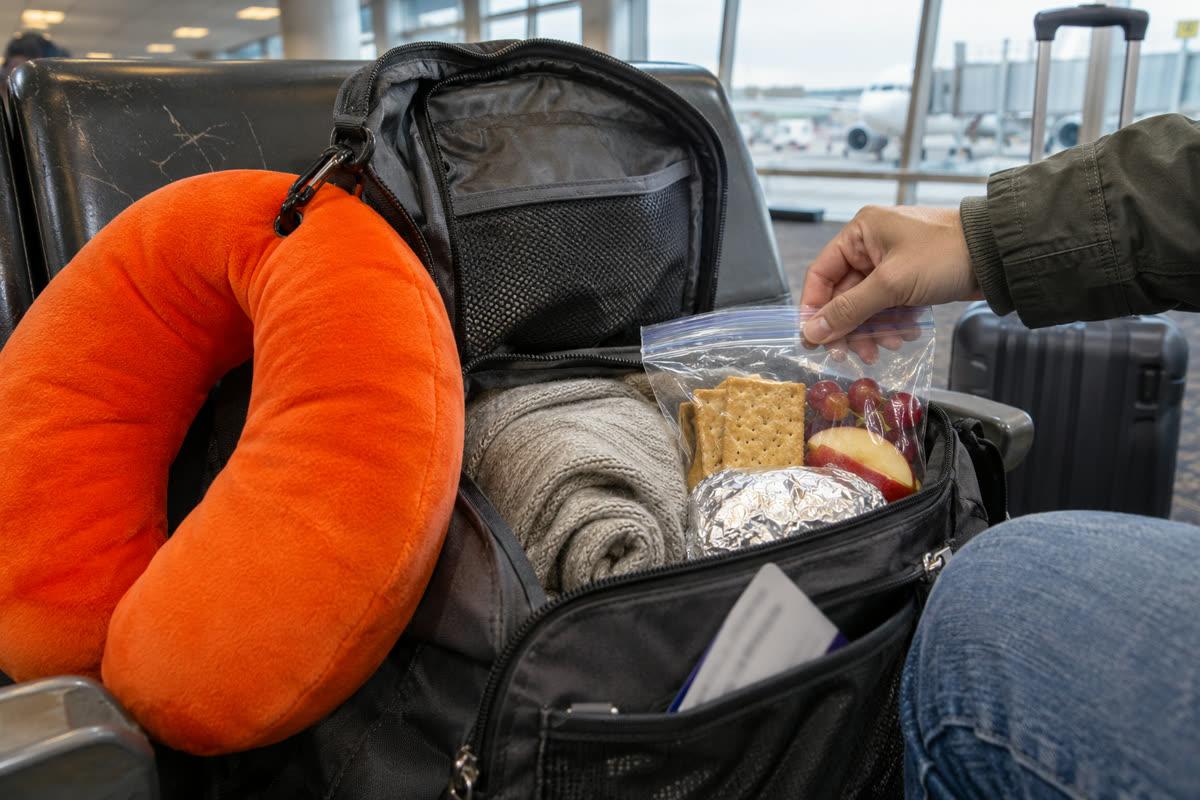
TSA says solid food items can go in carry-on or checked bags, while liquid or gel food items larger than 3.4 oz are not allowed in carry-ons and should go in checked bags if possible98.
Is the EU gluten-free limit the same as the US one?
Close, but not word for word. The EU regulation allows “gluten-free” only where the food as sold contains no more than 20 mg/kg of gluten99; the US rule says unavoidable gluten must be less than 20 ppm41. The travel section is where country guides appear.
What is “very low gluten” in the EU?
The EU regulation defines it for foods made with gluten grains that were specially processed to reduce gluten, at no more than 100 mg/kg of gluten in the food as sold100.
Do EU gluten rules cover restaurants?
The European Commission says Regulation (EU) No 828/2014 applies also to non pre-packed foods such as those served in restaurants101.
How does the EU treat oats?
The regulation says oats in a food presented as gluten-free or very low gluten must have been specially produced, prepared or processed to avoid contamination by wheat, rye or barley, and their gluten content cannot exceed 20 mg/kg102.
How Gluten Verdict checks
How does Gluten Verdict reach a verdict?
Each verdict starts from what the maker publishes about one US product: its own words, its ingredient list and any certifier listing, each read and dated by us103.
Do you test food in a lab?
No. We never test food in a lab104.
What does “Labeled gluten-free” mean on a verdict?
The maker uses the “gluten-free” claim105. Under the US rule that claim carries the limit above41.
What does “Certified gluten-free” mean?
A third-party certifier lists the product in its public directory, and we link the listing106.
What does “Not labeled gluten-free” mean?
The ingredient list names no wheat, barley, rye, malt or oats, but the maker makes no gluten-free claim, so it promises nothing about shared equipment107.
What does “Contains gluten” mean?
A gluten ingredient is listed, such as wheat flour or barley malt, or the maker says the product contains gluten108.
What does “Unknown” mean?
The sources do not settle it, and an unknown is never shown as a yes109.
What do “Naturally gluten-free” and “Depends on the product” mean?
For foods and ingredients, “Naturally gluten-free” means the usual US form has no wheat, barley, rye or oats in it and at least two US authorities or celiac charities say so110. “Depends on the product” means common US versions differ, and the products table settles each one111.
Where do the facts come from?
Every source a verdict relies on is listed on it with the date we read it, and other “is it gluten-free” websites are never a source97.
Why does a verdict carry a date?
Because makers change recipes: Gluten Intolerance Group says ingredients can change at any time64. The date is when we read the sources97.
Who checks the verdicts?
The review line on each verdict shows whether an editor has signed off. Completed reviews give the editor’s name and date112.
Does Gluten Verdict give medical advice?
No. Its about page says that if you have celiac disease, your doctor’s advice comes first113.
Do you cover other countries?
Not for verdicts: they are for US products only114. See the travel section for country guides.
Using this site
Where do I look up a food or ingredient?
Start at every verdict, A to Z, or the ingredients index. Each verdict lists its sources97.
What is in the shop?
The shop lists a product only when its maker or a certifier says “gluten-free” for it, and each card quotes the claim and its date116.
Is there a printable grocery list?
Print the gluten-free grocery list, built from our verdict records.
How do I report something out of date?
The about page points to the corrections log117.
Verdicts in this guide
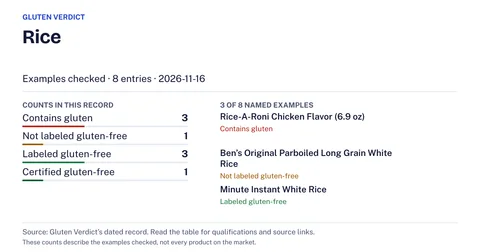 RiceNaturally gluten-free3 of 8 products we checked contain gluten: Rice-A-Roni Chicken Flavor (6.9 oz), Near East Original Rice Pilaf, and Ben’s Original Ready Rice Rice PilafBuy it labeled gluten-freechecked Nov 16, 2026
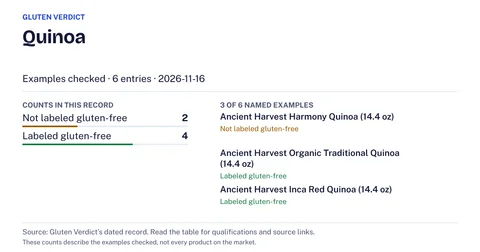 QuinoaNaturally gluten-freeBuy it labeled gluten-freechecked Nov 16, 2026
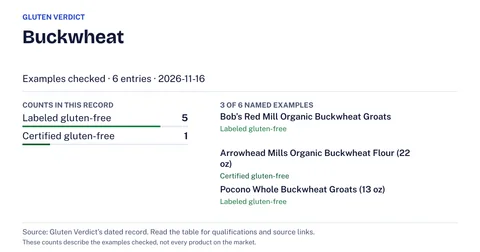 BuckwheatNaturally gluten-freeBuy it labeled gluten-freechecked Nov 16, 2026
 OatmealDepends on the productchecked Nov 16, 2026
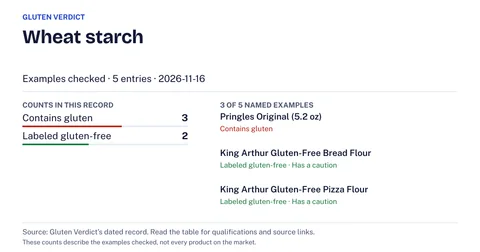 Wheat starchDepends on the product3 of 5 products we checked contain gluten: Pringles Original (5.2 oz), Jiffy Corn Muffin Mix, and Chex Mix Bold Garlic and Herbchecked Nov 16, 2026
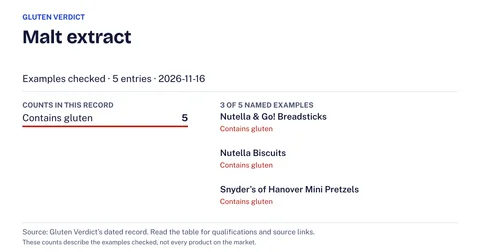 Malt extractContains glutenchecked Nov 16, 2026
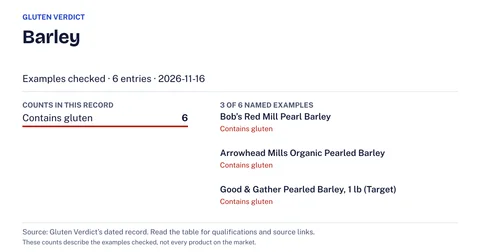 BarleyContains glutenchecked Nov 16, 2026
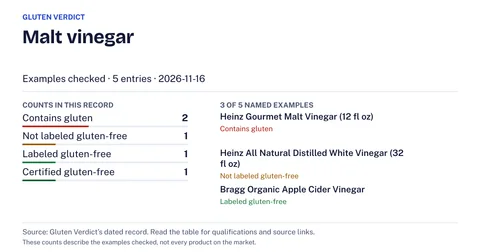 Malt vinegarContains glutenchecked Nov 16, 2026
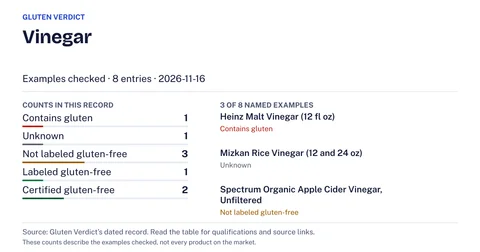 VinegarDepends on the product1 of 8 products we checked contains gluten: Heinz Malt Vinegar (12 fl oz)checked Nov 16, 2026
 Soy sauceDepends on the product3 of 7 products we checked contain gluten: Kikkoman Soy Sauce (Non-GMO), 20 oz; San-J Organic Shoyu Soy Sauce; and Lee Kum Kee Premium Soy Sauce (No Preservatives Added)checked Nov 16, 2026
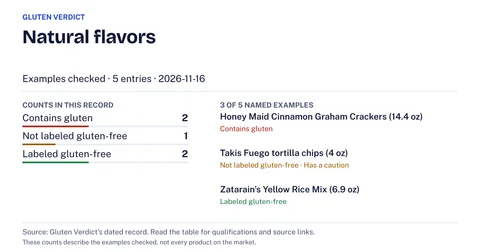 Natural flavorsDepends on the product2 of 5 products we checked contain gluten: Honey Maid Cinnamon Graham Crackers (14.4 oz) and Chex Mix Sour Cream & Onionchecked Nov 16, 2026
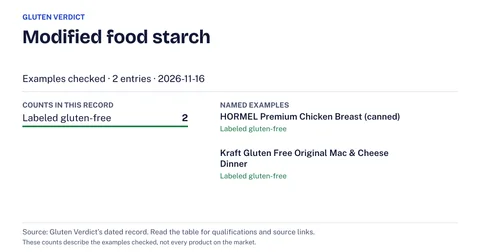 Modified food starchDepends on the productchecked Nov 16, 2026
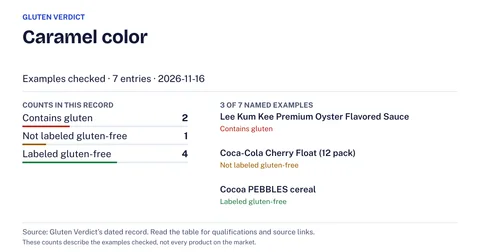 Caramel colorDepends on the product2 of 7 products we checked contain gluten: Lee Kum Kee Premium Oyster Flavored Sauce and Chex Mix Traditionalchecked Nov 16, 2026
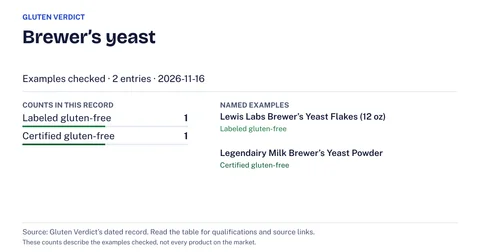 Brewer’s yeastDepends on the productchecked Nov 16, 2026
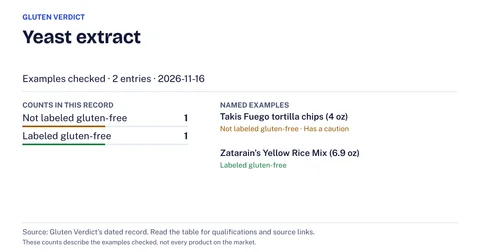 Yeast extractDepends on the productchecked Nov 16, 2026
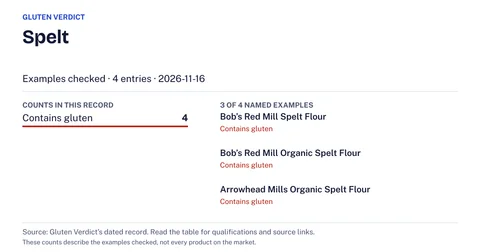 SpeltContains glutenchecked Nov 16, 2026
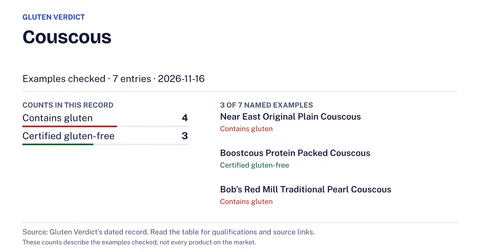 CouscousContains glutenchecked Nov 16, 2026
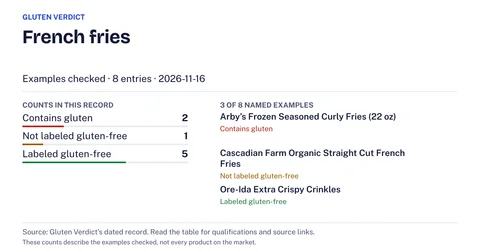 French friesDepends on the product2 of 8 products we checked contain gluten: Arby’s Frozen Seasoned Curly Fries (22 oz) and Checkers Frozen Crispy Seasoned Fries (28 oz)checked Nov 16, 2026
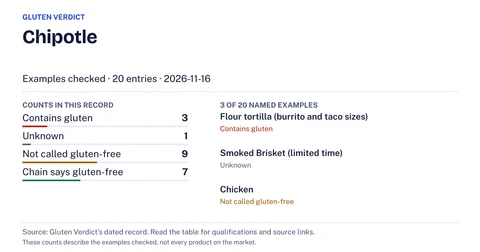 ChipotleDepends on the order3 of 20 menu items we checked contain gluten: Flour tortilla (burrito and taco sizes), Burrito, and QuesadillaChipotle Mexican Grill · checked Nov 16, 2026
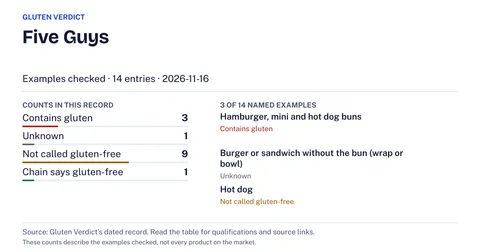 Five GuysDepends on the order3 of 14 menu items we checked contain gluten: Hamburger, mini and hot dog buns; Malt vinegar (fry condiment); and Oreo® Cookie Pieces shake mix-inFive Guys · checked Nov 16, 2026
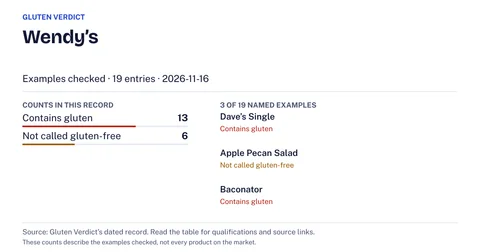 Wendy’sDepends on the order13 of 19 menu items we checked contain glutenWendy’s · checked Nov 16, 2026
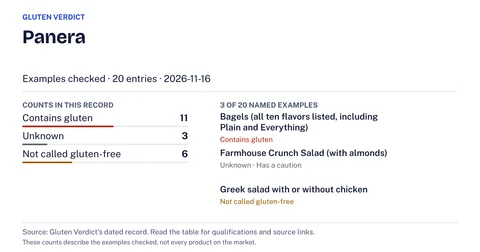 PaneraDepends on the order11 of 20 menu items we checked contain glutenPanera Bread · checked Nov 16, 2026
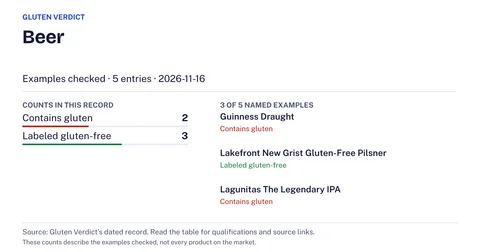 BeerDepends on the product2 of 5 products we checked contain gluten: Guinness Draught and Lagunitas The Legendary IPAchecked Nov 16, 2026
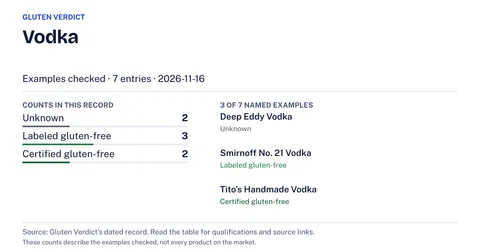 VodkaDepends on the productchecked Nov 16, 2026
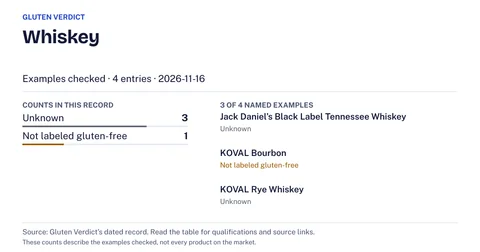 WhiskeyDepends on the productchecked Nov 16, 2026
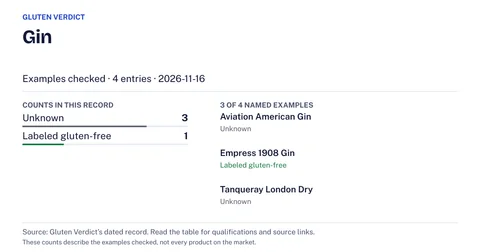 GinDepends on the productchecked Nov 16, 2026
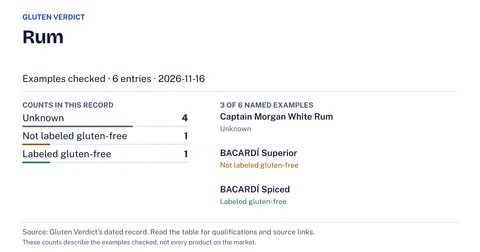 RumDepends on the productchecked Nov 16, 2026
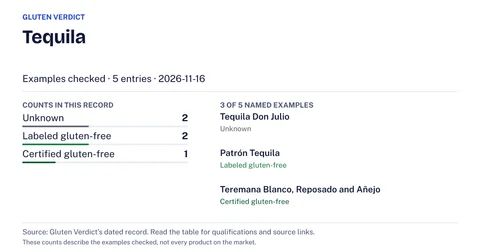 TequilaDepends on the productchecked Nov 16, 2026
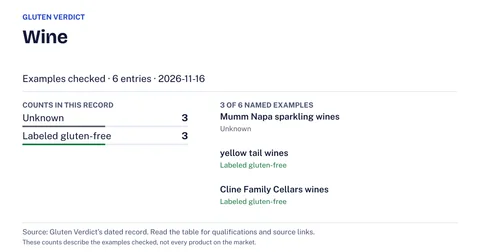 WineNaturally gluten-freechecked Nov 16, 2026
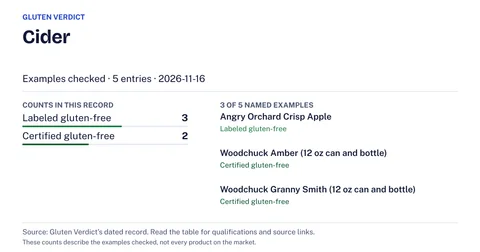 CiderNaturally gluten-freechecked Nov 16, 2026
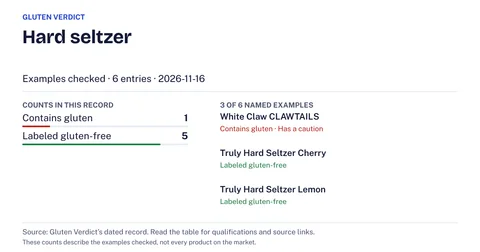 Hard seltzerDepends on the product1 of 6 products we checked contains gluten: White Claw CLAWTAILSchecked Nov 16, 2026
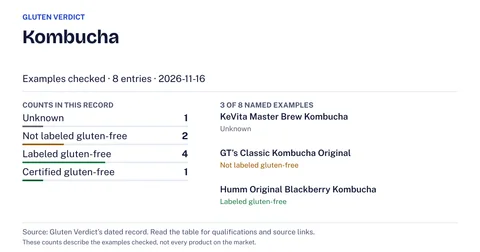 KombuchaDepends on the productchecked Nov 16, 2026
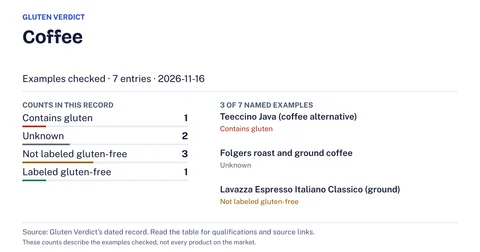 CoffeeDepends on the product1 of 7 products we checked contains gluten: Teeccino Java (coffee alternative)checked Nov 16, 2026
More in Newly diagnosed: the first weeks
 Starting a gluten-free diet: testing first, then labels, oats and the kitchenWhat NIH and the celiac charities say about starting a gluten-free diet: testing first, which foods to start with, a US label check, oats and the kitchen.
 Your first restaurant meal after a celiac diagnosisHow to pick a place, call ahead, ask the kitchen the right questions and decide what to do when answers are vague, for a first meal out.
 Feeling worse after going gluten-free: what the sources say to check firstWhat NIDDK, Coeliac UK and clinical reviews say about symptoms that do not improve or get worse on a gluten-free diet, and which causes you can check.
 Going gluten-free: what to remove and what to keep in your pantry and kitchenSort a full pantry into foods to remove, labels to read and plain foods to keep, then decide on shared jars, toasters and pans.
 How long until you feel better on a gluten-free diet?What NIH, celiac charities and studies report on when symptoms, antibody levels and the gut lining recover after a celiac diagnosis, and why they differ.
 Your first 30 days after a celiac diagnosis: a week-by-week planA week-by-week plan for the first month after a celiac diagnosis: label rules, kitchen changes, a dietitian, follow-up tests and questions for your doctor.
Related guides
 How to read a US food label for glutenWhere gluten shows up on a US food label: the gluten-free claim, the Contains line, the ingredient list and may-contain lines, and what each means.
 Eating out with celiac disease: what to check, ask and watch forPlan a restaurant meal with celiac disease: what to check before you go, the questions to ask in order, how to read the answers, and what studies measured.
 Gluten-free grocery shopping: what to check at the shelf, the bulk bins and the checkoutOne reading order for any US supermarket pack, plus what to do about bulk bins, frozen cases, wheat starch and storage once the bags are home.
 Flying gluten-free: what to arrange, pack and ask, from booking to landingA gluten-free flight in order: the airline's special-meal request, what TSA allows through the checkpoint, and the food to carry as a backup.
Sources
- [1] National Institute of Diabetes and Digestive and Kidney Diseases (NIDDK), Definition & Facts for Celiac Disease, checked Nov 17, 2026.
- [2, 42, 50, 52, 56, 66, 80] US Food and Drug Administration, Gluten and Food Labeling, checked Nov 17, 2026.
- [3, 28, 29, 33, 34, 35, 82, 83, 88, 89] National Institute of Diabetes and Digestive and Kidney Diseases (NIDDK), Eating, Diet, & Nutrition for Celiac Disease, checked Nov 17, 2026.
Read on 2026-11-17: the list headed “Gluten occurs naturally in certain grains, including” names wheat and types of wheat such as durum, emmer, semolina, and spelt; barley, which may be found in malt, malt extract, malt vinegar, and brewer’s yeast; rye; and triticale, a cross between wheat and rye.
- [36, 55, 64, 76, 77, 87, 92] Gluten Intolerance Group, Getting Started on a Gluten-Free Diet: A Step-By-Step Guide, checked Nov 17, 2026.
- [41, 43, 45, 46, 47, 48, 49, 51, 53, 54, 57, 58, 59, 63, 67, 68, 69, 70, 71, 74, 75, 78, 79, 81, 90] US Food and Drug Administration, Questions and Answers on the Gluten-Free Food Labeling Final Rule, checked Nov 17, 2026.
- [60, 61, 62, 72] US Food and Drug Administration, Food Allergen Labeling and Consumer Protection Act of 2004 (FALCPA), checked Nov 17, 2026.
- [65, 73] National Institute of Diabetes and Digestive and Kidney Diseases (NIDDK), Treatment for Celiac Disease, checked Nov 17, 2026.
- [84, 97, 103, 104, 105, 106, 107, 108, 109, 110, 111, 112, 113, 114, 116, 117] Gluten Verdict, How we check a gluten verdict, checked Nov 18, 2026.
- [85, 86] Gluten Intolerance Group, Questions to Ask When Eating Out, checked Nov 17, 2026.
- [91, 93, 94, 95, 96] Alcohol and Tobacco Tax and Trade Bureau (TTB), TTB Ruling 2020-2: Gluten Content Statements in the Labeling and Advertising of Wine, Distilled Spirits, and Malt Beverages, checked Nov 17, 2026.
- [98] Transportation Security Administration, What can I bring? Food, checked Nov 17, 2026.
- [99, 100, 102] European Commission (EUR-Lex), Commission Implementing Regulation (EU) No 828/2014, checked Nov 17, 2026.
- [101] European Commission, Gluten-free food, checked Nov 17, 2026.