Celiac disease vs gluten intolerance: three conditions, three diagnoses
Short answer
Celiac disease, non-celiac gluten sensitivity and wheat allergy are three different conditions17, 18, 20. The sources tell them apart by mechanism and by how each is diagnosed:
- Celiac disease is an autoimmune disease in which eating gluten damages the small intestine1, 19, 20; it is diagnosed with blood tests and biopsies of the small intestine, and the ACG guideline says a biopsy is required in most patients2, 3.
- The Gluten Intolerance Group (GIG) says there are no tests or biomarkers for non-celiac gluten sensitivity (NCGS), and that it may be diagnosed only after celiac disease, wheat allergy and other possible causes are ruled out4, 5.
- Wheat allergy is an IgE-mediated immune reaction to wheat proteins6; GIG says its diagnosis is generally done through RAST allergy testing and a double-blind placebo test, which an allergist usually completes7.
Part of Celiac diagnosis, testing and gluten sensitivity, 25 guides

Key points
- NIDDK, GIG and Coeliac UK each advise against starting a gluten-free diet before celiac testing; NIDDK and Coeliac UK say it can affect the results, and GIG says a patient must be eating gluten for an accurate diagnosis8, 10, 44.
- Symptoms alone do not separate the conditions: NIDDK says celiac disease is not diagnosed from symptoms alone, and GIG says celiac disease and NCGS share many symptoms11, 12.
- NCGS is defined by exclusion, and its mechanism is not established29, 14, 20.
- Wheat allergy can occur alongside celiac disease or NCGS, according to GIG15.
Three conditions that get one name
“Gluten intolerance” is an everyday phrase; the sources below use three separate names. NIDDK says celiac disease is different from gluten sensitivity and also from a wheat allergy17, 18. The third, non-celiac gluten sensitivity (NCGS), is also called gluten sensitivity or non-celiac wheat sensitivity by GIG13.
| What is happening | How it is identified | Treatment the sources describe | |
|---|---|---|---|
| Celiac disease | An autoimmune disease: the immune system attacks itself when gluten is eaten, damaging the lining of the gut19, 20 | Blood tests and biopsies of the small intestine2; biopsy is required in most patients3 | A gluten-free diet for life21 |
| Non-celiac gluten sensitivity | Not IgE-mediated and not autoimmune; the mechanism is undefined13, 20 | No test or biomarker; diagnosed after celiac disease, wheat allergy and other causes are ruled out4, 5 | Removing gluten from the diet22; whether long-term strict avoidance is needed is unknown23 |
| Wheat allergy | An IgE-mediated immune reaction to proteins in wheat6 | RAST allergy testing and a double-blind placebo test with the allergen, which an allergist usually completes7 | Removing all forms of wheat from the diet22 |
Celiac disease: what is happening and how it is confirmed
NIDDK describes celiac disease as a chronic digestive and immune disorder that damages the small intestine and is triggered by eating gluten1. Coeliac UK puts it as an autoimmune disease, not a food allergy or intolerance19. The American College of Gastroenterology (ACG) defines it as “a permanent immune-mediated response to gluten present in wheat, barley, and rye”24.
NIDDK adds that celiac disease can only occur in people who have certain genes25, and that experts estimate about 1 percent of people worldwide have it, with many not yet diagnosed26.
How it is confirmed
Doctors typically diagnose celiac disease with blood tests and biopsies of the small intestine2. The blood tests look for antibodies that are often higher than normal in people with untreated celiac disease27. The ACG guideline says that detecting celiac-specific antibodies in the blood is very helpful for initial screening, that an intestinal biopsy is required in most patients to confirm the diagnosis, and that a no-biopsy route is suggested for selected children3.
On genetic testing for the DQ2 and DQ8 gene variants, NIDDK says that without them celiac disease is very unlikely, and that having DQ2 or DQ8 alone does not mean celiac disease28.
NIDDK says celiac disease is not diagnosed from symptoms alone, because some symptoms resemble those of other digestive disorders such as irritable bowel syndrome or lactose intolerance11.
Non-celiac gluten sensitivity: how it is reached
The Salerno experts’ paper describes NCGS as a syndrome of intestinal and other symptoms linked to eating gluten-containing food in people who have neither celiac disease nor wheat allergy29. Coeliac UK says it is unclear how the immune system might be involved, because no antibodies are produced and there does not appear to be damage to the gut lining14.
Two things were still open when the Salerno paper was published in 2015. First, the trigger: the Salerno paper says the offending dietary protein has not been identified and could include components other than gluten itself30. Second, how common it is: the same paper says prevalence is not clearly defined31. It calls NCGS a clinical entity “for which we have very little certainty and many knowledge ‘black holes’”32.
Two ways the sources describe the diagnosis
GIG describes a short route: rule out celiac disease, wheat allergy and other possible causes, then, if symptoms improve on a gluten-free diet, gluten sensitivity may be diagnosed5. Coeliac UK says there are no specific diagnostic tests33.
Because there is no biomarker34, an experts’ meeting in Salerno, Italy in October 2014 met to reach a consensus on how the diagnosis should be confirmed35. The Salerno paper describes two steps:
- A period on a gluten-free diet. The diagnosis is excluded in people who show no symptomatic improvement after six weeks36.
- A double-blind placebo-controlled gluten challenge, required to confirm the diagnosis in people who respond to the diet: one week of challenge, one week of strict gluten-free washout, then a crossover to the second one-week challenge, with a variation of at least 30% in one to three main symptoms between the gluten and placebo challenge needed to tell a positive result from a negative one37, 38, 39.
Wheat allergy: a different immune pathway
GIG describes wheat allergy as an immune reaction to any of the hundreds of proteins in wheat, in which IgE antibodies are produced against the wheat6. NIDDK says wheat allergies also do not cause long-term damage to the small intestine, and that some symptoms, such as itchy eyes or trouble breathing, differ from celiac disease18.
GIG says the reaction happens very fast, within minutes to a few hours, and can range from nausea, abdominal pain, itching and swelling of the lips and tongue to trouble breathing or anaphylaxis, a life-threatening reaction40. Coeliac UK describes the usual timing as within seconds or minutes of eating41.
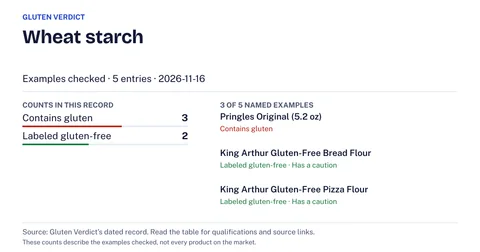
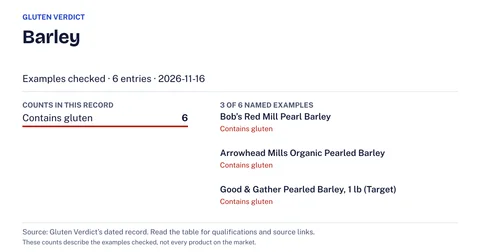
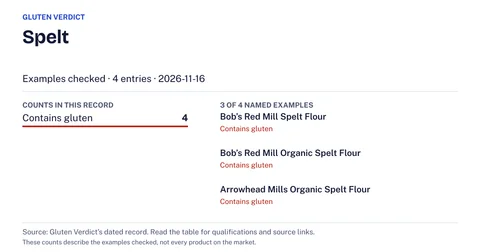
By GIG’s description, a person with a wheat allergy must avoid all forms of wheat but does not have trouble tolerating gluten from non-wheat sources, and a person can have a wheat allergy and also celiac disease or NCGS15. GIG lists barley and rye, as well as wheat, as sources of gluten22. The grains show the difference: our barley verdict covers a gluten grain that is not wheat, while our spelt verdict covers a form of wheat (FDA’s rule gives “spelt wheat” as its example of a gluten-containing grain42).
GIG also notes that wheat is one of the eight most common foods to which people in the United States are allergic, and that children may outgrow a wheat allergy while adults usually have it for life43.
Why the sources put celiac testing before a gluten-free diet
Three of the sources make the same point in different words:
- NIDDK: doctors don’t recommend starting a gluten-free diet before diagnostic testing, because a gluten-free diet can affect test results8.
- GIG: a patient must be eating a gluten-containing diet for an accurate celiac diagnosis44, and getting a proper diagnosis is, in its words, the most important reason not to start a gluten-free diet before being tested9.
- Coeliac UK: for people experiencing symptoms, it does not recommend trying a gluten-free diet as a first option, because it could stop a coeliac disease test from giving an accurate result, and it is essential to keep eating gluten for the tests to work10, 45.
Coeliac UK says that after a negative celiac test and other causes ruled out, a person might wish to discuss NCGS with their healthcare team46. How long, and how much gluten, a particular test needs is a question for the clinician ordering it.
What “gluten-free” means on a US food label
On a US food label, “gluten-free” is defined by FDA in terms of gluten: any unavoidable gluten in the food must be less than 20 parts per million (ppm)42. The same definition lets an ingredient made from a gluten grain, such as wheat starch, be used if it was processed to remove gluten and the food stays under 20 ppm42. Our FDA gluten-free labeling rule guide covers the rule in full.
FDA explains that it chose 20 ppm because it relies on scientifically validated test methods, and none validated for levels below 20 ppm existed when the rule was written16. FDA also notes that some celiac disease researchers and some epidemiological evidence suggest most people with celiac disease can tolerate variable trace amounts of gluten, including levels under 20 ppm, without adverse health effects47. FDA calls 20 ppm “one criterion” for a food labeled “gluten-free”16.
Where irritable bowel syndrome and FODMAPs overlap
NIDDK defines irritable bowel syndrome (IBS) as a group of symptoms including repeated abdominal pain and changes in bowel movements, without visible signs of damage or disease in the digestive tract48. The Salerno paper says symptoms common in NCGS, such as bloating, abdominal pain and irregular bowel movements, are usually diagnosed under the umbrella of IBS49.
The Salerno paper says patients who do not respond to the gluten-free diet should be investigated for other possible causes of IBS-like symptoms, such as intolerance to FODMAPs or small bowel bacterial overgrowth36. FODMAPs are fermentable, poorly absorbed, short-chain carbohydrates50.
One double-blind cross-over trial, of 37 people who believed they had NCGS and who had IBS but not celiac disease, found that symptoms improved on reduced FODMAP intake and then worsened to a similar degree on gluten or whey protein; gluten-specific effects were seen in only 8% of participants51, 52. That is one trial in one group, not a verdict on NCGS.
Questions people take to a clinician
This list is ours, built from the points above. It is general information, not medical advice.
- Has celiac disease been tested for while I was still eating gluten, and what did the blood tests show?
- Is a biopsy planned, and what does the result mean for the diagnosis?
- Has a wheat allergy been considered, and would an allergist do that testing?
- If celiac disease and wheat allergy are ruled out, how would NCGS be confirmed, and what would count as improvement?
- Could IBS or a FODMAP sensitivity explain my symptoms, and how would that be checked?
Verdicts in this guide
Questions people ask
Is gluten intolerance the same as celiac disease?
No. NIDDK says celiac disease is different from gluten sensitivity or wheat intolerance, and that unlike celiac disease, gluten sensitivity does not damage the small intestine17.
Can a blood test diagnose non-celiac gluten sensitivity?
GIG says there are no tests or biomarkers to identify gluten sensitivity4, and Coeliac UK says there are no specific diagnostic tests for it33. Blood tests are used for celiac disease27.
Can a person have a wheat allergy and celiac disease?
GIG says a person can have a wheat allergy and also have celiac disease or NCGS15.
Is non-celiac gluten sensitivity real?
The Salerno paper describes NCGS as a clinical entity distinct from celiac disease, with very little certainty and many knowledge gaps32. One trial found gluten-specific effects in only 8% of participants once FODMAPs were reduced52.
Why is the gluten-free label limit 20 ppm?
FDA says it adopted less than 20 ppm gluten as one criterion for a food labeled “gluten-free” because it relies on scientifically validated test methods, and none validated for lower levels were available when the rule was written16.
More in Celiac diagnosis, testing and gluten sensitivity
 Wheat allergy tests vs celiac tests: which test answers which conditionWhich test answers which condition: celiac antibodies and biopsy versus wheat IgE, skin prick and food challenge, as ACG, NIAID, FARE and NIH say.
 Celiac disease vs lactose intolerance: how each is tested and why they overlapWhat celiac disease and lactose intolerance are, how each is tested, and why lactose intolerance can come with celiac disease, from NIDDK and ACG.
 Wheat-dependent exercise-induced anaphylaxis (WDEIA): a wheat allergy that needs a co-factorWhat allergy societies say WDEIA is, how it is diagnosed, how it differs from celiac disease, and why an allergist and emergency plan matter.
 How non-celiac gluten sensitivity is diagnosed: the Salerno criteriaWhat counts as a diagnosis of non-celiac gluten sensitivity: the exclusions, the Salerno criteria steps and what a blinded gluten challenge involves.
 Can non-celiac gluten sensitivity go away? What the trials show and do not showWhat the sources say about whether non-celiac gluten sensitivity fades, what challenge and FODMAP trials found, and what to ask a clinician.
 Villous atrophy that is not celiac disease: other causes doctors checkConditions and medicines that clinical consensus and reviews name as causes of flat small-bowel villi besides celiac disease, and what the work-up covers.
All 25 guides in Celiac diagnosis, testing and gluten sensitivity
Related guides
 Celiac Blood Tests: What tTG-IgA, Total IgA, DGP and EMA Each CheckWhat tTG-IgA, total IgA, EMA and DGP check, why total IgA is drawn with tTG-IgA, when back-up tests are used, and why gluten stays in the diet first.
 Celiac disease or IBS: overlapping symptoms and what guidelines say about testingWhat the ACG IBS guideline says about celiac blood tests, how the two conditions compare per NIDDK, and why celiac testing needs gluten in the diet.
 Bloated after bread or pasta? Why the celiac blood test comes before cutting glutenWhy bloating after bread or pasta cannot name its cause, why celiac blood tests come before a gluten-free diet, and what to ask a clinician.
 Wheat-free, gluten-free and “no gluten ingredients”: what each label statement covers“Wheat-free”, “gluten-free” and “made with no gluten-containing ingredients” are three different statements. What each covers, and what to check.
Sources
- [1, 17, 18, 25, 26] National Institute of Diabetes and Digestive and Kidney Diseases (NIDDK), Definition & Facts for Celiac Disease, checked Nov 17, 2026.
- [2, 8, 11, 27, 28] National Institute of Diabetes and Digestive and Kidney Diseases (NIDDK), Diagnosis of Celiac Disease, checked Nov 17, 2026.
- [3, 24] American Journal of Gastroenterology, abstract via PubMed, American College of Gastroenterology Guidelines Update: Diagnosis and Management of Celiac Disease, checked Nov 17, 2026.
- [4, 5, 6, 7, 9, 12, 13, 15, 20, 21, 22, 40, 43, 44] Gluten Intolerance Group, Celiac Disease, Non-Celiac Gluten Sensitivity or Wheat Allergy: What is the Difference?, checked Nov 17, 2026.
- [10, 14, 19, 33, 41, 45, 46] Coeliac UK, What is Non Coeliac Gluten Sensitivity?, checked Nov 17, 2026.
- [16, 42, 47] US Food and Drug Administration, Questions and Answers on the Gluten-Free Food Labeling Final Rule, checked Nov 17, 2026.
- [23, 29, 30, 31, 32, 34, 35, 36, 37, 38, 39, 49] Nutrients (MDPI), via PubMed Central, Diagnosis of Non-Celiac Gluten Sensitivity (NCGS): The Salerno Experts’ Criteria, checked Nov 17, 2026.
- [48] National Institute of Diabetes and Digestive and Kidney Diseases (NIDDK), Definition & Facts for Irritable Bowel Syndrome, checked Nov 17, 2026.
- [50, 51, 52] Gastroenterology, abstract via PubMed, No effects of gluten in patients with self-reported non-celiac gluten sensitivity after dietary reduction of fermentable, poorly absorbed, short-chain carbohydrates, checked Nov 17, 2026.