Prenatal vitamins and gluten: how to check the label and the maker’s statement
Short answer
A “gluten-free” claim on a prenatal vitamin is the maker’s statement under FDA’s rule, which covers dietary supplements1, 2. Read it together with the label, in this order:
- The Other Ingredients list under the Supplement Facts panel, which names binders, fillers and flavors3, 4.
- Whether the label or the maker’s page carries a “gluten-free” claim, which is voluntary5.
- Whether a certification seal sits beside it; FDA does not endorse any one certification program6.
- If there is no claim or the list is unclear, check with the maker or a pharmacist7.
Part of Women, pregnancy and babies, 11 guides
Key points
- FDA’s gluten-free rule applies to FDA-regulated packaged foods, including dietary supplements1; the Gluten Intolerance Group says medications are not covered by it8.
- The claim is voluntary, and FDA says manufacturers are not required to test for gluten to make it5, 9.
- The Gluten Intolerance Group says gluten is more prevalent in supplements than in medications, and that excipients, or fillers, may contain gluten10, 11.
- “Wheat-free” is not the same as gluten-free12.
- Amounts of folic acid and iron are for a clinician to set. This guide gives none and shows where the published guidance sits.
Does FDA’s gluten-free rule cover prenatal vitamins?
A prenatal vitamin sold as a dietary supplement is inside it. FDA says the gluten-free regulation applies to FDA-regulated packaged foods, including dietary supplements1. A product that carries the claim has to contain less than 20 parts per million of gluten2.
The claim is voluntary5. FDA also says the regulation does not require manufacturers to test for gluten in ingredients or finished foods labeled “gluten-free”, although manufacturers are responsible for meeting the rule9. So a claim rests on the maker’s own compliance, not on a test FDA requires.
Medicines are a different case. The Gluten Intolerance Group says prescription and over-the-counter medications are not covered by the FDA gluten-free labeling regulation8. If your product has a Drug Facts label instead of a Supplement Facts panel, see our guide on gluten in medications, listed under related guides.
Where can gluten come from in a vitamin?
What the sources say:
- FDA’s labeling guide says the term “ingredient” also refers to substances such as binders, colors, excipients, fillers, flavors and sweeteners3.
- The Gluten Intolerance Group says many supplements use excipients, or “fillers”, which may contain gluten, and that the source may be wheat or a gluten-free source such as corn11.
- It says that in a nutritional feeding product, pill or capsule, gluten could be a fiber or binding agent13, and that gluten in natural and herbal supplements can be added grains, grain grasses or ingredients derived from gluten-containing grains14.
- It says gluten is more prevalent in supplements than in medications10. NIDDK lists vitamin and nutrient supplements among products that can contain gluten15.
If the list names a starch, a dextrin or a flavor, our verdicts show what the sources we read say about each: wheat starch, maltodextrin, dextrin, modified food starch and natural flavors.
Vitamin E is one name readers ask about. The Gluten Intolerance Group says vitamin E is gluten-free, and that confusion arises because it is sometimes derived from wheat germ oil16.
How do you read a prenatal vitamin label?
- Find the Supplement Facts panel. A source can be named inside it, as in “Calcium (as calcium carbonate)”, and then does not have to be repeated in the ingredient list17, 18.
- Look directly below the panel. FDA’s guide says the list is headed “Other Ingredients” when some ingredients are named as sources inside the panel4, and that it sits immediately below the panel or, when there is no room, immediately beside it on the right19.
- Read every item. Ingredients are listed in descending order of predominance by weight20, and a flavor may be declared with the words “natural flavor” instead of a specific name21.
- An Other Ingredients list may be missing. FDA says a maker that puts all source ingredients in the panel and has no other ingredients, such as excipients or fillers, does not need an ingredient statement22.
- Read the bottle in your hand, not only a web page, and read it again when you buy a new bottle.
| On the label or page | What it tells you | What it does not settle |
|---|---|---|
| “Gluten-free” claim | The maker says the product meets FDA’s rule, under 20 parts per million2. | FDA does not require the maker to test9. |
| Certification seal | What the certifier says it requires. GFCO, for one, says certified brands must give it any result above 10 ppm before the product leaves the facility, and that it audits each facility in person every year23, 24. | FDA does not endorse any one program6. |
| “Wheat-free” | Only that the product is labeled wheat-free. | Wheat-free is not the same as gluten-free12. |
| Other Ingredients list | The binders, fillers, flavors and other ingredients, heaviest first3, 20. | A flavor can be declared as “natural flavor” instead of a specific name21. |
| No gluten claim | The claim is voluntary5. | For supplements that are not labeled or certified gluten-free, the Gluten Intolerance Group says to read the label for the ingredients used25. |
What if the label has no gluten claim?
The claim is voluntary5, so its absence does not by itself show that gluten is present, and it does not show that gluten is absent either. The Gluten Intolerance Group’s advice is to read the ingredient list and, if in doubt, check with the pharmacist or the maker7.
What two makers’ pages show
These are examples of what a page can contain. They are the makers’ statements, not our verdicts, and not picks.
- Thorne’s page for Basic Prenatal lists “Gluten Free” among its attributes26 and gives its Other Ingredients as calcium laurate and a hypromellose (derived from cellulose) capsule27.
- Nature Made’s page for its Prenatal Multivitamin Folic Acid + DHA Softgels shows “GLUTEN FREE”28. The page text we read gives the Supplement Facts amounts but no Other Ingredients line29, so read the list on the bottle.
Five questions to put to the maker, in writing
- Is this exact product, by name and size, labeled gluten-free under FDA’s rule, or is the statement something else?
- What is the source of each starch, filler, binder, flavor and coating in the Other Ingredients list?
- Do you test the finished product for gluten, and who runs the test?
- Is it made on equipment shared with products that contain wheat, barley or rye?
- Will you confirm this in writing, and tell customers if the formula changes?
The third question matters because FDA does not require the test9. A written reply gives you something to show a pharmacist or a clinician.
What do certification seals say they check?
FDA does not endorse, accredit or recommend any particular third-party gluten-free certification program6. A seal therefore means what its own certifier says it means.
The Gluten Intolerance Group’s GFCO program says any company that makes supplements may apply30. It says certified brands must give the GFCO team any result showing gluten above 10 ppm in a product or its ingredients before the product leaves the production facility23, and that annual in-person audits check that each manufacturing facility follows steps to prevent gluten cross-contact24. The group adds that it can only vouch for GFCO-certified supplements25.
A seal can also be about something else. The Gluten Intolerance Group names U.S. Pharmacopeia, ConsumerLab.com and NSF International as companies that investigate the quality of supplements31. Nature Made’s page describes its USP mark as covering “ingredients, potency and manufacturing process”32; that sentence does not mention gluten.
Folate and iron: what national guidance says, and why this page gives no amounts
The US Preventive Services Task Force says clinicians should advise everyone who plans to or could become pregnant to take a daily folic acid supplement33. It says daily folic acid supplementation is shown to prevent neural tube defects34, and describes the timing as starting at least 1 month before anticipated conception and continuing through the first 2 to 3 months of pregnancy35.
The Gluten Intolerance Group says needs for iron and folic acid are greater in pregnant women and that supplementation is generally recommended36. It adds that a prenatal vitamin supplement can help ensure adequate intake37.
What the charities add for celiac disease
- On iron, the Gluten Intolerance Group says iron deficiency anemia is one of the most common symptoms of celiac disease in adults, and suggests discussing assessment of iron status with a healthcare team before becoming pregnant38.
- On folic acid, it says gluten-free grain-based products are less likely to be enriched or fortified, that intestinal damage may also cause deficiency, and suggests discussing supplementation before becoming pregnant39.
- Coeliac UK, a UK charity, makes a higher folic acid recommendation for women with coeliac disease than for the general population, which it calls precautionary, and says there is no evidence that people with coeliac disease are more at risk of neural tube defects40.
These bodies give different figures for different readers and countries. This page gives none and does not choose between them: the amount is for your own clinician. Our guides on celiac disease and pregnancy and on folic acid in gluten-free foods report the published figures.
What to bring to a clinician or pharmacist
NIDDK says that if you have celiac disease you should ask a pharmacist about the ingredients in herbal and nutritional supplements, in prescription and over-the-counter medicines, and in vitamin and mineral supplements41. It also says that on diagnosis a doctor may test for low levels of certain vitamins and minerals and may recommend or prescribe supplements42. FDA advises consumers to talk to a doctor, pharmacist or other healthcare professional before deciding to purchase or use a dietary supplement43.
What to carry:
- The bottle, or a photo of the Supplement Facts panel and the Other Ingredients list.
- The maker’s written reply to the five questions above.
- A list of every other vitamin, mineral and medicine you take, with the same two label sections for each.
Verdicts in this guide
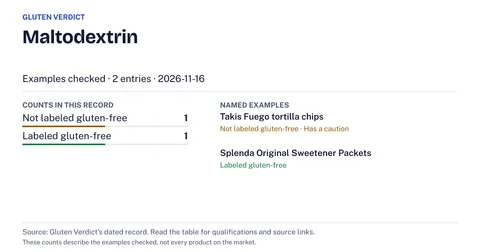 MaltodextrinNaturally gluten-freechecked Nov 16, 2026
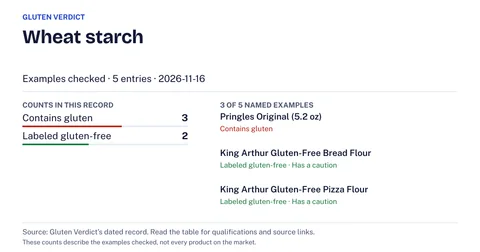 Wheat starchDepends on the product3 of 5 products we checked contain gluten: Pringles Original (5.2 oz), Jiffy Corn Muffin Mix, and Chex Mix Bold Garlic and Herbchecked Nov 16, 2026
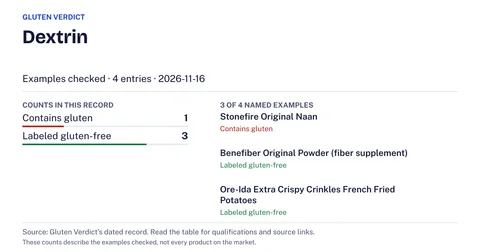 DextrinDepends on the product1 of 4 products we checked contains gluten: Stonefire Original Naanchecked Nov 16, 2026
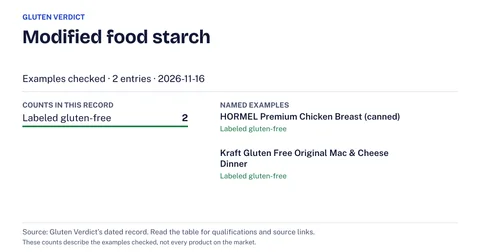 Modified food starchDepends on the productchecked Nov 16, 2026
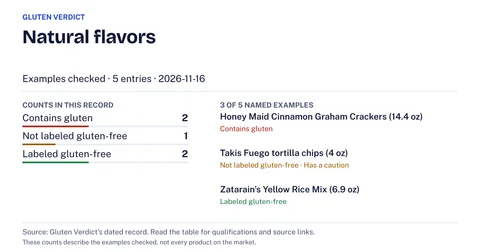 Natural flavorsDepends on the product2 of 5 products we checked contain gluten: Honey Maid Cinnamon Graham Crackers (14.4 oz) and Chex Mix Sour Cream & Onionchecked Nov 16, 2026
Questions people ask
Are prenatal vitamins gluten-free?
It depends on the product. FDA’s rule covers supplements that carry a gluten-free claim1, 5, and the Gluten Intolerance Group says gluten is more prevalent in supplements than in medications10. Read the Other Ingredients list for each product.
Does a gluten-free claim mean the maker tested the vitamin?
Not necessarily. FDA says the regulation does not require manufacturers to test for gluten, though they are responsible for meeting the rule9.
More in Women, pregnancy and babies
 Reading an infant formula or toddler drink label for glutenWhich words on a formula or toddler-drink label to read for wheat, barley and rye, what makers say about gluten, and what to ask when a page is silent.
 Celiac disease and pregnancy: what the research reportsWhat studies report on celiac disease and pregnancy, what charities, NIDDK and the USPSTF say about care and folic acid, and a child's own risk.
 Gluten-free baby food: what the makers’ labels say about wheat, barley and oatsWhat baby cereal, puff, snack and pouch makers print about wheat, barley, oats and gluten, read from their own pages, with the date we read them.
 Miscarriage and celiac disease: what studies report and how strong the evidence isWhat pooled studies report about celiac disease and miscarriage, why they cannot show cause, and what ESHRE and ACOG say about testing.
 Celiac disease and infertility: what studies report and what guidelines say about testingWhat meta-analyses report on celiac disease in women with infertility, what ESHRE, NICE and the ACG say about testing, and why a test needs gluten.
 Periods, menopause, PCOS and celiac disease: which links are documentedWhich period, menopause, hormone, PCOS and endometriosis links studies report for celiac disease, how firm each is, and when agencies advise a clinician.
Related guides
 Gluten in medications: what the label, DailyMed and a pharmacist can showFDA’s gluten-free food rule does not cover drugs. Use the ingredient list, DailyMed, the maker and a pharmacist, and know what each can show.
 How to read a US food label for glutenWhere gluten shows up on a US food label: the gluten-free claim, the Contains line, the ingredient list and may-contain lines, and what each means.
 Breastfeeding with celiac disease: what studies show about gluten in breast milkWhat studies measured about gluten in breast milk, what ESPGHAN says about breastfeeding and a child’s celiac risk, and what one survey found after birth.
 Where wheat, barley and rye hide in processed food: 15 places to checkFifteen processed foods where wheat, barley or rye turn up, the label step that catches each, and what US allergen law does and does not flag.
Sources
- [1, 5, 9] US Food and Drug Administration, Questions and Answers on the Gluten-Free Food Labeling Final Rule, checked Nov 17, 2026.
- [2, 6] US Food and Drug Administration, Gluten and Food Labeling, checked Nov 17, 2026.
- [3, 4, 17, 18, 19, 20, 21, 22] US Food and Drug Administration, Dietary Supplement Labeling Guide: Chapter V. Ingredient Labeling, checked Nov 17, 2026.
- [7, 11, 12, 31] Gluten Intolerance Group, Supplementing a Gluten-Free Diet, checked Nov 17, 2026.
- [8, 10, 13, 14, 25] Gluten Intolerance Group, Are Your Medications and Supplements Gluten-Free?, checked Nov 17, 2026.
- [15] NIDDK, National Institutes of Health, Definition & Facts for Celiac Disease, checked Nov 17, 2026.
- [16] Gluten Intolerance Group, Vitamin E and gluten (GIG FAQ), checked Nov 17, 2026.
- [23, 24, 30] Gluten Intolerance Group, How Does GFCO Certify Gluten-Free Food?, checked Nov 17, 2026.
- [26, 27] Thorne, Basic Prenatal, checked Nov 17, 2026.
Read on 2026-11-17: the page for Basic Prenatal lists “Gluten Free” among its attributes, beside “Dairy Free” and “Soy Free”.
- [28, 29, 32] Nature Made, Prenatal Multivitamin Folic Acid + DHA Softgels, checked Nov 17, 2026.
Read on 2026-11-17: the page for the Prenatal Multivitamin Folic Acid + DHA Softgels shows “GLUTEN FREE” beside “NO SYNTHETIC FD&C DYES”.
Read on 2026-11-17: the product page text gives the Supplement Facts amounts under “Ingredients – What’s Inside” and has no “Other Ingredients” line.
- [33, 34, 35] US Preventive Services Task Force, Folic Acid Supplementation to Prevent Neural Tube Defects: Preventive Medication, checked Nov 17, 2026.
- [36, 37, 38, 39] Gluten Intolerance Group, Pregnancy and Celiac Disease, checked Nov 17, 2026.
- [40] Coeliac UK, Pregnancy and coeliac disease, checked Nov 17, 2026.
- [41, 42] NIDDK, National Institutes of Health, Treatment for Celiac Disease, checked Nov 17, 2026.
Read on 2026-11-17: after “If you have celiac disease, ask a pharmacist about ingredients in”, the list names herbal and nutritional supplements; prescription and over-the-counter medicines; and vitamin and mineral supplements.
- [43] US Food and Drug Administration, Information for Consumers on Using Dietary Supplements, checked Nov 17, 2026.