Gluten in medications: what the label, DailyMed and a pharmacist can show
Short answer
FDA’s gluten-free food rule applies to the labeling of foods, not drugs, so for oral medicines FDA has not established criteria for a gluten-free claim1, 10. Four routes can tell you more, and each shows something different:
- The inactive-ingredient list: the “Drug Facts” label on nonprescription products, and the “Description” section of the labeling for prescription ones2.
- DailyMed, where the NDC code on the package finds the label for the exact product you hold3, 4.
- The maker’s statement for that exact product. In 2017 FDA’s draft guidance said it knew of no test methods validated to detect gluten in finished drug products at the low levels expected5, and a scoping review reports that many makers believed their products had no gluten but did not certify or test the final product6.
- A pharmacist, whom the Gluten Intolerance Group names, along with the maker, as the people to consult when in doubt7.
Part of Medications, supplements and non-food products, 13 guides
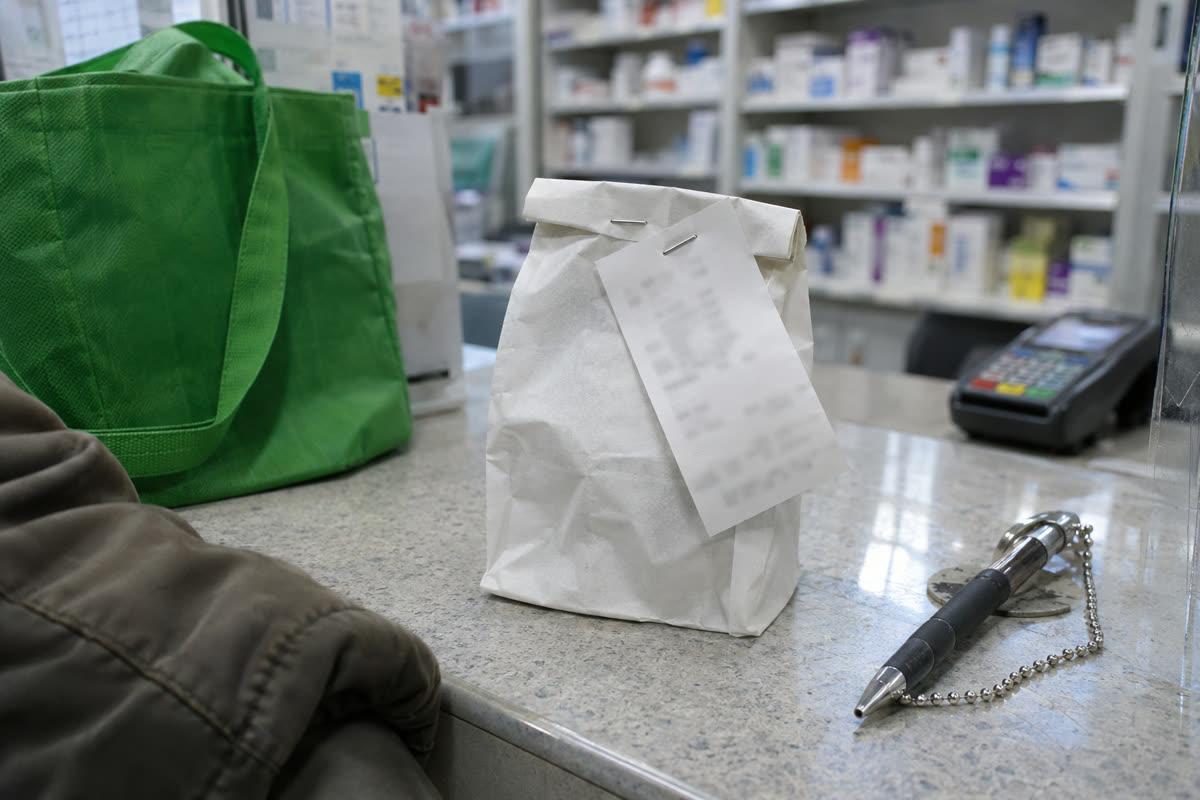
Key points
- FDA’s “gluten-free” definition applies to food labeling; for drugs FDA has issued a draft guidance, which is not binding1, 8.
- The draft recommends an optional statement, “Contains no ingredient made from a gluten-containing grain (wheat, barley, or rye)”, and says it is not a gluten-free claim9, 10.
- FDA says the majority of orally administered drug products contain no gluten or virtually no gluten, and, in the very rare cases where gluten may be present, estimates that wheat starch and other wheat-derived ingredients would contribute no more than 0.5 mg to a unit dose11, 12.
- Hypromellose is derived from natural cellulose and is not named among the ingredient categories FDA’s draft treats as derived from wheat; the rest of a product’s ingredients still need reading13, 14.
- Inactive ingredients can differ between makers of the same drug, so check again when the maker on the label changes15, 16.
Why the gluten-free food rule does not reach medicines
FDA’s definition of “gluten-free” sits in a regulation titled “Gluten-free labeling of food”17, and FDA says that regulation only applies to the labeling of foods1. A food that bears the claim without meeting the definition is deemed misbranded18. For oral drug products, FDA’s draft guidance says FDA has not established criteria for gluten-free statements10.
Dietary supplements are on the food side of that line: FDA says the rule applies to FDA-regulated packaged foods, including dietary supplements19. A supplement can therefore carry a “gluten-free” claim that has to meet the rule19, while for oral drugs FDA has not established criteria for such statements10. The Gluten Intolerance Group says gluten is not a common ingredient in medications but is more prevalent in supplements20.
What FDA’s draft guidance says, and where it stands
In December 2017 FDA’s drug center announced a draft guidance for industry, “Gluten in Drug Products and Associated Labeling Recommendations”21. The draft says it is not binding on FDA or the public8. FDA’s consumer page on medications and gluten still describes it as a draft22, and the copy we read carries a content date of 12/12/201723.
What the draft recommends
- An optional statement for makers who choose to say something about gluten: “Contains no ingredient made from a gluten-containing grain (wheat, barley, or rye).” FDA recommends it only when it is truthful and substantiated9.
- That statement would mean the maker knows that no ingredient was derived directly or indirectly from wheat, barley, or rye or their crossbred hybrids24.
- It is not a gluten-free claim: FDA has not established criteria for such statements on oral drug products10.
- On a prescription product the statement would sit at the end of the inactive-ingredients list in the Description section25; on a nonprescription product, on the container label and carton, outside the Drug Facts label26.
Because the statement is voluntary9, a label without it tells you nothing either way. The draft notes that some marketed oral drug products already carry a gluten statement worded differently from the recommended one27, so wording varies.
The draft is about oral drug products. It says gluten is not believed to harm people with celiac disease through routes of exposure other than oral or enteral ingestion28.
Where gluten can enter a medicine
The Gluten Intolerance Group points to excipients, the inactive ingredients that give a drug its form: they are often made from corn, potato or tapioca, but some are derived from wheat or, in rare cases, barley29.
FDA says it knows of no oral drug product marketed in the United States with wheat gluten or wheat flour intentionally added as an inactive ingredient30, and believes wheat starch is added only very rarely, with corn and potato starch more common31. FDA estimates that in the very rare cases where gluten may be present, wheat starch and other wheat-derived ingredients would contribute no more than 0.5 mg of gluten to a unit dose of an oral drug product12. That is an estimate from formulation information, not a measurement of the product in your hand.
| Name on an ingredient list | What the sources say | Our food page |
|---|---|---|
| Wheat starch | FDA expects wheat starch in oral drugs only very rarely31. The draft says wheat starch, not “starch”, is the established name by which it must be identified in drug labeling32. | Wheat starch |
| Modified starch, pregelatinized starch, sodium starch glycolate | FDA lists these as ingredients potentially derived from wheat starch33. The Gluten Intolerance Group’s bulletin lists pre-gelatinized starch and sodium starch glycolate among excipients that could be derived from wheat or barley34. | Modified food starch |
| Maltodextrin, dextrose, maltose, sorbitol, xylitol, maltitol, mannitol | FDA lists these starch hydrolysates and sugar alcohols as potentially derived from wheat starch33. The same GIG bulletin lists dextrose, maltose, mannitol and sorbitol among common gluten-free excipients35. The name alone does not settle it. | Maltodextrin |
| Dextrin, dextrates, cyclodextrins, dextrimaltose | FDA’s list of starch hydrolysates includes dextrates33. The Gluten Intolerance Group lists dextrin, dextrates, cyclodextrins and dextrimaltose among excipients that could be derived from wheat or barley34. | Dextrin |
| Starch with no source named | GIG lists “starch” among excipients that could be derived from wheat or barley34. FDA says the starch used as a starting material for drug ingredients is often corn or potato starch, not wheat starch36. | Cornstarch |
| Citric acid, ethanol | FDA says some ingredients, including these two, may be produced by fermentation from plant carbohydrates that potentially include wheat37. It also says gluten is unlikely in ethanol purified by distillation under good manufacturing practices64. | None yet |
Our food pages describe these names in food. For a medicine, they show which names to ask about, not what a given product contains.
Is hypromellose gluten-free?
The two sources we read point away from grain: one describes hypromellose as cellulose-based13, and FDA’s draft does not name it14. Hypromellose, also called hydroxypropyl methylcellulose (HPMC), is derived from natural cellulose through etherification, according to a 2025 review in Pharmaceutics13. FDA’s draft guidance lists the ingredient categories it treats as derived or potentially derived from wheat: wheat gluten, wheat flour, wheat starch, starch-derived ingredients, fermentation-derived ingredients and wheat germ oil. Hypromellose is not named in any of them14.
The same review lists “gluten-free” among the properties of HPMC capsules38.
That speaks to the polymer and the capsule shell. It does not cover the rest of a product, where colors, preservatives and fillers are separate inactive ingredients29. If a name in that list is in doubt, the maker’s statement for the exact product is the next step.
Route 1: the label’s inactive-ingredient list
On a nonprescription product, ingredients are listed under “inactive ingredients” on the Drug Facts label. On a prescription product they will generally be in the “Description” section of the labeling2. As the 2017 draft describes the rules, nonprescription labels must list the established name of each inactive ingredient39, while for prescription products listing them is not mandated by FDA’s regulations, though makers generally provide the list40.
What the list can show
FDA says that if the list does not mention wheat gluten or wheat flour, the product should not contain gluten in an amount that would harm a typical (non-refractory) individual with celiac disease41. The qualifier, “typical (non-refractory)”, is FDA’s own.
What it cannot show
- The grain behind a processed starch derivative. The draft says the more highly processed starch-derived and fermentation-derived ingredients carry no botanical source such as wheat in their established names42.
- Gluten that arrives by contact during manufacture. The draft says FDA has no systematic data on this and expects any such gluten to be present only in very small amounts43.
Check the label against the product you are holding. FDA says the product name and the manufacturer or distributor on the label should match44.
Route 2: DailyMed and the NDC code
DailyMed, from the National Library of Medicine, carries the most recent labeling that companies have submitted to FDA and that is currently in use45. FDA points readers to it for looking up the labeling of prescription and nonprescription products46.
- Find the NDC code on the outside of the package3.
- Search DailyMed by drug name, NDC code, manufacturer, drug class or SET ID47. The NDC code finds the exact drug you have, because the same drug may be made by many manufacturers4.
- Open the label and check that the product name and maker match your package44, then read the inactive ingredients2.
- To find labels by ingredient, Advanced Search has an inactive-ingredient field48.
DailyMed shows the original packaging’s NDC code as the source code and treats the other codes as repackaged versions49, so a repackaged product can carry a different code from the source label’s. DailyMed shows what the company’s labeling says; because a gluten statement is voluntary9, it appears there only if the maker chose to include one.
Route 3: the maker’s statement, and what it is worth
FDA encourages makers to keep accurate information on the sources of their ingredients so they can answer questions from the public and from health care providers50. The Gluten Intolerance Group tells readers who have doubts to check with the manufacturer7, and says most makers do not clearly label the gluten content of their products or packaging51.
A statement has limits, and the sources say what they are:
- Makers are responsible for the truthfulness of their gluten statements and for having information that supports them52. For the recommended statement, FDA says the support should include a written commitment from ingredient suppliers that wheat, barley and rye are not used to produce each ingredient that could be derived from them53.
- In 2017 FDA said it was not aware of test methods validated to detect or quantify gluten in finished drug products, or in drug ingredients, at the low levels where it would be expected5.
- A 2021 scoping review reports that, although many manufacturers believed their products were devoid of gluten, they did not certify or test the final products6. The same review concludes that information is still scarce54.
What to have in hand when you ask
- The product name, strength and dosage form, and the NDC code from the package.
- The inactive-ingredient list from the label or DailyMed.
- The question: which inactive ingredients are made from wheat, barley or rye, or from a starch whose grain is not known.
- The answer in writing, with the date, so it can be compared with the next refill.
Route 4: the pharmacist
The Gluten Intolerance Group names the pharmacist, and the manufacturer, as the people to consult when a medication’s gluten status is in doubt7. The authors of a 2021 scoping review write that pharmacists must support patients with celiac disease and other gluten-related disorders55.
Bring the package or its NDC code, the DailyMed page, and a list of everything else taken, including over-the-counter products and supplements, so the whole list can be read in one sitting.
Coeliac UK, writing for readers in the UK, says prescribed medications should only be taken or stopped under medical advice56.
Generics, refills and formulation changes
Two products with the same active ingredient can list different inactive ingredients. FDA’s draft notes that a generic’s labeling can differ from the reference drug’s to reflect permissible differences in inactive ingredients15. A 2025 paper says different commercially available versions of the same medicinal product may contain distinct excipient profiles16; its sample was products authorized in Portugal57.
Makers also change ingredient sources. FDA’s draft says makers should consider the impact of changes in ingredient sources or formulations on gluten content58, and the scoping review cites advice to check with the manufacturer for each specific product because excipients and manufacturing processes can change59.
That makes the NDC code the thing to compare. It identifies the labeler, product and package size60, so a refill from a different maker has a different code, and the DailyMed label for the new code is the one to read.
Other routes, supplements and the UK
The Gluten Intolerance Group says that for an inhalant, injectable, patch or IV, gluten is not routinely included61.
The UK has its own arrangements. Coeliac UK says that in the UK a medicine containing wheat starch says so on the label and the patient information leaflet62, and describes pharmaceutical-quality wheat starch as containing no more than 100 parts per million of gluten63. Apart from the Coeliac UK note and the Portugal sample, the rest of this guide describes the US.
Verdicts in this guide
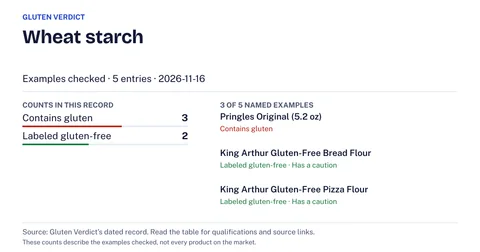 Wheat starchDepends on the product3 of 5 products we checked contain gluten: Pringles Original (5.2 oz), Jiffy Corn Muffin Mix, and Chex Mix Bold Garlic and Herbchecked Nov 16, 2026
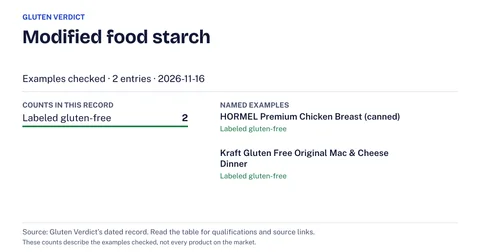 Modified food starchDepends on the productchecked Nov 16, 2026
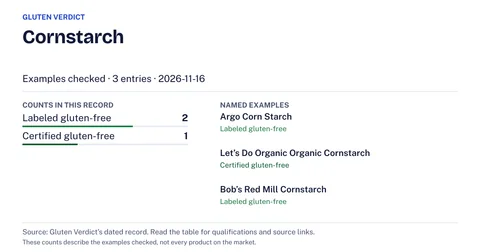 CornstarchNaturally gluten-freeBuy it labeled gluten-freechecked Nov 16, 2026
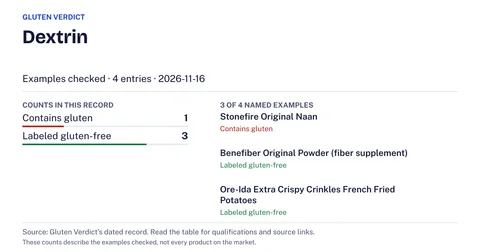 DextrinDepends on the product1 of 4 products we checked contains gluten: Stonefire Original Naanchecked Nov 16, 2026
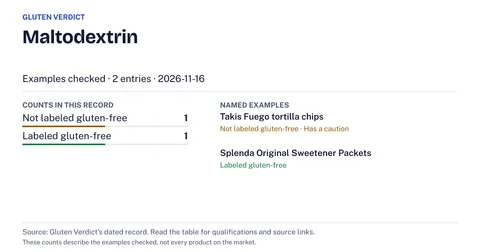 MaltodextrinNaturally gluten-freechecked Nov 16, 2026
Questions people ask
Is there a gluten-free label for medicines?
Not one that FDA has defined for oral drugs. The gluten-free definition applies to food labeling1, and for oral drug products FDA’s draft guidance says FDA has not established criteria for gluten-free statements10. The draft notes that some marketed products carry their own gluten statement27.
Would wheat starch be named on a US drug label?
The draft guidance says wheat starch, not “starch”, is the established name by which wheat starch must be identified in drug labeling32. It adds that more highly processed starch-derived ingredients carry no botanical source in their names42.
More in Medications, supplements and non-food products
 How to check a medicine for gluten, from the bottle to the makerFind your exact medicine by NDC in DailyMed, read its inactive ingredients, compare refills, and ask the maker about starch names the label leaves open.
 What gluten wording on an over-the-counter medicine box meansFind the inactive-ingredient line in Drug Facts and see what each kind of gluten wording on an OTC medicine box has behind it, from silence to a mark.
 Are vitamins gluten-free? What a bottle’s claim, mark and ingredient list showWhat “gluten-free” on a vitamin bottle rests on (FDA rule, certifier listing or nothing) and how to read Other Ingredients for binders and fillers.
 How to read a supplement label for glutenWhere gluten can hide on a US supplement label: the Supplement Facts panel, the Other Ingredients list and the allergen line, and what each leaves out.
 Children’s medicines, gummies and liquids: reading the ingredients for glutenHow to read a children’s medicine, syrup or gummy for gluten: drug or supplement, which list to read, how to match it on DailyMed, and who to ask.
 Gluten in lipstick, lip balm, shampoo and other cosmeticsWhat celiac organisations say about gluten in lipstick, lip balm, shampoo and creams, what the FDA rule covers, and which ingredient names to check.
All 13 guides in Medications, supplements and non-food products
Related guides
 Who regulates a gluten-free claim on pills, cosmetics, toothpaste and pet foodWhich products FDA’s 20 ppm gluten-free rule covers, and what a gluten-free line on a medicine, cosmetic, toothpaste or pet food rests on.
 Prenatal vitamins and gluten: how to check the label and the maker’s statementHow to read a prenatal vitamin’s Other Ingredients list and gluten claim, what to ask the maker, and where folic acid and iron advice comes from.
 Wheat, barley and rye on an ingredient list: the names to look forLook up wheat, barley and rye names on a US ingredient list, from durum to malt, and sort each as contains gluten, depends on the maker, or lookalike.
 Maltodextrin, dextrin and glucose syrup made from wheat: what the label rules sayWhat US label law, FDA and the two US celiac charities say about wheat-made maltodextrin, dextrin and glucose syrup, and how to confirm one.
Sources
- [1, 19, 21] US Food and Drug Administration, Questions and Answers on the Gluten-Free Food Labeling Final Rule, checked Nov 17, 2026.
- [2, 11, 12, 22, 23, 30, 41, 44, 46, 50] US Food and Drug Administration, Medications and Gluten, checked Nov 17, 2026.
Read on 2026-11-17: the page’s footer reads “Content current as of: 12/12/2017”, its text describes the guidance only as a draft, and it names no final version.
- [3, 4, 47, 48, 49, 60] US National Library of Medicine, DailyMed help: search and NDC codes, checked Nov 17, 2026.
Read on 2026-11-17: the Advanced Search help lists a table of search fields that includes “INACTIVE INGREDIENT”, described as “Inactive Ingredients contained in the drug”, and “INACTIVE INGREDIENT UNII CODE”.
- [5, 8, 9, 10, 14, 15, 24, 25, 26, 27, 28, 31, 32, 33, 36, 37, 39, 40, 42, 43, 52, 53, 58, 64] US Food and Drug Administration, Gluten in Drug Products and Associated Labeling Recommendations (draft guidance, December 2017), checked Nov 17, 2026.
Read on 2026-11-17: section II.A of the draft (“Possible Sources and Amounts of Gluten in Oral Drug Products”) names wheat gluten, wheat flour, wheat starch, ingredients derived from starch, ingredients produced through fermentation and wheat germ oil; the word hypromellose does not appear anywhere in the document.
- [6, 54, 55, 59] Systematic Reviews (Lizano-Díez et al., 2021), Gluten in pharmaceutical products: a scoping review, checked Nov 17, 2026.
- [7, 20, 29, 51, 61] Gluten Intolerance Group, Are Your Medications and Supplements Gluten-Free?, checked Nov 17, 2026.
- [13, 38] Pharmaceutics (2025), Hydroxypropyl Methylcellulose: A Key Excipient in Pharmaceutical Drug Delivery Systems, checked Nov 17, 2026.
- [16, 57] Scientific Reports (Figueiredo et al., 2025), Presence of gluten and soy derived excipients in medicinal products, checked Nov 17, 2026.
- [17, 18] eCFR, 21 CFR 101.91 Gluten-free labeling of food, checked Nov 17, 2026.
- [34, 35] Gluten Intolerance Group, Medications and the Gluten-Free Diet (educational bulletin), checked Nov 17, 2026.
Read on 2026-11-17: the list headed “Excipients which could be derived from wheat or barley” names starch, pre-gelatinized starch, dextrimaltose, dextrin, dextrates, cyclodextrins and sodium starch glycolate.
Read on 2026-11-17: the list headed “Common Gluten-Free Pharmaceutical Excepients” [sic] includes corn starch, dextrose, maltose, mannitol and sorbitol.
- [45] US National Library of Medicine, DailyMed home page: About DailyMed, checked Nov 17, 2026.
- [56, 62, 63] Coeliac UK, Medication and coeliac disease, checked Nov 17, 2026.