Reading an infant formula or toddler drink label for gluten
Short answer
No FDA page we read says whether infant formula is gluten-free: FDA’s infant formula page does not mention gluten, and FDA’s question-and-answer page on the gluten-free rule does not mention infant formula1, 2, 13. The answer for a given tub comes from its ingredient line, allergen statement and the maker’s own wording, which differs by brand8, 9, 10, 11.
- Read the ingredient line for wheat, barley, rye, malt and wheat starch3, 4.
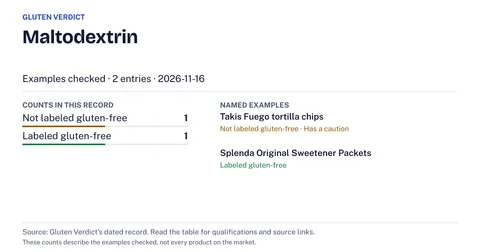
- For words such as maltodextrin, corn syrup solids and starch, read the plant named with them: the National Celiac Association says maltodextrin is almost always made from corn in the United States5.
- Read the allergen statement: wheat has to be named there, barley and rye do not6, 24, 25, 7.
- Find the maker’s own gluten statement. Pages we read differ from clear statements to none, and the page you need may be silent8, 9, 10, 11.
- If the maker’s page is silent, ask the maker in writing, using the questions below.
Part of Women, pregnancy and babies, 11 guides
Key points
- FDA’s infant formula page does not mention gluten, its “gluten-free” claim is voluntary, and its question-and-answer page on that rule does not mention infant formula2, 12, 13.
- In the Similac lists cited here, maltodextrin and corn syrup solids are named for corn14, 15; FDA says malt extract and malt syrup are derived from barley that has not been processed to remove gluten3.
- Maker statements differ: Similac says its Pure Bliss formulas are made without gluten-containing ingredients, and Kendamil says all of its baby formula is gluten-free8, 9.
What a formula label has to show, and where gluten fits
FDA says its regulations specify 30 nutrients that must be in any infant formula sold in the United States16. It also says FDA has specific requirements for formula labels, and the information it calls most helpful for caregivers is directions for preparation and use, a pictogram of the preparation steps and a “use by” date1. That page does not mention gluten2.
FDA’s rule on “gluten-free” claims is voluntary12. Its definition says the food is inherently gluten free or has no ingredient that is a gluten-containing grain, is derived from one and not processed to remove gluten, or is derived from one and processed to remove gluten if its use results in 20 parts per million or more gluten in the food; any unavoidable gluten must also be under 20 ppm17. FDA’s question-and-answer page on that rule does not mention infants or infant formula13, so we cannot tell you from FDA’s pages how the claim is applied to formula. We read the makers’ own pages instead (below), and say whose words they are.
This guide is about reading labels. Which formula a baby feeds on is a medical decision for the baby’s clinician.
Words in a formula’s ingredient line that raise gluten questions
The table uses ingredient lines the makers print on their own product pages, read on 2026-11-17. Where we link a word to our verdict, that page covers the ingredient in foods generally.
| Word on the label | What the source says | Where we saw it |
|---|---|---|
| Maltodextrin | The National Celiac Association says it is a partially hydrolyzed starch used as a thickener, that it can be made from wheat but is almost always made from corn in the United States5. Gluten Intolerance Group says that even when made from wheat it is so highly processed that it is gluten-free18. | Similac lists “Corn Maltodextrin”14; Similac’s Alimentum toddler drink lists “Corn Maltodextrin”19. |
| Corn syrup, corn syrup solids | The word names the plant: corn. | Similac NeoSure lists “Corn Syrup Solids”15; a Similac toddler drink lists “Corn Syrup”20. |
| Starch: tapioca, rice | The plant is named in front of the word, and none of these pages names wheat, barley or rye. | Similac Alimentum lists “Modified Tapioca Starch”21; Enfamil sells a formula “with added rice starch”22; Enfamil’s 3232A base “contains tapioca starch”23. |
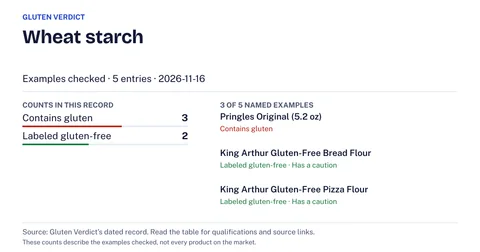
| Wheat starch | Gluten Intolerance Group says not all wheat starch is gluten-free: it has to be processed to under 20 ppm to qualify under FDA’s definition4. The word “wheat” is what changes the question. | Not named in the Similac lines we read14, 15, 19, 20, 21. |
| Hydrolysate | In these lines the protein is named in front of the word: whey protein, casein. | Similac lists “Whey Protein Hydrolysate”14 and “Casein Hydrolysate [Derived from Milk]”21. |
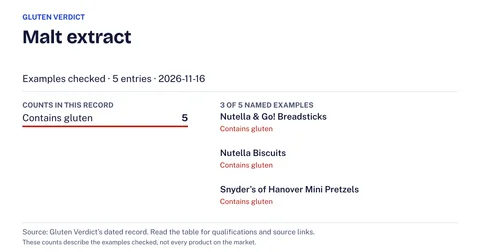
| Malt extract, malt syrup | FDA says malt extract and malt syrup are ingredients derived from barley that has not been processed to remove gluten3. | Not named in the Similac lines we read14, 15, 19, 20, 21. |
Read the line itself every time you buy a new tub or switch to a new product from the same maker. We read Similac’s lines on one date; the line on your tub is the one that counts.
The allergen statement: what it names and what it leaves out
US allergen labeling law lets a maker name a major allergen in either of two places: after the ingredient in parentheses24, or in a line starting “Contains” printed right after or next to the ingredient list25. Wheat is on the law’s list of major allergens (the list in FDA’s FALCPA page); barley and rye are not on it6. Gluten Intolerance Group notes that barley and rye are not given the same treatment on ingredient labels7.
The National Celiac Association says maltodextrin made from wheat has to be declared on foods FDA regulates, either in parentheses after the ingredient or in a “Contains” statement26.
On the Similac pages we read, the allergen statement reads “Contains milk ingredients.” on Gentle Comfort27 and “Contains milk and soy ingredients.” on NeoSure28 and on a Go & Grow toddler drink29. None of those statements names wheat.
A line such as “made in a facility that also processes…” is voluntary and not required or regulated by FDA30. Do not read the absence of such a line as an answer; ask the maker.
What the makers’ own pages say about gluten
These are the makers’ statements as they read on 2026-11-17. We did not test any product, and none of the statements below gives a test result or a parts-per-million figure.
| Maker and product | What the page says |
|---|---|
| Similac, Pure Bliss organic | Yes, Pure Bliss® by Similac® infant formulas are made without gluten-containing ingredients8. This is a statement about ingredients. |
| Similac, other products we opened | No gluten statement on the Gentle Comfort, NeoSure, Alimentum and Go & Grow pages14, 15, 19, 20, 21, and none on the Similac FAQ page, which covers purchases and orders10. |
| Enfamil | No gluten statement in the visible text of the NeuroPro formula page11 or on the Help Center ingredients page31. The NeuroPro page’s code carries image descriptions for two other Enfamil listings that read “no known sources of gluten”11. |
| Kendamil | Kendamil’s FAQ page says all of the baby formula it makes is gluten-free, and that some of its cereals contain gluten9. The page does not say which country’s gluten-free rule it follows9. |
| ByHeart | Lists “No Gluten” among the things it does not include32. |
| Bobbie | Lists “no gluten” among the things it leaves out33. |
Two kinds of wording appear. “Made without gluten-containing ingredients” describes the recipe. “Gluten-free” is the term FDA defines, and its definition also covers gluten that cannot be avoided, which has to stay under 20 ppm17. When a maker uses either phrase, ask which one it means and what supports it.
Toddler drinks, hydrolysate formulas and bases you add to
A toddler drink has its own product page and its own ingredient line. Similac’s Go & Grow Total Care Sensitive begins with “Corn Syrup”20 and its Alimentum toddler drink with “Corn Maltodextrin”19; read the product you are holding, not the brand’s infant formula page.
Some metabolic formulas are sold as a base. Enfamil describes 3232A as a protein hydrolysate base that contains tapioca starch and is to be used with added carbohydrates23. The carbohydrate added to such a base has its own label to read.
What to put in an email to the maker
When the page is silent, a written answer from the maker is the next step. Send the product name, the size, and the “use by” date from the tub, so the answer is about that product.
- Does this product contain any ingredient made from wheat, barley, rye or oats, including carbohydrates, starches, flavors and processing aids?
- What plant is the maltodextrin, starch or syrup made from?
- Is the product made on lines or in a facility that also handles wheat, barley or rye?
- Does the maker label or test it as gluten-free under FDA’s definition, with any unavoidable gluten under 20 ppm17? If so, what supports that?
- How will you tell customers if the recipe changes?
Save the reply with the date. Our guide to reading food labels covers the same label words for foods in general, and hidden sources of gluten covers words in other products.
Verdicts in this guide
Questions people ask
Is infant formula gluten-free?
There is no single answer for every formula. The maker pages we read differ: Similac says its Pure Bliss formulas are made without gluten-containing ingredients8, Kendamil says all its baby formula is gluten-free9, and the other Similac product pages and the Enfamil NeuroPro page text we opened carry no gluten statement14, 15, 11.
Does maltodextrin in formula mean wheat?
Not by the word alone. The National Celiac Association says maltodextrin can be made from wheat but is almost always made from corn in the United States5. The Similac lines we read name “Corn Maltodextrin”14.
Does the “Contains” line cover barley and rye?
No. Wheat is a major allergen under US law; barley and rye are not on the list6.
More in Women, pregnancy and babies
 Prenatal vitamins and gluten: how to check the label and the maker’s statementHow to read a prenatal vitamin’s Other Ingredients list and gluten claim, what to ask the maker, and where folic acid and iron advice comes from.
 Gluten-free baby food: what the makers’ labels say about wheat, barley and oatsWhat baby cereal, puff, snack and pouch makers print about wheat, barley, oats and gluten, read from their own pages, with the date we read them.
 Miscarriage and celiac disease: what studies report and how strong the evidence isWhat pooled studies report about celiac disease and miscarriage, why they cannot show cause, and what ESHRE and ACOG say about testing.
 Periods, menopause, PCOS and celiac disease: which links are documentedWhich period, menopause, hormone, PCOS and endometriosis links studies report for celiac disease, how firm each is, and when agencies advise a clinician.
 Breastfeeding with celiac disease: what studies show about gluten in breast milkWhat studies measured about gluten in breast milk, what ESPGHAN says about breastfeeding and a child’s celiac risk, and what one survey found after birth.
 Starting solids in a home with a celiac family member: kitchen routinesKitchen routines for a baby starting solids when someone at home has celiac disease: crumbs, spreads, towels, spills and hands, from charity guidance.
Related guides
 How to read a US food label for glutenWhere gluten shows up on a US food label: the gluten-free claim, the Contains line, the ingredient list and may-contain lines, and what each means.
 Where wheat, barley and rye hide in processed food: 15 places to checkFifteen processed foods where wheat, barley or rye turn up, the label step that catches each, and what US allergen law does and does not flag.
 Wheat, barley and rye on an ingredient list: the names to look forLook up wheat, barley and rye names on a US ingredient list, from durum to malt, and sort each as contains gluten, depends on the maker, or lookalike.
 How to read a supplement label for glutenWhere gluten can hide on a US supplement label: the Supplement Facts panel, the Other Ingredients list and the allergen line, and what each leaves out.
Sources
- [1, 2, 16] US Food and Drug Administration, Infant Formula, checked Nov 17, 2026.
Read on 2026-11-17: the page, which lists FDA’s infant formula requirements for nutrients and ingredients, labeling and inspections, does not mention gluten.
- [3, 12, 13, 17] US Food and Drug Administration, Questions and Answers on the Gluten-Free Food Labeling Final Rule, checked Nov 17, 2026.
Read on 2026-11-17: the page does not mention infants or infant formula.
- [4, 7, 30] Gluten Intolerance Group, Do All Wheat Mentions on Food Labels Mean Not Gluten-Free?, checked Nov 17, 2026.
- [5, 26] National Celiac Association, Maltodextrin, checked Nov 17, 2026.
- [6, 24, 25] US Food and Drug Administration, Food Allergen Labeling and Consumer Protection Act of 2004 (FALCPA), checked Nov 17, 2026.
- [8] Abbott (Similac), Pure Bliss by Similac Organic ready-to-feed, product page (FAQ), checked Nov 17, 2026.
- [9] Kendamil, Are your products gluten free? (kendamil.com FAQ), checked Nov 17, 2026.
- [10] Abbott (Similac), Similac FAQ (purchases and orders), checked Nov 17, 2026.
Read on 2026-11-17: the Similac FAQ page, headed “Questions and Answers About Your Purchase”, answers questions on payment, orders, shipping and returns; it has no question or answer about gluten.
- [11] Reckitt Mead Johnson (Enfamil), Enfamil NeuroPro Infant Formula powder, product page, checked Nov 17, 2026.
Read on 2026-11-17: the visible text of this formula’s page has no statement about gluten. A line reading “No artificial sweeteners, artificial flavors, high fructose corn syrup, sugar or gluten” sits in the page code, in the description of a separate product, Enfamom Prenatal Multivitamin. Image descriptions in the page code for two other Enfamil listings, Enfamil Infant Formula and NeuroPro Enfacare, read “no known sources of gluten”; we did not open those listings.
- [14, 27] Abbott (Similac), Similac Gentle Comfort (Total Comfort) powder, product page, checked Nov 17, 2026.
Read on 2026-11-17: the Ingredients line begins “Corn Maltodextrin, Whey Protein Hydrolysate, High Oleic Safflower Oil, Sugar, Soy Oil, Coconut Oil”; it names no wheat, barley, rye or malt, and the page carries no gluten statement.
- [15, 28] Abbott (Similac), Similac NeoSure powder, product page, checked Nov 17, 2026.
Read on 2026-11-17: the Ingredients line begins “Nonfat Milk, Corn Syrup Solids, Lactose, Soy Oil, High Oleic Safflower Oil, Whey Protein Concentrate”; it names no wheat, barley, rye or malt, and the page carries no gluten statement.
- [18] Gluten Intolerance Group, Are maltose and maltodextrin gluten-free?, checked Nov 17, 2026.
- [19] Abbott (Similac), Similac Alimentum toddler drink powder, product page, checked Nov 17, 2026.
Read on 2026-11-17: the Ingredients line begins “Corn Maltodextrin (35%), Casein Hydrolysate [Derived from Milk] (18%), Sugar (15%)”; it names no wheat, barley, rye or malt, and the page carries no gluten statement.
- [20, 29] Abbott (Similac), Similac Go & Grow Total Care Sensitive toddler drink, product page, checked Nov 17, 2026.
Read on 2026-11-17: the Ingredients line begins “Corn Syrup, Milk Protein Concentrate, High Oleic Safflower Oil, Sugar, Soy Oil, Coconut Oil”; it names no wheat, barley, rye or malt, and the page carries no gluten statement.
- [21] Abbott (Similac), Similac Alimentum ready-to-feed, product page, checked Nov 17, 2026.
Read on 2026-11-17: the Ingredients line begins “Water (87%), Sugar (4%), Casein Hydrolysate [Derived from Milk] (2%), Modified Tapioca Starch (2%)”; it names no wheat, barley, rye or malt, and the page carries no gluten statement.
- [22] Reckitt Mead Johnson (Enfamil), Enfamil A.R. Infant Formula, product page, checked Nov 17, 2026.
- [23] Reckitt Mead Johnson (Enfamil), Enfamil 3232A metabolic formula, product page, checked Nov 17, 2026.
- [31] Reckitt Mead Johnson (Enfamil), Enfamil Help Center: Nutrients and ingredients, checked Nov 17, 2026.
Read on 2026-11-17: the page has no question or answer about gluten.
- [32] ByHeart, Our ingredients, checked Nov 17, 2026.
Read on 2026-11-17: under the line “And we’re just as meticulous about the things we DON’T include.” the page lists “No Corn Syrup”, “No Gluten”, “No GMO”, “NO MALTODEXTRIN” and other items, and its full ingredient list ends “contains: milk”.
- [33] Bobbie, Bobbie Ingredients: What’s in baby formula?, checked Nov 17, 2026.
Read on 2026-11-17: the page lists, among others, “no corn syrup”, “no filler”, “no maltodextrin” and “no gluten”.