Where wheat, barley and rye hide in processed food: 15 places to check
Short answer
Gluten turns up in processed food as the wheat flour in a roux that thickens soups28, 55, as malt extract and malt syrup made from barley8, and as the wheat in traditional soy sauce2. Three label checks, in this order:
- A gluten-free claim: on a food FDA regulates, it means less than 20 parts per million of gluten3.
- The full ingredient list, not only the Contains line, because US allergen law names wheat but not barley or rye4.
- The maker, when a food with no claim lists natural flavor or yeast extract, because US labels need not name barley there5, 6.
Part of Hidden gluten in ingredients, sauces and processed foods, 21 guides
Key points
- Wheat is on FDA’s list of major food allergens and has to be declared; barley and rye are not on it, so a Contains line without wheat says nothing about them7, 4.
- Malt extract and malt syrup are made from barley and cannot be used in a food labeled gluten-free8, 9.
- Names that sound like gluten are not always it: the National Celiac Association considers maltodextrin and dextrose gluten free whatever they are made from10, 11.
- Foods whose labeling USDA regulates, generally meat, poultry and certain egg products, sit outside FDA’s gluten-free rule12, and wheat-based modified food starch may go unnamed on them13.
- Of the 19 foods and ingredients we link here, 15 have a verdict of varies: the product in your hand decides.
Three label checks for hidden gluten
Gluten Intolerance Group (GIG) describes hidden gluten as gluten that is either not mentioned on a label in a way that is obvious, or is in products that may not seem likely to contain it14. Three checks, in order:
- Look for a gluten-free claim. The claim is voluntary15, and on a food FDA regulates it means less than 20 parts per million (ppm) of gluten3, 12. FDA notes that the claim may not appear even when a food is gluten-free16, so a missing claim is not a warning by itself.
- Read the whole ingredient list. The NIDDK tells readers to check labels for wheat, barley and rye and for ingredients or additives made from those grains17. The Contains line is not enough, because wheat has to be declared and barley and rye do not7, 4.
- Ask the maker when the list leaves it open. The NIDDK advises not eating a food when you are not sure whether it contains gluten, and contacting the company or visiting its website18. The gray-area names further down show where it applies.
For the claim, the Contains line and may-contain wording in more depth, see how to read a US food label for gluten.
What the US wheat-allergen rule catches and what it misses
FDA lists wheat among the major food allergens that must be declared on FDA-regulated foods; barley and rye are not on the list7, 4.
Wheat is defined broadly for this rule. FDA’s guidance counts any species in the genus Triticum, and names spelt, semolina, durum, einkorn, emmer, Khorasan and triticale among them19.
Flavorings are covered when they carry the allergen: a flavoring, coloring or incidental additive that is, or contains, a major food allergen is subject to the labeling requirements20. An ingredient derived from a major allergen that contains no protein from it is not subject to them21. So wheat in a natural flavor has to be declared, while malt or barley in one does not5.
Generally, USDA rather than FDA regulates the labeling of meat, poultry and certain egg products12. On those labels the National Celiac Association says wheat in a modified food starch may not be stated13.
Other countries differ. GIG says barley and rye are easier to identify on EU and UK labels than on US labels22. This guide covers US labels.
Fifteen places to check, aisle by aisle
Each row says why gluten turns up and what to read. Where we checked products, our verdict page shows which ones list wheat, barley or rye and which carry a maker’s gluten-free claim, with the page we read and its date. Of the 19 foods and ingredients linked in this guide, 3 are plain contains-gluten verdicts (malt extract, malt vinegar, seitan), 1 is naturally gluten free (maltodextrin) and 15 are varies: the product decides.
Sauces, marinades and dressings
| Place | Why gluten turns up | What to read |
|---|---|---|
| 1. Soy sauce and teriyaki sauce | GIG: traditionally made with fermented crushed wheat and soy2. FDA: in general, a soy sauce made from soybeans and wheat may not carry a gluten-free claim23. | Wheat in the list, or a gluten-free claim. GIG says tamari is often but not always gluten-free55. |
| 2. Worcestershire sauce | Vinegar is the ingredient to check: FDA says malt vinegar, made by fermenting an infusion of barley malt, cannot be used in a food labeled gluten-free24. | Malt vinegar in the list, or a gluten-free claim. |
| 3. BBQ sauce and marinades | GIG: may contain malt vinegar, soy sauce or flour25. | Malt vinegar, soy sauce or flour in the list. |
| 4. Salad dressings, including Caesar dressing | GIG says dressings may contain malt vinegar, soy sauce or flour, and could also contain modified food starch26; and NIDDK names salad dressing among foods where gluten may be found27. | The same names, plus modified food starch (see the gray-area table below). |
Soups, gravies and broth
| Place | Why gluten turns up | What to read |
|---|---|---|
| 5. Soup | GIG: soup thickened with “roux”, which is a mixture of fat, usually butter, and flour28. NIDDK names soups among foods where gluten may be found27. | Flour, roux or barley in the list. |
| 6. Gravy | GIG lists roux, traditionally made with wheat flour as the thickener, among reliably gluten-containing ingredients55. | Flour, roux or wheat in the list, or a gluten-free claim on the package. |
| 7. Broth, stock and bouillon, such as chicken broth | GIG: some powdered or packaged broths can contain gluten, such as yeast extract derived from barley, and some may contain hydrolyzed wheat protein29. | Yeast extract and hydrolyzed wheat protein in the list, or a gluten-free claim on the package. |
Seasonings
| Place | Why gluten turns up | What to read |
|---|---|---|
| 8. Seasoning packets, taco seasoning and spices | Wheat starch, wheat flour and malted barley flour are common carrier agents in seasoning blends30. GIG says certain taco seasonings contain wheat31, and the National Celiac Association says some spices have been found contaminated with wheat, barley or rye32. | The ingredient list, where non-spice ingredients such as starch have to be named33, or a gluten-free claim on the blend. |
Cereals and snacks
| Place | Why gluten turns up | What to read |
|---|---|---|
| 9. Corn flakes and rice cereals | GIG: some popular brands are made with malt from barley1. | Malt extract, malt flavoring or malt syrup in the list (see malt extract). |
| 10. Granola bars and energy bars | GIG: many bars are made with oats and are often not labeled or certified gluten-free57. FDA: oats labeled gluten-free must contain less than 20 ppm of gluten34. | Wheat in the list, and a gluten-free claim on the oats. |
| 11. Potato chips and flavored chips | GIG: some chip brands use wheat starch or whole wheat in their “reconstituted” chips (versus sliced potatoes or corn-only), and it says to watch out for flavorings derived from wheat or barley35. | Wheat starch, whole wheat, or wheat or barley in the flavoring, and whether the chip is made from sliced potatoes or corn only. |
Meat, substitutes, seafood and potatoes
| Place | Why gluten turns up | What to read |
|---|---|---|
| 12. Meat substitutes: seitan and imitation meats such as bacon | GIG: seitan is made of wheat gluten, and certain imitation bacon brands could contain gluten from vital wheat gluten or yeast extract36. | Wheat gluten, vital wheat gluten or yeast extract in the list. |
| 13. Imitation crab | GIG: some may use wheat starch to bind, and unless labeled or certified, wheat starch cannot be assumed to be gluten-free37. | Wheat starch in the list, and whether the pack carries a gluten-free label. |
| 14. Hot dogs, sausage and deli meat | NIDDK names hot dogs and sausages among foods where gluten may be found27. GIG says sausage could contain rusk, a gluten-containing bread used as a cereal filler in some types, such as British “banger” sausages38, and that sliced deli meats may contain thickeners such as wheat-derived dextrin or modified food starch39. | Rusk, dextrin or modified starch in the list. Deli meat is USDA-regulated, and GIG says to contact the manufacturer with questions40. |
| 15. French fries and frozen potatoes | GIG advises against “crunchy,” “seasoned” or “battered” fries unless you can verify that they use entirely gluten-free ingredients, and says fast-food fries are most likely fried in the same oil as gluten-containing foods56. It adds that frozen seasoned fries from the grocery store could also contain wheat flour41. | Wheat flour in the coating or seasoning list. |
Names that sound like gluten and names that hide it
The NIDDK says many food ingredients and additives, such as colorings, flavorings, starches and thickeners, are made from grains that contain gluten42. The sources below agree on some of these names and differ on others, so each row says whose position it is.
| Name on the list | What the sources say |
|---|---|
| Malt, malt extract, malt flavoring, malt syrup (malt extract) | The National Celiac Association: any product containing malt is not gluten free43. FDA: malt extract and malt syrup are derived from barley that has not been processed to remove gluten8. |
| Malt vinegar and plain vinegar (malt vinegar) | The National Celiac Association: malt vinegar is not gluten free because it contains barley44, and the single word vinegar on a list means vinegar made from apples45. |
| Natural flavor (natural flavors) | Wheat has to be declared on FDA-regulated foods, but malt or barley does not, so the National Celiac Association says to contact the manufacturer5. It adds that on a food labeled gluten free you do not have to worry about natural flavorings46. |
| Yeast extract | The National Celiac Association: yeast extract may be made from spent brewer’s yeast59, a beer-brewing byproduct that can be contaminated with small amounts of gluten-containing grain and malt47. GIG: in the US the source may not be clear because barley is not a major allergen6. |
| Modified food starch | GIG: if modified starch is made from wheat, wheat must be declared on US labels48; the National Celiac Association says it will be listed in the ingredients or a Contains statement on FDA-regulated products49, but on USDA-regulated products wheat may not be stated13. |
| Maltodextrin and dextrose (maltodextrin) | The National Celiac Association: maltodextrin is usually made from cornstarch in the US, though it may be made from wheat starch50, and it is considered gluten free regardless of the starting material10. It says the same of dextrose11. |
| Caramel color | The sources differ. The National Celiac Association considers caramel gluten free regardless of the starting material51; GIG lists it among ingredients that may contain gluten, noting some sources suggest it could contain malt syrup52. |
| Vegetable protein | GIG: the protein may come from soy, peas, wheat or another plant, so the source named in the list matters53. |
| Brown rice syrup | The National Celiac Association: the enzymes used to make rice syrup are sometimes derived from barley58. |
Imports, meat and foods with no claim
- Imported packaged foods. GIG says some could contain gluten grain derivatives even where similar products are considered gluten-free in the US, such as certain mustards, sausages, sauces and spreads54.
- Meat, poultry and certain egg products. FDA says USDA generally regulates their labeling, and that its gluten-free rule does not apply to foods whose labeling USDA regulates12. Ask the maker, as GIG says for deli meats40.
- A food with no claim and a list you cannot settle. The NIDDK advises not eating it and contacting the company or visiting its website18.
Our gluten scanner looks for these names in a photo of a label or in pasted text. For the packaged foods we have checked, each verdict shows what the maker’s own pages said, with the date we read them: start at every verdict, A to Z. Recipes change, so the package in your hand has the final word.
Verdicts in this guide
 Soy sauceDepends on the product3 of 7 products we checked contain gluten: Kikkoman Soy Sauce (Non-GMO), 20 oz; San-J Organic Shoyu Soy Sauce; and Lee Kum Kee Premium Soy Sauce (No Preservatives Added)checked Nov 16, 2026
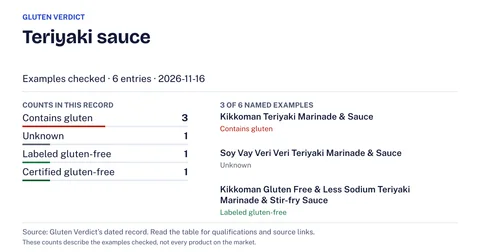 Teriyaki sauceDepends on the product3 of 6 products we checked contain gluten: Kikkoman Teriyaki Marinade & Sauce, Kikkoman Teriyaki Marinade & Stir-fry Sauce – Roasted Garlic, and Kikkoman Teriyaki BBQ Sauce – Originalchecked Nov 16, 2026
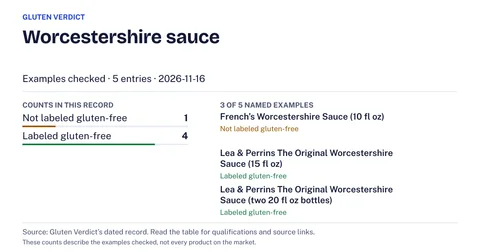 Worcestershire sauceDepends on the productchecked Nov 16, 2026
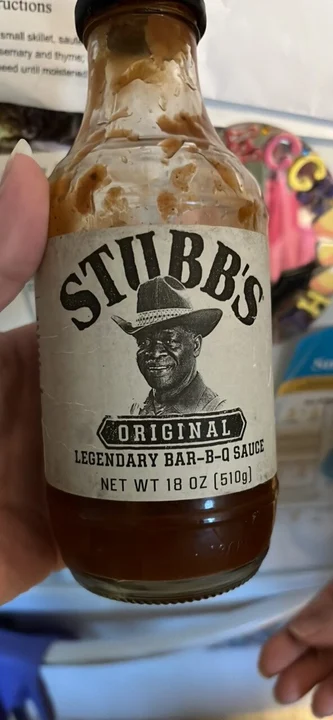 BBQ sauceDepends on the product1 of 6 products we checked contains gluten: Kikkoman Teriyaki BBQ Sauce – Originalchecked Nov 16, 2026
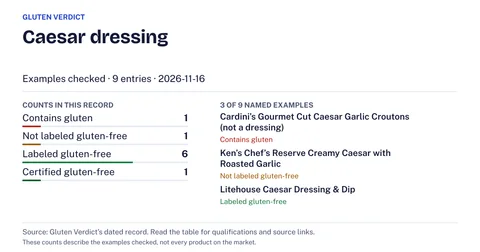 Caesar dressingDepends on the product1 of 9 products we checked contains gluten: Cardini’s Gourmet Cut Caesar Garlic Croutons (not a dressing)checked Nov 16, 2026
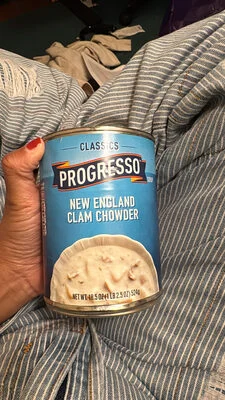 SoupDepends on the product3 of 8 products we checked contain gluten: Campbell’s Condensed Tomato Soup (10.75 oz), Campbell’s Condensed Cream of Mushroom Soup (10.5 oz), and Progresso Traditional Chicken Noodlechecked Nov 16, 2026
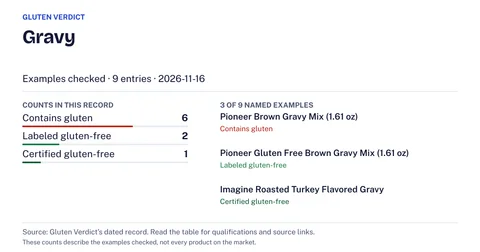 GravyDepends on the product6 of 9 products we checked contain glutenchecked Nov 16, 2026
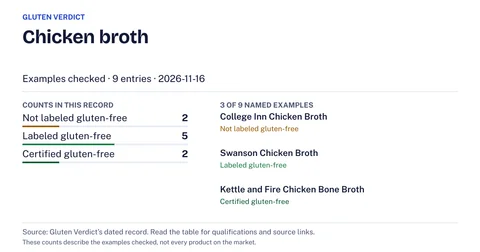 Chicken brothDepends on the productchecked Nov 16, 2026
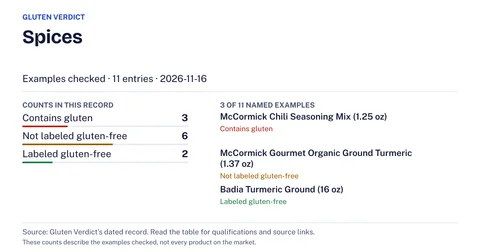 SpicesDepends on the product3 of 11 products we checked contain gluten: McCormick Chili Seasoning Mix (1.25 oz), Lawry’s Chili Spices & Seasonings Mix (1.48 oz), and McCormick Cheesy Taco Seasoning Mix (1.12 oz)checked Nov 16, 2026
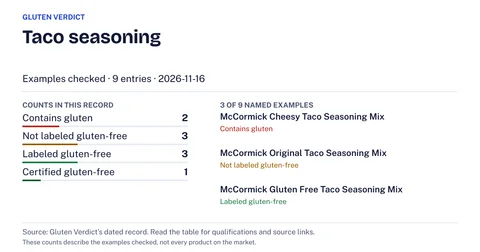 Taco seasoningDepends on the product2 of 9 products we checked contain gluten: McCormick Cheesy Taco Seasoning Mix and Lawry’s Taco Seasoning Mixchecked Nov 16, 2026
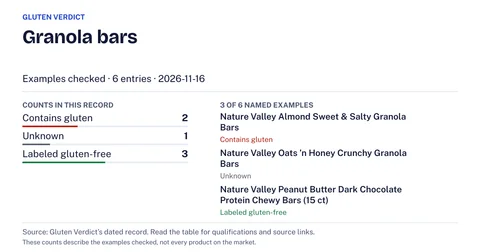 Granola barsDepends on the product2 of 6 products we checked contain gluten: Nature Valley Almond Sweet & Salty Granola Bars and Nature Valley Cinnamon Brown Sugar Soft-baked Oatmeal Squareschecked Nov 16, 2026
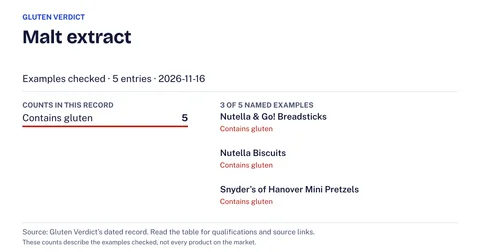 Malt extractContains glutenchecked Nov 16, 2026
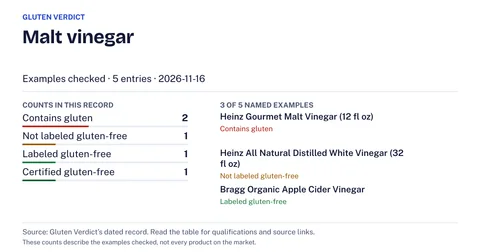 Malt vinegarContains glutenchecked Nov 16, 2026
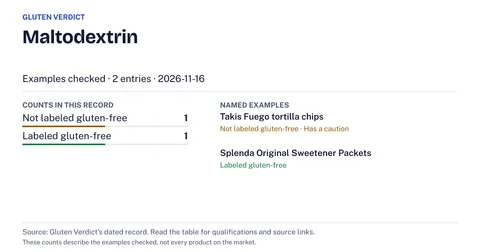 MaltodextrinNaturally gluten-freechecked Nov 16, 2026
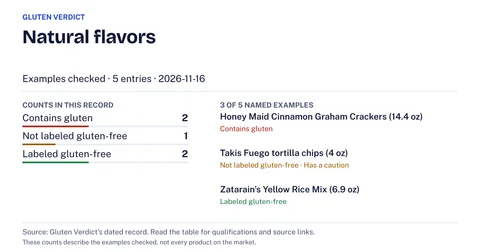 Natural flavorsDepends on the product2 of 5 products we checked contain gluten: Honey Maid Cinnamon Graham Crackers (14.4 oz) and Chex Mix Sour Cream & Onionchecked Nov 16, 2026
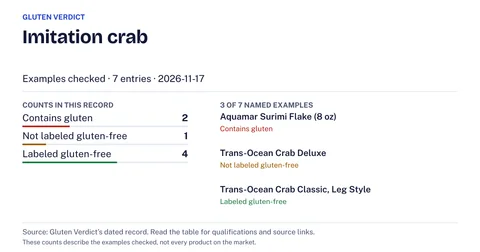 Imitation crabDepends on the product2 of 7 products we checked contain gluten: Aquamar Surimi Flake (8 oz) and Aquamar Surimi Stick (8 oz)checked Nov 17, 2026
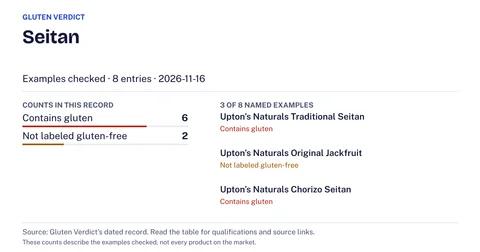 SeitanContains glutenchecked Nov 16, 2026
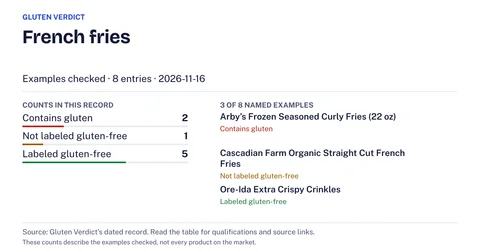 French friesDepends on the product2 of 8 products we checked contain gluten: Arby’s Frozen Seasoned Curly Fries (22 oz) and Checkers Frozen Crispy Seasoned Fries (28 oz)checked Nov 16, 2026
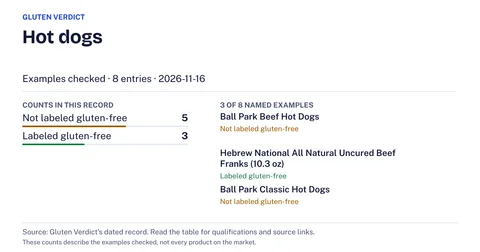 Hot dogsDepends on the productchecked Nov 16, 2026
Questions people ask
Does a Contains line without wheat mean a food has no gluten?
No. Wheat is on FDA’s list of major food allergens; barley and rye are not7, 4. Read the full ingredient list for barley, rye and malt17.
Is maltodextrin made from wheat?
In the US it is usually made from cornstarch, though it may be made from wheat starch50. The National Celiac Association considers it gluten free regardless of the starting material10. Our maltodextrin page shows what we read.
More in Hidden gluten in ingredients, sauces and processed foods
 Wheat, barley and rye on an ingredient list: the names to look forLook up wheat, barley and rye names on a US ingredient list, from durum to malt, and sort each as contains gluten, depends on the maker, or lookalike.
 Foods that contain gluten, aisle by aisle, and the label words that give them awayA store-order map of foods that contain gluten, which depend on the brand, and which need a cross-contact check, with the label words to look for.
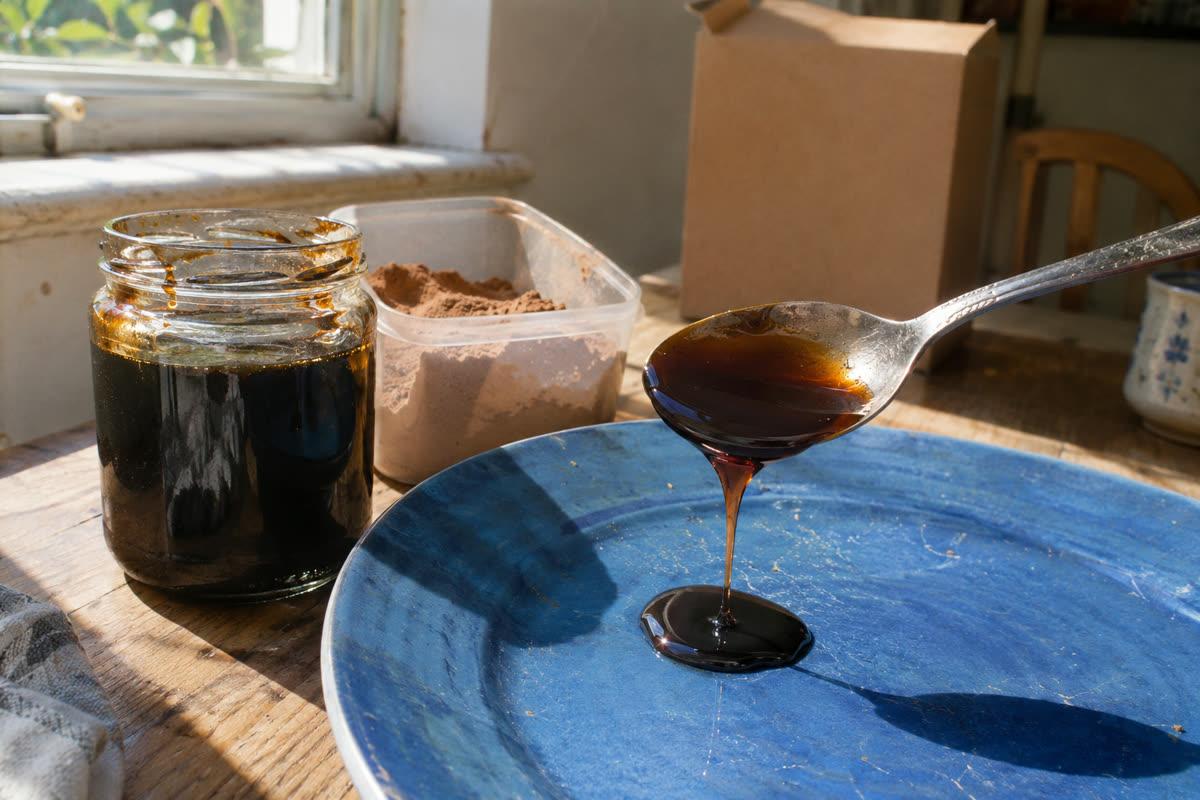 Malt on a food label: which forms are barley and what to checkWhat malt extract, syrup, flavoring and vinegar on a US label mean for gluten, why the Contains line misses barley, and what to check first.
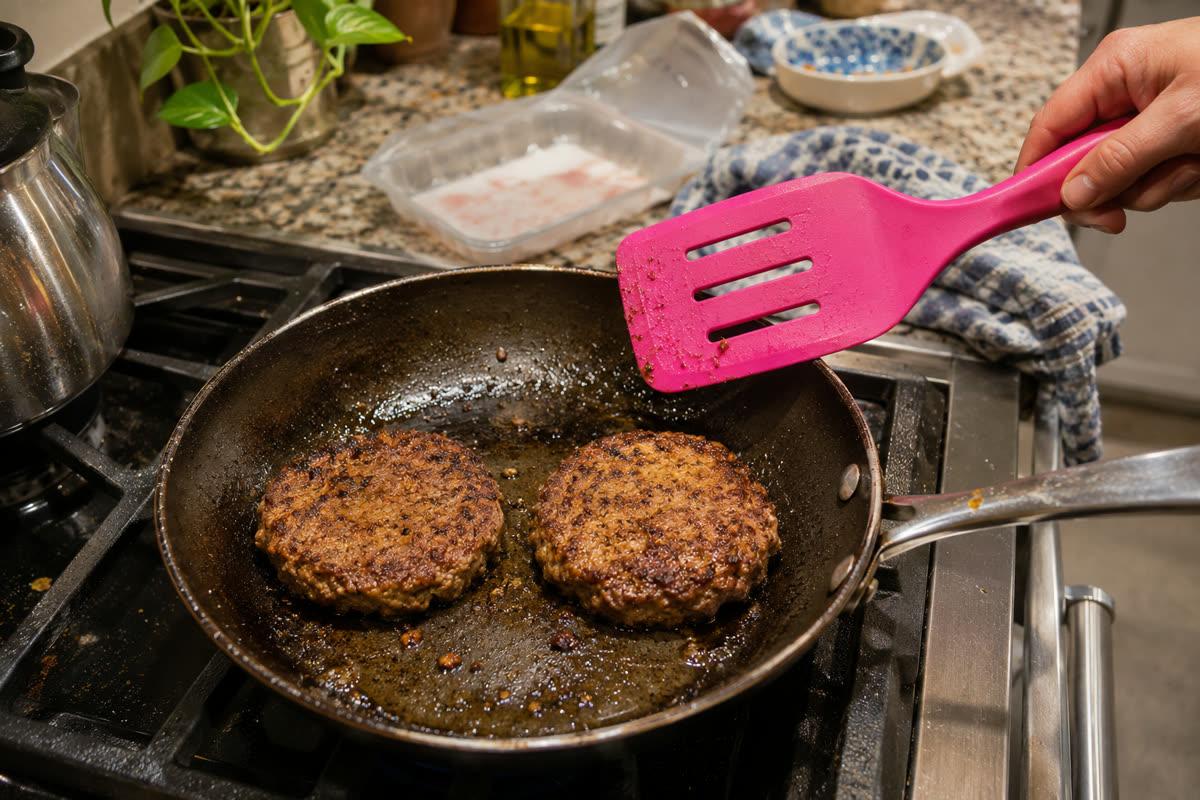 Plant-based meat, tofu and seitan: finding the wheat glutenSeitan and some meat substitutes are made from wheat gluten. How to spot it on a plant-based label, with ingredient lists from maker pages.
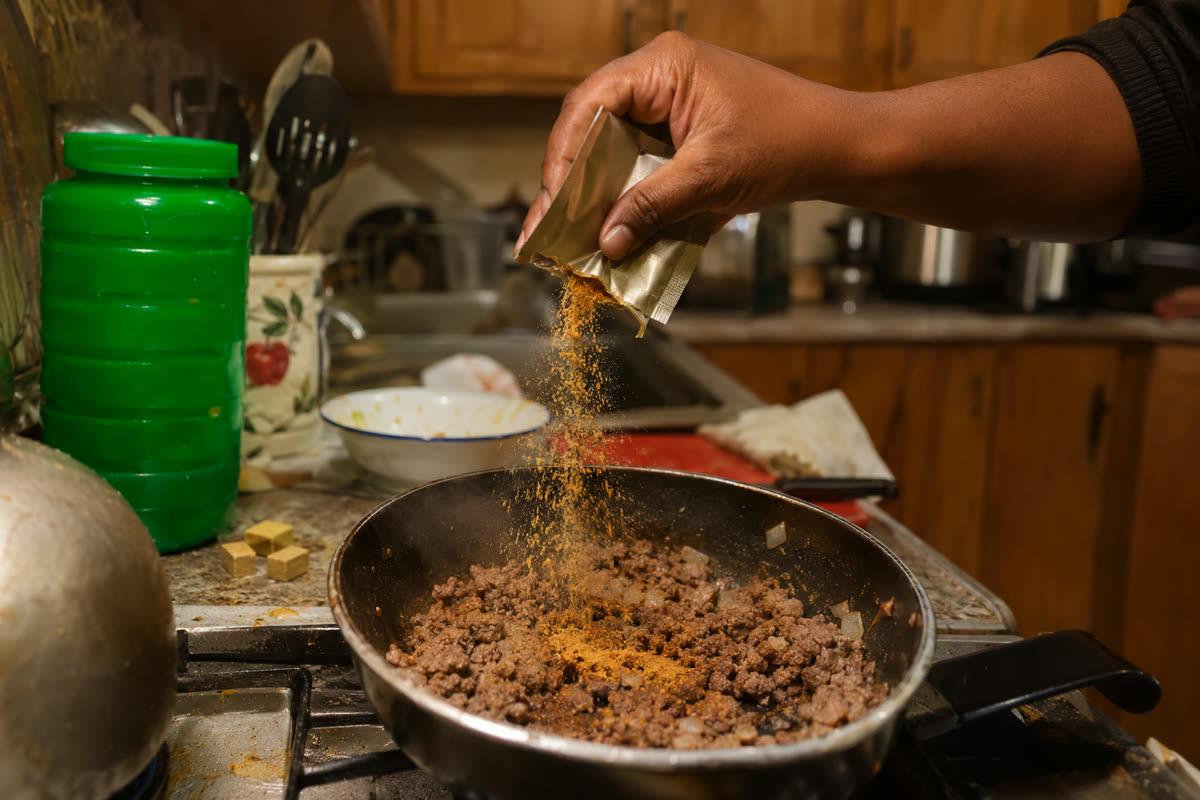 Seasoning packets, bouillon cubes and spice blends: where wheat entersWhy a packet, cube or blend can list wheat flour or barley when a single spice lists one item, and the order to read the label in.
 Natural flavors, caramel color and modified food starch: which can carry glutenWhich additives on a US label can come from a gluten grain, which sources describe as gluten free, and what the maker has to disclose.
All 21 guides in Hidden gluten in ingredients, sauces and processed foods
Related guides
 Hydrolyzed protein, yeast extract and wheat starch on a US food labelWhich grain is behind hydrolyzed protein, yeast extract and wheat starch, what a US label must name, and what to ask the maker.
 How to read a US food label for glutenWhere gluten shows up on a US food label: the gluten-free claim, the Contains line, the ingredient list and may-contain lines, and what each means.
 What “may contain wheat” and “made in a facility with wheat” mean on a US labelHow to read “may contain wheat”, shared-facility and shared-equipment lines on US labels, with and without a gluten-free claim, and what to check next.
 A gluten-free grocery list by aisle for US supermarketsAn aisle-by-aisle gluten-free grocery list for US stores: what needs no label, what needs a check, and what stays off the list.
Sources
- [1, 2, 14, 25, 26, 28, 29, 31, 35, 36, 37, 38, 39, 40, 41, 54, 56, 57] Gluten Intolerance Group, 38 Foods Where Gluten May Be “Hidden”, checked Nov 17, 2026.
- [3, 15, 16] US Food and Drug Administration, Gluten and Food Labeling, checked Nov 17, 2026.
- [4, 6, 22, 48, 52, 53, 55] Gluten Intolerance Group, Advanced Label-Reading Tips, checked Nov 17, 2026.
- [5, 10, 11, 13, 30, 32, 33, 43, 44, 45, 46, 47, 49, 50, 51, 58, 59] National Celiac Association, Confusing Gluten-Free Diet Ingredients, checked Nov 17, 2026.
- [7] US Food and Drug Administration, Frequently Asked Questions: Food Allergen Labeling Guidance for Industry, checked Nov 17, 2026.
- [8, 9, 12, 23, 24, 34] US Food and Drug Administration, Questions and Answers on the Gluten-Free Food Labeling Final Rule, checked Nov 17, 2026.
- [17, 18, 27, 42] NIDDK (NIH), Eating, Diet, & Nutrition for Celiac Disease, checked Nov 17, 2026.
- [19, 21] US Food and Drug Administration, Questions and Answers Regarding Food Allergens, Including the Food Allergen Labeling Requirements (Edition 5), checked Nov 17, 2026.
- [20] US Food and Drug Administration, Food Allergen Labeling and Consumer Protection Act of 2004 (FALCPA), checked Nov 17, 2026.