How to read a US food label for gluten
Short answer
Check four places on the package, in this order:
- A “gluten-free” claim, which on foods FDA regulates means less than 20 parts per million of gluten1.
- The Contains line, where allergen law covers wheat but not barley or rye13, 15.
- The ingredient list, for barley, rye, malt, oats and brewer’s yeast20, 21.
- Any may-contain or shared-facility line, which makers add voluntarily4.
Part of Label reading and gluten-free claims, 17 guides
Key points
- “Gluten-free”, “free of gluten”, “without gluten” and “no gluten” all mean the food has to meet FDA’s rule, including less than 20 ppm of gluten1, 2.
- Allergen labeling covers wheat, not barley or rye, so a Contains line without wheat does not clear a food: read the full ingredient list15.
- Malt in any form is made from barley and is not allowed in a food labeled gluten-free5.
- “Wheat-free” is not “gluten-free”: a wheat-free food can still contain spelt, rye or barley19.
- Meat, poultry and most alcohol labels follow USDA and TTB rules instead of FDA’s gluten-free rule7.
What a “gluten-free” claim promises
On a food FDA regulates, “gluten-free” means three things: no gluten grain as an ingredient; no ingredient made from one, unless it was processed to remove gluten and the food stays under 20 parts per million (ppm); and less than 20 ppm of any gluten the maker could not avoid1.
The rule covers three other phrases too: “free of gluten”, “without gluten” and “no gluten”. A food using any of them has to meet the same requirements2.
Makers do not have to use the claim at all3. FDA notes that makers of foods that are gluten-free by nature, such as fresh fruit, vegetables and seafood, may leave it off11, so a missing claim is not a warning by itself.
“Made with no gluten-containing ingredients” is a different statement. FDA says that unless the label also carries a “gluten-free” claim, you should not assume the food meets the gluten-free rule9.
What the Contains line can and cannot tell you
US allergen law gives a maker two ways to name a major allergen: a line that starts with “Contains”, printed right after or next to the ingredient list13, or the allergen’s source in parentheses after an ingredient’s name in the list, as in “semolina (wheat)”14.
Wheat is on the law’s list of major food allergens; barley and rye are not15. A Contains line that names no wheat therefore says nothing about barley, rye or malt, which can still be in the ingredient list15, 20.
That is why the full list matters every time. Our gluten scanner looks for these names in a photo of the label or in pasted text.
Names in the ingredient list that mean gluten
These names come from the Celiac Disease Foundation’s list of gluten sources and from FDA’s rule. Where we have checked a name, it links to our verdict.
| Name on the label | Why it matters |
|---|---|
| Wheat and its varieties: wheatberries, durum, emmer, semolina, spelt, farina, farro, graham, KAMUT® khorasan wheat, einkorn | All forms of wheat21. A food labeled gluten-free cannot be made with any of them22. |
| Barley, rye and triticale | Gluten grains; triticale is a crossbred hybrid of them. A food labeled gluten-free cannot be made with any of them22. |
| Malt in any form: malt extract, malt syrup, malt flavoring, malted barley flour, malted milk | Listed as a gluten source20. Malt extract and malt syrup are made from barley that has not been processed to remove gluten5. |
| Malt vinegar | Fermented from barley and not processed to remove gluten, so FDA says it cannot be used in a food labeled gluten-free6. |
| Brewer’s yeast | On the Celiac Disease Foundation’s list of gluten sources21. |
| Wheat starch | Allowed in a food labeled gluten-free only when it was processed to remove gluten and the food stays under 20 ppm1; otherwise a gluten source21. |
| Oats | Not a gluten grain under FDA’s rule, but oats labeled gluten-free must still contain less than 20 ppm8. Granola is often made with regular oats rather than gluten-free oats24. |
| Soy sauce | Often brewed from soybeans and wheat; soy sauce made that way may not carry a gluten-free claim10. |
A “wheat-free” label does not settle the question: a wheat-free food can still contain spelt, rye or barley19.
May-contain and shared-facility lines
Lines such as “made in a facility that also processes wheat” are voluntary, and FDA allows one on a food that also says gluten-free, as long as it is truthful and not misleading4.
Neither the line nor its absence decides the question. A food labeled gluten-free still has to meet the 20 ppm limit1, and plain grains, beans and seeds can pick up gluten through crop rotation and shared harvest, transport and storage equipment12.
Meat, eggs and most alcohol follow other agencies’ rules
FDA’s gluten-free rule does not cover foods whose labels USDA or TTB regulate. USDA generally covers meat, poultry and certain egg products, and TTB covers most alcoholic drinks, including all distilled spirits7.
TTB lets an alcohol label say “gluten-free” when the drink would qualify under FDA’s definition16. A drink fermented from gluten grains, such as most beer, may instead say it was processed, treated or crafted to remove gluten, with a qualifying statement17. That wording is not a gluten-free claim.
When the label makes no claim at all
The Celiac Disease Foundation’s advice is to read the label of any food you buy when it does not say gluten-free18.
For the packaged foods we have checked, each verdict shows what the maker’s own pages and ingredient list said, with the date we read them: start at every verdict, A to Z. Recipes change, so the package in your hand has the final word.
Verdicts in this guide
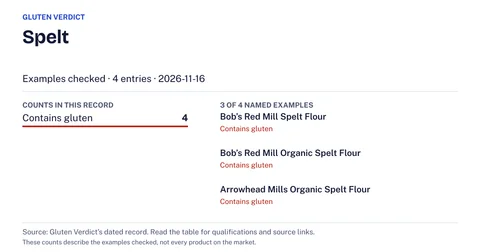 SpeltContains glutenchecked Nov 16, 2026
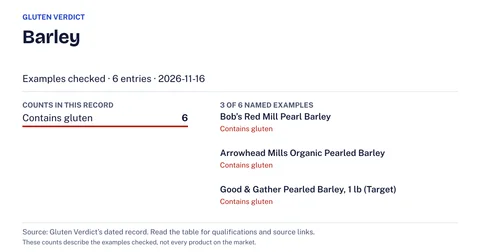 BarleyContains glutenchecked Nov 16, 2026
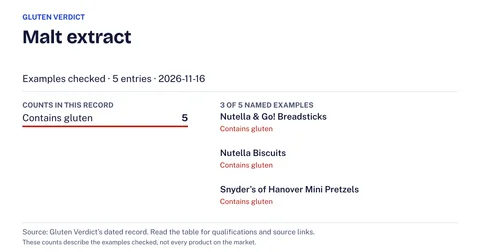 Malt extractContains glutenchecked Nov 16, 2026
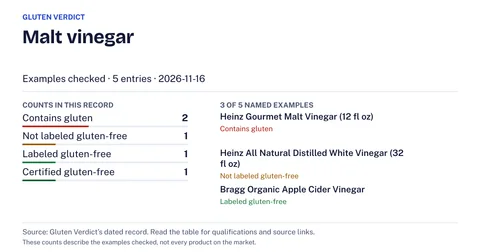 Malt vinegarContains glutenchecked Nov 16, 2026
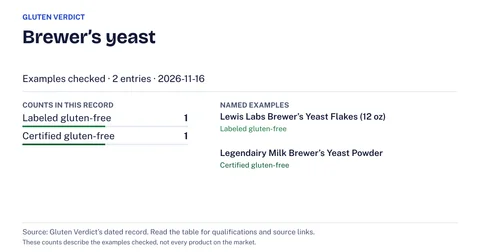 Brewer’s yeastDepends on the productchecked Nov 16, 2026
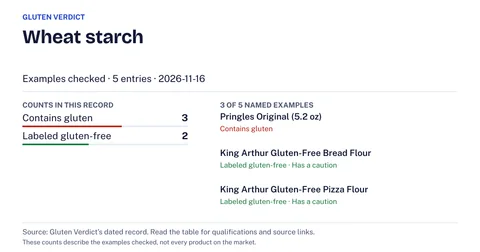 Wheat starchDepends on the product3 of 5 products we checked contain gluten: Pringles Original (5.2 oz), Jiffy Corn Muffin Mix, and Chex Mix Bold Garlic and Herbchecked Nov 16, 2026
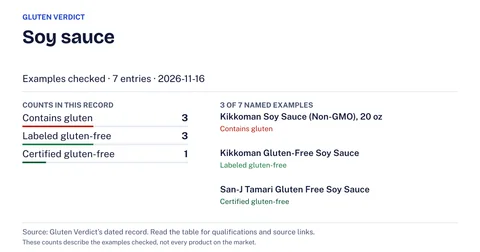 Soy sauceDepends on the product3 of 7 products we checked contain gluten: Kikkoman Soy Sauce (Non-GMO), 20 oz; San-J Organic Shoyu Soy Sauce; and Lee Kum Kee Premium Soy Sauce (No Preservatives Added)checked Nov 16, 2026
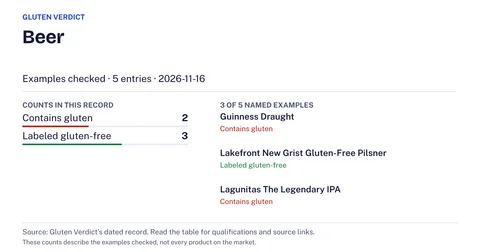 BeerDepends on the product2 of 5 products we checked contain gluten: Guinness Draught and Lagunitas The Legendary IPAchecked Nov 16, 2026
Questions people ask
Does “gluten-free” mean zero gluten?
No. Under FDA’s rule it means less than 20 parts per million1. FDA says it chose that level because tests validated to measure lower levels were not available when the rule was written23.
Can oats be labeled gluten-free?
Yes, when they contain less than 20 ppm of gluten. FDA does not require oats to be certified to carry the claim8.
Is “wheat-free” the same as gluten-free?
No. A wheat-free food can still contain spelt, rye or barley19.
More in Label reading and gluten-free claims
 The Contains line names wheat, not barley or rye: what US allergen labels coverWhat the US allergen Contains line covers, why it names wheat but not barley or rye, and which ingredient-list names stand in for them.
 How to check whether a packaged food is gluten-freeA four-step check for one packaged food: the claim, the ingredient and allergen lines, the maker’s dated page and the certifier’s directory.
 When a gluten-free label looks wrong: what to keep, who to tell, where to lookFound wheat, barley or malt in a food labeled gluten-free? What to keep, whom to tell, which US agency takes the report, and where recalls are listed.
 Fermented, hydrolyzed and distilled foods: how a gluten-free claim is checkedHow FDA’s 2020 rule checks a gluten-free claim on fermented, hydrolyzed and distilled foods, why a test cannot settle it, and where TTB takes over.
 The FDA gluten-free rule: what 21 CFR 101.91 requires and what 20 ppm measuresWhat FDA’s gluten-free rule requires, which claim words it covers, what 20 ppm means for a portion of food, and how FDA checks that a claim holds.
 “Low gluten”, “gluten removed” and “gluten friendly” on a labelWhat “low gluten”, “gluten removed” and “gluten friendly” mean on a US label, which phrases FDA or TTB define, and what to ask the maker.
Related guides
 Wheat, barley and rye on an ingredient list: the names to look forLook up wheat, barley and rye names on a US ingredient list, from durum to malt, and sort each as contains gluten, depends on the maker, or lookalike.
 Malt on a food label: which forms are barley and what to checkWhat malt extract, syrup, flavoring and vinegar on a US label mean for gluten, why the Contains line misses barley, and what to check first.
 A gluten-free grocery list by aisle for US supermarketsAn aisle-by-aisle gluten-free grocery list for US stores: what needs no label, what needs a check, and what stays off the list.
 How to read a supplement label for glutenWhere gluten can hide on a US supplement label: the Supplement Facts panel, the Other Ingredients list and the allergen line, and what each leaves out.
Sources
- [1, 2, 3, 4, 5, 6, 7, 8, 9, 10, 11, 12, 22, 23] US Food and Drug Administration, Questions and Answers on the Gluten-Free Food Labeling Final Rule, checked Nov 17, 2026.
- [13, 14, 15] US Food and Drug Administration, Food Allergen Labeling and Consumer Protection Act of 2004 (FALCPA), checked Nov 17, 2026.
- [16, 17] Alcohol and Tobacco Tax and Trade Bureau (TTB), TTB Ruling 2020-2: Gluten Content Statements in the Labeling and Advertising of Wine, Distilled Spirits, and Malt Beverages, checked Nov 17, 2026.
- [18, 19, 20, 21, 24] Celiac Disease Foundation, Sources of Gluten, checked Nov 17, 2026.
Read on 2026-11-17: the list headed “Gluten-Containing Grains and Their Derivatives” names wheat; varieties and derivatives of wheat (wheatberries, durum, emmer, semolina, spelt, farina, farro, graham, KAMUT® khorasan wheat, einkorn wheat); rye; barley; triticale; malt in various forms; brewer’s yeast; and wheat starch that has not been processed to remove gluten to below 20 ppm.