Buffets, food courts and food trucks with celiac disease: what to ask at each
Short answer
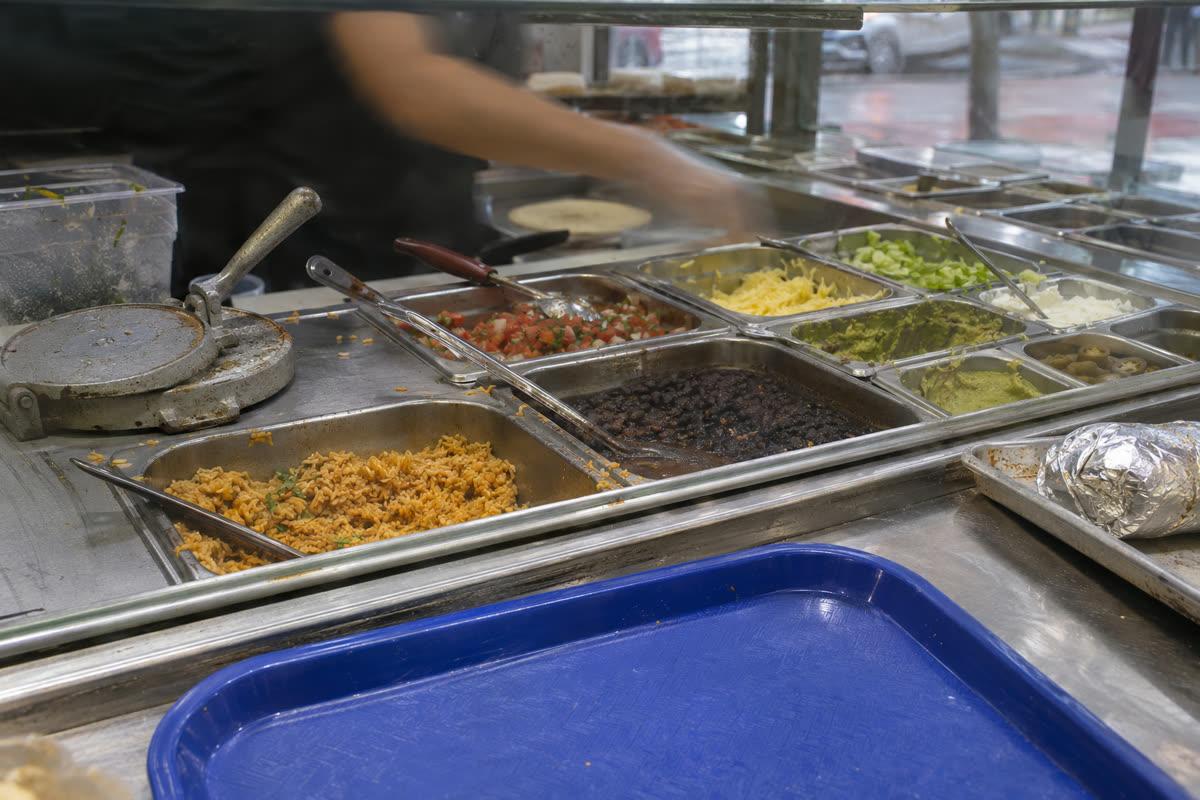
A self-service buffet line carries a risk the Gluten Intolerance Group (GIG) names directly: any buffet-style display of food introduces new opportunities for cross-contact1. Decide each stop this way:
- Self-service line: serving utensils that might be used in both gluten-free and gluten-containing food are the problem1; GIG’s dining hall article suggests asking for your food from the back unless the station is a dedicated gluten-free one2.
- Station where a cook makes your plate: ask about the grill, the pan and the cooking surface before the food goes on3, 4.
- Food truck: ask what is in the dish and what oil it is fried in5, 6; GIG warns that the staff may not know what gluten-free means7. Food-court counter: ask about ingredients and how the food is prepared25.
- Fair or festival stand: a gluten-free sign is only a first step8.
Part of Eating out and chain restaurant policies, 25 guides
Key points
- Shared serving utensils are a named route: GIG lists using the same serving utensil in both types of food among the most common ways gluten crumbs reach gluten-free food9.
- A gluten-free sign at a fair booth is a starting point: GIG says most fair and concession vendors are unable to fully guarantee the gluten-free status of their foods8.
- GIG suggests simplifying the dish, such as a plain baked potato with butter and sour cream, or rice and beans at a Mexican food stand10.
- Timing helps: GIG suggests eating before or after the busiest mealtime11 and visiting a food truck before the meal rush12.
- When no one can tell you what is in a dish, GIG’s suggestions are to move on to another booth13 or to bring your own gluten-free food14.
Why a self-service line is a named cross-contact risk
GIG’s list of ways cross-contact happens names the buffet directly: any buffet-style display of food introduces new opportunities for cross-contact, and even when foods are kept apart, the serving utensils might inadvertently be used in both1. The same list calls the use of one serving utensil in both types of food one of the most common ways gluten crumbs reach gluten-free food9.
Store hot bars work the same way. GIG says prepared foods from a store’s deli, hot bar or salad bar are at risk of cross-contact from the production kitchen to the food bar, and that once the food is on display, spills or swapped utensils can carry gluten into gluten-free items15.
NIDDK defines cross-contact as foods that contain gluten coming into contact with gluten-free foods16, and says it can happen when food is prepared or served17. On a buffet line, watch the serving step.
A food that is gluten-free by nature does not settle the question on a buffet line. Whether it picked up gluten depends on what touched it, and the spoon is the first thing to look at1, 16.
If you eat at a buffet anyway
We found no source that says a buffet line can be made workable by one step. What follows is what GIG advises for restaurants and gatherings, applied to a buffet; where a step is our adaptation, the source named is the closest one.
- Call ahead and speak to the chef about your meal options. GIG suggests calling the day before or earlier the same day18.
- Go before or after the busiest mealtime, when staff have more time and are easier to reach11.
- Ask whether your plate can be made up away from the line. GIG’s dining hall article says that unless it is a dedicated gluten-free station, cross-contact is always a risk, and that you may need to ask for your food from the back2.
- If you doubt an ingredient, ask to see the package. GIG says most eating establishments can accommodate the request19.
- At a catered buffet, ask the person placing the order about shared fryers and shared equipment, which GIG calls the most common places for hidden gluten20.
- Say no thank you to a dish you cannot confirm. GIG’s holiday-party article says it is always acceptable21.
If nothing on the line can be confirmed, eat first and bring something of your own; the last section covers that.
Made-to-order stations and carving lines
At a station where a cook prepares your plate, the questions move from the spoon to the cooking surface. GIG’s restaurant questions apply: is the grill used for gluten-free food separate from or shared with gluten foods, how is a shared grill cleaned and how often, and can the meal be cooked in a separate pan3.
GIG also suggests asking for a clean surface and clean utensils, finding out whether breaded or gluten-containing foods were cooked on the same surface beforehand, and suggesting foil over the cooking surface4. When the plate arrives, GIG suggests double-checking with the server that it is what you ordered22.
On a carving line the meat may not be the issue. GIG’s restaurant bulletin notes that if prime rib is too rare for a diner’s taste, the cook may “cook” it in a pot of au jus, which could come from a can or mix and might contain hydrolyzed wheat protein23. Ask what is in the jus before it goes on your plate.
Food courts: counter by counter
Treat each counter as its own restaurant: ask at the one you choose, not about the court as a whole.
GIG’s closest comment is about fast food: fast food establishments are less likely to be able to make appropriate adjustments, and cross-contact could be an issue24. Going before or after the lunch rush gives staff more time11.
At the counter, NIDDK’s advice for restaurants is to tell the server you have celiac disease and ask about ingredients, how the food is prepared and whether a gluten-free menu is available25.
A gluten-free claim on a menu board is where the questions start, not where they stop. FDA says restaurants’ use of gluten-free labeling should be consistent with its federal definition26, and that state and local governments play an important role in overseeing restaurants27.
GIG calls the best approach to feeling more confident about a place choosing a restaurant that has gone through its Gluten-Free Food Services (GFFS) validation program28; look for that before you leave home. For chains, start with our guide on eating out with celiac disease, and see where gluten hides in a restaurant kitchen for the question behind each risk. Our restaurants section is where to look for a chain’s own allergen information.
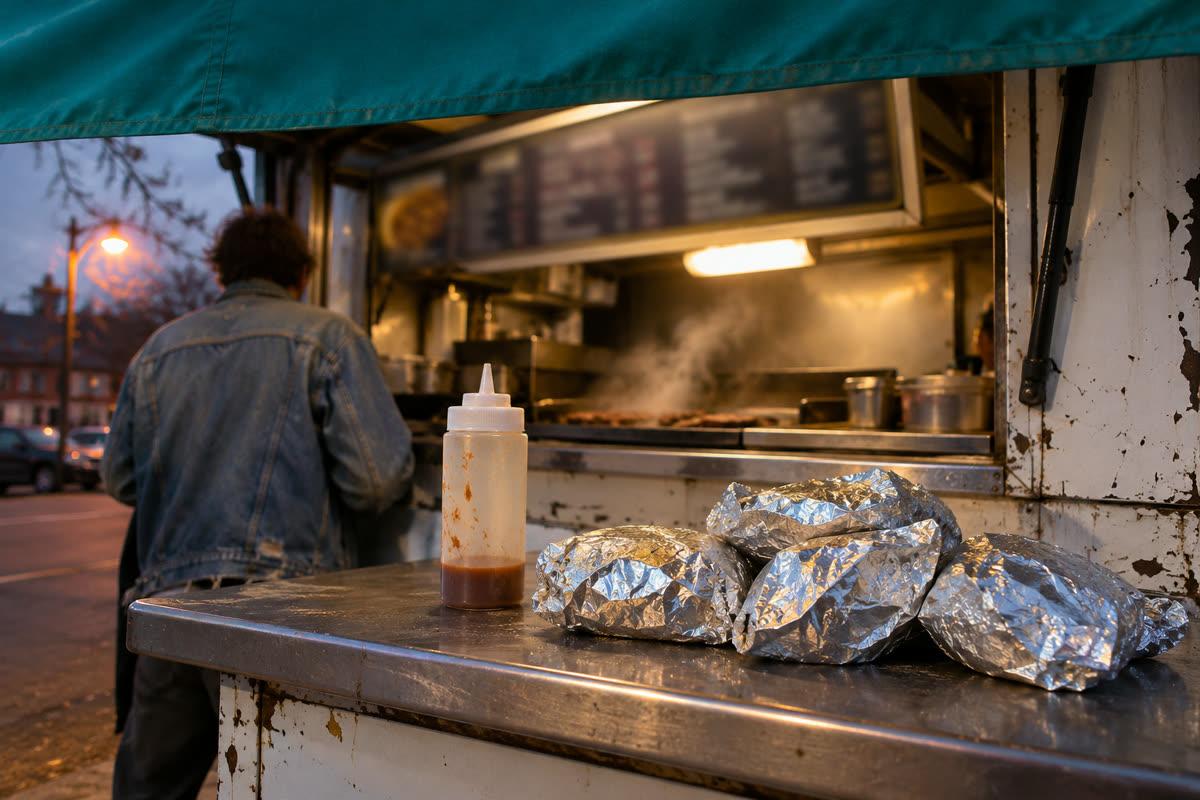
Food trucks: small kitchens, short menus
GIG lists three things to keep in mind about a food truck: the staff may not know what gluten-free means, may know it but not the cross-contact risks, or may not be able to avoid cross-contact because of the small size of the kitchen7.
The questions GIG suggests start with flour and sauces: does the dish contain flour, and if so wheat flour. GIG adds that many people do not know soy sauce usually contains gluten, and that gluten could also be in teriyaki sauce5. Then ask whether it is made from scratch or from a package, whether you can see the packaging, and whether the same oil fries gluten-free and gluten-containing food6.
The kind of truck matters. GIG says the risk of crumbs on a hot dog or burger truck is high unless only gluten-free buns are used, and that a doughnut or cupcake truck is more likely a haven for gluten than a flavored ice or ice cream truck, if you can check the flavors and toppings29.
The fryer question
GIG’s restaurant bulletin says the oil used to deep-fry foods may be used for both breaded and non-breaded items, in which case it advises avoiding them30. One 2026 study (Weisbrod and colleagues, in Nutrients) tested 98 samples of French fries and tortilla chips from US food service establishments, all fried in fryers shared with gluten-containing foods31. Six exceeded 20 ppm32. Samples from establishments reporting daily oil changes all measured below 20 ppm, while samples from establishments reporting weekly oil changes gave higher and more variable results33. The abstract names fast food, fast casual, casual dining, fine dining, cafés and “other food service settings”, not food trucks, so read it as a reason to ask how often the oil is changed, not as a finding about any truck.
The line
GIG notes that a busy truck may leave no time for your questions, and suggests contacting the truck in advance through its website or social pages, or visiting before the meal rush12.
Festivals and fairs
Booths at a festival are often separate businesses. GIG says most food vendors at these events operate independently and rent space for a booth or stand, and may be less experienced with gluten-free preparation34. Sometimes food is prepared elsewhere and brought to the stand, so neither you nor the vendor staff may know how it was made35.
Check before you go: GIG says some fairs publish a food guide, in print or online36.
A sign is a start. GIG says most fair and concession vendors are unable to fully guarantee the gluten-free status of their foods, and that seeing a gluten-free sign is only a first step8. Even for booths that state they provide gluten-free food, GIG says it is still important to ask questions to confirm37.
Ask how toppings and add-ons are stored and served, so a utensil that dug into gluten-containing food is not used straight afterward on gluten-free food38. Modifications are easier to get before the lunch or dinner rush39, and lines are long, so keep the questions quick40. GIG’s short list is to ask whether there is anything gluten-free, whether there is a gluten-free option for the dish, and whether one item can be substituted for another to make it gluten-free41.
GIG says burgers and hot dogs might not be okay even without the bun, because of potential cross-contact, and for a fried taco suggests finding out what else is fried in the same oil42.
What to order when the line is not workable
The fallback is plain food you can ask about. GIG’s examples are a plain baked potato with butter and sour cream, or rice and beans at a Mexican food stand10. Our verdicts for these foods show what packaged versions list; a tray or a stand has no label, so the cook’s answer takes its place.
| Item | What to ask, and why | Our verdict |
|---|---|---|
| Soup | Ask whether it has a roux or flour thickener. GIG says roux is flour and fat cooked together to thicken soups, and the flour is often wheat flour43; soup bases may be made with roux44. | Soup |
| Gravy | Ask whether it contains flour or roux43, and whether it is made in-house. | Gravy |
| Mashed potatoes | NIDDK lists potatoes among naturally gluten-free foods “without additives or some seasonings”45. Ask what goes into the mash and what goes on top. | Mashed potatoes |
| Rice | Plain or steamed rice cooked in water is a good choice per GIG; some pilafs and seasoned rice have added gluten-containing ingredients46. | Rice |
| Chicken | Ask what it is marinated or seasoned with47, and whether the oil is shared with breaded items30. | Chicken |
| Coleslaw and potato salad | The dressing is the question: NIDDK lists salad dressing among the foods where gluten may be found48. | Coleslaw, potato salad |
| Salad bar toppings | GIG says croutons and some salad dressings can bring gluten, and cutting boards can pass it on49. | (none) |
Questions to ask at each stop
| Venue | Ask |
|---|---|
| Buffet or catered line | May I see a gluten-free menu or allergen list50? Can I see the package for this ingredient19? Are these items cooked in a shared fryer or on shared equipment20? Can my plate come from the back2? |
| Station or grill | Is the grill separate or shared, and if shared how is it cleaned and how often? Can my meal be cooked in a separate pan3? Is there a dedicated fryer51? |
| Counter | Tell the server you have celiac disease, then ask about ingredients, how the food is prepared, and whether a gluten-free menu is available25. |
| Food truck | Does the dish contain flour, and is it wheat flour5? Is it made from scratch or from a package, can I see the packaging, and is the same oil used for gluten-free and gluten-containing food6? |
| Fair or festival booth | Do you have anything that is gluten-free? Is there a gluten-free option for that? Could I substitute one item for another to make it gluten-free41? |
When to eat first and bring something
NIDDK says that when attending a social gathering you should let the host know you have celiac disease and find out if gluten-free foods will be available52. GIG says that at an event where you do not know the host well, you may wish to bring your own gluten-free food14, and for a fair suggests packing packaged gluten-free snacks that hold up in a bag or pocket53.
When in doubt, GIG’s fair article says to move on to another booth13, and its holiday article says it is always acceptable to say no thank you21.
These are charity and NIH suggestions, not a promise about any venue. GIG’s food truck article says the information on its website is for educational purposes only and to consult your healthcare team54.
Verdicts in this guide
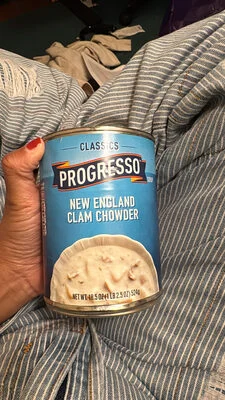 SoupDepends on the product3 of 8 products we checked contain gluten: Campbell’s Condensed Tomato Soup (10.75 oz), Campbell’s Condensed Cream of Mushroom Soup (10.5 oz), and Progresso Traditional Chicken Noodlechecked Nov 16, 2026
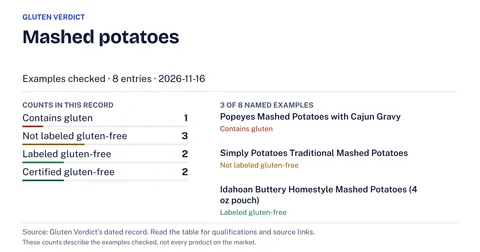 Mashed potatoesDepends on the product1 of 8 products we checked contains gluten: Popeyes Mashed Potatoes with Cajun Gravychecked Nov 16, 2026
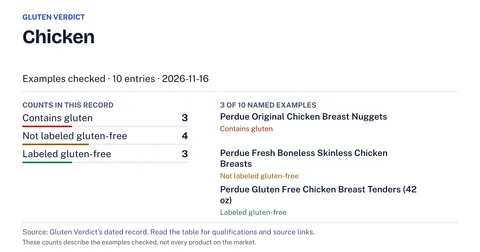 ChickenNaturally gluten-free3 of 10 products we checked contain gluten: Perdue Original Chicken Breast Nuggets, Bell & Evans Breaded Chicken Tenders, and Foster Farms Chicken Nuggets (33.6 oz)checked Nov 16, 2026
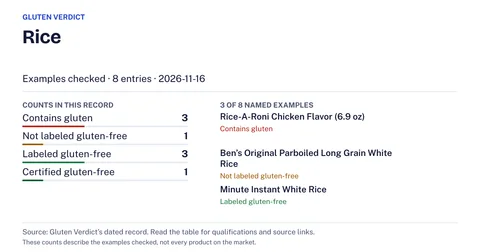 RiceNaturally gluten-free3 of 8 products we checked contain gluten: Rice-A-Roni Chicken Flavor (6.9 oz), Near East Original Rice Pilaf, and Ben’s Original Ready Rice Rice PilafBuy it labeled gluten-freechecked Nov 16, 2026
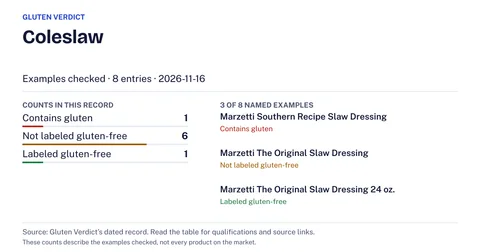 ColeslawDepends on the product1 of 8 products we checked contains gluten: Marzetti Southern Recipe Slaw Dressingchecked Nov 16, 2026
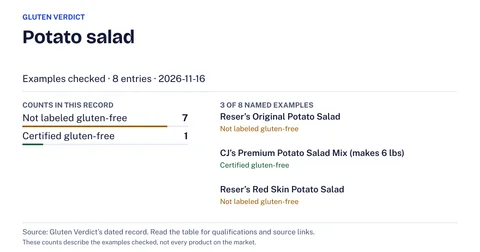 Potato saladDepends on the productchecked Nov 16, 2026
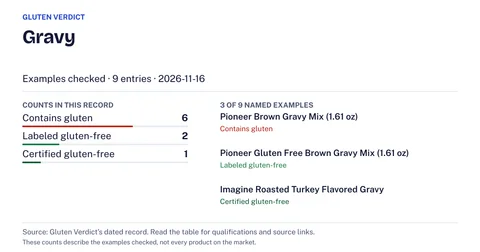 GravyDepends on the product6 of 9 products we checked contain glutenchecked Nov 16, 2026
Questions people ask
Is a buffet item that is gluten-free by nature fine to eat?
Not by that fact alone. GIG says serving utensils at a buffet-style display might be used in both gluten-free and gluten-containing food1, and NIDDK says cross-contact can occur when food is prepared or served17.
Does a gluten-free sign at a stand mean the food meets FDA’s definition?
Not necessarily. FDA says restaurants’ use of gluten-free labeling should be consistent with the federal definition26, and that state and local governments play an important role in overseeing restaurants27. GIG says most fair and concession vendors are unable to fully guarantee the gluten-free status of their foods, and that a sign is only a first step8.
Is a shared fryer always a problem?
One 2026 observational study of French fries and tortilla chips from US food service establishments found six of 98 samples fried in shared fryers above 20 ppm31, 32, and its authors concluded that shared fryers were not uniformly associated with meaningful gluten cross-contact55. Samples from establishments reporting daily oil changes all measured below 20 ppm33. GIG still lists the oil as a question to ask6.
What if the food truck line is too long to ask questions?
GIG suggests contacting the truck in advance through its website or social pages, or visiting before the meal rush so the staff can answer without distraction12.
More in Eating out and chain restaurant policies
 Ordering steak and burgers with celiac disease: marinades, sides, fryers and bunsWhat to ask about marinades, seasoning, butters, grills, fryers, sides and buns when you order steak or a burger with celiac disease.
 Where gluten hides in a restaurant kitchen, and the question to ask about each sourceFryers, sauces, roux, marinades, grills, pasta water and eggs: how gluten reaches restaurant food and the question GIG lists for each source.
 Sandwich and sub chains and gluten: what Subway, Panera, Jersey Mike’s and others say in writingWhat Subway, Jersey Mike’s, Jimmy John’s, Firehouse, Potbelly and Panera say in their own documents about gluten-free bread, shared equipment and dates.
 Ordering at an Indian restaurant: where wheat enters the menuWhere wheat enters an Indian menu (naan, hing, thickeners, samosas, the fryer and the tandoor) and the questions to ask before you order.
 What Chipotle, Moe’s and Taco Bell say about gluten, fryers and tortillasWhat Chipotle, Moe’s and Taco Bell say on their own pages about flour tortillas, fryers, gloves and shared kitchens, with the date we read each.
 Casual-dining chains and gluten: what nine chains’ own allergen documents sayWhat Olive Garden, Outback, Applebee’s, Texas Roadhouse, Red Lobster, Chili’s and others say in writing about fryers, gluten menus and cross-contact.
Related guides
 Eating out with celiac disease: what to check, ask and watch forPlan a restaurant meal with celiac disease: what to check before you go, the questions to ask in order, how to read the answers, and what studies measured.
 When a restaurant gets your gluten-free order wrong or says no: what to do at the table and afterwardWhat to check on the plate, how to ask for a remake, when to leave, and who to report a restaurant gluten mistake to: manager, chain, health department.
 Gluten-free at a holiday dinner, potluck or cookout as a guestHow a guest with celiac disease can message the host, bring a dish, serve first at a buffet and decide when to eat only their own food.
 Eating at a wedding with celiac disease: what to write, who to call and what to askA wedding guest with celiac disease: the RSVP line, the caterer call, the questions to ask and when to rely on your own food.
Sources
- [1, 9, 14, 19] Gluten Intolerance Group, 25 Ways Cross-Contact Could Happen (And How to Avoid It), checked Nov 17, 2026.
- [2] Gluten Intolerance Group, Dorms, Dining Halls, and Gluten-Free Living, checked Nov 17, 2026.
- [3, 43, 47, 50, 51] Gluten Intolerance Group, What are some of the most important questions to ask the wait staff or management of a food service or restaurant?, checked Nov 17, 2026.
- [4, 11, 18, 22, 23, 24, 28, 30, 44, 46, 49] Gluten Intolerance Group, Eating Out: 7 Tips For Staying Gluten-Free, checked Nov 17, 2026.
- [5, 6, 7, 10, 12, 29, 34, 35, 54] Gluten Intolerance Group, Food Truck, Festivals, and Gluten-Free Food Fun, checked Nov 17, 2026.
- [8, 13, 36, 37, 38, 39, 40, 41, 42, 53] Gluten Intolerance Group, The Search for Gluten-Free Fair Food, checked Nov 17, 2026.
- [15] Gluten Intolerance Group, 7 Tips for Avoiding Gluten Cross-Contact at Home, checked Nov 17, 2026.
- [16, 17, 25, 45, 48, 52] NIDDK (National Institutes of Health), Eating, Diet, & Nutrition for Celiac Disease, checked Nov 17, 2026.
- [20, 21] Gluten Intolerance Group, Taking The Stress Out Of The Holiday Buffets & Parties, checked Nov 17, 2026.
- [26, 27] US Food and Drug Administration, Gluten and Food Labeling, checked Nov 17, 2026.
- [31, 32, 33, 55] PubMed (NCBI), Shared Fryers May Not Always Be as Risky for Gluten Cross-Contact in Celiac Disease as Dietary Guidance Suggests (Weisbrod and colleagues, Nutrients 2026; PMID 42943004), checked Nov 17, 2026.