Eating out with celiac disease: what to check, ask and watch for
Short answer
Cross-contact can happen while food is prepared or served1, so a menu line is only the start. Work through three checks:
- Before you go: look for a gluten-free menu online, and review menus or call ahead2, 3.
- At the table: tell the server you have celiac disease, ask how the food is prepared, and ask to talk with the chef if you want more detail4.
- When the answers come back: GIG lists confirmation that gluten-free foods share cooking oil or grill space with heavily breaded items among its red flags for eating elsewhere5, 6, and says to double-check with your server that what you were served is the meal you ordered7.
Part of Eating out and chain restaurant policies, 25 guides

Key points
- FDA’s regulation applies to packaged foods. For a gluten-free claim on a restaurant menu, FDA recommends consistency with its definition, which is less than 20 parts per million of gluten8, 9.
- NIDDK says cross-contact can occur when food is prepared or served1. GIG’s question lists ask about fryers, grills, pans and seasonings10, 11, 12, 33.
- A 2019 study of crowd-sourced tests found gluten in 32% of gluten-free labeled restaurant foods tested. The authors note the device may detect levels below 20 ppm, with unknown clinical significance13, 14.
- A 2026 study of 98 shared-fryer samples found six above 20 ppm. All samples from establishments reporting daily oil changes measured below 20 ppm15, 16, 62.
- Chains word their kitchens differently: Buffalo Wild Wings says it does not use separate fryers, while P.F. Chang’s describes a designated gluten-free cooking area17, 18.
Before you go: the menu, the chain’s allergen page and a phone call
NIDDK’s advice for eating out starts before you leave: search online for restaurants that offer a gluten-free menu2, then review menus online or call ahead3.
GIG suggests calling the day before or earlier the same day and speaking to the chef19. Its FAQ suggests calling when the establishment may be less busy, and asking how gluten-free items are prepared and what procedures are in place to avoid cross-contact20. Coeliac UK, the UK charity, gives the same steer: call ahead and ask to speak to a manager or a chef21.
GIG’s bulletin also suggests timing the meal before or after the busiest mealtime, so you have more time and easier access to the people who can help22.
Reading a chain’s allergen page
A chain’s allergen chart and its notes on how the kitchen works are two different things. Chipotle’s chart carries a note that individual foods may come into contact with one another during preparation, which the chart does not reflect23. Buffalo Wild Wings writes that it cannot eliminate the risk of cross-contact or guarantee that any item is free of an allergen, and that no items are certified gluten-free24.
Each chain further down links to our verdict, which lists the pages we read and the date. Read the chart and the preparation note together.
What “gluten-free” on a restaurant menu does and does not mean
FDA’s gluten-free rule says a food labeled gluten-free must contain less than 20 parts per million of gluten9. Whether a restaurant menu has to follow it is a separate matter: FDA says the regulation applies to packaged foods, which may be sold in some retail and food-service establishments such as some carry-out restaurants8.
For a gluten-free claim on a restaurant menu, FDA words it as a recommendation: restaurants making the claim should be consistent with its definition8. FDA says state and local governments play an important role in oversight of restaurants25, and that it shares complaints about unpackaged foods, such as those served in restaurants, with those partners26.
Whether a kitchen’s practices match a claim is a separate question. A 2017 survey of 90 chefs and cooks in Dunedin, New Zealand, found that half of the chefs and cooks had received no formal training27, 28, 66. Its authors concluded that awareness of coeliac disease did not necessarily mean policies were in place to prepare contamination-free gluten-free meals29.
Where gluten can get into an order
NIDDK defines cross-contact as foods that contain gluten coming into contact with gluten-free foods30. In a restaurant kitchen, the charities’ question lists point to the same handful of places.
| Where | What the charity says or asks |
|---|---|
| Fryer oil | GIG says the oil used to deep-fry foods may be used for both breaded and non-breaded items31. It asks whether french fries are cooked in a dedicated fryer or share oil with breaded items10. |
| Pasta water | GIG asks whether gluten-free pasta is boiled in fresh water or in the same water used for regular pasta32. |
| Grill, flat-top and pans | GIG asks whether the item is cooked on a clean section of the grill or flat-top, separate from breaded foods11, and whether the meal can be cooked in a separate pan33. Its bulletin says to find out whether breaded or gluten-containing foods were cooked on the same surface beforehand34. |
| Sauces, marinades and seasonings | GIG says dressings, sauces and marinades may contain added gluten as a thickener or binding agent35, and asks whether the seasoning blend on a dish is gluten-free12. |
| Soups | GIG says soup bases may be made with roux, a combination of butter and flour36. It adds that the flour in a roux is often wheat flour37. |
| Salads | GIG says cross-contact can happen on cutting boards used to chop ingredients, and through croutons or salad dressings containing gluten38. |
| Rice and sides | GIG says some rice pilafs and seasoned rice may have added gluten-containing ingredients39. |
What the studies measured at some of these places is in the research section below.
The questions to ask, in the order to ask them
These come from NIDDK, GIG and Coeliac UK. The order is ours: it moves from who you are talking to, to what is on the menu, to how it is cooked, to the plate in front of you.
- Say what you need. NIDDK says to tell the server you have celiac disease, then ask about ingredients, how the food is prepared and whether a gluten-free menu is available4. GIG adds that busy servers respond best to short, direct explanations40.
- Ask for the menu. GIG’s first question is whether there is an allergen or dedicated gluten-free menu41.
- Ask who can answer. GIG suggests asking who the best person would be to speak with directly about how the food is prepared42, and NIDDK says to ask to talk with the chef4. If the server does not know, GIG says it is fine to ask them to double-check with the kitchen43.
- Ask about the fryer. GIG asks whether there is a dedicated fryer for gluten-free foods44, and Coeliac UK says to double check that the fryer and utensils are specifically used for gluten free options45.
- Ask about the grill, pan and utensils. GIG asks whether the grill used for gluten-free foods is separate or shared and, if shared, how it is cleaned and how often46, and whether the kitchen can use clean utensils and a freshly sanitized surface47.
- Ask about sauces and seasonings. GIG asks whether the dish contains flour or roux37 and whether the seasoning blend is gluten-free12.
- Check the plate. GIG says to double-check with the server that what you were served is the special meal you ordered, and to confirm that your instructions were followed7. Coeliac UK also says to confirm your order before eating48.
Reading the answers: what the charities list as reasons to eat elsewhere
GIG’s list of red flags, from its 2026 article on questions to ask when eating out, which is written for parents and carers of a gluten-free child or dependent65:
- Staff members saying “A little bit of gluten won’t hurt, right?”49
- Kitchen staff refusing or hesitating to check ingredient labels on packaged sauces or mixes50
- Confirmation that gluten-free foods share cooking oil or grill space with heavily breaded items6
GIG’s advice if you hear or see any of these is to consider eating elsewhere, or to stick strictly to pre-packaged, pre-verified items5. Its FAQ says to make an informed decision about your comfort level with dining in an establishment once you have the answers to your questions51. This guide does not score the answers; that decision is yours.
The kind of place also comes up. GIG’s bulletin says fast food, quick-service restaurants and those with a standard menu may have little time to thoroughly check ingredients52, and that finer dining establishments offer a less-hurried atmosphere and usually have more time53. That is the charity’s general observation, not a statement about any one restaurant.
Where wheat is an ingredient, not just a contact risk
Some menu items carry wheat as an ingredient, so no question about the fryer will change them. GIG lists couscous and bulgur among the forms of wheat54, and the National Celiac Association says couscous is made from semolina, which comes from durum wheat55. GIG says soy sauce is traditionally made with fermented crushed wheat and soy56.
Our verdicts cover foods that come up on Middle Eastern, Greek and Japanese menus: bulgur, couscous, pita, falafel, gyro meat, soy sauce and sushi. Each lists the sources we read and the date.
Where three chains’ own words stand
| Chain | What its own page says | Our verdict |
|---|---|---|
| Chipotle | Its allergens page says that if you avoid gluten, don’t eat the flour tortillas, and, for people who are highly sensitive to gluten, offers to change gloves if you ask at the start of your order57. It also says items containing corn may have trace amounts of gluten from co-mingling with gluten-containing grains in the field58. | Chipotle |
| P.F. Chang’s | Its nutrition page describes a designated gluten-free cooking area with gluten-free woks and cooking utensils, and says many restaurants use designated gluten-free plates18. | P.F. Chang’s |
| Buffalo Wild Wings | Its allergen guide says it does not use separate fryers, so there is potential for gluten cross-contact between fried foods17, and that no items are certified gluten-free24. | Buffalo Wild Wings |
These are the chains’ statements, not our findings. We have also read the pages of Panera, Five Guys, Wendy’s, Chili’s, The Cheesecake Factory and TGI Fridays; each verdict lists the pages we read and the date. All chains are listed under restaurants.
What the research on restaurant food measured
The 2019 crowd-sourced sensor study
Lerner and colleagues analyzed data from a portable gluten detection device, Nima, collected across the United States over 18 months from users who opted to share their test results59. There were 5,624 tests by 804 users, and gluten was detected in 32% of the foods labeled gluten-free13. Pizza (53.2%) and pasta (50.8%) were most likely to test positive60.
What it did not measure: the authors note that the device may detect gluten at levels below 20 parts per million, leading to exposure of unknown clinical significance14. Because the tests came from users who chose to share them59, the figures describe those tests, not every restaurant meal.
The 2026 shared-fryer study
Weisbrod and colleagues analyzed 98 samples of French fries (55) and tortilla chips (43) from fast food, fast casual, casual dining, fine dining, café and other food service settings across several US states61. Six samples (6.1%) exceeded 20 ppm15. All samples from establishments reporting daily oil changes measured below 20 ppm, while those reporting weekly oil changes were higher and more variable16. The authors concluded that shared fryers were not uniformly associated with meaningful gluten cross-contact62.
That sits beside GIG’s bulletin, which says oil used for both breaded and non-breaded items is a reason to avoid fried foods31. The study covers fries and chips, not other fried foods, and the oil-change frequencies are the ones the establishments reported.
A 2026 scoping review
A scoping review of real-life contamination data included 59 studies from 1993 to 2024 in 28 countries and 27,806 food samples63. It reported that restaurant meals demonstrated the greatest inconsistency64.
These are measurements of food samples. This guide does not rank restaurants, and the study summaries above name none.
Verdicts in this guide
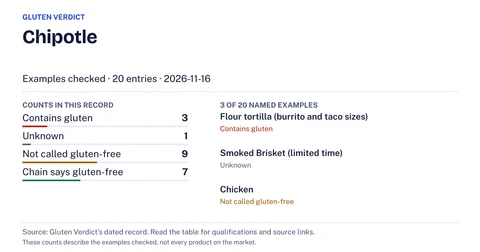 ChipotleDepends on the order3 of 20 menu items we checked contain gluten: Flour tortilla (burrito and taco sizes), Burrito, and QuesadillaChipotle Mexican Grill · checked Nov 16, 2026
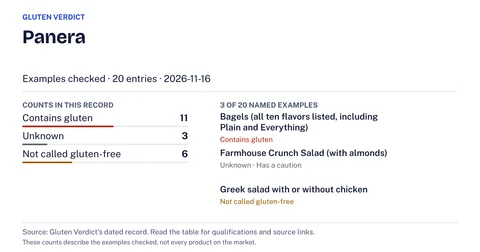 PaneraDepends on the order11 of 20 menu items we checked contain glutenPanera Bread · checked Nov 16, 2026
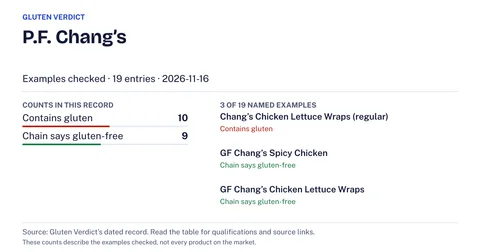 P.F. Chang’sDepends on the order10 of 19 menu items we checked contain glutenP.F. Chang’s · checked Nov 16, 2026
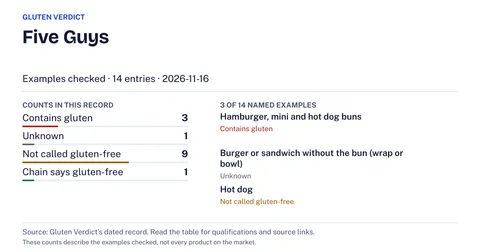 Five GuysDepends on the order3 of 14 menu items we checked contain gluten: Hamburger, mini and hot dog buns; Malt vinegar (fry condiment); and Oreo® Cookie Pieces shake mix-inFive Guys · checked Nov 16, 2026
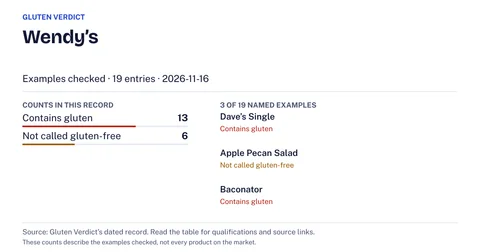 Wendy’sDepends on the order13 of 19 menu items we checked contain glutenWendy’s · checked Nov 16, 2026
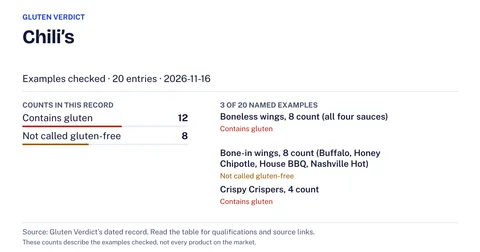 Chili’sDepends on the order12 of 20 menu items we checked contain glutenChili’s Grill & Bar · checked Nov 16, 2026
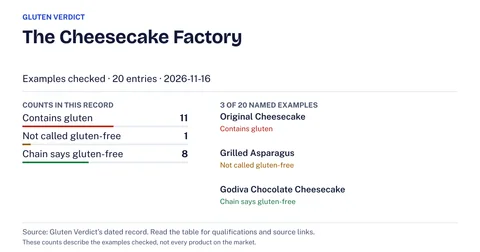 The Cheesecake FactoryDepends on the order11 of 20 menu items we checked contain glutenThe Cheesecake Factory · checked Nov 16, 2026
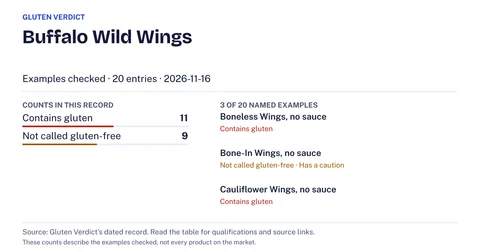 Buffalo Wild WingsDepends on the order11 of 20 menu items we checked contain glutenBuffalo Wild Wings · checked Nov 16, 2026
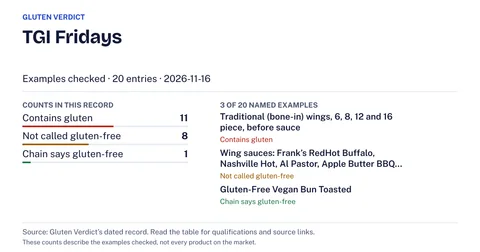 TGI FridaysDepends on the order11 of 20 menu items we checked contain glutenTGI Fridays · checked Nov 16, 2026
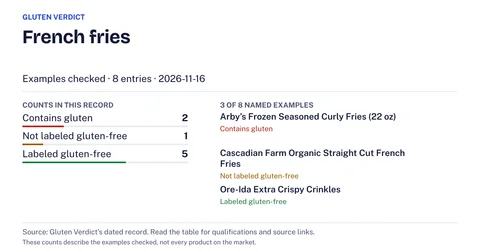 French friesDepends on the product2 of 8 products we checked contain gluten: Arby’s Frozen Seasoned Curly Fries (22 oz) and Checkers Frozen Crispy Seasoned Fries (28 oz)checked Nov 16, 2026
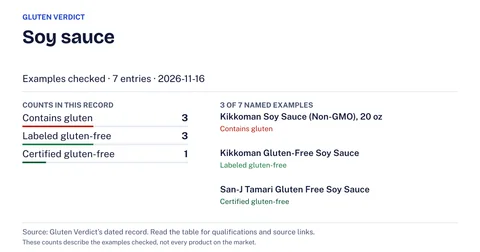 Soy sauceDepends on the product3 of 7 products we checked contain gluten: Kikkoman Soy Sauce (Non-GMO), 20 oz; San-J Organic Shoyu Soy Sauce; and Lee Kum Kee Premium Soy Sauce (No Preservatives Added)checked Nov 16, 2026
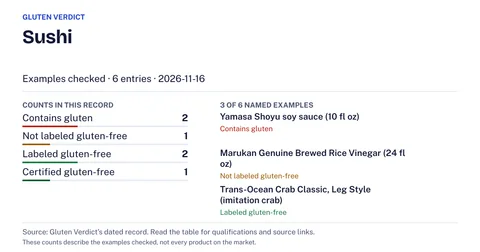 SushiDepends on the product2 of 6 products we checked contain gluten: Yamasa Shoyu soy sauce (10 fl oz) and Lee Kum Kee Less Sodium Soy Saucechecked Nov 16, 2026
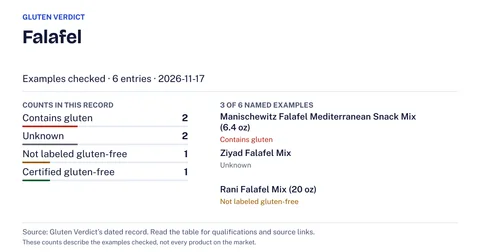 FalafelDepends on the product2 of 6 products we checked contain gluten: Manischewitz Falafel Mediterranean Snack Mix (6.4 oz) and Al’Fez Lebanese Falafel Kit (5.3 oz)checked Nov 17, 2026
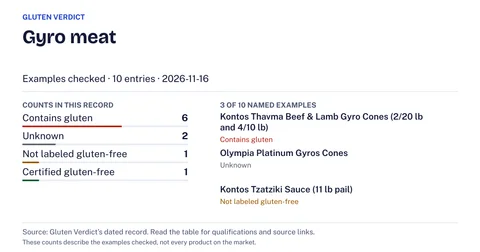 Gyro meatDepends on the product6 of 10 products we checked contain glutenchecked Nov 16, 2026
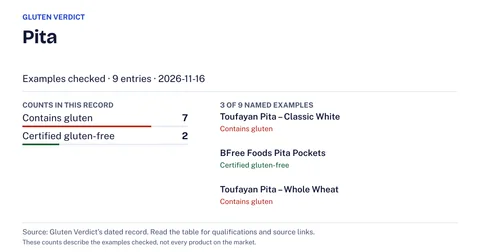 PitaContains glutenchecked Nov 16, 2026
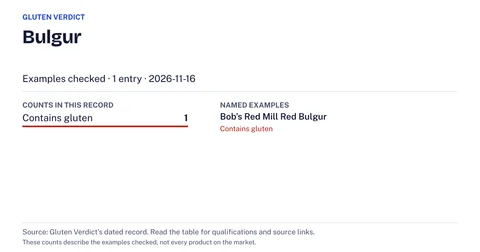 BulgurContains glutenchecked Nov 16, 2026
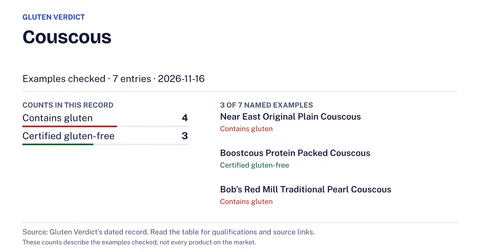 CouscousContains glutenchecked Nov 16, 2026
Questions people ask
Does a restaurant’s gluten-free menu label follow FDA’s rule?
FDA says its regulation applies to packaged foods, and recommends that restaurants making a gluten-free claim on their menus be consistent with its definition8.
Did the 2019 study find that a third of gluten-free restaurant meals contain too much gluten?
It reported gluten detected in 32% of gluten-free labeled foods tested13. The authors note the device may detect levels below 20 ppm, with exposure of unknown clinical significance14, so the 32% may include foods below FDA’s 20 ppm limit.
What if the server does not know what gluten is?
GIG suggests short, direct explanations40, and asking the server to double-check with the kitchen43.
More in Eating out and chain restaurant policies
 What “gluten-free” on a restaurant menu meansFDA’s gluten-free rule is written for packaged food. See what a menu label can mean, and how to tell a recipe from a procedure or an audited program.
 How to read a restaurant allergen chart for glutenWhat a mark, a blank cell, an X and a footnote mean on real US chain allergen charts, and which gluten questions the chart cannot answer.
 Casual-dining chains and gluten: what nine chains’ own allergen documents sayWhat Olive Garden, Outback, Applebee’s, Texas Roadhouse, Red Lobster, Chili’s and others say in writing about fryers, gluten menus and cross-contact.
 What fast-food chains say about shared fryers, and what a shared-fryer study measuredEach chain's own sentence on fryer oil, with its document and date, plus what a 2026 study measured in fries and chips from shared fryers.
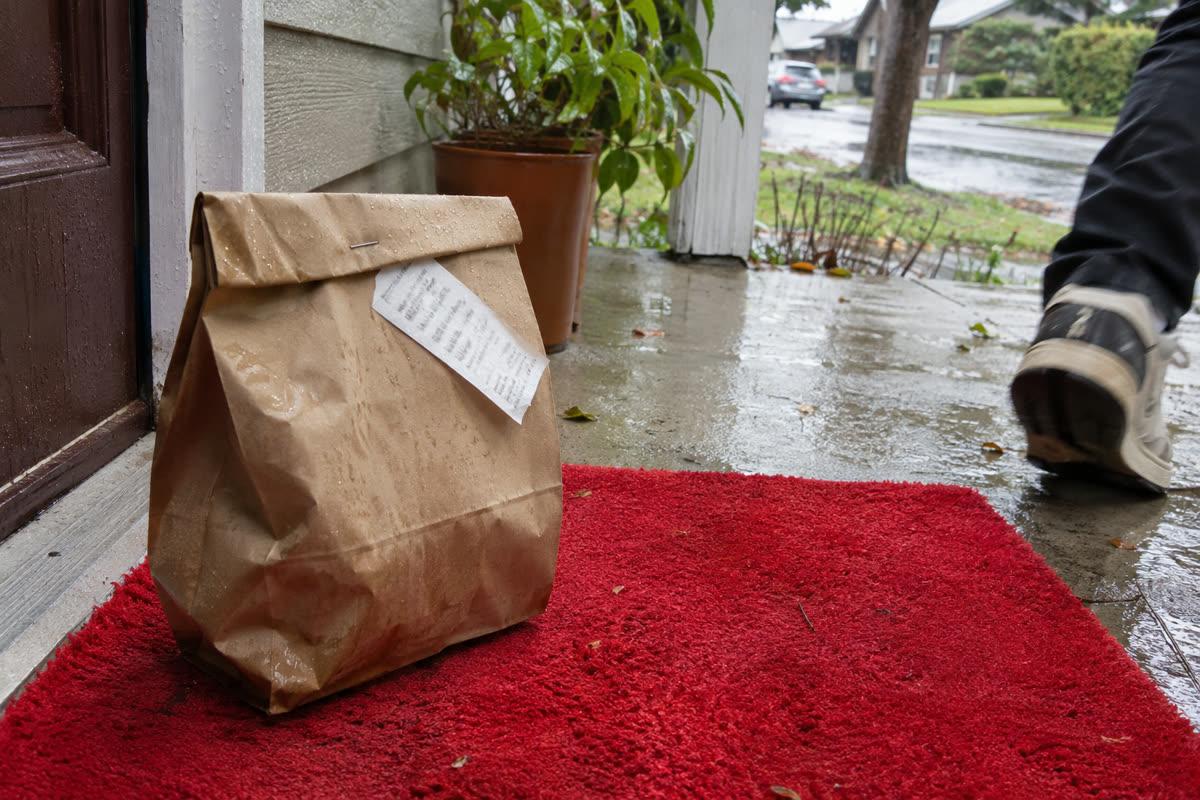 Ordering gluten-free through delivery apps and online menusWhat a dietary filter, tag or special-instructions note does in DoorDash and Uber Eats, and how to check a chain’s page and call before you order.
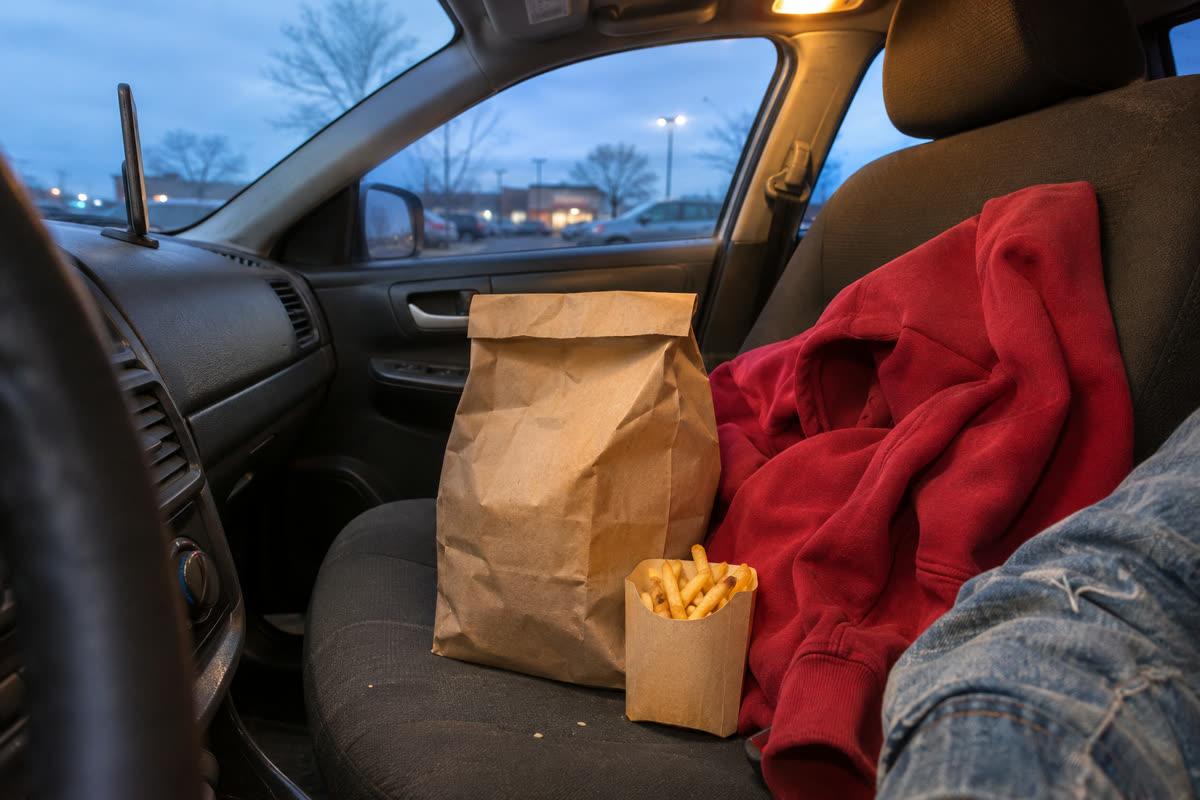 Burger and chicken chains and gluten: what Popeyes, Arby’s, Wendy’s and Five Guys say in writingWhat Popeyes, Arby’s, Wendy’s and Five Guys say in their own allergen documents about fryers, buns, breading and cross-contact, with dates.
Related guides
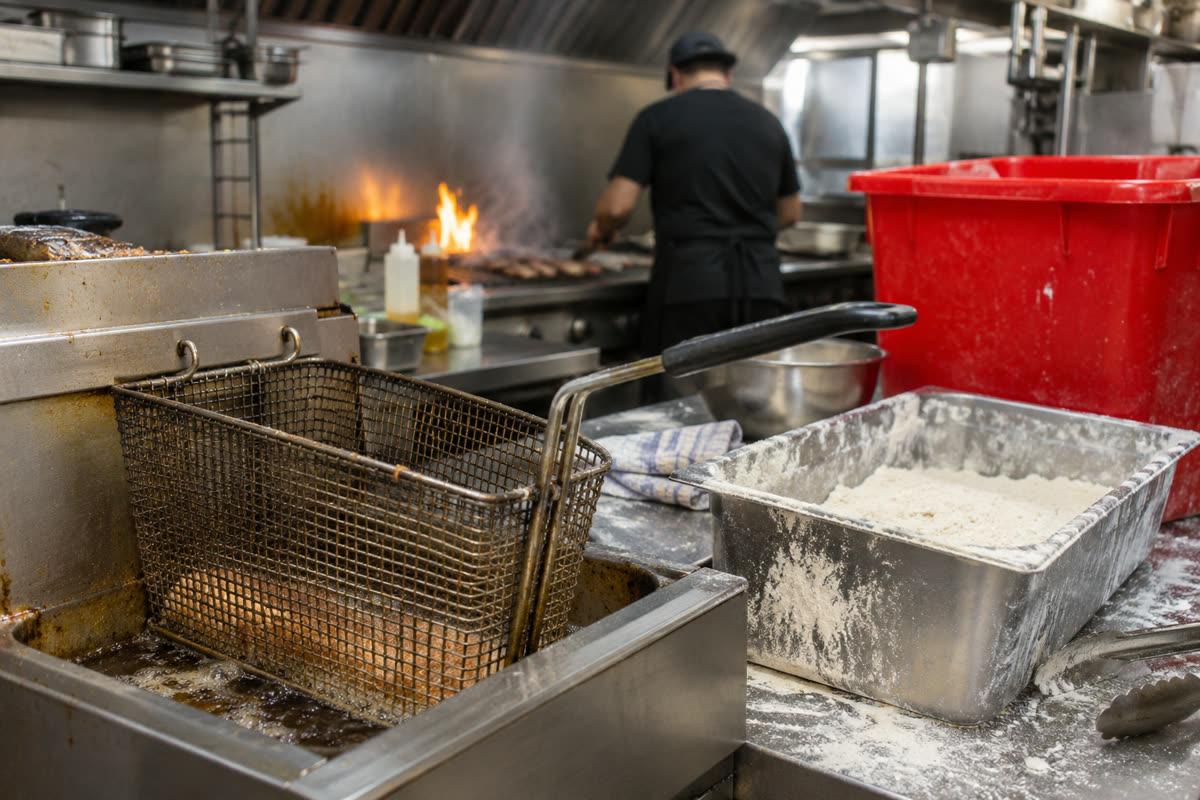 Where gluten hides in a restaurant kitchen, and the question to ask about each sourceFryers, sauces, roux, marinades, grills, pasta water and eggs: how gluten reaches restaurant food and the question GIG lists for each source.
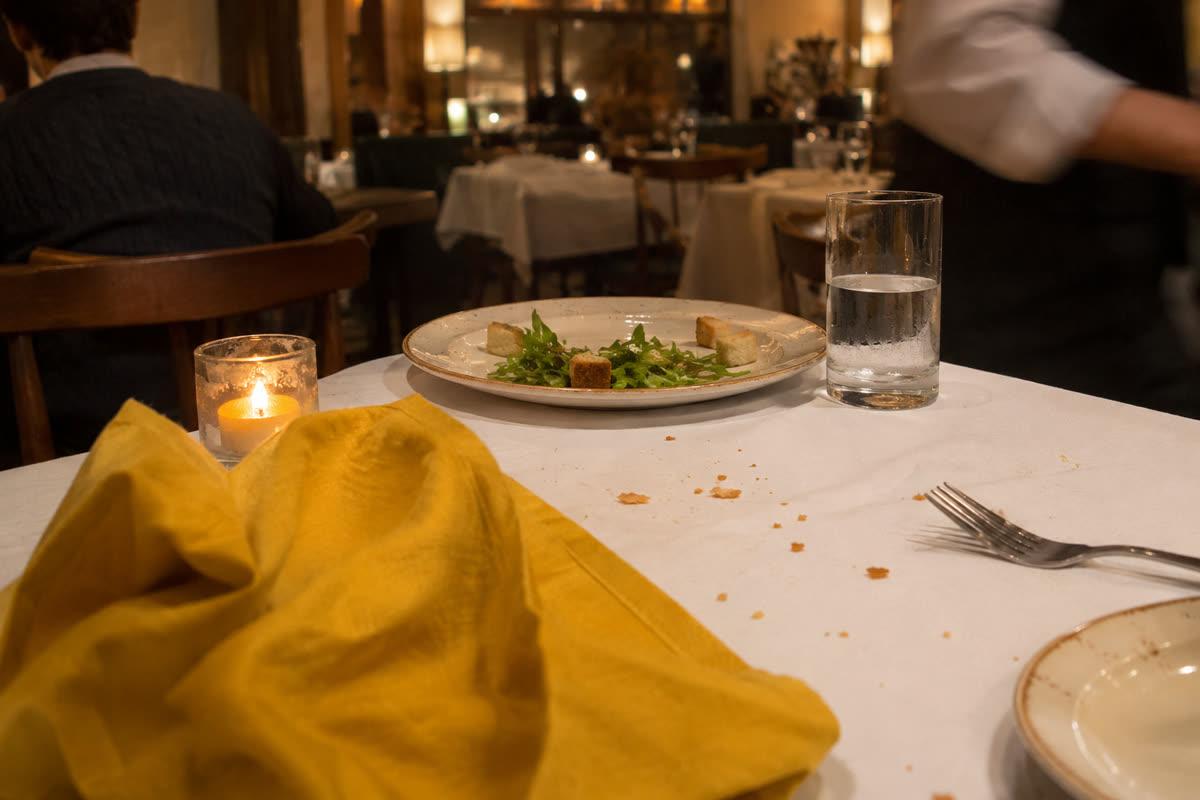 When a restaurant gets your gluten-free order wrong or says no: what to do at the table and afterwardWhat to check on the plate, how to ask for a remake, when to leave, and who to report a restaurant gluten mistake to: manager, chain, health department.
 If you think you were glutened: what the celiac organizations say to doWhat the celiac charities, FDA and NIDDK say to do after accidental gluten exposure, when to contact a clinician, and how to trace the cause.
 Your first restaurant meal after a celiac diagnosisHow to pick a place, call ahead, ask the kitchen the right questions and decide what to do when answers are vague, for a first meal out.
Sources
- [1, 2, 3, 4, 30] NIDDK (National Institutes of Health), Eating, Diet, & Nutrition for Celiac Disease, checked Nov 17, 2026.
- [5, 6, 10, 11, 12, 32, 40, 41, 42, 43, 47, 49, 50, 65] Gluten Intolerance Group, Questions to Ask When Eating Out, checked Nov 17, 2026.
- [7, 19, 22, 31, 34, 35, 36, 38, 39, 52, 53] Gluten Intolerance Group, Eating Out: 7 Tips For Staying Gluten-Free, checked Nov 17, 2026.
- [8, 26] US Food and Drug Administration, Questions and Answers on the Gluten-Free Food Labeling Final Rule, checked Nov 17, 2026.
- [9, 25] US Food and Drug Administration, Gluten and Food Labeling, checked Nov 17, 2026.
- [13, 14, 59, 60] PubMed (NCBI), Detection of Gluten in Gluten-Free Labeled Restaurant Food: Analysis of Crowd-Sourced Data (Lerner and colleagues, Am J Gastroenterol 2019; PMID 30920417), checked Nov 17, 2026.
- [15, 16, 61, 62] PubMed (NCBI), Shared Fryers May Not Always Be as Risky for Gluten Cross-Contact in Celiac Disease as Dietary Guidance Suggests (Weisbrod and colleagues, Nutrients 2026; PMID 42943004), checked Nov 17, 2026.
- [17, 24] Buffalo Wild Wings, Allergen & Preparation Guide, checked Nov 17, 2026.
- [18] P.F. Chang’s, Menu Nutrition (gluten-free menu section), checked Nov 17, 2026.
- [20, 51] Gluten Intolerance Group, I went to a restaurant that had food marked “gluten-free” on the menu, but I felt “glutened” after my meal. How could this have happened?, checked Nov 17, 2026.
- [21, 45, 48] Coeliac UK, Essential Gluten Free Eating Out Tips, checked Nov 17, 2026.
- [23, 57, 58] Chipotle Mexican Grill, Allergens & Special Diet, checked Nov 17, 2026.
- [27, 28, 29, 66] PubMed (NCBI), Awareness of coeliac disease among chefs and cooks depends on the level and place of training (Schultz and colleagues, Asia Pac J Clin Nutr 2017; PMID 28582825), checked Nov 17, 2026.
- [33, 37, 44, 46] Gluten Intolerance Group, What are some of the most important questions to ask the wait staff or management of a food service or restaurant?, checked Nov 17, 2026.
- [54] Gluten Intolerance Group, Getting Started on a Gluten-Free Diet: A Step-By-Step Guide, checked Nov 17, 2026.
- [55] National Celiac Association, Couscous, checked Nov 17, 2026.
- [56] Gluten Intolerance Group, 38 Foods Where Gluten May Be “Hidden”, checked Nov 17, 2026.
- [63, 64] PubMed (NCBI), Understanding cross-contamination in a gluten-free diet: A scoping review (Studerus and colleagues, Clin Nutr ESPEN 2026; PMID 41386568), checked Nov 17, 2026.