Where gluten hides in a restaurant kitchen, and the question to ask about each source
Short answer
Gluten reaches a restaurant order in two ways, and the Gluten Intolerance Group (GIG) lists a separate question for each:
- In the recipe: Worcestershire-type sauces and soy sauce could contain gluten1, roux is flour and fat cooked together2, and marinades may contain malt vinegar, soy sauce or flour17. GIG also says some restaurants add pancake batter to scrambled egg and omelet mixtures4. GIG’s questions: are the sauces certified gluten-free1, does the dish contain flour or roux2, and are the marinades and seasonings gluten-free3.
- On shared equipment: fryer oil, the grill, the pan and the pasta water5, 6, 7, 8. GIG’s questions: is there a dedicated fryer5, is the grill shared and, if so, how is it cleaned6, can the meal be cooked in a separate pan7, and is gluten-free pasta boiled in fresh water8.
Part of Eating out and chain restaurant policies, 25 guides
Key points
- Roux is flour and fat cooked together to thicken soups, and GIG notes that the flour used is often wheat flour2.
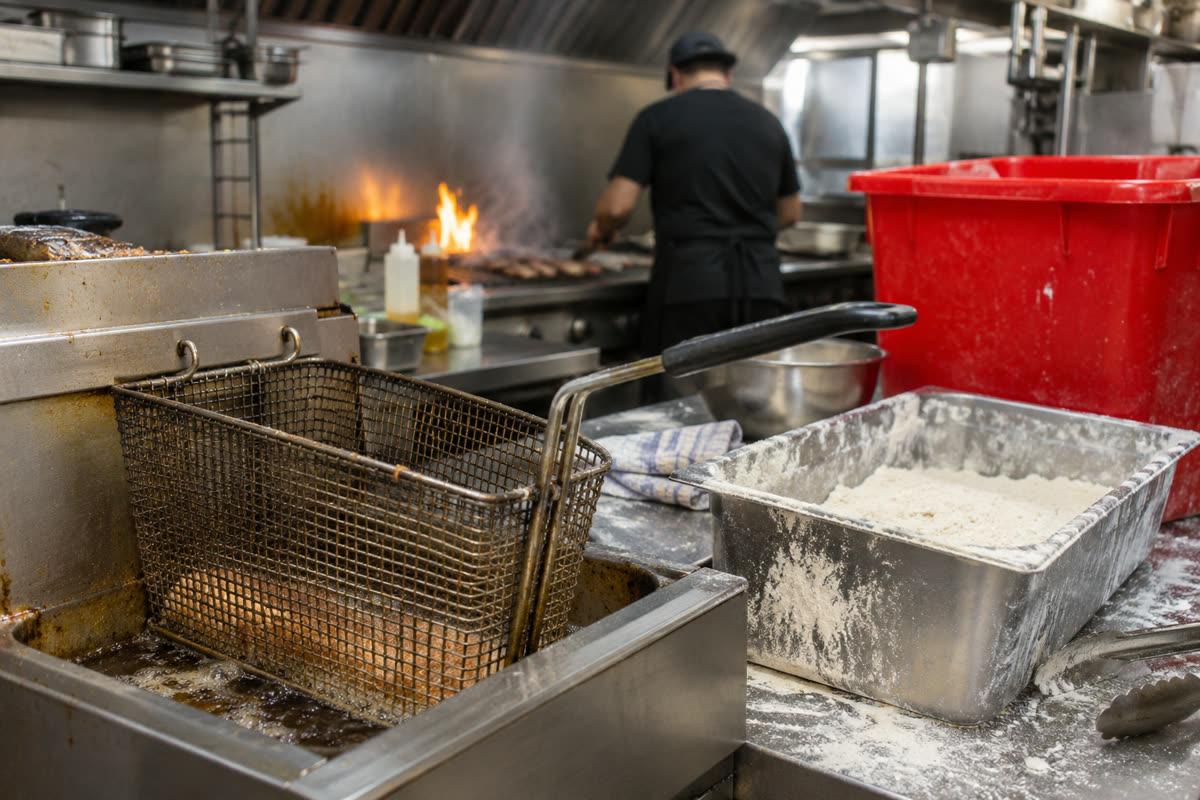
- GIG says the oil used to deep-fry foods may be used for both breaded and non-breaded items9. A 2026 study of 98 shared-fryer samples found six (6.1%) above 20 ppm10.
- FDA’s gluten-free regulation applies to packaged foods, and for menus FDA recommends that a gluten-free claim be consistent with its definition11, 12.
- A 2019 crowd-sourced study detected gluten in 32% of gluten-free-labeled restaurant foods tested with a sensor that its authors say may detect gluten below 20 ppm13, 14.
- GIG’s list of hidden gluten includes restaurant eggs: some restaurants add pancake batter to scrambled egg and omelet mixtures4.
Two ways gluten gets into a restaurant order
GIG defines cross-contact as gluten crumbs or particles getting into gluten-free ingredients or food15. NIDDK says it can occur at any time, including when foods are prepared or served16.
In a restaurant kitchen there are two routes: gluten can be an ingredient of the dish, or it can arrive on the oil, surface, pan or water the dish touches. The table pairs each source with a question GIG lists and with our verdicts for the foods involved. Sections below give the detail and what the studies measured.
| Kitchen source | What GIG says | Question GIG lists | Our verdicts |
|---|---|---|---|
| Fryer | The oil used to deep-fry foods may be used for both breaded and non-breaded items9 | Is there a dedicated fryer for gluten-free foods?5 | French fries, onion rings, tater tots, tempura |
| Sauces | Worcestershire-type sauces and soy sauce could contain gluten1 | Are these sauces certified gluten-free? If made in-house, do they know if they contain gluten?1 | Soy sauce, teriyaki sauce, Worcestershire sauce |
| Soups, gravies and jus | Roux is flour and fat cooked together to thicken soups; the flour used is often wheat flour2 | Does this contain flour or roux?2 | Gravy, au jus |
| Marinades and seasonings | Marinades and barbeque sauces may contain malt vinegar, soy sauce, or flour17 | Are your marinades and seasonings gluten-free?3 | Spices, malt vinegar |
| Grill or flat-top | Among its red flags: confirmation that gluten-free foods share cooking oil or grill spaces with heavily breaded items18 | Is the grill used to cook gluten-free foods separate or shared with gluten foods? If shared, how is it cleaned and how often?6 | Equipment, not an ingredient |
| Pan | GIG suggests finding out if breaded or gluten-containing foods have been cooked on the same surface beforehand19 | Can my meal be cooked in a separate pan from gluten foods?7 | Equipment, not an ingredient |
| Pasta water | Its 2026 list asks about the water the pasta is boiled in8 | Is the GF pasta boiled in fresh water, or in the same water used for regular pasta?8 | Pasta |
| Eggs | Some restaurants add pancake batter to scrambled egg and omelet mixtures4 | Can I have my egg soft-boiled?20 | Eggs, pancakes |
| Salads | Cross-contact can happen on cutting boards, and through croutons or salad dressings containing gluten21 | GIG’s tip: ask how dressings are made, or whether the ingredients list can be double-checked22 | Croutons, Caesar dressing |
For the full sequence of calling ahead, speaking to the kitchen and reading the answers, see eating out with celiac disease. For packaged foods, see where wheat, barley and rye hide in processed food.
Fryers: fries, onion rings, tempura and chips
GIG’s restaurant tips say the oil used to deep-fry foods may be used for both breaded and non-breaded items, in which case they should be avoided, and that in large restaurants where French fries are cooked in separate fryers there is less chance of cross-contact9. Its list of hidden gluten adds that French fries from fast food restaurants are most likely fried in the same oil as gluten-containing foods, and tells readers to say no to “crunchy,” “seasoned,” or “battered” fries, or fries with gravy or sauces, if you cannot verify that they use entirely gluten-free ingredients23.
The ingredient side is a separate question. Our verdicts for French fries, tater tots, hash browns, onion rings, tempura show what we found for each, with the dates we read the sources.
What two studies measured about fries and fryers
A 2019 crowd-sourced study tested food with a gluten sensor and found gluten in 32% of foods labeled gluten-free13. Its table lists French fries at 53 of 175 samples labeled gluten-free (30.3%), with a p-value of 0.6213 against all other foods tested24.
A 2026 study in Nutrients measured gluten by ELISA in 98 samples of foods that are naturally gluten-free before frying, 55 of French fries and 43 of tortilla chips, all cooked in fryers shared with gluten-containing foods26. Six samples (6.1%) were above 20 ppm, the FDA gluten-free threshold, and 84 of 98 (85.7%) were below the assay’s 5 ppm limit of quantification10. All samples from establishments reporting daily oil changes measured under 20 ppm; samples from establishments reporting weekly oil changes were higher and more variable, including values above 20 ppm27.
The 2026 study’s limits, in its authors’ words: establishments were not randomly selected28; oil-change frequency was reported by restaurant staff and not verified, and each establishment was sampled once29. The authors conclude that shared fryers are not inherently high-risk sources of gluten cross-contact30. GIG’s guidance above says foods fried in oil used for both breaded and non-breaded items should be avoided. Both are on record, and this page does not pick between them.
Sauces, gravies, soups and dressings
GIG’s question list says Worcestershire-type sauces and soy sauce could contain gluten1, and its hidden-gluten list says soy sauce and teriyaki sauce are traditionally made with fermented crushed wheat and soy31. Under FDA’s gluten-free labeling rule, FDA says that in general, soy sauce made from soybeans and wheat, or any other gluten-containing grain, may not bear a “gluten-free” claim32.
Roux is flour and fat cooked together to thicken soups, and GIG notes the flour used is often wheat flour2. GIG’s tips add that soup bases could be made with roux33, and that au jus can come from a can or mix and might contain hydrolyzed wheat protein34. Its hidden-gluten list names some powdered or packaged broths as well, giving yeast extract derived from barley as an example35.
For dressings, GIG says salad dressings may contain malt vinegar, soy sauce, or flour36. NIDDK lists salad dressing and soups among the foods where gluten may be found37.
Asking to see the package
GIG notes that some restaurants use canned sauces, so you might be able to ask to check the ingredients list on the can38. It also suggests asking to see the package of any questionable ingredient, and says most eating establishments can accommodate the request39. Among its red flags is kitchen staff refusing or acting hesitant to check ingredient labels on packaged sauces or mixes40.
Our verdicts for the foods in this section: soy sauce, teriyaki sauce, Worcestershire sauce, malt vinegar, gravy, au jus, Caesar dressing.
Marinades, seasonings and seasoned rice
GIG’s hidden-gluten list says marinades and barbeque sauces may contain malt vinegar, soy sauce, or flour17, and that certain brands of taco seasoning contain wheat41. For meat, poultry and fish, GIG’s restaurant tips say seasonings are often used and the ingredients should be verified42. Its 2026 list asks whether the seasoning blend on the dish is gluten-free43.
Rice is a side GIG singles out. Some rice pilafs and seasoned rice may have added gluten-containing ingredients44, and pilaf could be made with orzo, a small wheat pasta, or contain wheat flour45.
Our verdict for spices covers the ingredient side of seasoning blends.
Grills, flat-tops and pans
GIG’s question list asks whether the grill used for gluten-free foods is separate from or shared with gluten foods and, if shared, how it is cleaned and how often6. It also asks whether the meal can be cooked in a separate pan7. Its 2026 list asks whether the item is cooked on a clean section of the grill or flat-top, separate from breaded foods46.
GIG’s tips suggest finding out if breaded or gluten-containing foods have been cooked on the same surface beforehand, and suggest using foil over the cooking surface19. The 2026 list also asks whether the kitchen can prepare the meal with clean utensils and a freshly sanitized surface47, and counts confirmation that gluten-free foods share cooking oil or grill spaces with heavily breaded items among its red flags18.
On heat: in its guide to home appliances, GIG writes that gluten cannot be “burned” off by high temperature but can be removed by a thorough cleaning with soap, water, and a good metal grill scrubber48. That page is about home grills; it does not describe restaurant flat-tops.
Pasta water
GIG’s 2026 list asks whether gluten-free pasta is boiled in fresh water or in the same water used for regular pasta8. In the 2019 sensor study, gluten was detected in 50.8% of samples of pasta labeled gluten-free, and in 53.2% of pizza25.
The authors write that it is not entirely clear why pizza and pasta were more likely to test positive49. For pasta they name two possibilities: cooking in the same water as conventional pasta, although gluten is generally poorly soluble in water, or the sauce on the pasta50.
Our verdict for pasta covers the ingredient side.
Eggs and omelets
FDA lists eggs among foods that are naturally gluten-free51. GIG’s hidden-gluten list has an entry for restaurant eggs: some restaurants add pancake batter to their scrambled egg and omelet mixtures to increase fluffiness and sweetness, and even though eggs are naturally gluten-free, these dishes are not4.
GIG’s question list includes whether the egg can be soft-boiled, because soft-boiled eggs remain in their shell, which limits the chance of cross-contact in a pan20.
Salads, bread and shared utensils
GIG’s tips say cross-contact with gluten can happen on cutting boards used to chop salad ingredients, and through croutons or salad dressings containing gluten21. On a salad bar, GIG notes that even if foods are kept apart, the serving utensils might inadvertently be used in both52. It calls the use of the same serving utensil in both types of food one of the most common ways gluten crumbs can get into gluten-free food53.
For toasters, GIG’s home-appliance page says gluten crumbs can end up on gluten-free bread54. That page is written for home kitchens.
Our verdicts: croutons, Caesar dressing.
What a gluten-free label on a menu has to meet
FDA says its regulation applies to packaged foods, and that it shares complaints about unpackaged food, such as food served in restaurants, with state and local government partners11. For menus, FDA recommends that restaurants making a “gluten-free” claim be consistent with its definition12, and says state and local governments play an important role in oversight of restaurants55. The definition for labeled foods is less than 20 parts per million of gluten56.
GIG says some restaurants offering gluten-free menu options may not have the procedures set up to reliably produce gluten-free items57. Its advice is to ask how gluten-free items are prepared and what procedures are in place to avoid cross-contact58.
GIG also runs a validation program for restaurants, Gluten-Free Food Services (GFFS), which it says works with foodservice establishments to educate, train and audit their staff59.
The 2019 sensor study: what it measured and what the sensor can and cannot say
The study analyzed results that users of a portable gluten sensor chose to share, collected across the United States over an 18-month period60. There were 5624 tests by 804 users, and gluten was detected in 32% of foods labeled gluten-free13. Pizza and pasta were the foods most likely to test positive25.
| Source | What it reports |
|---|---|
| The 2019 study’s authors | The sensor’s output is binary: gluten detected or gluten not detected61. It may detect gluten at levels below 20 ppm, leading to exposure of unknown clinical significance14. For a food spiked in the 10 ppm range, its specificity is closer to 50%62. |
| The sensor’s maker (Nima Labs authors, 2019) | Describes the sensor as detecting gluten proteins at or below the accepted 20 ppm threshold63. |
| University of Nebraska-Lincoln evaluation (2018) | At 20 ppm added gluten, it failed to detect gluten in one type of pasta and detected it in 63 of 72 other subsamples64. At 10 ppm it detected gluten in 9 of 13 food types, but not in the three pastas or the puffed corn snack65. It did not perform reliably at 5 ppm in 11 of 13 food types66. |
| GIG’s review (2020) | Says the sensor’s performance makes it impossible to determine what fraction of the restaurant samples contained 20 ppm of gluten67, and that a result reflects the one sample tested, not the whole serving or meal68. |
The authors list their own limit: it was not systematic testing, it was crowd-sourced, and the foods tested could have been chosen because of doubts about their gluten-free status69. GIG recommends caution in interpreting the data70.
The authors argue that the differences they found between regions, time of day and specific foods are unlikely to be differentially affected by overestimation from a hypersensitive sensor71.
Verdicts in this guide
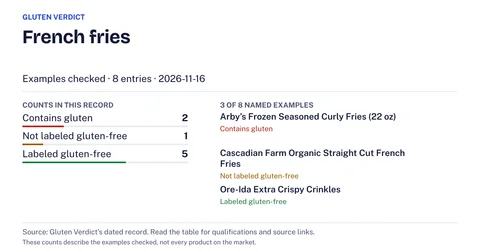 French friesDepends on the product2 of 8 products we checked contain gluten: Arby’s Frozen Seasoned Curly Fries (22 oz) and Checkers Frozen Crispy Seasoned Fries (28 oz)checked Nov 16, 2026
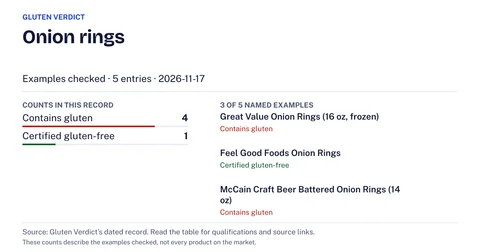 Onion ringsDepends on the product4 of 5 products we checked contain glutenchecked Nov 17, 2026
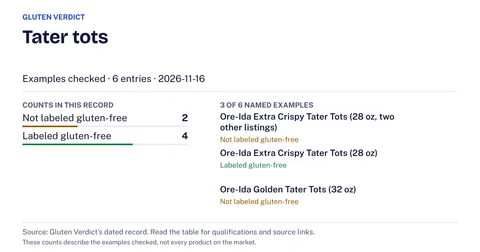 Tater totsDepends on the productchecked Nov 16, 2026
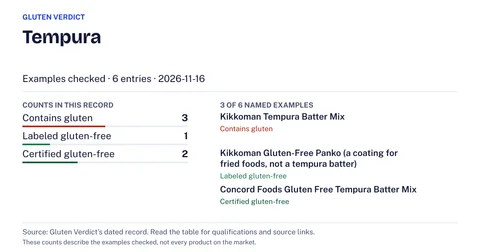 TempuraDepends on the product3 of 6 products we checked contain gluten: Kikkoman Tempura Batter Mix, Kikkoman Tempura Dipping Sauce, and Nongshim Tempura Udon Cupchecked Nov 16, 2026
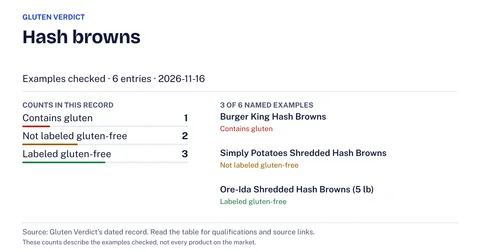 Hash brownsDepends on the product1 of 6 products we checked contains gluten: Burger King Hash Brownschecked Nov 16, 2026
 Soy sauceDepends on the product3 of 7 products we checked contain gluten: Kikkoman Soy Sauce (Non-GMO), 20 oz; San-J Organic Shoyu Soy Sauce; and Lee Kum Kee Premium Soy Sauce (No Preservatives Added)checked Nov 16, 2026
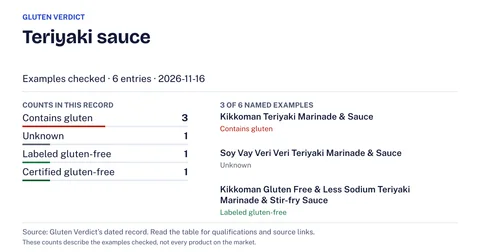 Teriyaki sauceDepends on the product3 of 6 products we checked contain gluten: Kikkoman Teriyaki Marinade & Sauce, Kikkoman Teriyaki Marinade & Stir-fry Sauce – Roasted Garlic, and Kikkoman Teriyaki BBQ Sauce – Originalchecked Nov 16, 2026
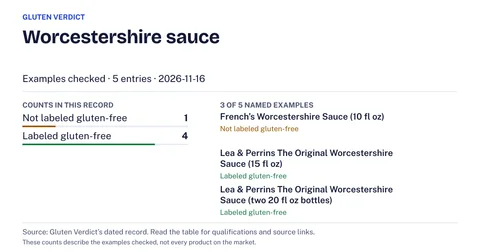 Worcestershire sauceDepends on the productchecked Nov 16, 2026
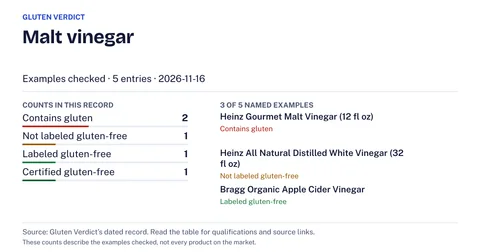 Malt vinegarContains glutenchecked Nov 16, 2026
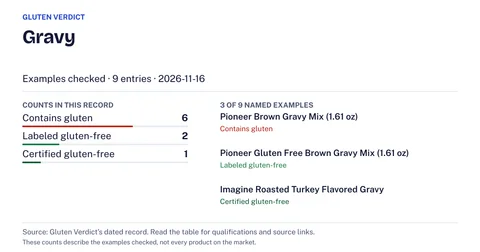 GravyDepends on the product6 of 9 products we checked contain glutenchecked Nov 16, 2026
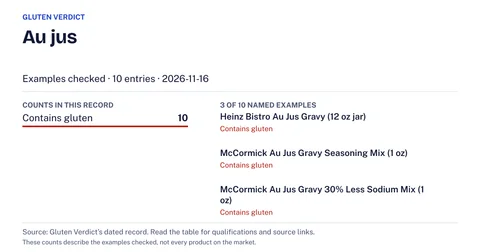 Au jusContains glutenchecked Nov 16, 2026
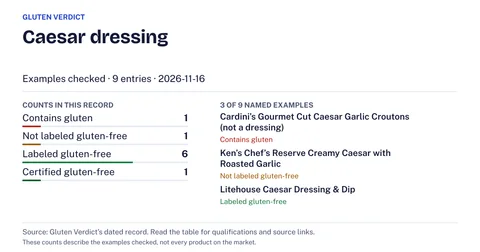 Caesar dressingDepends on the product1 of 9 products we checked contains gluten: Cardini’s Gourmet Cut Caesar Garlic Croutons (not a dressing)checked Nov 16, 2026
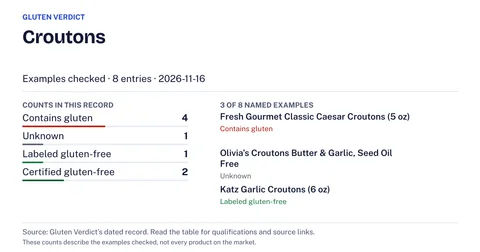 CroutonsContains glutenchecked Nov 16, 2026
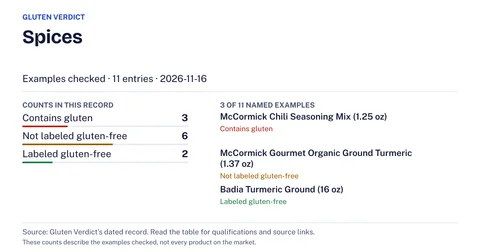 SpicesDepends on the product3 of 11 products we checked contain gluten: McCormick Chili Seasoning Mix (1.25 oz), Lawry’s Chili Spices & Seasonings Mix (1.48 oz), and McCormick Cheesy Taco Seasoning Mix (1.12 oz)checked Nov 16, 2026
 PastaContains glutenchecked Nov 16, 2026
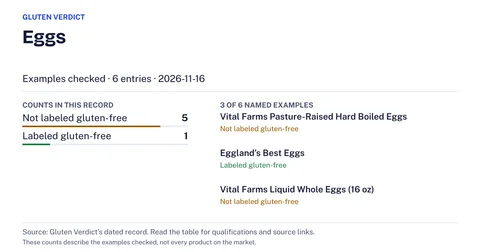 EggsNaturally gluten-freechecked Nov 16, 2026
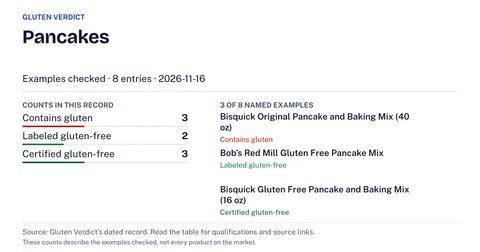 PancakesContains glutenchecked Nov 16, 2026
Questions people ask
Does FDA’s gluten-free rule cover a restaurant menu?
FDA says its regulation applies to packaged foods11. For menus it recommends that a gluten-free claim be consistent with its definition12.
What is roux, and why is it on the list?
GIG describes roux as flour and fat cooked together to thicken soups, and says the flour used is often wheat flour2.
Are eggs gluten-free at a restaurant?
FDA lists eggs as naturally gluten-free51. GIG says some restaurants add pancake batter to scrambled egg and omelet mixtures, and that those dishes are not gluten-free4.
Does high heat remove gluten from a grill?
In its guide to home appliances, GIG writes that gluten cannot be “burned” off by high temperature but can be removed by thorough cleaning48. That page covers home grills, not restaurant flat-tops.
More in Eating out and chain restaurant policies
 Ordering gluten-free at an Italian restaurantBefore you order at an Italian restaurant: where the gluten-free pasta is boiled, what thickens the sauces, and what is breaded or fried.
 Ordering steak and burgers with celiac disease: marinades, sides, fryers and bunsWhat to ask about marinades, seasoning, butters, grills, fryers, sides and buns when you order steak or a burger with celiac disease.
 What fast-food chains say about shared fryers, and what a shared-fryer study measuredEach chain's own sentence on fryer oil, with its document and date, plus what a 2026 study measured in fries and chips from shared fryers.
 Ordering sushi and Japanese food when you avoid glutenWhich sushi, ramen and hibachi items carry wheat, what to ask about soy sauce, imitation crab, tempura and shared fryers, and a first-visit order.
 Gluten-free breakfast at restaurant chains: griddles, toasters and batterWhat IHOP, Panera and Tim Hortons say about shared griddles, toasters and fryers, and three questions to ask before you order breakfast out.
 Casual-dining chains and gluten: what nine chains’ own allergen documents sayWhat Olive Garden, Outback, Applebee’s, Texas Roadhouse, Red Lobster, Chili’s and others say in writing about fryers, gluten menus and cross-contact.
Related guides
 Eating out with celiac disease: what to check, ask and watch forPlan a restaurant meal with celiac disease: what to check before you go, the questions to ask in order, how to read the answers, and what studies measured.
 Where wheat, barley and rye hide in processed food: 15 places to checkFifteen processed foods where wheat, barley or rye turn up, the label step that catches each, and what US allergen law does and does not flag.
 How to read a restaurant allergen chart for glutenWhat a mark, a blank cell, an X and a footnote mean on real US chain allergen charts, and which gluten questions the chart cannot answer.
 Your first restaurant meal after a celiac diagnosisHow to pick a place, call ahead, ask the kitchen the right questions and decide what to do when answers are vague, for a first meal out.
Sources
- [1, 2, 3, 5, 6, 7, 20] Gluten Intolerance Group, Most important questions to ask the wait staff or management of a restaurant (GIG FAQ), checked Nov 17, 2026.
- [4, 17, 23, 31, 35, 36, 41, 45] Gluten Intolerance Group, 38 Foods Where Gluten May Be “Hidden”, checked Nov 17, 2026.
- [8, 18, 40, 43, 46, 47] Gluten Intolerance Group, Questions to Ask When Eating Out (September 8, 2026), checked Nov 17, 2026.
- [9, 19, 21, 22, 33, 34, 38, 42, 44, 59] Gluten Intolerance Group, Eating Out: 7 Tips for Staying Gluten-Free, checked Nov 17, 2026.
- [10, 26, 27, 28, 29, 30] Nutrients (via PubMed Central), Shared Fryers May Not Always Be as Risky for Gluten Cross-Contact in Celiac Disease as Dietary Guidance Suggests (Weisbrod and colleagues, 2026; PMID 42943004), checked Nov 17, 2026.
- [11, 12, 32] US Food and Drug Administration, Questions and Answers on the Gluten-Free Food Labeling Final Rule, checked Nov 17, 2026.
- [13, 14, 24, 25, 49, 50, 60, 61, 62, 69, 71] American Journal of Gastroenterology (via PubMed Central), Detection of Gluten in Gluten-Free Labeled Restaurant Food: Analysis of Crowd-Sourced Data (Lerner and colleagues, 2019; PMID 30920417), checked Nov 17, 2026.
Read on 2026-11-17: Table 2, “Factors associated with detection of gluten in GF labeled foods”, lists French fries 53/175 (30.3%, p = 0.6213), Pizza 199/374 (53.2%) and Pasta 62/122 (50.8%) among the ten food items it lists; the table footnote says each food item was compared with all other tested foods.
- [15, 39, 52, 53] Gluten Intolerance Group, 25 Ways Cross-Contact Could Happen (And How to Avoid It), checked Nov 17, 2026.
- [16, 37] NIDDK (NIH), Eating, Diet, & Nutrition for Celiac Disease, checked Nov 17, 2026.
- [48, 54] Gluten Intolerance Group, Appliances: Risks of Cross-Contact (home kitchens), checked Nov 17, 2026.
- [51, 55, 56] US Food and Drug Administration, Gluten and Food Labeling, checked Nov 17, 2026.
- [57, 58] Gluten Intolerance Group, A restaurant had food marked gluten-free but I felt glutened: how could this happen? (GIG FAQ), checked Nov 17, 2026.
- [63] Food Chemistry (via PubMed), Nima Labs authors, An integrated, accurate, rapid, and economical handheld consumer gluten detector (Zhang and colleagues, 2019; PMID 30724219), checked Nov 17, 2026.
- [64, 65, 66] Journal of Food Protection (via PubMed), Evaluation of a Handheld Gluten Detection Device (Taylor and colleagues, University of Nebraska-Lincoln, 2018; PMID 30239212), checked Nov 17, 2026.
- [67, 68, 70] Gluten Intolerance Group, Hot Topic: gluten-free restaurant food and personal testing devices (GIG review of the Nima study, October 7, 2020), checked Nov 17, 2026.