Type 1 diabetes and celiac disease: the overlap and the screening guidelines
Short answer
Celiac disease is more common in people with type 1 diabetes than in the general population: the American Diabetes Association (ADA) gives 1.6–16.4% against 0.3–1%1. The ADA’s 2026 Standards of Care advise screening children and adolescents with type 1 diabetes soon after diagnosis, within 2 years and again after 5 years2, 3, and adults when symptoms, signs, laboratory manifestations or clinical suspicion suggest it4. ISPAD, ACG and NIDDK word their advice differently, so ask which guideline your care team follows5, 6, 7.
Part of Related conditions and complications, 16 guides

Key points
- The ADA says about 95% of people with type 1 diabetes and almost 99% of people with celiac disease carry HLA-DQ2 and/or HLA-DQ88, and Gluten Intolerance Group describes a genetic link between the two conditions18.
- Figures differ by source and country: 1.6–16.4% in the ADA’s text1, 3% to 10% in ACG’s6, and 6% confirmed in a global meta-analysis that put the United States among the lowest at 2%9, 10.
- ADA 2026 advises children and adolescents be screened soon after diagnosis, within 2 years and after 5 years3; ISPAD 2022 says the initial year and then 2–5 year intervals5; for adults the ADA ties screening to symptoms, signs, laboratory manifestations or clinical suspicion4.
- Celiac disease can go unnoticed in type 1 diabetes: Coeliac UK says its symptoms can be attributed to the diabetes11, and Gluten Intolerance Group says they are often absent12.
- NIDDK says doctors don’t recommend starting a gluten-free diet before diagnostic testing, because the diet can affect test results13.
Why the two conditions travel together
Both are autoimmune conditions, and celiac disease is found more often in people with type 1 diabetes than in the general population, as Coeliac UK, a UK charity, puts it14. The ADA’s section on comorbidities lists celiac disease, with thyroid disease and pernicious anemia, among the most common other autoimmune diseases in type 1 diabetes15.
NIDDK says celiac disease almost always occurs in people who have one of two groups of gene variants, called DQ2 and DQ816. About 30 percent of people have DQ2 or DQ8, but only about 3 percent of those develop celiac disease17. The ADA adds that about 95% of people with type 1 diabetes and almost 99% of people with celiac disease carry HLA-DQ2 and/or HLA-DQ88. Gluten Intolerance Group describes it as a genetic link between the two18.
NIDDK names type 1 diabetes among the immune-related disorders that some people with celiac disease also have19. Type 2 diabetes is different: Coeliac UK says there is no increased risk of coeliac disease in people with type 2 diabetes20, and Gluten Intolerance Group says there is no connection18.
Which way the numbers run
Most of the figures answer one question: how many people with type 1 diabetes also have celiac disease. Coeliac UK, answering from the other side, says most people with coeliac disease won’t develop type 1 diabetes, and that type 1 diabetes is usually diagnosed first21.
| Source | Who it covers | What it reports |
|---|---|---|
| ADA Standards of Care in Diabetes—2026 | People with type 1 diabetes | 1.6–16.4% of individuals, compared with 0.3–1% in the general population1 |
| ISPAD 2022 | Children and adolescents with type 1 diabetes | A range of 1%–16.4%22; one international comparison reported 3.5% biopsy-proven, from 1.9% in the U.S. to 7.7% in Australia23 |
| ACG 2023 | Patients with type I diabetes | Estimates varying between 3% and 10%6 |
| Meta-analysis, 2025 | 65,102 people with type 1 diabetes in 40 countries | Pooled seroprevalence 9% and confirmed prevalence 6%; the United States was among five countries with the lowest prevalence, 2%9, 10 |
| Swedish national cohort, 2024 | 5,295 children with type 1 diabetes | 9.8% with confirmed celiac disease24 |
| Coeliac UK | People with type 1 diabetes (UK charity) | Between 4 and 9%20 |
| Gluten Intolerance Group | People with type 1 diabetes | About 6% worldwide25 |
| NIDDK, for comparison | Everyone | About 1 percent of people around the world have celiac disease26 |
The figures differ because of who was tested and how. The meta-analysis authors say prevalence varies globally due to differing screening protocols27. Age matters too: ISPAD says the risk is inversely and independently associated with age at diagnosis of diabetes, with the greatest risk in those diagnosed before 5 years of age28.
The usual order is not the only one. In the Swedish cohort, 58.2% of the children with biopsy-proven celiac disease already had a celiac diagnosis before or at the onset of type 1 diabetes29. Among those diagnosed after the diabetes, 95.9% were found within 5 years of the diabetes diagnosis63.
What each guideline says about screening
The wording is not the same across guidelines, so the name and edition matter. This table gives each one’s own advice for people with type 1 diabetes.
| Guideline and edition | People covered | What it says |
|---|---|---|
| ADA Standards of Care in Diabetes—2026, section 14 | Children and adolescents with type 1 diabetes | Screen by measuring IgA tissue tTG antibodies soon after diagnosis2; repeat within 2 years of diagnosis and again after 5 years, with more frequent screening to be considered for those with symptoms or a first-degree relative with celiac disease3 |
| ADA Standards of Care in Diabetes—2026, section 4 | Adults with type 1 diabetes | Screen in the presence of gastrointestinal symptoms, signs, laboratory manifestations, or clinical suspicion suggestive of celiac disease4 |
| ISPAD Clinical Practice Consensus Guidelines 2022, chapter 19 | Children and adolescents with type 1 diabetes | Screening during the initial year of diabetes diagnosis and at 2–5 years intervals5; more frequent assessment if symptomatic celiac disease is possible or a first-degree relative has it30 |
| ACG guidelines update, 2023 | Patients with type I diabetes | Test if there are any suggestive symptoms or signs; for children, ACG says yearly or every-other-year serology screening has been suggested6 |
| NIDDK (United States) | People with type 1 diabetes, and blood relatives of people with celiac disease | Doctors in the United States do not routinely screen for celiac disease, but those with type 1 diabetes should talk with their doctor about their chances of getting it, to see if they should be tested; the page was last reviewed October 20207 |
| Coeliac UK (United Kingdom charity) | People with type 1 diabetes | Tested for coeliac disease at diagnosis, and again if symptoms continue or new ones develop31 |
ADA and ISPAD share an outline for children (test near diagnosis, then repeat) but not the dates: the ADA recommends repeating within 2 years of diagnosis and again after 53, ISPAD says 2–5 years intervals5. ISPAD also says that in an asymptomatic child, screening may be deferred after the period of initial diagnosis, because managing new-onset diabetes and celiac disease together may be overwhelming for children and families33.
On timing, the ADA says most cases are diagnosed within the first 5 years after the diabetes diagnosis, and that celiac disease can be diagnosed more than 10 years afterward, with insufficient data after 5 years to set the best screening frequency32, 34. ISPAD says most cases are diagnosed within the first year35.
Editions: this page reads the 2026 edition of the ADA Standards and the 2022 edition of the ISPAD chapter. ISPAD says six chapters were revised in 202436; the chapters its site lists for that set do not include this one37.
Which tests are used, and when a biopsy follows
NIDDK says doctors typically diagnose celiac disease with blood tests and biopsies of the small intestine38. For people with type 1 diabetes, the ADA names IgA tissue transglutaminase (tTG) antibodies, with documentation of acceptable serum IgA levels, or IgG tTG and deamidated gliadin antibodies if IgA is deficient2. ISPAD adds that screening for IgA deficiency should be done at the time of celiac screening39.
Whether a biopsy is needed is where the guidelines are least uniform. ISPAD notes that recent European guidelines suggest that in children with normal IgA, a tTG-IgA level of 10 times the upper limit of normal or more, confirmed by a positive EmA-IgA in a second blood sample taken while eating gluten, can be used to diagnose celiac disease40. ISPAD also says this approach has not been universally adopted as standard of care internationally and is inconsistent with other guidelines41. The ADA says a biopsy is recommended when the diagnosis is in question, especially in asymptomatic children and adolescents, before a diagnosis is established and significant eating plan changes are endorsed42. ISPAD adds that a positive tTG-IgA at screening may be transient43.
Genetic testing is not the first step. ISPAD says measuring HLA-DQ2 and DQ8 is rarely helpful to exclude celiac disease in people with type 1 diabetes and is not recommended as a screening test44; the ADA says genetic testing may not be needed because so many people with either condition carry those variants8.
NIDDK says doctors don’t recommend starting a gluten-free diet before diagnostic testing, because a gluten-free diet can affect test results13.
Why celiac disease can go unnoticed alongside diabetes
Coeliac UK says celiac disease may be missed in people with type 1 diabetes because symptoms of ill health can be attributed to the diabetes, and that some people have mild or no obvious symptoms while their gut lining is still damaged when they eat gluten11. Gluten Intolerance Group says symptoms are often absent in people with type 1 diabetes12, and ISPAD says finding it by symptoms alone can be challenging because it is frequently asymptomatic in children and young adults with type 1 diabetes45.
The ADA justifies screening by celiac disease’s association with osteoporosis, vitamin D deficiency, iron deficiency, growth failure, erratic glucose levels due to altered food absorption, and a potential increased risk of retinopathy and albuminuria46.
What the guidelines list as reasons to test
- ISPAD, for children: gastrointestinal signs (diarrhea, nausea, abdominal pain), extra-intestinal signs (unexplained weight loss, iron deficiency anemia, decreased bone mineralization, aphthous stomatitis) or diabetes-related ones (unexplained hypoglycemia)47.
- The ADA, for adults: suggestive symptoms (diarrhea, malabsorption, abdominal pain) or signs (osteoporosis, vitamin deficiencies, iron deficiency anemia)48.
- The ADA, for children: poor growth or increased hypoglycemia can prompt screening between the scheduled tests32.
These are the guidelines’ own lists, not a way to tell at home. NIDDK says celiac disease isn’t diagnosed based on symptoms alone, because some symptoms are like those of other digestive disorders49.
Eating gluten-free with type 1 diabetes
The guidelines point to a dietitian who knows both conditions. The ADA says to prescribe a gluten-free eating pattern for children and adolescents with confirmed celiac disease and to refer them and their caregivers to a registered dietitian nutritionist experienced in managing both diabetes and celiac disease50. ISPAD says children diagnosed with celiac disease should receive education and support from an experienced pediatric dietitian51, and Coeliac UK says people with both conditions should get guidance from a dietitian52.
Blood glucose can change once the diet starts. Coeliac UK says it may, because taking gluten out lets the gut lining heal and absorption of nutrients, including carbohydrates, improves53; it adds that people may need to keep a closer eye on blood glucose and talk to their diabetes team about insulin requirements53. ISPAD says people with diabetes and their care team should be vigilant because insulin requirements may change during the transition, and cites a report of greater glycemic excursions and inadequate nutritional intake on the diet in youth with both conditions54.
What the diet does to glucose control is described as mixed. ACG calls the impact of identifying and treating celiac disease on type 1 diabetes management mixed55, with some data suggesting fewer hypoglycemic events, especially after meals56. The ADA says gluten-free eating patterns reduce symptoms and rates of hypoglycemia in symptomatic children with confirmed celiac disease57. A 2025 systematic review and meta-analysis of seven studies in children and adolescents with type 1 diabetes58 found two studies, with 164 patients, that compared the diet with a standard diet in those who also had celiac disease64. It concluded that the diet may offer benefits to children and adolescents with both conditions, and rated the quality of that evidence as low59.
For the label side, see how to read a US food label for gluten and hidden sources of gluten.
Checking juices, sports drinks and sugar ingredients for gluten
In the United States, a “gluten-free” claim on a food FDA regulates is voluntary60, and under the rule for that claim any unavoidable presence of gluten must be less than 20 parts per million61. Check the specific product’s label.
Our verdicts cover these juices, this sports drink and these sugar ingredients, each with its sources and the date we read them: apple juice, orange juice, Gatorade, glucose syrup, dextrin and maltodextrin. Which products suit a diabetes plan is a question for the diabetes team.
Questions to bring to the diabetes team and the gastroenterologist
Prompts for an appointment, not medical advice:
- Which guideline does this clinic follow for celiac screening, and when is the next antibody test due? ADA 2026 and ISPAD 2022 both repeat screening but word the dates differently3, 5.
- Was total IgA checked along with the antibody test? ISPAD says screening for IgA deficiency should be done at the time of celiac screening39.
- If a test is positive, will a biopsy be done, or is the clinic using an antibody-level pathway? ISPAD notes that pathway is not universally adopted41; the ADA recommends a biopsy when the diagnosis is in question42.
- Should the diet wait until testing is finished? NIDDK says doctors don’t recommend starting a gluten-free diet before diagnostic testing13.
- Is there a dietitian who works with both conditions? The ADA recommends referral to one50.
- What should be watched on the diabetes side once the diet starts? Coeliac UK and ISPAD both say blood glucose or insulin needs may change53, 54.
- Should relatives be tested? ISPAD says family members of a child with newly diagnosed celiac disease should be screened62, and NIDDK says blood relatives of people with celiac disease should talk with their doctor7.
Verdicts in this guide
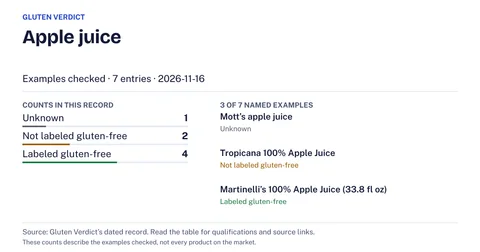 Apple juiceNaturally gluten-freechecked Nov 16, 2026
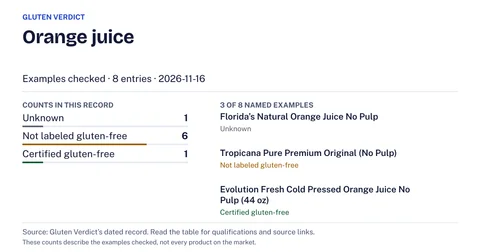 Orange juiceDepends on the productchecked Nov 16, 2026
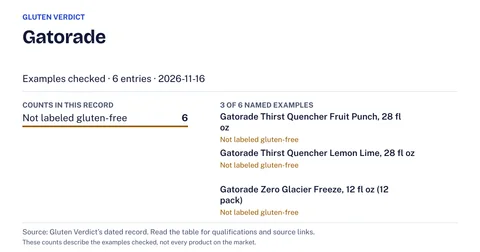 GatoradeNot labeled gluten-freePepsiCo · checked Nov 16, 2026
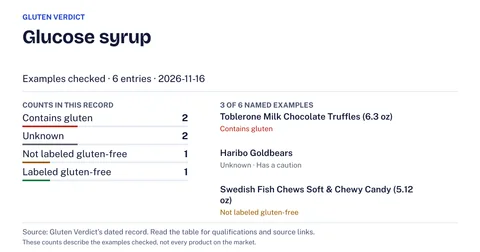 Glucose syrupNaturally gluten-free2 of 6 products we checked contain gluten: Toblerone Milk Chocolate Truffles (6.3 oz) and Darrell Lea Original Black Licorice (7 oz)checked Nov 16, 2026
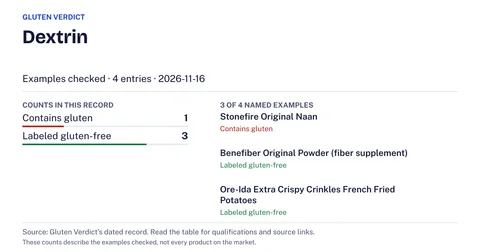 DextrinDepends on the product1 of 4 products we checked contains gluten: Stonefire Original Naanchecked Nov 16, 2026
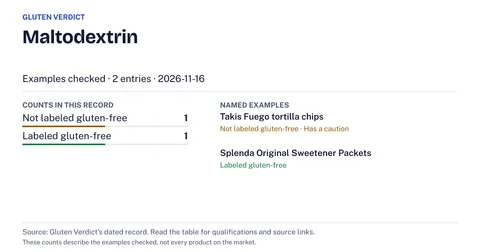 MaltodextrinNaturally gluten-freechecked Nov 16, 2026
Questions people ask
More in Related conditions and complications
 Celiac disease and other autoimmune conditions: which pairings have testing adviceWhich autoimmune conditions are reported with celiac disease, which have testing advice from named bodies, and which do not.
 Celiac disease and thyroid disease: how they are linked and which tests the guidelines nameHow often celiac and thyroid disease occur together, which tests guidelines name in each direction, and how to check a thyroid tablet’s label.
 Iron deficiency anemia and celiac disease: why it appears and what clinicians checkWhy celiac disease causes iron deficiency anemia, what NICE and ACG say about testing, what decides oral or IV iron, and checking a supplement for gluten.
 Celiac disease complications and cancer risk: how to read the numbersWhat NIDDK, Coeliac UK, a 2025 European guideline and Swedish cohort studies report on celiac disease complications and cancer, relative next to absolute.
 Microscopic colitis and celiac disease: how they overlap and how each is diagnosedWhat microscopic colitis is, why a colon biopsy diagnoses it, what studies report about its overlap with celiac disease, and questions to ask.
 Eosinophilic esophagitis and celiac disease: how they differ and how each is diagnosedHow eosinophilic esophagitis and celiac disease differ, what studies report about having both, how each is diagnosed, and how their diets differ.
Related guides
 Celiac Blood Tests: What tTG-IgA, Total IgA, DGP and EMA Each CheckWhat tTG-IgA, total IgA, EMA and DGP check, why total IgA is drawn with tTG-IgA, when back-up tests are used, and why gluten stays in the diet first.
 Celiac genetic testing: what HLA-DQ2 and DQ8 results can and cannot tell youWhat HLA-DQ2 and DQ8 typing checks for, how NIDDK, ACG, ESPGHAN and WGO read a negative or positive result, and where the guidelines place the test.
 Follow-up testing after a celiac diagnosis: what the guidelines listWhat celiac guidelines and charities list for follow-up: antibody checks, repeat biopsy, nutrient tests, and what is checked if symptoms continue.
 Gluten-free with type 2 diabetes or high cholesterol: where the plans overlapWhere a gluten-free plan and a diabetes or cholesterol plan agree, where packaged gluten-free foods cut across them, and what to ask a dietitian.
Sources
- [1, 2, 3, 8, 32, 34, 42, 46, 50, 57] American Diabetes Association, Standards of Care in Diabetes—2026, 14. Children and Adolescents, checked Nov 17, 2026.
- [4, 15, 48] American Diabetes Association, Standards of Care in Diabetes—2026, 4. Comprehensive Medical Evaluation and Assessment of Comorbidities, checked Nov 17, 2026.
- [5, 22, 23, 28, 30, 33, 35, 39, 40, 41, 43, 44, 45, 47, 51, 54, 62] International Society for Pediatric and Adolescent Diabetes (ISPAD), ISPAD Clinical Practice Consensus Guidelines 2022: Other complications and associated conditions in children and adolescents with type 1 diabetes, checked Nov 17, 2026.
- [6, 55, 56] American College of Gastroenterology, ACG Guidelines Update: Diagnosis and Management of Celiac Disease (2023), checked Nov 17, 2026.
- [7, 13, 38, 49] National Institute of Diabetes and Digestive and Kidney Diseases (NIDDK), Diagnosis of Celiac Disease, checked Nov 17, 2026.
- [9, 10, 27] Alimentary Pharmacology & Therapeutics (PubMed record), Meta-Analysis: Global Prevalence of Coeliac Disease in Type 1 Diabetes, checked Nov 17, 2026.
- [11, 14, 20, 21, 31, 52, 53] Coeliac UK, Coeliac Disease and Type 1 Diabetes, checked Nov 17, 2026.
- [12, 18, 25] Gluten Intolerance Group, Diabetes and Celiac Disease (educational bulletin), checked Nov 17, 2026.
- [16, 17] National Institute of Diabetes and Digestive and Kidney Diseases (NIDDK), Symptoms & Causes of Celiac Disease, checked Nov 17, 2026.
- [19, 26] National Institute of Diabetes and Digestive and Kidney Diseases (NIDDK), Definition & Facts for Celiac Disease, checked Nov 17, 2026.
Read on 2026-11-17: the list under “What other health problems do people with celiac disease have?” names type 1 diabetes, thyroid diseases, selective immunoglobulin A (IgA) deficiency, rheumatic diseases and liver diseases as disorders related to the immune system that some people have along with celiac disease.
- [24, 29, 63] Diabetes Care (American Diabetes Association), Prevalence and Predictive Factors for Celiac Disease in Children With Type 1 Diabetes: Whom and When to Screen?, checked Nov 17, 2026.
- [36, 37] International Society for Pediatric and Adolescent Diabetes (ISPAD), 2024 Clinical Practice Consensus Guidelines (ISPAD guidelines page), checked Nov 17, 2026.
Read on 2026-11-17: the list headed “2024 Clinical Practice Consensus Guidelines” names Chapter 02 (Screening, Staging, and Strategies to Preserve Beta-Cell Function in Children and Adolescents with Type 1 Diabetes), Chapter 03 (Type 2 Diabetes in Children and Adolescents), Chapter 08 (Glycemic Targets), Chapter 09 (Insulin and Adjunctive Treatments in Children and Adolescents with Diabetes), Chapter 16 (Diabetes Technologies – Insulin Delivery), Chapter 17 (Diabetes Technologies: Glucose Monitoring) and an editorial. The chapter on other complications and associated conditions is not in it.
- [58, 59, 64] Archives of Endocrinology and Metabolism (PubMed record), Gluten-free diets for metabolic control of type 1 diabetes mellitus in children and adolescents: a systematic review and meta-analysis, checked Nov 17, 2026.
- [60, 61] US Food and Drug Administration, Questions and Answers on the Gluten-Free Food Labeling Final Rule, checked Nov 17, 2026.