Celiac disease vs lactose intolerance: how each is tested and why they overlap
Short answer
Lactose intolerance is digestive symptoms from not digesting lactose, the sugar in milk1, 2. Celiac disease is a digestive and immune disorder triggered by gluten3. They are checked with different tests, and NIDDK lists celiac disease among the conditions that injure the small intestine and may make it produce less lactase4, which can lead to secondary lactose intolerance10.
Part of Celiac diagnosis, testing and gluten sensitivity, 25 guides

Key points
- NIDDK describes lactose intolerance as digestive symptoms after foods that contain lactose, and celiac disease as a digestive and immune disorder triggered by gluten1, 3.
- Lactose intolerance is checked from history, a trial without milk products and sometimes a hydrogen breath test5, 6, 7; celiac disease with blood tests and small-intestine biopsies8.
- NIDDK says doctors do not recommend starting a gluten-free diet before celiac testing, because it can affect the results9.
- Lactose intolerance caused by injury to the small intestine is called secondary, and NIDDK says that if the cause of the injury is treated you may be able to tolerate lactose again10.
How do celiac disease and lactose intolerance differ?
NIDDK describes them as separate conditions with separate triggers. The table sets out what its pages say about each.
| Lactose intolerance | Celiac disease | |
|---|---|---|
| What it is | Digestive symptoms after foods or drinks that contain lactose1 | A chronic digestive and immune disorder that damages the small intestine3 |
| What sets it off | Lactose, a sugar naturally found in milk and milk products1 | Eating foods containing gluten3 |
| What is happening | With lactose malabsorption, the small intestine makes low levels of lactase, the enzyme that breaks down lactose2 | Damage to the small intestine3 |
Their symptoms overlap. NIDDK’s list for lactose intolerance includes bloating, diarrhea, gas, nausea and abdominal pain11, and its list of digestive symptoms of celiac disease also names bloating, chronic diarrhea, gas, nausea or vomiting, and pain in the abdomen12. NIDDK also says celiac disease is not diagnosed on symptoms alone for this reason13.
Lactose malabsorption on its own is not the same as intolerance: NIDDK says not everyone with lactose malabsorption has digestive symptoms, and only people who have symptoms are lactose intolerant14.
A milk allergy is a third condition. NIDDK says it is caused by the immune system’s response to proteins in milk, while lactose intolerance is caused by problems digesting lactose15.
How is lactose intolerance checked?
NIDDK says a doctor will ask about your symptoms, family and medical history, and eating habits5. The doctor may ask you to stop milk and milk products for a period to see whether symptoms go away, and may order further tests if they do not6.
One further test is the hydrogen breath test: you drink a liquid with a known amount of lactose and breathe into a container every 30 minutes for a few hours, so the hydrogen in your breath can be measured16. If breath hydrogen rises and symptoms get worse during the test, NIDDK says the doctor may diagnose lactose intolerance7.
NIDDK’s page names celiac disease among the other conditions that can cause symptoms similar to lactose intolerance17.
How is celiac disease checked?
NIDDK says doctors typically diagnose celiac disease with blood tests and biopsies of the small intestine8. The blood tests look for antibodies that are often higher than normal in people with untreated celiac disease18.
The American College of Gastroenterology’s 2023 guideline says serologic testing should consist of measuring TTG IgA while on a regular, gluten-containing diet, together with total IgA if IgA deficiency has not been checked, and that an elevated TTG IgA should proceed to an endoscopy with duodenal biopsy19. The same guideline recommends that endoscopy with multiple duodenal biopsies confirm the diagnosis in children and adults with suspected celiac disease20. The Celiac Disease Foundation says a doctor may suggest an endoscopic biopsy if antibody or genetic screening tests are positive21.
Timing matters because of the diet. NIDDK says doctors do not recommend starting a gluten-free diet before diagnostic testing, because it can affect test results9.
On genetic testing, NIDDK says having the DQ2 or DQ8 gene variants alone does not mean you have celiac disease, and most people with them do not develop it22.
Why can lactose intolerance happen with celiac disease?
NIDDK lists celiac disease among the conditions that injure the small intestine and may cause it to make less lactase4. Lactose intolerance from that cause is called secondary lactose intolerance10, and NIDDK includes “lactose intolerance due to damage to the small intestine” in its list of digestive symptoms of celiac disease12.
A 2021 review explains the mechanism: in untreated celiac disease the villi atrophy where lactase normally sits, causing a partial lactase deficiency23. One immunostaining study of duodenal biopsies from 26 patients found lactase expression in all 11 control patients with normal histology and none in the 9 patients with active celiac disease24. A 1988 Danish study of 51 adults with biopsy-verified coeliac disease concluded that lactose malabsorption was clinically important in many of them before treatment25.
The overlap also runs the other way. The same review reports evidence that 24% of patients with lactose intolerance diagnosed by hydrogen breath test had celiac disease26, and says clinicians tend to over-diagnose lactose intolerance and can possibly miss celiac disease, especially in children27. Coeliac UK, a UK charity, says lactose intolerance is associated with undiagnosed coeliac disease28.
What do the sources say about lactose after a celiac diagnosis?
Coeliac UK says that on a gluten-free diet the gut heals and you might be able to digest lactose again, so lactose intolerance is usually temporary29. NIDDK says the same of secondary lactose intolerance in general: if the cause of the injury is treated, you may be able to tolerate lactose again10.
Published reports on lactose after treatment differ:
- The 2021 review says most patients can tolerate lactose one to two months after the mucosa is restored on a gluten-free diet30.
- In a 2008 Italian study of 15 patients with celiac disease and a positive lactose breath test, the test normalized in 1 of 15 after 6 months and in 9 of the remaining 14 after 12 months31.
- The 1988 Danish study treated its patients with a gluten-free and low-lactose diet, and found that in well-treated coeliac disease lactose malabsorption was not commoner than in the general population32, 39.
These are single studies and a review, not a rule for any one person. Coeliac UK’s advice is not to remove lactose from your diet until you have spoken to a healthcare professional, because this could potentially reduce calcium intake33. NIDDK notes that most people with lactose intolerance can have some lactose without symptoms34.
Where do dairy, lactose and gluten-free foods meet?
Coeliac UK says gluten-free foods can sometimes contain milk as an ingredient, that most people with lactose intolerance do not need to avoid them, and that anyone concerned can ask the maker about a specific product35.
To see whether a packaged food contains lactose, NIDDK points to the ingredient list36, and names the words that mean it does37.
Our verdicts cover the dairy foods people ask about most, including milk, yogurt and cheese. Each shows the sources we read and the date we read them.
What questions follow from these sources?
These follow from what the sources above say. They are questions, not instructions.
- Will the celiac blood test be done while gluten is still in the diet, as the ACG guideline describes19?
- If lactose intolerance is suspected, is a hydrogen breath test planned, or a trial without milk products first6, 16?
- If celiac disease is confirmed, when should lactose be looked at again? The authors of the 2008 study suggested a breath test after 12 months on a gluten-free diet38.
- Can a healthcare professional advise on calcium intake while lactose is limited33?
Verdicts in this guide
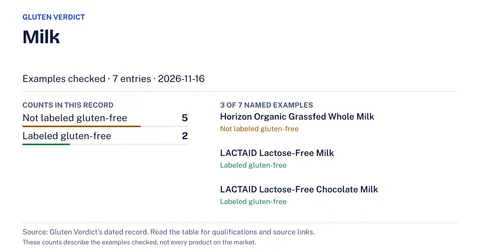 MilkNaturally gluten-freechecked Nov 16, 2026
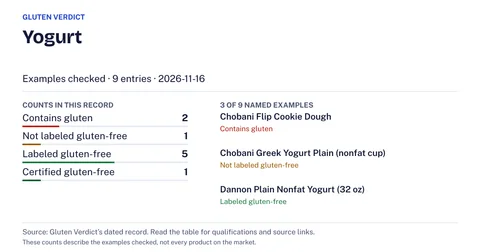 YogurtDepends on the product2 of 9 products we checked contain gluten: Chobani Flip Cookie Dough and Chobani Flip Cookies & Creamchecked Nov 16, 2026
 CheeseNaturally gluten-free3 of 9 products we checked contain gluten: Sargento Balanced Breaks Cheese & Crackers, Monterey Jack & Mild Cheddar with Wheat Thins Mini (6-pack); Farm Rich Mozzarella Sticks; and Farm Rich Cheddar Cheese Curdschecked Nov 16, 2026
Questions people ask
Can you have celiac disease and lactose intolerance at the same time?
Yes. NIDDK lists lactose intolerance due to damage to the small intestine among the digestive symptoms of celiac disease12.
More in Celiac diagnosis, testing and gluten sensitivity
 Celiac disease vs gluten intolerance: three conditions, three diagnosesHow celiac disease, non-celiac gluten sensitivity and wheat allergy differ in mechanism, diagnosis and diet, with a source behind every point.
 Silent celiac disease: who is tested when there are no symptomsWhat silent celiac disease means, what the US Preventive Services Task Force said about screening without symptoms, and which groups guidelines test.
 How celiac disease is diagnosed, step by stepFrom blood test to biopsy or no-biopsy diagnosis: what US, European and UK guidelines say, where they differ, and what they say about eating gluten first.
 Celiac disease or IBS: overlapping symptoms and what guidelines say about testingWhat the ACG IBS guideline says about celiac blood tests, how the two conditions compare per NIDDK, and why celiac testing needs gluten in the diet.
 Questions to bring to a gastroenterologist when celiac disease is suspectedQuestions for a celiac disease appointment: what to bring, what the sources say about diet before testing, and what to ask about the biopsy and follow-up.
 Seronegative celiac disease: when antibodies are negative but the biopsy is notWhat seronegative celiac disease means, which checks come before the label (total IgA, gluten intake, other causes) and what published series report.
All 25 guides in Celiac diagnosis, testing and gluten sensitivity
Related guides
 Celiac Blood Tests: What tTG-IgA, Total IgA, DGP and EMA Each CheckWhat tTG-IgA, total IgA, EMA and DGP check, why total IgA is drawn with tTG-IgA, when back-up tests are used, and why gluten stays in the diet first.
 Bloated after bread or pasta? Why the celiac blood test comes before cutting glutenWhy bloating after bread or pasta cannot name its cause, why celiac blood tests come before a gluten-free diet, and what to ask a clinician.
 Lactose intolerance after a celiac diagnosis: why it happens and how long it lastsWhy lactose intolerance can follow a celiac diagnosis, what published studies report about recovery on a gluten-free diet, and how lactose-free milk fits.
 Gluten-free and dairy-free: how to check a US label for bothUS labels treat milk and gluten under different rules. How to read for both, which makers state both claims, and what to ask when eating out.
Sources
- [1, 14] National Institute of Diabetes and Digestive and Kidney Diseases (NIDDK), Definition & Facts for Lactose Intolerance, checked Nov 17, 2026.
- [2, 4, 10, 11, 15] National Institute of Diabetes and Digestive and Kidney Diseases (NIDDK), Symptoms & Causes of Lactose Intolerance, checked Nov 17, 2026.
Read on 2026-11-17: the list under “What are the symptoms of lactose intolerance?” names bloating, diarrhea, gas, nausea, pain in your abdomen, stomach “growling” or rumbling sounds, and vomiting.
- [3] National Institute of Diabetes and Digestive and Kidney Diseases (NIDDK), Definition & Facts for Celiac Disease, checked Nov 17, 2026.
- [5, 6, 7, 16, 17] National Institute of Diabetes and Digestive and Kidney Diseases (NIDDK), Diagnosis of Lactose Intolerance, checked Nov 17, 2026.
- [8, 9, 13, 18, 22] National Institute of Diabetes and Digestive and Kidney Diseases (NIDDK), Diagnosis of Celiac Disease, checked Nov 17, 2026.
- [12] National Institute of Diabetes and Digestive and Kidney Diseases (NIDDK), Symptoms & Causes of Celiac Disease, checked Nov 17, 2026.
Read on 2026-11-17: the list of digestive symptoms of celiac disease names bloating, chronic diarrhea, constipation, gas, lactose intolerance due to damage to the small intestine, loose, greasy, bulky, and bad-smelling stools, nausea or vomiting, and pain in the abdomen.
- [19, 20] American College of Gastroenterology (American Journal of Gastroenterology, 2023), American College of Gastroenterology Guidelines Update: Diagnosis and Management of Celiac Disease, checked Nov 17, 2026.
- [21] Celiac Disease Foundation, Diagnosis of Celiac Disease, checked Nov 17, 2026.
- [23, 26, 27, 30] Nutrients (MDPI), via PubMed Central, Nutrition in Patients with Lactose Malabsorption, Celiac Disease, and Related Disorders (Alkalay, Nutrients, 2021), checked Nov 17, 2026.
- [24] American Journal of Gastroenterology (PubMed), Lactase enzyme, detected immunohistochemically, is lost in active celiac disease, but unaffected by oats challenge (Srinivasan et al., 1999), checked Nov 17, 2026.
- [25, 32, 39] Scandinavian Journal of Gastroenterology (PubMed), Incidence and clinical significance of lactose malabsorption in adult coeliac disease (Bodé and Gudmand-Høyer, 1988), checked Nov 17, 2026.
- [28, 29, 33, 35] Coeliac UK, Lactose Intolerant with Coeliac Disease? What You Need to Know, checked Nov 17, 2026.
- [31, 38] Scandinavian Journal of Gastroenterology (PubMed), Regression of lactose malabsorption in coeliac patients after receiving a gluten-free diet (Ojetti et al., 2008), checked Nov 17, 2026.
- [34, 36, 37] National Institute of Diabetes and Digestive and Kidney Diseases (NIDDK), Eating, Diet, & Nutrition for Lactose Intolerance, checked Nov 17, 2026.
Read on 2026-11-17: the list after “The following words mean that the product contains lactose:” names milk, lactose, whey, curds, milk by-products, dry milk solids, and nonfat dry milk powder.