Gluten-free and dairy-free: how to check a US label for both
Short answer
Read every package twice, once for each limit, because US rules treat the two differently:
- Gluten: look for a voluntary “gluten-free” claim, which FDA says means less than 20 parts per million of gluten1, 2. Barley and rye are not on FDA’s allergen table, so a Contains line cannot clear them3.
- Milk: it is a major allergen, and its food source name has to appear in the ingredient list or in a Contains line4, 5, 6.
- “Dairy-free” and “milk-free”: FDA does not define either term, and a maker who uses one has to be truthful7.
- A maker’s own page that states both claims is the place to check a dairy-free substitute for gluten; the table below lists some.
Part of Nutrition and combining diets, 24 guides
Key points
- Milk must be named on a US label as a major allergen4, 8; barley and rye are not on FDA’s table of major allergens3.
- “Gluten-free” is a voluntary claim defined by FDA1, 2; FDA does not define “dairy-free” or “milk-free”7.
- Whey, caseinate and nonfat dry milk all come from milk: FDA’s own example is “whey (milk)”5, and it says sodium caseinate and nonfat dry milk are derived from milk9. A Contains line has to name milk when it is an ingredient10.
- Oat-based and nut-based milks add a gluten question (oats) or a tree-nut question (nuts) on top of the milk question11, 3.
- Food a restaurant or store puts in a wrapper or container in response to a customer’s order is outside the packaged-food allergen labeling requirements12.
Why one label needs two checks
Milk and gluten follow different US rules. Milk is one of the major food allergens that FDA-regulated labels must name4: FDA lists milk, eggs, fish, crustacean shellfish, tree nuts, peanuts, wheat and soybeans8, plus sesame since January 1, 202313.
Gluten is handled another way. Wheat is on that list, but FDA’s table of major allergens does not name barley or rye3, while the gluten-free rule defines gluten-containing grains as wheat, rye and barley and their crossbred hybrids14. A Contains line that names milk and says nothing about wheat therefore tells you nothing about barley or rye; our guide to the Contains line goes through it.
| Milk | Gluten | |
|---|---|---|
| Named by law on a label? | Yes, as a major food allergen4 | Wheat is a major allergen; barley and rye are not named3 |
| How it shows up | Source name in the ingredient list, or in a Contains line5, 6 | A voluntary “gluten-free” claim, which FDA says means less than 20 parts per million1, 2 |
| What a “free” claim means | FDA does not define “dairy-free” or “milk-free”; if used, the claim must be truthful7, and for a “milk-free” or similar claim FDA would expect no milk allergen in the product, including from cross-contact15 | Defined by rule: any unavoidable gluten in the food must be below 20 ppm16 |
So one claim is silent on the other. A “gluten-free” claim speaks to gluten only, and “dairy-free” speaks to milk only. Read the package for both, and treat a claim for one limit as no information about the second. Our guide to reading a US food label for gluten covers the gluten side in detail.
Words for milk on the label
FDA says the milk requirement is met when an ingredient’s own name already carries the allergen’s source name, and its example is buttermilk17. Otherwise the source name goes in parentheses after the ingredient, as in “whey (milk)”5, or in a Contains line6.
- Sodium caseinate and nonfat dry milk are both derived from milk, FDA says9. When a Contains line is used, it has to name the source of every major allergen used as an ingredient10.
- Lactose and ghee: FDA notes that residual milk protein is often present in these ingredients, so the allergen labeling rules apply to them when it is18.
- Goat and sheep milk count as milk for FDA’s allergen rules19; FDA says labels should also name the animal, as in “whey (goat milk)”20.
- For lactose, NIDDK lists these ingredient-list words as meaning the product contains it: milk, lactose, whey, curds, milk by-products, dry milk solids and nonfat dry milk powder21.
The front-of-pack word “nondairy” is not a clearing word on its own. NIDDK’s list of products that may contain lactose includes nondairy coffee creamers and nondairy whipped toppings22, and Coeliac UK notes that gluten-free foods can sometimes contain milk as an ingredient23. The ingredient list and the allergen declaration decide.
A “dairy-free” claim is the maker’s statement. In FDA’s sampling of dark chocolate bars and chips labeled “dairy free” or with similar claims, run from July 2018 to October 2019, four of 52 products had potentially hazardous levels of milk allergen24. FDA says people with milk allergy who choose dairy-free chocolate may wish to ask makers whether the product is made on dedicated equipment, whether the ingredients are free of milk, and whether the maker tests for milk25.
Lactose intolerance, milk allergy and celiac disease are different
Lactose intolerance, milk allergy and celiac disease are separate matters, and the sources keep them apart. NIDDK says lactose intolerance and milk allergy are different conditions: the first is a problem digesting the sugar lactose, the second an immune response to milk proteins26.
Celiac disease can overlap with the first. NIDDK lists lactose intolerance due to damage to the small intestine among the digestive symptoms of celiac disease27, and Coeliac UK says it is associated with undiagnosed coeliac disease and is usually temporary28. Our guide on lactose intolerance after a celiac diagnosis sets out what the sources say about how long it lasts.
Asked whether people with celiac disease also have to avoid dairy, a National Celiac Association dietitian’s answer begins “Likely, no”29. The same answer names reasons some people cannot tolerate milk at all30.
Whether a person cuts milk, and for how long, is a decision for their own doctor or dietitian: NIDDK advises talking with one before changing the diet for lactose intolerance31, and Coeliac UK says not to remove lactose before speaking to a healthcare professional32.
Milk, cheese and butter substitutes: what each base adds
In the same answer, the National Celiac Association dietitian says the BIDMC Celiac Center recommends a few months of a lactose-free or lactose-reduced trial when it suspects lactose intolerance, and that meanwhile substitutions can be lactose-free milk or yogurt, hard and aged cheeses, and non-dairy beverages such as almond, coconut, rice or soy milk. The answer adds: “All must be labeled gluten free”33. Each plant base brings its own question to the two checks:
| Base | Gluten side | Allergen side | Our verdict |
|---|---|---|---|
| Oat | GIG says oat milk is assessed the same way as whole oats11; the Celiac Disease Foundation says oats are often processed on the same equipment as wheat34; oats labeled gluten-free must contain less than 20 ppm35 | Oats are not named in FDA’s major allergen table3 | Oat milk |
| Soy | Soy is on the Celiac Disease Foundation’s list of naturally gluten-free foods36 | Soybeans are a major food allergen8 | Soy milk |
| Almond and cashew | The Celiac Disease Foundation lists nuts among naturally gluten-free food groups37 | Tree nuts, such as almonds, are a major allergen group3; cashew is on FDA’s table of tree nuts it considers major food allergens62 | Almond milk, cashew milk |
| Coconut | See our verdict | FDA no longer considers coconut a major food allergen38, but as an ingredient it still has to be listed in the ingredient list, unless an exemption applies39 | Coconut milk |
| Rice and pea | See our verdicts | Neither is named in FDA’s major allergen table3 | Rice milk, pea milk |
For the dairy foods themselves, our verdicts show what makers’ pages said about gluten: milk, cheese, butter, yogurt, sour cream, cream cheese, ice cream, whipped cream. For baking swaps, see egg and dairy substitutes in gluten-free baking.
Products whose makers state both claims
These rows come only from a maker’s own page, read on 2026-11-17, where the page states both a gluten-free and a dairy-free claim. They are the makers’ statements, not results from our own testing, and a product that is not listed has simply not been checked. Recipes change, so the package in your hand has the final word.
| Product | What the maker’s page says | Allergens the page declares | Our verdict |
|---|---|---|---|
| Silk Original Soymilk | “Free from dairy, gluten, carrageenan, cholesterol, and artificial colors & flavors”40 | “CONTAINS SOY.”41 | Soy milk |
| Planet Oat Original Oatmilk | Lists Gluten Free and Dairy Free among its “Reasons to Love”42 | Lists Soy Free, Peanut Free and Tree Nut Free42 | Oat milk |
| Oatly Oatmilk (US) | US products are made from certified gluten-free oats and labeled gluten-free43 | US products are made without tree nuts, peanuts, dairy and egg44 | Oat milk |
| Forager Project Organic Unsweetened Cashewmilk | Badges read Dairy free and Gluten free; the oats in it are gluten-free oats45 | Contains: Cashews; may contain: coconut45 | Cashew milk |
| Daiya Dairy-Free Original Cream Cheese | Lists Dairy and Gluten under “Free of These Common Allergens”; made with gluten-free oat flour46 | Ingredients list oat flour, pea protein and coconut oil46 | Cream cheese |
| Country Crock Plant Butter with Olive Oil | “It is plant-based, dairy-free and gluten-free”47 | Ingredients include soybean oil and soy lecithin48 | Butter |
Silk’s FAQ says its kosher OU-D mark means its dairy-free products may have been processed on equipment that was also used for dairy49. FDA, writing about dairy-free chocolate, says people with milk allergy may wish to ask makers how a product is made25.
Ordering with both limits
The packaged-food allergen rules reach food packaged by a retail or foodservice business, but not food placed in a wrapper or container in response to a customer’s order12. For gluten-free wording on menus, FDA says restaurants’ use of it should be consistent with the federal definition50, with state and local governments overseeing restaurants51. In practice the information comes from the restaurant: its chart or its staff.
A chart can carry both limits on one page. Buffalo Wild Wings’ guide, for example, has MILK, WHEAT and GLUTEN columns52, and says it cannot eliminate the risk of cross-contact or guarantee that any item is free of any allergen53. Our guide to reading a restaurant allergen chart covers what the columns and symbols do and do not say.
NIDDK’s celiac page tells people to let the server know about celiac disease and to ask about ingredients and how food is prepared54. With both limits, ask each question twice:
- Gluten: “Are the french fries cooked in a dedicated fryer, or do they share oil with breaded items?” is one of the questions the Gluten Intolerance Group suggests55; it lists shared cooking oil or grill space with heavily breaded items as a red flag56.
- Milk: does the dish, sauce, dressing or marinade contain milk, cream, butter, cheese or whey, and is anything finished with butter on the grill or pan?
- Both: can the kitchen use clean utensils and a clean surface, and can someone check the packaged sauces and mixes in the kitchen?
- Ask for the answer from the kitchen rather than from memory, and ask again if the order is changed.
Where the calcium goes
Dropping milk affects more than the label. NIDDK’s lactose page says that avoiding all milk and milk products may leave less calcium and vitamin D than needed57, and its celiac page says that starting a gluten-free diet without advice may leave a diet short of nutrients such as calcium58.
FDA notes that the Dietary Guidelines for Americans include only fortified soy beverages in the dairy group59, and suggests comparing the Nutrition Facts labels of milk and plant-based beverages60. Which foods and amounts suit one person is a question for a doctor or dietitian.
Verdicts in this guide
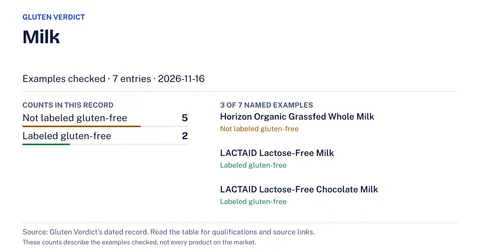 MilkNaturally gluten-freechecked Nov 16, 2026
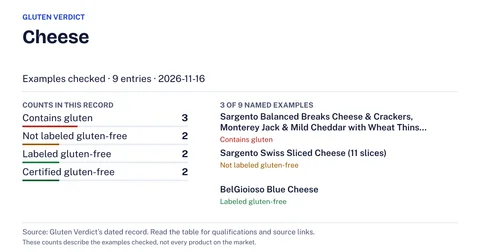 CheeseNaturally gluten-free3 of 9 products we checked contain gluten: Sargento Balanced Breaks Cheese & Crackers, Monterey Jack & Mild Cheddar with Wheat Thins Mini (6-pack); Farm Rich Mozzarella Sticks; and Farm Rich Cheddar Cheese Curdschecked Nov 16, 2026
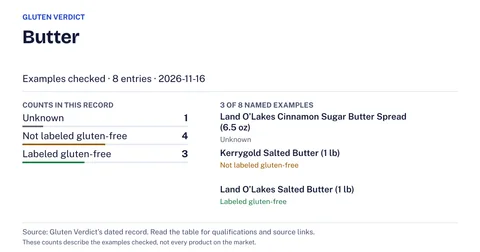 ButterNaturally gluten-freechecked Nov 16, 2026
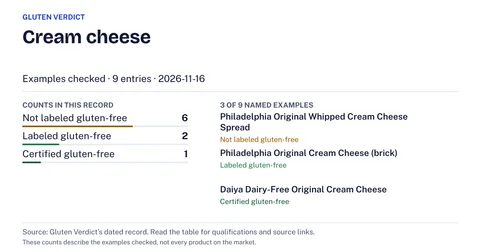 Cream cheeseNaturally gluten-freechecked Nov 16, 2026
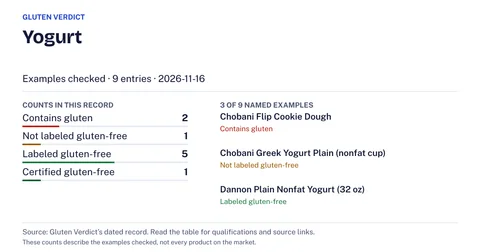 YogurtDepends on the product2 of 9 products we checked contain gluten: Chobani Flip Cookie Dough and Chobani Flip Cookies & Creamchecked Nov 16, 2026
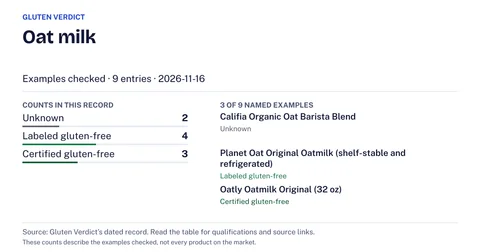 Oat milkDepends on the productchecked Nov 16, 2026
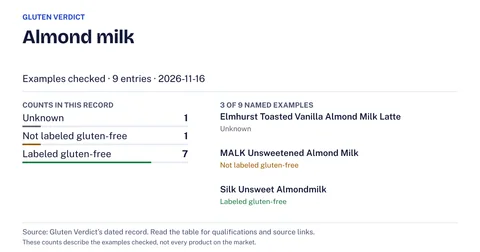 Almond milkNaturally gluten-freechecked Nov 16, 2026
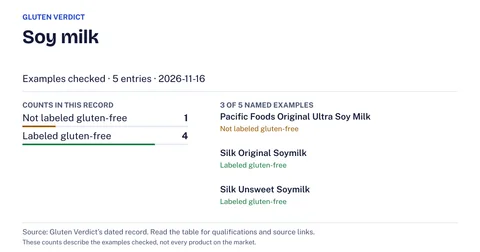 Soy milkNaturally gluten-freechecked Nov 16, 2026
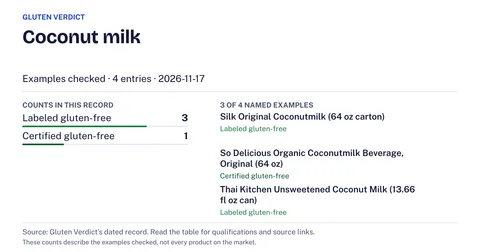 Coconut milkNaturally gluten-freechecked Nov 17, 2026
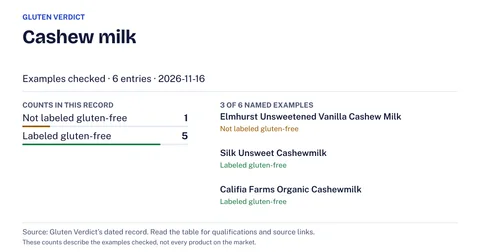 Cashew milkNaturally gluten-freechecked Nov 16, 2026
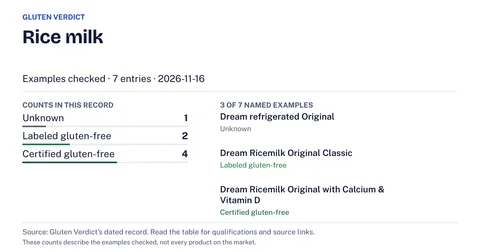 Rice milkDepends on the productchecked Nov 16, 2026
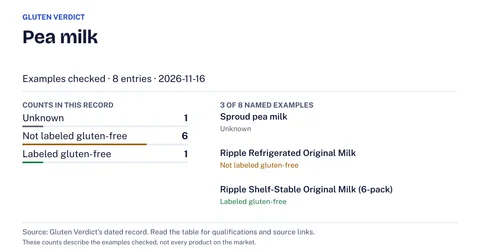 Pea milkNaturally gluten-freechecked Nov 16, 2026
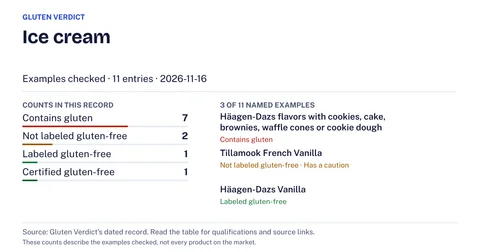 Ice creamDepends on the product7 of 11 products we checked contain glutenchecked Nov 16, 2026
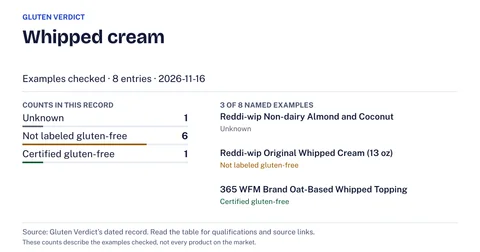 Whipped creamDepends on the productchecked Nov 16, 2026
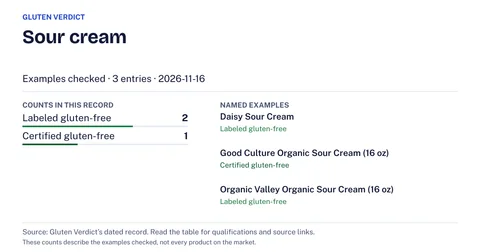 Sour creamNaturally gluten-freechecked Nov 16, 2026
Questions people ask
Does “dairy-free” have a legal meaning in the US?
FDA says it does not define “dairy-free” or “milk-free”, and that such claims are voluntary and must be truthful and not misleading7. FDA’s allergen guidance says no regulations define the conditions for a “free” claim from a major allergen source61, but that it would expect no milk allergen in a product with a “milk-free” claim, including from cross-contact15.
More in Nutrition and combining diets
 Calcium and magnesium on a gluten-free, dairy-free dietWhere calcium and magnesium come from without dairy or gluten, and how to read a plant milk’s panel and ingredient list for added calcium.
 Reading a US label for gluten and another food allergyHow to read a US food label for gluten and a second allergen: what the Contains line, gluten-free claim and may-contain lines each cover.
 Vitamin D with celiac disease: reading a result and checking a supplement for glutenWhat a vitamin D blood result measures, the published reference levels and upper intake level, and how to check a supplement label for gluten.
 What to eat after a celiac diagnosis: what the sources document and what they do notBone broth, collagen, glutamine or plain staples? What NIDDK, ACG and celiac charities document after a diagnosis, and what no page we read names.
 Gluten-free vegetarian protein: what to check on beans, lentils, tofu and tempehWhat to read on beans, lentils, tofu, tempeh and meat substitutes when you are vegetarian and gluten-free: stray grain, added grains, sauces and batters.
 Gluten-free and low FODMAP: what to check when symptoms continueHow gluten and FODMAPs differ, what guidelines list for persistent symptoms on a gluten-free diet, and FODMAP ingredients to look for on labels.
Related guides
 Lactose intolerance after a celiac diagnosis: why it happens and how long it lastsWhy lactose intolerance can follow a celiac diagnosis, what published studies report about recovery on a gluten-free diet, and how lactose-free milk fits.
 How to read a US food label for glutenWhere gluten shows up on a US food label: the gluten-free claim, the Contains line, the ingredient list and may-contain lines, and what each means.
 Where wheat, barley and rye hide in processed food: 15 places to checkFifteen processed foods where wheat, barley or rye turn up, the label step that catches each, and what US allergen law does and does not flag.
 Oat milk and other plant milks: what to check for glutenWhy oat milk is the plant milk to check for gluten, what a gluten-free claim and a certifier’s mark mean, and how almond, soy and other milks compare.
Sources
- [1, 2, 50, 51] US Food and Drug Administration, Gluten and Food Labeling, checked Nov 17, 2026.
- [3, 9, 10, 12, 15, 18, 19, 20, 61, 62] US Food and Drug Administration, Questions and Answers Regarding Food Allergens (Edition 5), checked Nov 17, 2026.
Read on 2026-11-17: the table under question A.1, “What foods and food groups are designated as ‘major food allergens’?”, lists the foods Milk, Eggs, Peanuts, Wheat, Soybeans and Sesame, and the food groups Fish, Crustacean shellfish (such as crab, lobster, shrimp) and Tree nuts (such as almonds, walnuts, pecans). Barley, rye, oats, rice and peas are not named.
Read on 2026-11-17: Table 1 under question C.7, “Tree Nuts FDA Considers as Major Food Allergens with Their Common or Usual Names and Scientific Names”, lists Almond and Cashew among the common or usual names.
- [4, 5, 6, 8, 13, 17] US Food and Drug Administration, Food Allergies: What You Need to Know, checked Nov 17, 2026.
- [7, 24, 25] US Food and Drug Administration, FDA Releases Results on Sampling of Dairy-Free Dark Chocolate for Milk Allergen (constituent update, October 1, 2020), checked Nov 17, 2026.
- [11] Gluten Intolerance Group, Oat milk in a gluten-free diet (GIG FAQ), checked Nov 17, 2026.
- [14, 16] US Government Publishing Office / National Archives (eCFR), 21 CFR 101.91 Gluten-free labeling of food, checked Nov 17, 2026.
- [21, 22, 31, 57] US National Institute of Diabetes and Digestive and Kidney Diseases (NIDDK), Eating, Diet, & Nutrition for Lactose Intolerance, checked Nov 17, 2026.
Read on 2026-11-17: under “What foods and drinks contain lactose?” the page says “The following words mean that the product contains lactose” and lists milk, lactose, whey, curds, milk by-products, dry milk solids and nonfat dry milk powder.
Read on 2026-11-17: the list on the page of products that may contain lactose names bread and other baked goods, processed foods (including breakfast cereals, instant potatoes, soups, margarine, salad dressings and flavored chips and other snack foods), processed meats, milk-based meal replacement liquids and powders, smoothies, protein powders and bars, and “nondairy liquid and powdered coffee creamers, and nondairy whipped toppings”.
- [23, 28, 32] Coeliac UK, Lactose intolerance, checked Nov 17, 2026.
- [26] US National Institute of Diabetes and Digestive and Kidney Diseases (NIDDK), Symptoms & Causes of Lactose Intolerance, checked Nov 17, 2026.
- [27] US National Institute of Diabetes and Digestive and Kidney Diseases (NIDDK), Symptoms & Causes of Celiac Disease, checked Nov 17, 2026.
Read on 2026-11-17: the list of digestive symptoms of celiac disease on the page names bloating, chronic diarrhea, constipation, gas, lactose intolerance due to damage to the small intestine, loose, greasy, bulky, and bad-smelling stools, nausea or vomiting, and pain in the abdomen.
- [29, 30, 33] National Celiac Association, Do I have to avoid dairy products?, checked Nov 17, 2026.
Read on 2026-11-17: after “Some patients find that they cannot tolerate milk at all. They might:” the answer lists four reasons: being highly sensitive to lactose even in small amounts; being unable to tolerate milk proteins (whey and, more often, casein); having a true food allergy to milk; or having chosen to avoid animal products for ethical, environmental or other health reasons.
- [34, 36, 37] Celiac Disease Foundation, Gluten-Free Foods, checked Nov 17, 2026.
Read on 2026-11-17: the list on the page headed “The following grains, legumes, seeds, and other starchy foods are naturally gluten-free” includes nut flours, rice and soy.
Read on 2026-11-17: the page lists “Dairy” and “Beans, legumes, and nuts” among the naturally gluten-free food groups.
- [35] US Food and Drug Administration, Questions and Answers on the Gluten-Free Food Labeling Final Rule, checked Nov 17, 2026.
- [38, 39] US Food and Drug Administration, Frequently Asked Questions: Food Allergen Labeling Guidance, checked Nov 17, 2026.
- [40, 41] Silk (Danone North America), Silk Original Soymilk, checked Nov 17, 2026.
- [42] Planet Oat, Planet Oat Original Oatmilk, checked Nov 17, 2026.
Read on 2026-11-17: under “Reasons to Love Planet Oat” the page lists Gluten Free, Dairy Free, Lactose Free, No Artificial Flavors, Colors & Preservatives, Soy Free, Non-GMO Project Verified, Peanut Free and Tree Nut Free.
- [43, 44] Oatly, Oatly US FAQ (Random Answers), checked Nov 17, 2026.
- [45] Forager Project, Organic Unsweetened Cashewmilk, checked Nov 17, 2026.
Read on 2026-11-17: the product page lists the badges Organic, Vegan, Soy free, Dairy free, Gluten free and BPA free; the ingredients read “Filtered Water, Cashews*, Gluten-free Oats*, Sea Salt”; and the allergen line reads “Contains: Cashews. May Contain: Coconut”.
- [46] Daiya, Dairy-Free Original Cream Cheese, checked Nov 17, 2026.
Read on 2026-11-17: under the heading “Free of These Common Allergens” the page lists Dairy and Gluten; its ingredients begin “Daiya Oat Cream Blend (Water, Gluten-free Oat Flour, Pea Protein, Cultures, Enzymes), Coconut Oil, Modified Potato Starch”.
- [47, 48] Country Crock (Upfield), Country Crock Plant Butter tub with Olive Oil, checked Nov 17, 2026.
Read on 2026-11-17: the ingredients list begins “Blend Of Plant-based Oils (Soybean, Palm Fruit, Palm Kernel, Olive and Extra Virgin Olive Oil), Water, Salt, Pea Protein, Soy Lecithin”.
- [49] Silk (Danone North America), Silk FAQ, checked Nov 17, 2026.
- [52, 53] Buffalo Wild Wings, Allergen & Preparation Guide (8-page PDF chart), checked Nov 17, 2026.
Read the 8-page PDF on 2026-11-17: menu items run down the left side and the column headings across the top read FRIED (IN BEEF TALLOW) under the heading Preparation, then EGG, FISH, MILK, PEANUTS, SESAME, SHELLFISH, SOY*, TREE NUTS, WHEAT and GLUTEN under the heading Common Allergens.
- [54, 58] US National Institute of Diabetes and Digestive and Kidney Diseases (NIDDK), Eating, Diet, & Nutrition for Celiac Disease, checked Nov 17, 2026.
- [55, 56] Gluten Intolerance Group, Questions to Ask When Eating Out, checked Nov 17, 2026.
- [59, 60] US Food and Drug Administration, Using the Nutrition Facts Label to Choose Milk and Plant-Based Beverages, checked Nov 17, 2026.