Coffee and donut chains and gluten: what Starbucks and Tim Hortons say about shared equipment
Short answer
Starbucks says on its own pages that it uses shared equipment to prepare and serve unpackaged products, and Tim Hortons says normal kitchen operations may involve shared equipment11, 1. Tim Hortons says it cannot guarantee that cross-contact of allergens will not occur, and Starbucks says it cannot guarantee that unpackaged products are allergen-free2, 11. Before you choose an item, check three things:
- The chain’s own allergen line or chart for that item: Starbucks shows an Allergens line on the item pages we read, and Tim Hortons marks a “Wheat & Gluten” column14, 6.
- The chain’s shared-equipment wording, which says what the item may touch on its way to you1, 11.
- Whether the item is packaged: FDA says its gluten-free regulation applies to packaged foods, and that for unpackaged food it will monitor reported information18, 20.
Part of Eating out and chain restaurant policies, 25 guides

Key points
- Tim Hortons’ notice names the oven, beverage machines, toaster and panini press as possibly shared1.
- Starbucks says it cannot guarantee that any unpackaged product served in its cafés is allergen-free, because it uses shared equipment11.
- A row with no wheat mark describes the item’s listed ingredients, not how it was handled5, 1.
- We found no gluten-free claim on the Tim Hortons Allergens page or PDF, or on the Starbucks egg bites page10, 9, 15.
- Neither the Tim Hortons PDF nor the Starbucks egg bites page names tongs or a pastry case9, 15.
Why food at a coffee counter is a different question
Food at a coffee counter raises a question a plain drink rarely does: what else the item touches. Both chains address it in general terms. Starbucks writes that it cannot guarantee that any unpackaged product served in its cafés is allergen-free because it uses shared equipment to prepare and serve them11. Tim Hortons says normal kitchen operations may involve shared equipment, naming the oven, beverage machines, toaster and panini press, plus shared cooking and preparation areas and utensils1.
Gluten Intolerance Group defines cross-contact as gluten crumbs or particles getting into gluten-free ingredients or food in amounts that could cause an adverse reaction22. At a counter that gives you two questions: what is the item made of, and what touches it on the way to you.
One 2021 study in Clinical Nutrition looked at three everyday practices: frying gluten-free food in a shared fryer, toasting gluten-free bread in a shared toaster, and spreading from a knife used on gluten-containing bread25. It found small amounts of gluten cross-contact, although 93.6% of its results showed no significant cross-contact, and its mayonnaise and peanut butter samples came out above the limit FDA sets for a gluten-free claim26. That study did not test any chain’s kitchen, so it is context rather than a verdict on either chain.
What each chain says, in its own words
| Chain and page | On shared equipment | How an item shows wheat or gluten |
|---|---|---|
| Tim Hortons (US): the Allergens page and the PDF it links, dated “as of January 2025”3 | Names “oven, beverage machines, toaster, panini press”, shared cooking and preparation areas and utensils, and says it cannot guarantee that cross-contact of allergens will not occur1, 2 | A chart with a “Wheat & Gluten” column; its key reads “x = Contains | o = May Contain”6 |
| Starbucks (US): item pages on starbucks.com/menu | “We cannot guarantee that any unpackaged products served in our cafés are allergen-free because we use shared equipment to café, prepare, and serve them.”11 | An Allergens line on the item pages we read: “Egg, Milk” on the Bacon & Gruyère Egg Bites, “Egg, Milk, Wheat” on the Butter Croissant14, 16 |
Neither statement names gluten. Tim Hortons’ notice speaks of allergens in general, and “Gluten” appears in its PDF only as the heading of the wheat column9; Starbucks’ egg bites page does not use the word either15. Where gluten is concerned, the item-level mark is what each chain gives you.
Items with no wheat mark: egg bites, omelette bites and the hash brown
Starbucks’ Bacon & Gruyère Egg Bites page lists Egg and Milk as allergens, and its ingredient list names no wheat, barley or rye14. The page makes no gluten-free claim15, and it carries the shared-equipment sentence quoted above11. Our Starbucks egg bites verdict has the full reading.
In Tim Hortons’ PDF, the “Wheat & Gluten” column carries no mark on the Hash Brown or on the three Omelette Bite rows8. The same PDF says the oven and toaster may be shared and that it cannot guarantee that cross-contact will not occur1, 2, and it makes no gluten-free claim9. See the Tim Hortons verdict for how we read the chart.
No wheat mark means the chain’s chart lists no wheat for the item. Tim Hortons says the chart is based on standard product formulations and information from its suppliers5, so it describes what the item is made of, not how it was heated, held or handed over.
Donuts, muffins and bakery items
Tim Hortons’ chart carries an x in the “Wheat & Gluten” column on every row under Donuts, Timbits®, Muffins, Cookies, Croissants and Bagels, and on its breakfast sandwiches and grilled wraps7. At Starbucks, the Butter Croissant page lists Wheat among its allergens16. For these items the chain’s own chart or page already marks wheat, so the shared-tongs and shared-case question is one for items that carry no such mark.
The Starbucks Breakfast menu puts the egg bites on the same page as its sandwiches, wraps, croissant and bagels17. Our verdicts for the baked items:
Drinks are a separate question; for plain coffee, see our coffee verdict.
Packaged and unpackaged food: what the label adds
FDA’s gluten-free regulation applies to packaged foods, which may be sold in some food-service establishments such as some carry-out restaurants18. For unpackaged food, FDA says it will monitor reported information and share complaints about foods such as those served in restaurants with state and local government partners20. It recommends that restaurants making a gluten-free claim on their menus be consistent with its definition19. Because the regulation is stated for packaged foods, it does not itself cover an item taken from an open case20.
On a packaged food, the claim has to meet FDA’s definition, which includes less than 20 parts per million for any unavoidable gluten21. Starbucks points customers with allergies to the labels of its packaged products, or to Starbucks.com/menu, for ingredient information12. For how to read such a label, see how to read a US food label for gluten.
If you are unsure about an ingredient in a prepared item, Gluten Intolerance Group suggests asking to see the package of any questionable ingredient that went into it24.
Where the pages say nothing
- Tongs and the pastry case: neither the Tim Hortons PDF nor the Starbucks egg bites page names either. Tim Hortons says utensils may be shared9, 1, and Starbucks says “shared equipment”15, 11.
- Fryers: the Tim Hortons PDF does not name one9.
- Dunkin’ and Krispy Kreme: our direct fetch of each site returned a location-restricted page on 2026-11-1727, 28, and we read no allergen wording from either, so this guide does not describe them.
How versions and dates change the answer
Tim Hortons’ PDF reflects products as of January 20253, and menu items in test, Limited Time Only and certain regional offerings may not be in it4. Starbucks calculates its nutrition information from standard recipes and says that, because products may be customized, exact information may vary13. A seasonal or customized item can therefore differ from the page you read.
Three questions at the counter
- What is this item made of, on the chain’s own page or chart for it today?
- Is it sealed in its own package, with a label I can read?
- What does it share on the way to me: an oven, a toaster, tongs, a case?
Gluten Intolerance Group’s advice for eating out is to ask the wait staff, the manager or the cook about how they handle gluten-free food23. For the wider picture, see eating out with celiac disease, breakfast restaurant chains and fast-food fryer and prep policies.
Verdicts in this guide
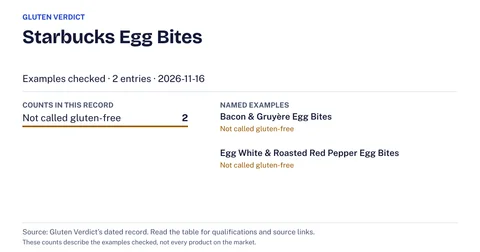 Starbucks Egg BitesNot called gluten-freeStarbucks · checked Nov 16, 2026
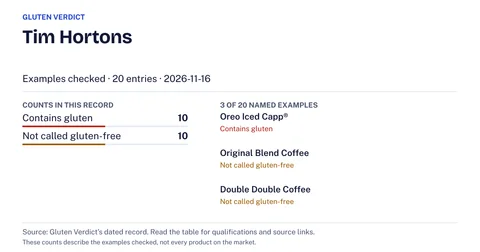 Tim HortonsDepends on the order10 of 20 menu items we checked contain glutenTim Hortons · checked Nov 16, 2026
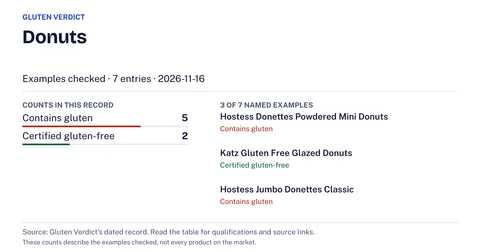 DonutsContains glutenchecked Nov 16, 2026
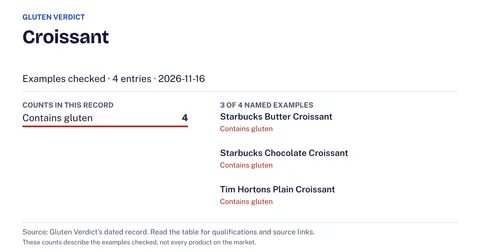 CroissantContains glutenchecked Nov 16, 2026
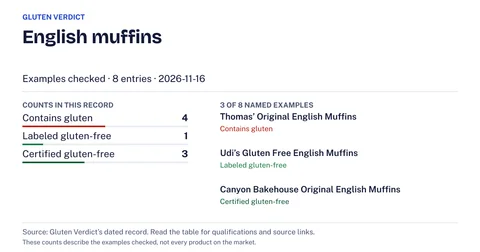 English muffinsDepends on the product4 of 8 products we checked contain glutenchecked Nov 16, 2026
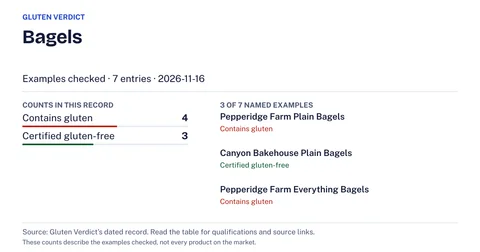 BagelsContains glutenchecked Nov 16, 2026
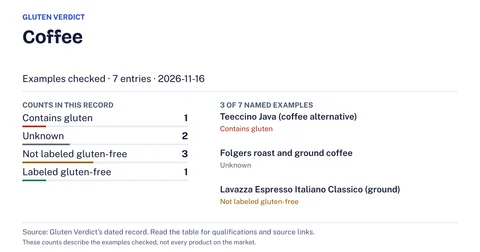 CoffeeDepends on the product1 of 7 products we checked contains gluten: Teeccino Java (coffee alternative)checked Nov 16, 2026
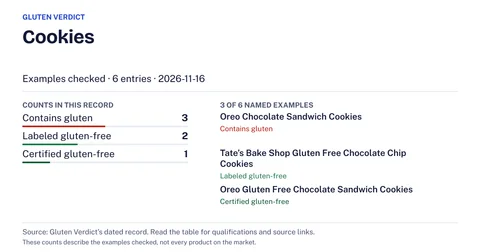 CookiesContains glutenchecked Nov 16, 2026
Questions people ask
More in Eating out and chain restaurant policies
 Ordering at a bagel shop, bakery or coffee counter with celiac diseaseWhat to ask at a bagel shop, bakery or coffee counter: spreads, toasters, knives, display cases, flour in the room, and what the chains say.
 Gluten-free breakfast at restaurant chains: griddles, toasters and batterWhat IHOP, Panera and Tim Hortons say about shared griddles, toasters and fryers, and three questions to ask before you order breakfast out.
 What fast-food chains say about shared fryers, and what a shared-fryer study measuredEach chain's own sentence on fryer oil, with its document and date, plus what a 2026 study measured in fries and chips from shared fryers.
 How to order gluten-free at an ice cream shopWhat to check at a scoop shop or soft-serve counter: flavors, scoops, cones, toppings and shakes, what three chains say, and when a sealed pint helps.
 Pizza chain gluten-free crusts: what each chain says about its kitchenWhat Domino's, Papa Johns, Pizza Hut and Little Caesars say on their own pages about gluten-free crust, shared kitchens and celiac customers.
 Casual-dining chains and gluten: what nine chains’ own allergen documents sayWhat Olive Garden, Outback, Applebee’s, Texas Roadhouse, Red Lobster, Chili’s and others say in writing about fryers, gluten menus and cross-contact.
Related guides
 Gluten in coffee-shop drinks: milk, syrups, toppings and shared toolsTake a coffee-shop drink apart: base, milk, syrup, topping and shared tools. See which label or maker page to read for each part.
 Eating out with celiac disease: what to check, ask and watch forPlan a restaurant meal with celiac disease: what to check before you go, the questions to ask in order, how to read the answers, and what studies measured.
 Eating gluten-free in Canada: gluten-source labels, poutine and Tim HortonsHow a Canadian label names gluten sources, what Health Canada says about gluten-free claims, and how to judge poutine and Tim Hortons.
 Gluten-free bread, buns and wraps: what the package tells youHow to tell a gluten-free bread, bun or wrap from a wheat look-alike: certification mark, maker’s claim or ingredient list, in a fixed order.
Sources
- [1, 2, 3, 4, 5, 6, 7, 8, 9] Tim Hortons (US site), Allergen Information (US PDF linked from the Allergens page), checked Nov 17, 2026.
Read on 2026-11-17: every row listed under Donuts, Donuts - Limited Time Only, Timbits®, Muffins, Cookies, Croissants, Bagels, Classic Breakfast Sandwiches, Bagel Breakfast Sandwiches and Grilled Breakfast Wraps carries an x in the “Wheat & Gluten” column.
Read on 2026-11-17: the “Wheat & Gluten” column carries no mark on the rows Hash Brown, Bacon & Cheese Omelette Bite, Spinach & Egg White Omelette Bite and Loaded Hashbrown Omelette Bite.
Read on 2026-11-17: no sentence in the PDF names a fryer, tongs or a pastry case, and no row or sentence makes a gluten-free claim; the word “Gluten” appears only in the column heading “Wheat & Gluten”.
- [10] Tim Hortons (US site), Allergens, checked Nov 17, 2026.
Read on 2026-11-17: the page’s text is the heading “Allergens” and a “Download Allergen PDF” link to the PDF; it makes no gluten-free claim and has no other allergen wording.
- [11, 12, 13, 14, 15] Starbucks (starbucks.com US), Bacon & Gruyère Egg Bites: Nutrition, checked Nov 17, 2026.
Read on 2026-11-17: the page’s Allergens line reads “Egg, Milk”, and its ingredient list names no wheat, barley or rye.
Read on 2026-11-17: the page makes no gluten-free claim and does not use the word gluten; it names no tongs, pastry case or oven, and its only handling statement is the shared-equipment sentence.
- [16] Starbucks (starbucks.com US), Butter Croissant: Nutrition, checked Nov 17, 2026.
- [17] Starbucks (starbucks.com US), Breakfast menu, checked Nov 17, 2026.
Read on 2026-11-17: the page lists, under Breakfast Sandwiches, Breakfast Wraps, Egg Bites & Bakes and More Breakfast Classics, items including the Bacon & Gruyère Egg Bites, the Butter Croissant, the Plain Bagel and the Everything Bagel.
- [18, 19, 20, 21] US Food and Drug Administration, Questions and Answers on the Gluten-Free Food Labeling Final Rule, checked Nov 17, 2026.
- [22, 23, 24] Gluten Intolerance Group, 25 Ways Cross-Contact Could Happen (And How to Avoid It), checked Nov 17, 2026.
- [25, 26] Clinical Nutrition (PubMed), Gluten cross-contact from common food practices and preparations (abstract), checked Nov 17, 2026.
- [27] Dunkin’, Dunkin’ website (US), checked Nov 17, 2026.
Read on 2026-11-17: our direct fetch returned a page reading “The Dunkin' U.S. website is only available in the United States.” and “We're sorry, but this website cannot be accessed from your current location.”; a second fetch route returned the homepage text, a promotional banner with no allergen or gluten wording.
- [28] Krispy Kreme, Krispy Kreme website, checked Nov 17, 2026.
Read on 2026-11-17: our direct fetch returned a page whose own description reads “The Krispy Kreme site is not available in your location.”; a second fetch route returned the homepage text, a menu and promotions list with no allergen or gluten wording.