Gluten-free bread, buns and wraps: what the package tells you
Short answer
Breads are among the foods that typically contain gluten1, so check a bread, bun or wrap in this order:
- A third-party certification mark, which GFCO says counts when the product is also on its list2; GFCO says certified products test at 10 ppm of gluten or less3.
- A maker’s “gluten-free” claim: FDA’s rule says foods that carry it must contain less than 20 parts per million of gluten46, and the rule applies to packaged foods11.
- The ingredient list, for wheat varieties such as spelt and khorasan, rye and barley malt5, 6; GIG notes that barley and rye are not allergens, so they are not given the same treatment on ingredient labels as wheat, which US law lists as a major food allergen7, 36.
- Any “may contain” or shared-facility line, which is voluntary8.
Part of Grocery shopping and meal planning, 15 guides
Key points
- A certification mark and a maker’s “gluten-free” claim are different things: GIG says a gluten-free label should mean less than 20 ppm, but there is no guarantee the food is properly tested, and points to GFCO certification for added assurance9.
- One gluten-free bread does not clear the maker’s other breads: FDA says a manufacturer may make both gluten-free foods and foods that contain gluten10.
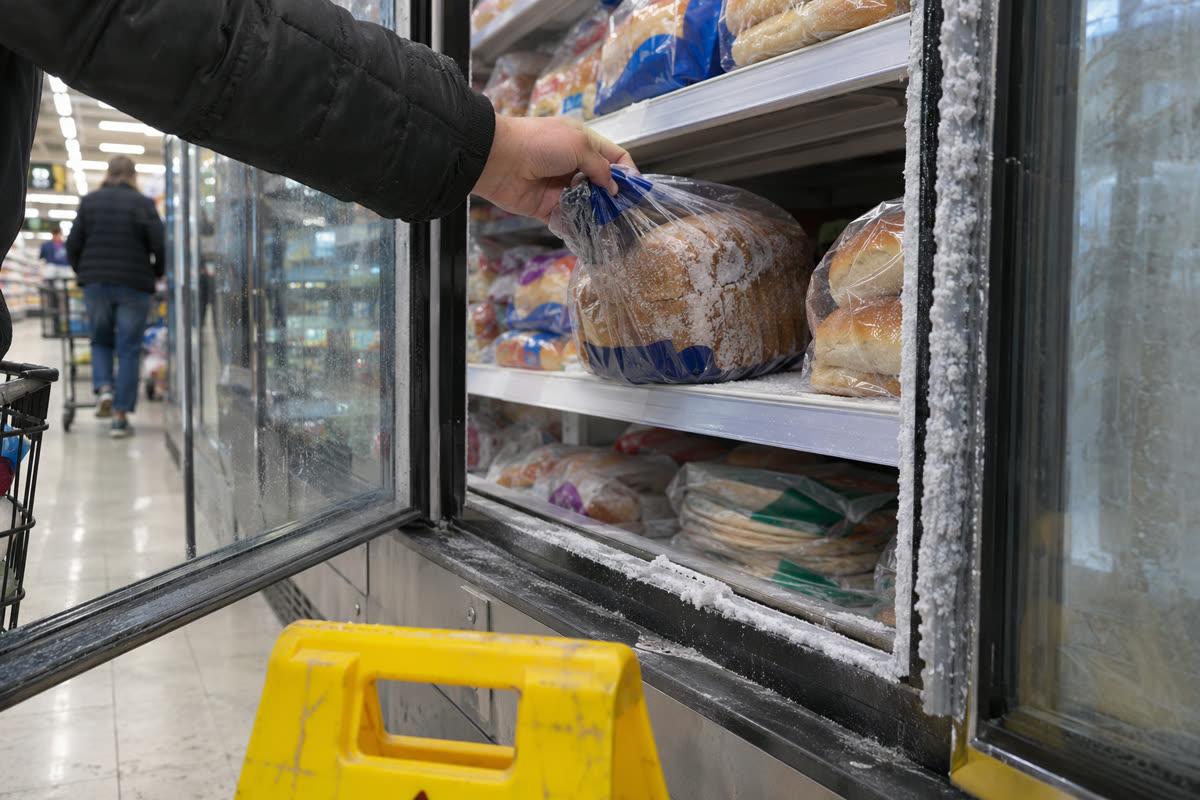
- FDA’s gluten-free regulation applies to packaged foods, so an unpackaged loaf from a bakery counter is not covered the way a bag is11.
- A bread labeled “wheat free” might contain rye or other grains12.
- A wrap’s name does not settle it: Mission describes its certified gluten-free wraps as soft taco flour tortillas13, 37, and GIG says some corn tortillas contain a mix of corn and wheat flour14.
Which of three claims is on the package?
A bread bag can carry a certification mark, a maker’s own “gluten-free” claim, or neither. They rest on different things, and they are not interchangeable.
| On the package | What stands behind it | What it leaves open |
|---|---|---|
| A certification mark (GFCO’s, for example) | GFCO says it certifies physical products, not brands or facilities15. For established brands, it says it requires ongoing regular testing of ingredients, shared equipment and finished products16, and annual in-person audits at every facility where certified products are made17. It says certified products test at 10 ppm or less3. | FDA does not endorse, accredit or recommend any particular third-party certification program18. GFCO’s product finder says products are considered certified if they appear on its list and carry a certification mark2. |
| “Gluten-free” (or “free of gluten”, “without gluten”, “no gluten”) from the maker | The food has to meet FDA’s rule, including less than 20 ppm for any unavoidable gluten4, 19. FDA enforces it through sampling, inspections, label reviews and complaint follow-up20. | FDA does not require manufacturers to test for gluten to use the claim21. GIG says there is no guarantee that foods labeled gluten-free are properly tested, and points to GFCO certification for added assurance9. |
| Neither: the ingredient list alone | Only what the list shows. FDA allows a truthful statement such as “made with no gluten-containing ingredients”, but says that without a “gluten-free” claim on the label, consumers should not assume the food meets all FDA requirements for that claim22. | GIG says some products that look gluten-free from their ingredient lists carry a higher risk of cross-contact and are best avoided unless certified or labeled gluten-free; its examples include oats and milled products such as sorghum flour23. |
Our advice is to take them in that order: a mark you can find in the certifier’s list, then a maker’s claim, then the ingredient list alone. To check a mark, see how to check a gluten-free seal in the certifier’s own directory; for how programs differ, see gluten-free certification programs compared.
What FDA’s gluten-free claim covers on a bread
For a packaged bread, the rule asks that the loaf contain no gluten-containing grain and no ingredient derived from one that was not processed to remove gluten, and that any unavoidable gluten be under 20 parts per million4. FDA adds that a food labeled gluten-free cannot be intentionally made with any amount of such a grain or ingredient24.
Three other phrases carry the same requirements: “free of gluten”, “without gluten” and “no gluten”19. Using any of them is voluntary25.
In 2017 FDA released the results of an analysis of 702 samples from more than 250 products labeled gluten-free; only one of the products did not comply26. That is FDA’s figure for the products it sampled, and it says nothing about any one loaf.
A Contains-wheat line next to a gluten-free claim
GIG explains that a gluten-free claim can appear on a label that also names wheat only if the wheat-derived ingredient was processed to remove gluten to a level that meets FDA’s definition27. For specially processed wheat starch, GIG says FDA also requires a statement that the wheat has been processed to allow the food to meet FDA’s requirements for gluten-free foods28.
Wheat starch in a product with no claim and no certification is, in GIG’s words, a concern and should be avoided29. Our verdict on wheat starch and our guide to hydrolyzed protein, yeast extract and wheat starch go further.
May-contain and shared-facility lines
FDA allows a voluntary advisory line, such as “made in a facility that also processes wheat”, on a food that also carries a gluten-free claim, as long as the statement is truthful and not misleading8. GIG reads a gluten-free mention beside such a line as a product that should meet FDA’s definition, but whose claim is not third-party verified30. More in what “may contain wheat” means on a US label.
Where the claim stops
One gluten-free product does not make the rest of a maker’s range gluten-free: FDA says a manufacturer may make both foods that are gluten-free and foods that contain gluten, and uses the claim to show which complies10. Read the claim on each package.
No claim and no mark: reading the ingredient list
With neither, the ingredient list is all you have. NIDDK lists baked goods and breads among the foods that contain ingredients made from the gluten grains31.
| On the list | What to know |
|---|---|
| Wheat and its varieties: wheat flour, spelt, khorasan, einkorn, emmer, semolina, wheat bran, wheat germ | The National Celiac Association (NCA) lists all varieties of wheat, such as spelt, khorasan, einkorn and emmer, among its not-allowed foods5. See our spelt verdict. |
| Rye and triticale | On the same NCA list: rye in all types, including triticale6. |
| Barley, malt, malt extract, malt syrup, malt flavoring | NCA lists most forms of barley, including malt, malt flavoring and malt extract6. FDA says malt extract and malt syrup are derived from barley that has not been processed to remove gluten32. See malt on a food label and our barley verdict. |
| Wheat starch | NCA lists wheat starch unless it is labeled gluten free5. See wheat starch. |
| Oats | FDA says oats labeled gluten-free must contain less than 20 ppm of gluten33. NCA says conventionally grown oats are not gluten free, because of high levels of cross-contact34. See gluten-free oats vs regular oats. |
| “Wheat free” on the front | Not the same as gluten free: NCA says breads labeled “wheat free” might contain rye or other grains12. |
Why the Contains line is not enough
Under the US allergen law, a Contains line is the word “Contains” followed by the food source, printed immediately after or next to the ingredient list35. Wheat is on the law’s list of major food allergens36. GIG notes that barley and rye are not allergens, so they are not given the same treatment on ingredient labels7. A bread whose Contains line does not name wheat can therefore still list barley malt or rye in its ingredients36, 7.
Our gluten scanner looks for these names in a photo of a label or in pasted text.
Buns, bagels, pita, naan and the other bread-aisle look-alikes
These are bread-type foods, so the same order of checks applies. FDA lists breads among the foods that typically contain gluten1, and spelt, khorasan, einkorn and emmer are wheat varieties5, so a loaf sold under one of those names still needs a mark or a claim.
| Food | Our verdict |
|---|---|
| Burger and sandwich buns | Hamburger buns: the labels we read, brand by brand, with the date we read them. |
| Sliced bread | Bread and sourdough. |
| Bagels | Bagels: what the package says, wheat or gluten-free, product by product. |
| English muffins | English muffins. |
| Pita and naan | Pita and naan. |
| Croissants | Croissants. |
| Breadcrumbs and croutons | Breadcrumbs and croutons. |
Each verdict lists the products we checked and the pages we read for them, so you can open the source rather than take our word.
Wraps and tortillas: the flour decides, not the name
Mission Foods’ FAQ says its wheat tortillas and wraps are generally not gluten free, because they are made of wheat flour, and that its Gluten Free Wraps are Certified Gluten Free37. Mission’s own page for those wraps calls them soft taco flour tortillas that are gluten free13. So the word “flour” on a tortilla does not settle the question either way; the claim or mark does.
Corn tortillas are a different case. Mission says its corn products are certified gluten free and made with corn masa flour, with no wheat or other gluten ingredients added to the formulation38. GIG warns that some corn tortillas contain a mix of corn and wheat flour, and advises confirming the gluten-free status of the corn products you buy14. On a corn tortilla with no claim, read the list for wheat flour.
Our verdicts: tortillas and corn tortillas. For the question of the griddle as well as the label, see corn vs flour tortillas.
In-store bakery loaves and other unpackaged bread
FDA’s gluten-free regulation applies to packaged foods. For unpackaged food, such as food served in restaurants, FDA says it will monitor reported information and share complaints with state and local government partners11. Reading that line, a sign on an unpackaged loaf’s shelf is not covered the way a claim on a sealed bag is11.
For a prepared dish, GIG’s advice when eating out is to ask to see the package of any questionable ingredient39. The same question works at a bakery counter: if the loaf came in a labeled package, read that label; if it has none, you have only the staff’s word.
After you buy: toaster, knife and spreads
A certified or labeled loaf can still pick up gluten at home. GIG notes that gluten can be introduced once a product is opened and served in your home or through a food service, even if the product is labeled or certified gluten-free40.
- The National Celiac Association advises buying a new toaster for dedicated use with gluten-free breads41.
- GIG gives this example of cross-contact: a knife used to spread mayonnaise on wheat bread, then dipped back in the jar to spread it on gluten-free bread42.
More on the kitchen side in gluten cross-contact at home. For storing a loaf, see freezing gluten-free food; for loaves that fall apart, why gluten-free bread crumbles.
Using our verdicts, and checking the next bag
Start with the bread verdict or every verdict, A to Z. For a certified loaf, the maker’s own page is a good place to see the claim and the ingredients together: Canyon Bakehouse calls its Heritage Style Honey White “Certified Gluten-Free”43, and lists water, brown rice flour, tapioca flour and whole grain sorghum flour first among its ingredients44.
The same page points back to the package: for the most complete and up-to-date ingredient list, it says to refer to the product packaging45. Read the package again on each purchase.
Verdicts in this guide
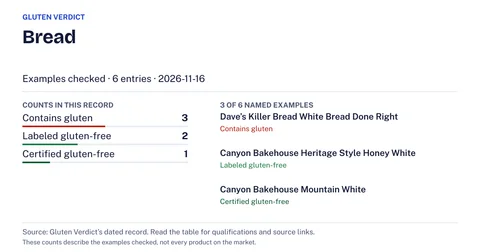 BreadContains glutenchecked Nov 16, 2026
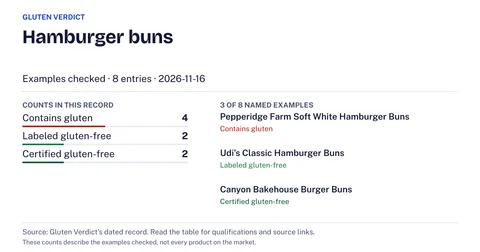 Hamburger bunsContains glutenchecked Nov 16, 2026
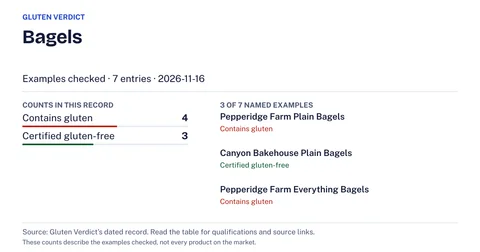 BagelsContains glutenchecked Nov 16, 2026
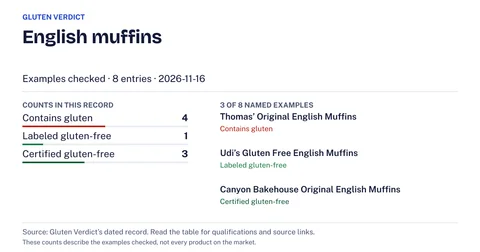 English muffinsDepends on the product4 of 8 products we checked contain glutenchecked Nov 16, 2026
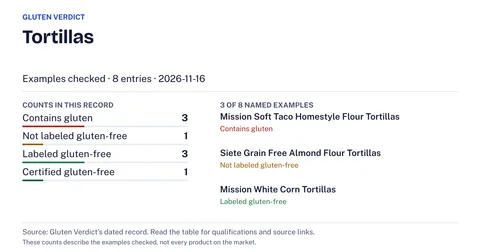 TortillasDepends on the product3 of 8 products we checked contain gluten: Mission Soft Taco Homestyle Flour Tortillas, Guerrero Riquisimas Soft Taco Flour Tortillas (24 ct), and Guerrero Corn and Wheat Tortillaschecked Nov 16, 2026
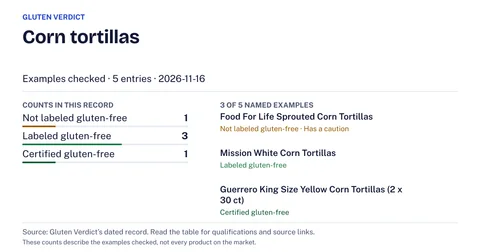 Corn tortillasDepends on the productchecked Nov 16, 2026
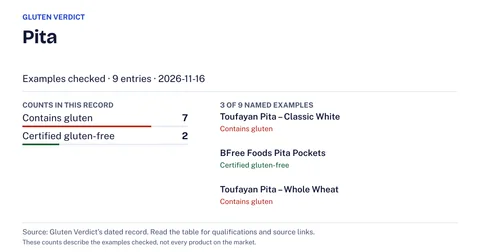 PitaContains glutenchecked Nov 16, 2026
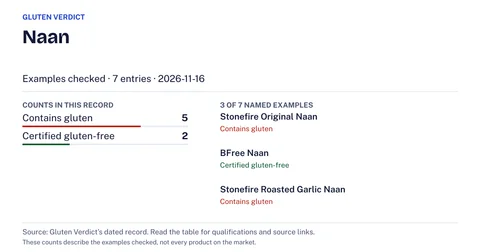 NaanContains glutenchecked Nov 16, 2026
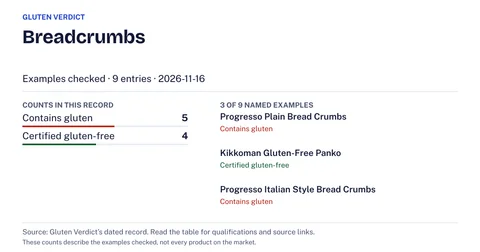 BreadcrumbsContains glutenchecked Nov 16, 2026
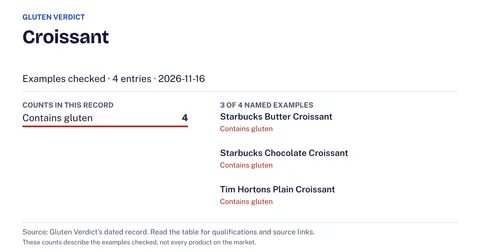 CroissantContains glutenchecked Nov 16, 2026
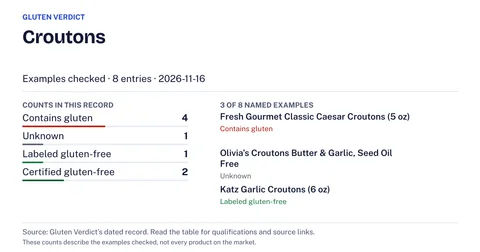 CroutonsContains glutenchecked Nov 16, 2026
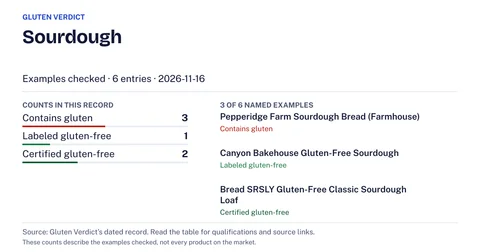 SourdoughContains glutenchecked Nov 16, 2026
Questions people ask
Can a bread labeled gluten-free list wheat?
GIG says a gluten-free claim can sit on a label that names wheat only if the wheat-derived ingredient was processed to remove gluten to a level that meets FDA’s definition27. FDA’s definition counts a processed ingredient such as wheat starch only when the food stays under 20 ppm4.
If a brand makes one gluten-free bread, are its other breads gluten-free?
No. FDA says a manufacturer may make both foods that are gluten-free and foods that contain gluten10.
Is “wheat free” bread gluten-free?
Not necessarily. NCA says breads labeled “wheat free” might contain rye or other grains12.
Does a “made in a facility that also processes wheat” line mean the bread is not gluten-free?
FDA allows that kind of line on a food that also makes a gluten-free claim, if the statement is truthful and not misleading8. The claim itself still has to meet the gluten-free definition4.
Are all corn tortillas gluten-free?
No. GIG says some corn tortillas contain a mix of corn and wheat flour14.
More in Grocery shopping and meal planning
 Deli, bakery and bulk-bin counters on a gluten-free dietFor each store counter (deli, bakery, bulk bins, bars): skip it, ask first, or buy the packaged item, and what a store’s own statement tells you.
 Freezing gluten-free food: what holds up, how to thaw it and how to keep it apartHow to freeze, label and thaw gluten-free food, which foods lose texture, and how to keep gluten-free packages apart in a shared freezer.
 Gluten-free grocery pickup and delivery: setting substitutions and checking swapsHow to set no-substitution choices on Instacart, Target and Whole Foods orders, check each swapped item at the door, and report a swap that fails.
 A gluten-free meal plan as a shopping template, by meal slotA weekly gluten-free shopping template: staples for each meal slot, the check each packaged item needs, and a ledger of when you last read each label.
 A gluten-free grocery list by aisle for US supermarketsAn aisle-by-aisle gluten-free grocery list for US stores: what needs no label, what needs a check, and what stays off the list.
 Gluten-free at the farmers market and in a CSA box: what to ask each producerWhich farmers market stalls and CSA add-ons need no label, which need questions, and the order to ask them, with what state cottage food rules cover.
Related guides
 Frozen meals, pizza and nuggets on a gluten-free diet: what to read on the boxCheck a frozen meal, pizza or nugget box for gluten in order: the claim, any certification mark, the ingredient list, the Contains line and facility lines.
 Certified or naturally gluten-free: when a seal mattersWhich naturally gluten-free foods are worth buying with a claim or seal: produce, grains, flours, oats and processed foods, with FDA rules and test data.
 Corn vs flour tortillas: the label line and the griddle questionFlour tortillas contain wheat; corn ones may too. What to read on the package, and two questions to ask a restaurant about the tortillas and the griddle.
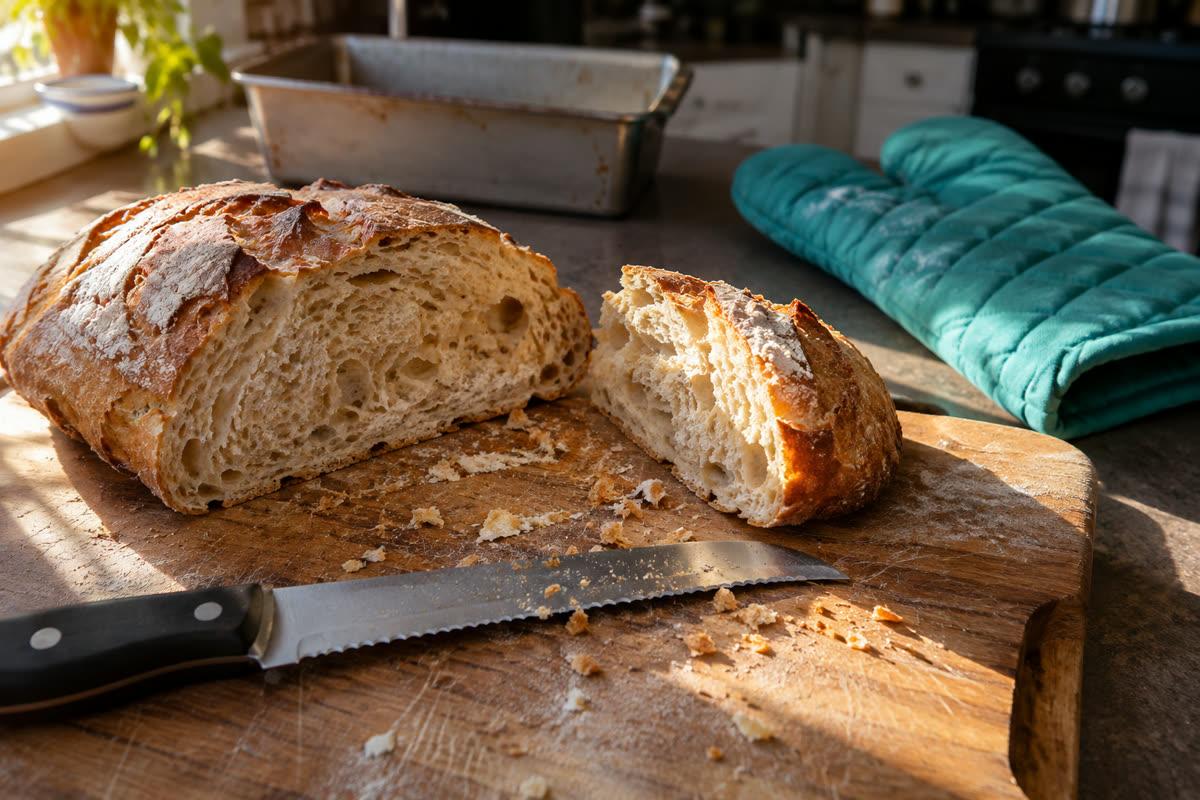 Why gluten-free bread crumbles: binder, rise, oven and storageWhat flour, mix and yeast makers and a 2026 review say about crumbly gluten-free bread: binder, rise, oven setting, cooling and storage.
Sources
- [1, 26, 46] US Food and Drug Administration, Gluten and Food Labeling, checked Nov 17, 2026.
- [2] Gluten-Free Certification Organization (GFCO), GFCO Product Finder, checked Nov 17, 2026.
- [3, 7, 27, 28, 29, 30, 40] Gluten Intolerance Group, Do All Wheat Mentions on Food Labels Mean Not Gluten-Free?, checked Nov 17, 2026.
- [4, 8, 10, 11, 18, 19, 20, 21, 22, 24, 25, 32, 33] US Food and Drug Administration, Questions and Answers on the Gluten-Free Food Labeling Final Rule, checked Nov 17, 2026.
- [5, 6, 12, 34, 41] National Celiac Association, I’m Hungry! What Can I Eat?, checked Nov 17, 2026.
- [9, 39, 42] Gluten Intolerance Group, 25 Ways Cross-Contact Could Happen (And How to Avoid It), checked Nov 17, 2026.
- [13] Mission Foods (Gruma), Gluten Free Original Tortilla Wraps, checked Nov 17, 2026.
- [14] Gluten Intolerance Group, The Wonders of Gluten-Free Mexican Meals, checked Nov 17, 2026.
- [15, 16, 17] Gluten Intolerance Group, How Does GFCO Certify Gluten-Free Food?, checked Nov 17, 2026.
- [23] Gluten Intolerance Group, FAQ: choosing a product when none is certified or labeled gluten-free, checked Nov 17, 2026.
- [31] National Institute of Diabetes and Digestive and Kidney Diseases (NIDDK), Eating, Diet, & Nutrition for Celiac Disease, checked Nov 17, 2026.
- [35, 36] US Food and Drug Administration, Food Allergen Labeling and Consumer Protection Act of 2004 (FALCPA), checked Nov 17, 2026.
- [37, 38] Mission Foods (Gruma), Mission Foods FAQ, checked Nov 17, 2026.
- [43, 44, 45] Canyon Bakehouse, Heritage Style Honey White, checked Nov 17, 2026.