Gluten-free breakfast at restaurant chains: griddles, toasters and batter
Short answer
IHOP and Panera say they cannot guarantee any menu item is free of allergens, and Tim Hortons says shared equipment and cross-contact are possible, so before ordering find out three things1, 2, 3:
- What is in the eggs: IHOP says its omelettes are made with a splash of pancake batter and its scrambled eggs are not4.
- What they are cooked on: GIG, the Gluten Intolerance Group, suggests asking for a clean section of the flat-top or a separate pan, and whether breaded or gluten-containing food was cooked on the same surface beforehand28, 6, 5.
- What the potatoes and the bread share: fryer oil, which IHOP counts among its shared cooking and prep areas, and the toaster, which Tim Hortons says may be shared equipment1, 3.
Part of Eating out and chain restaurant policies, 25 guides
Key points
- IHOP says its omelettes contain wheat and gluten because they are made with pancake batter; its scrambled eggs do not4.
- IHOP calls its items “gluten-friendly”, not “gluten free”, because it cannot confirm they meet FDA’s definition of under 20 parts per million7.
- In one 2026 study of fries and tortilla chips from shared fryers, 6 of 98 samples exceeded 20 ppm, and all samples from places reporting daily oil changes were under 20 ppm8, 9.
- Tim Hortons marks wheat and gluten on its biscuit, English muffin, croissant and bagel breakfast sandwiches and grilled wraps, so for those the question is the bread10.
- FDA’s gluten-free rule covers packaged foods; for restaurant menus FDA only recommends that a claim match its definition11.
What is different about a breakfast kitchen
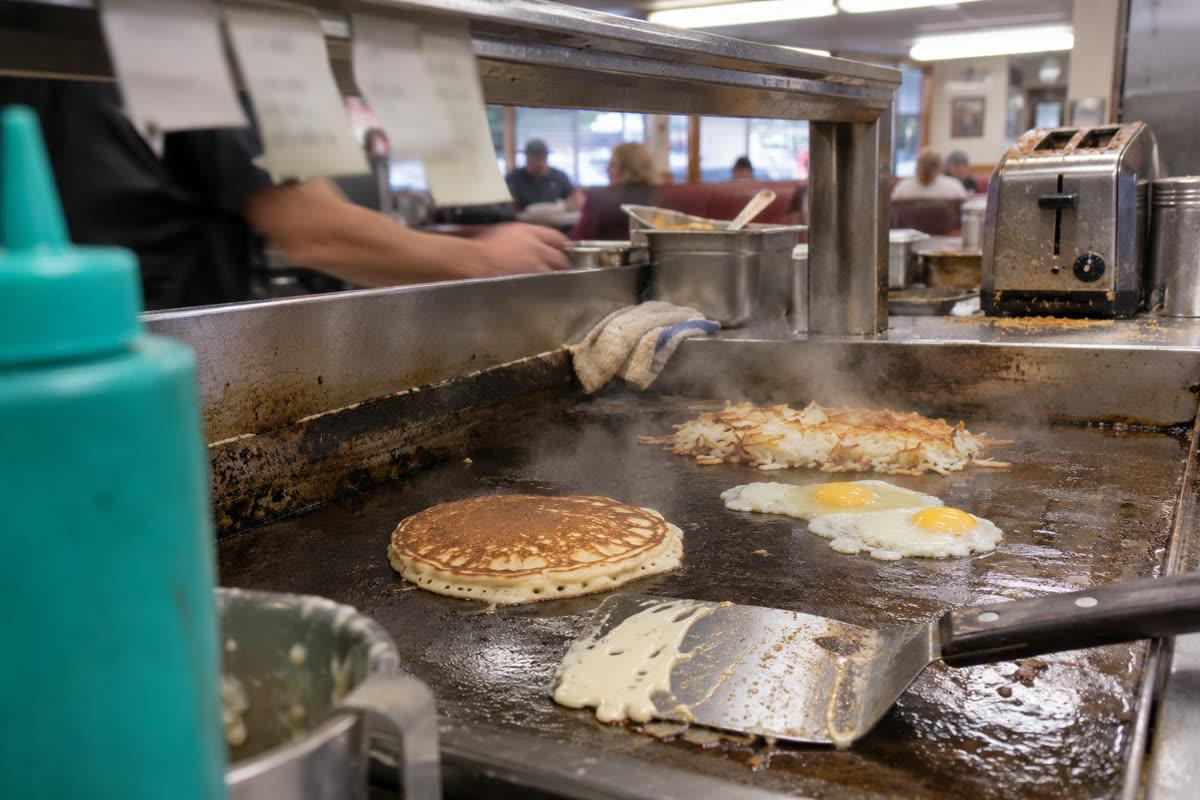
Four parts of a breakfast kitchen each deserve a question: the batter, the flat-top, the fryer and the toaster. The bullets show what a chain, or GIG, says about each.
- Batter. IHOP says its omelettes are made with a splash of buttermilk pancake batter4.
- Flat-top. GIG, the Gluten Intolerance Group, lists asking whether the grill used for gluten-free food is separate or shared, and if shared, how it is cleaned and how often12.
- Fryer. IHOP counts common fryer oil among its shared cooking and prep areas1.
- Toaster. Tim Hortons names the toaster among equipment that may be shared3.
Kitchens differ even inside one chain: Panera says its menus vary by location and tells guests with an allergy concern to ask a manager to check the ingredient listing for the item13. Treat a chain page as a starting list for your café or restaurant, not as a description of every kitchen.
What three chains say on their own pages
We read each page or PDF below on 2026-11-17. Denny’s, Waffle House, Cracker Barrel and McDonald’s are not covered because their allergen pages would not open for our reader that day, and we do not describe a chain we could not read. Open their pages yourself before you order.
| Chain and page | What it says | Where to start |
|---|---|---|
| IHOP, Nutrition FAQ (current as of 9/15/2514) | Offers “gluten-friendly” items and does not call them “gluten free”, because it cannot confirm they meet FDA’s definition of under 20 parts per million7. Lists common fryer oil among shared cooking and prep areas and cannot guarantee any item is free of gluten-containing ingredients1. | The ‘Avoid Gluten’ filter on its Interactive Nutrition Menu lists its gluten-friendly offerings15. |
| Panera Bread, Allergen and Nutrition Information (page marked “Effective 11/4/2026”16) | Cannot guarantee that any menu item is free of allergens because it uses shared equipment2. | Its allergen information for your café’s menu through online ordering, then a manager30. Our Panera verdict lists what its guide marks. |
| Tim Hortons, US allergen chart (as of January 202517) | Says normal kitchen operations may involve shared equipment, including the toaster, and shared cooking areas and utensils3. | Its chart marks bread-based breakfast items for wheat and gluten; see the toast section below10. |
Allergen pages change. Check the date on the page or PDF you open against the one in the table, and use the version on the chain’s site for your visit.
Eggs and omelettes: the pancake-batter question
IHOP’s FAQ is specific about its omelettes: they are marked as containing wheat and gluten because they are made with a splash of buttermilk pancake batter. The same batter goes into its burritos, tacos, savory crepes and Jr. Breakfast Quesadilla, and its scrambled eggs do not contain it4.
That is one chain’s recipe, not a rule for all chains, and it is why “it’s just eggs” is a question to ask rather than an assumption. Our eggs verdict covers the plain egg.
GIG’s list of questions for a restaurant includes asking for an egg soft-boiled, since soft-boiled eggs remain in their shell, which limits the chance of cross-contact in a pan18. That only helps where the kitchen boils eggs.
Pancakes and waffles are wheat-based in their usual form (see our pancakes and waffles verdicts), so the question for them is whether a chain offers a version it calls gluten-free at all, and what it says about the surface it is cooked on.
“Gluten-friendly” and “gluten-free” on a breakfast menu
IHOP says it does not claim its items are “gluten free” because it cannot confirm they meet FDA’s definition, under 20 parts per million7. So “gluten-friendly” is IHOP’s own term for a filtered list; it is not the gluten-free claim.
FDA’s gluten-free rule covers packaged foods. For a restaurant that makes a “gluten-free” claim on its menu, FDA recommends that the claim be consistent with its definition11.
IHOP’s calculator updates allergen information for some modifications, not all19. If you order “no toast” or “eggs on their own”, confirm it with the kitchen, not only on the screen.
Hash browns, fries and fryer oil
Two questions matter for a hash brown: what the product is made of, and whether it is cooked in a fryer or on a flat-top. Our hash browns verdict covers the product side, which varies by brand.
Tim Hortons’ US chart (as of January 2025) leaves its Hash Brown row and its Omelette Bite rows unmarked in the Wheat & Gluten column, while its breakfast sandwiches, wraps and bagels are marked10. The same document says shared equipment and cooking areas are possible3.
On fryer oil, GIG says deep-fry oil may be used for both breaded and non-breaded items, in which case it advises avoiding them, and that in large restaurants where French fries are cooked in separate fryers there is less chance of cross-contact20.
One 2026 study measured gluten in 98 samples of French fries and tortilla chips from US food service settings, all fried in fryers shared with gluten-containing foods21. Six of the 98 (6.1%) exceeded 20 ppm, and 84 measured under 5 ppm8. All samples from establishments reporting daily oil changes measured under 20 ppm, while samples from establishments reporting weekly oil changes were higher and more variable, including values above 20 ppm9. The authors concluded that shared fryers are not inherently high-risk and that daily oil replacement was a key factor associated with lower gluten levels22.
That study tested fries and chips, not hash browns, and oil-change frequency was what each establishment reported. It is one study. What it does support is the question: how often is the oil changed, and what else goes in it?
Toast, English muffins and biscuits
At Tim Hortons, the breakfast sandwiches are a bread question first. Its chart marks wheat and gluten on every one of its biscuit, English muffin, croissant and bagel breakfast sandwiches and on its grilled wraps10.
Where a chain offers gluten-free bread, the toaster is the next question. GIG’s article on kitchen appliances, written about home kitchens, says of toasters that errant gluten crumbs can end up on gluten-free bread23.
Lab work adds a counterpoint, with limits. A Brigham Young University study looked at gluten-free bread toasted in a toaster also used for gluten-containing bread, along with a shared fryer and a shared knife24. It reported small amounts of cross-contact, with the majority of its results (93.6%, across all three practices) showing no significant cross-contact25; its abstract also reports mayonnaise and peanut butter samples above the FDA’s gluten-free limit31. A 2024 review of five studies says shared environments and equipment may not significantly increase cross-contamination if appropriate protocols are followed26, and that in controlled experiments shared equipment including the toaster did not lead to significant contamination of samples27. A busy restaurant is not a controlled experiment, so ask how the toaster is used.
Our English muffins and biscuits and gravy verdicts show what the usual breads and the gravy are made of. For the sides, see grits, bacon and sausage.
The three questions to ask at the counter or the table
- “Is anything added to the eggs, such as pancake batter?” IHOP’s own FAQ shows why: its omelettes are made with it4.
- “What will this be cooked on?” GIG’s lists include whether the grill is separate or shared and how it is cleaned12, whether the meal can be cooked in a separate pan6, and, in its 2026 article, whether the item is cooked on a clean section of the grill or flat-top, separate from breaded foods28. GIG also suggests asking whether breaded or gluten-containing food was cooked on the same surface beforehand5.
- “What do the potatoes and the bread share?” GIG’s list asks whether there is a dedicated fryer29. The toaster is the bread-side equivalent: Tim Hortons names it as equipment that may be shared3.
A chain’s page is a starting list, not a promise; the table above shows what each of the three says1, 2, 3. For the wider picture of how restaurant kitchens share surfaces, see where gluten hides in restaurant kitchens and eating out with celiac disease.
Verdicts in this guide
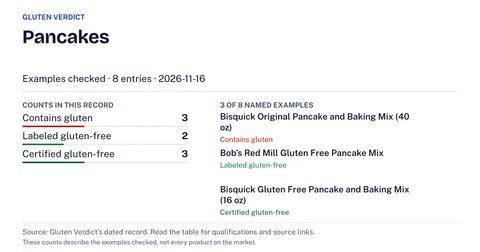 PancakesContains glutenchecked Nov 16, 2026
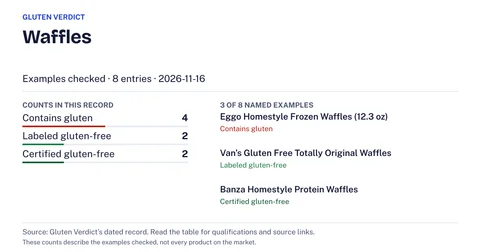 WafflesContains glutenchecked Nov 16, 2026
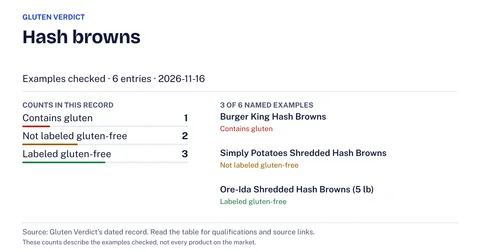 Hash brownsDepends on the product1 of 6 products we checked contains gluten: Burger King Hash Brownschecked Nov 16, 2026
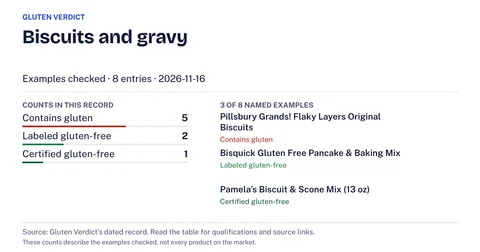 Biscuits and gravyContains glutenchecked Nov 16, 2026
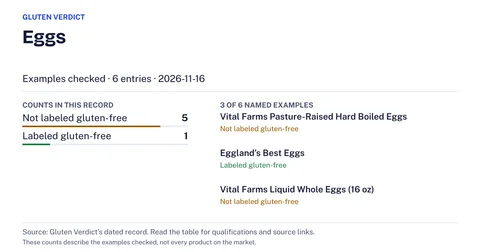 EggsNaturally gluten-freechecked Nov 16, 2026
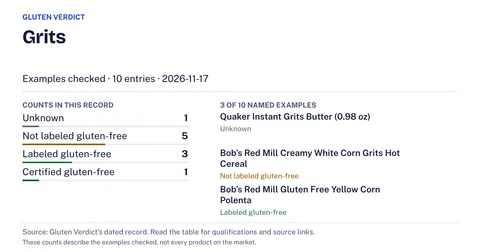 GritsNaturally gluten-freeBuy it labeled gluten-freechecked Nov 17, 2026
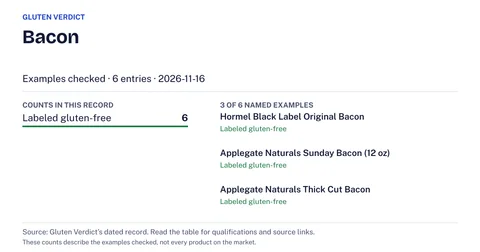 BaconDepends on the productchecked Nov 16, 2026
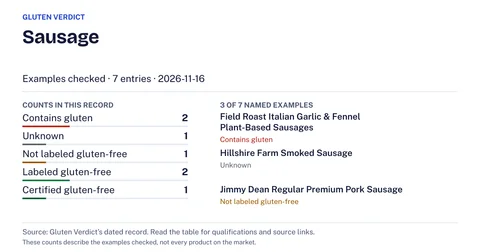 SausageDepends on the product2 of 7 products we checked contain gluten: Field Roast Italian Garlic & Fennel Plant-Based Sausages and Tofurky Plant-Based Italian Sausagechecked Nov 16, 2026
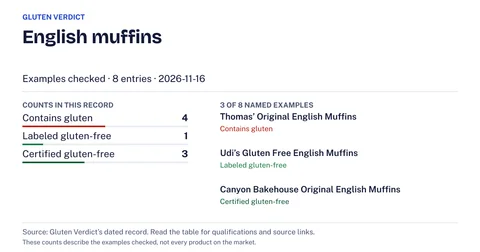 English muffinsDepends on the product4 of 8 products we checked contain glutenchecked Nov 16, 2026
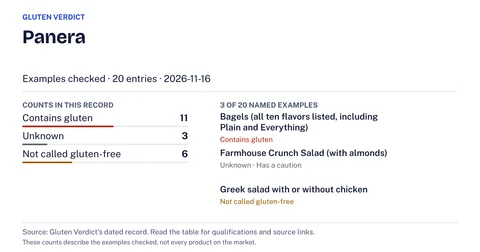 PaneraDepends on the order11 of 20 menu items we checked contain glutenPanera Bread · checked Nov 16, 2026
Questions people ask
Are IHOP omelettes gluten-free?
IHOP marks its omelettes as containing wheat and gluten because they are made with a splash of buttermilk pancake batter. Its scrambled eggs do not contain the batter4.
Does IHOP offer gluten-free breakfast items?
IHOP says it offers “gluten-friendly” items and does not claim them to be gluten free, because it cannot confirm they meet FDA’s definition7. They are listed under the ‘Avoid Gluten’ filter of its Interactive Nutrition Menu15.
Are hash browns gluten-free at a restaurant?
It depends on the product and on how they are cooked. Our hash browns verdict covers the product. On cooking, GIG advises avoiding fried foods when the oil is used for both breaded and non-breaded items20.
Is a shared fryer always a problem?
One 2026 study of French fries and tortilla chips found 6 of 98 samples above 20 ppm8, and its authors concluded that shared fryers are not inherently high-risk and that daily oil replacement was a key factor in lower gluten levels22.
Can I rely on “gluten-free” on a restaurant menu?
FDA’s gluten-free rule covers packaged foods; for restaurant menus FDA recommends that a gluten-free claim be consistent with its definition11.
More in Eating out and chain restaurant policies
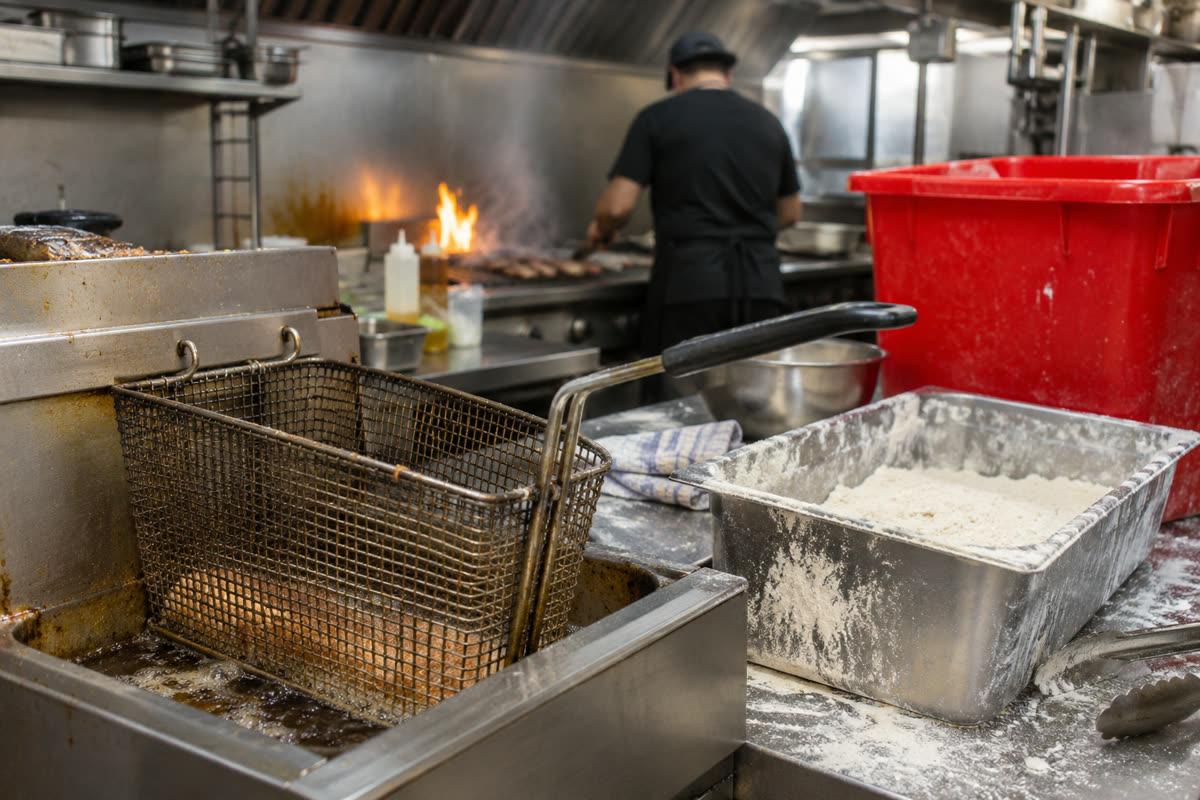 Where gluten hides in a restaurant kitchen, and the question to ask about each sourceFryers, sauces, roux, marinades, grills, pasta water and eggs: how gluten reaches restaurant food and the question GIG lists for each source.
 Coffee and donut chains and gluten: what Starbucks and Tim Hortons say about shared equipmentWhat Starbucks and Tim Hortons say on their own pages about shared ovens, toasters and utensils, which items carry a wheat mark and what packaging changes.
 What fast-food chains say about shared fryers, and what a shared-fryer study measuredEach chain's own sentence on fryer oil, with its document and date, plus what a 2026 study measured in fries and chips from shared fryers.
 Eating out with celiac disease: what to check, ask and watch forPlan a restaurant meal with celiac disease: what to check before you go, the questions to ask in order, how to read the answers, and what studies measured.
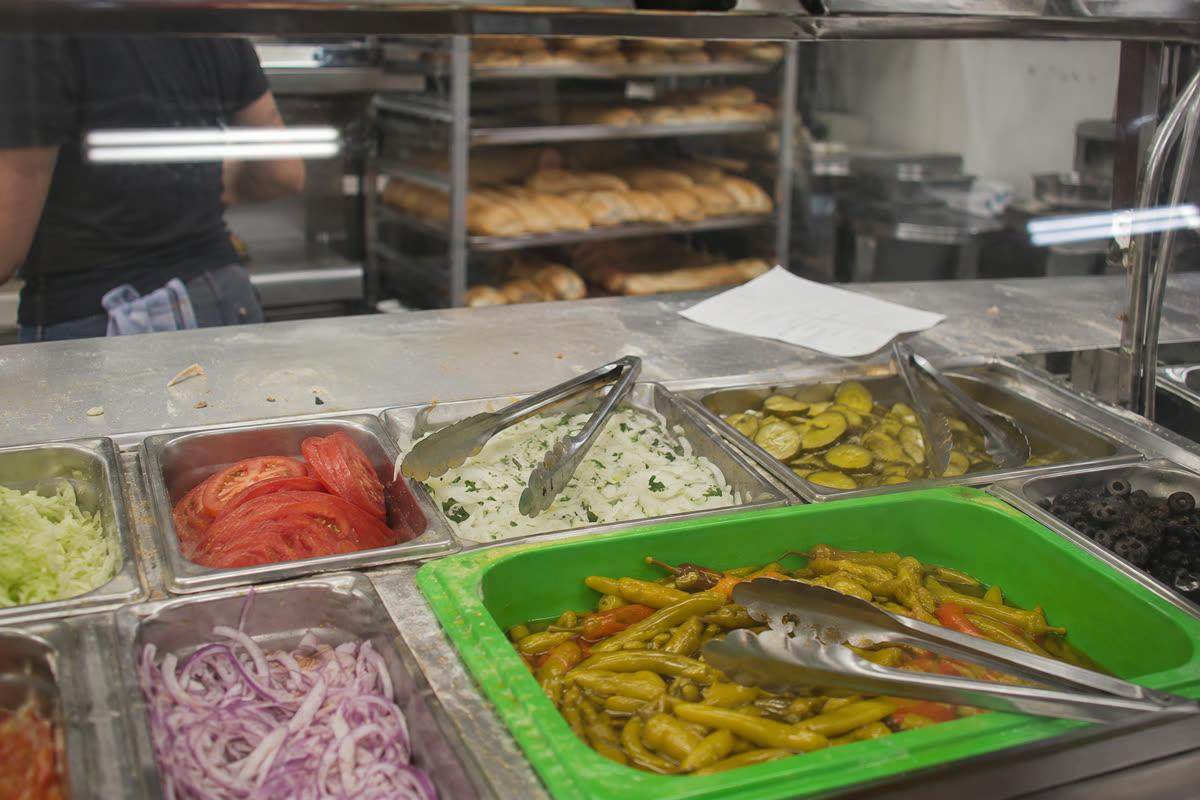 Sandwich and sub chains and gluten: what Subway, Panera, Jersey Mike’s and others say in writingWhat Subway, Jersey Mike’s, Jimmy John’s, Firehouse, Potbelly and Panera say in their own documents about gluten-free bread, shared equipment and dates.
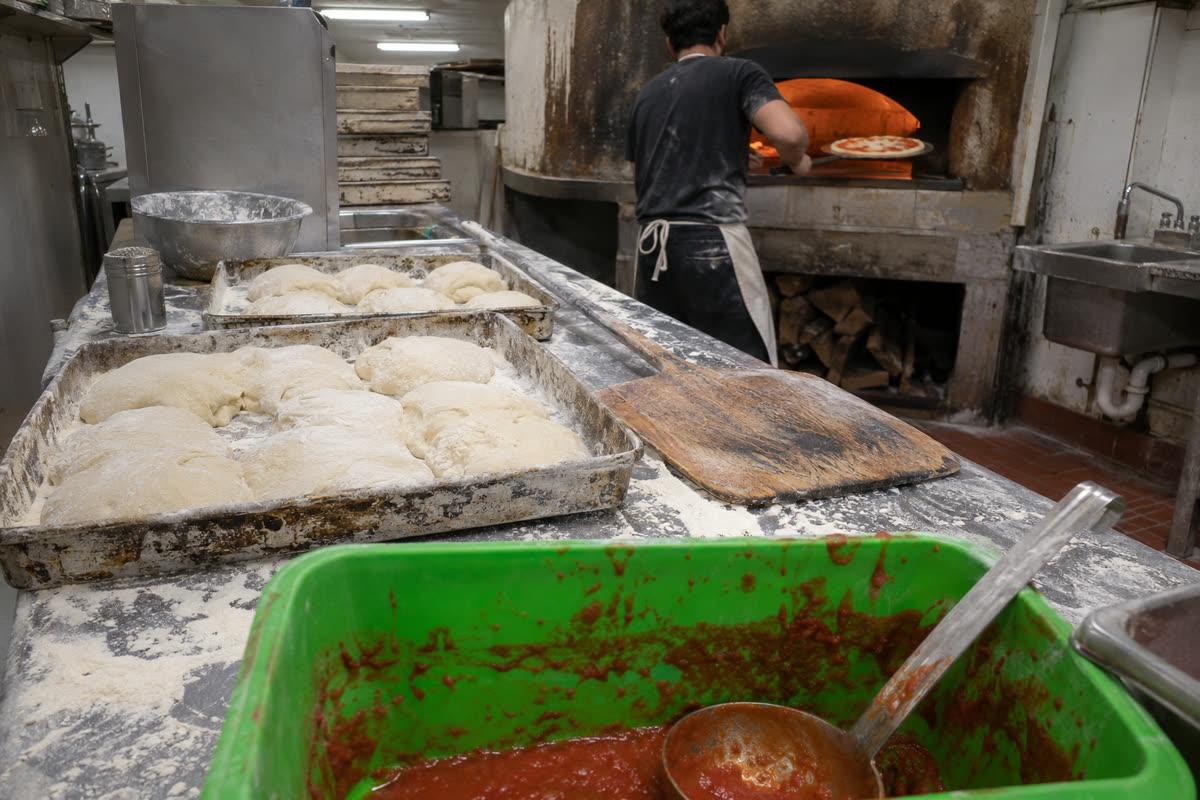 Pizza chain gluten-free crusts: what each chain says about its kitchenWhat Domino's, Papa Johns, Pizza Hut and Little Caesars say on their own pages about gluten-free crust, shared kitchens and celiac customers.
Related guides
 Ordering at a bagel shop, bakery or coffee counter with celiac diseaseWhat to ask at a bagel shop, bakery or coffee counter: spreads, toasters, knives, display cases, flour in the room, and what the chains say.
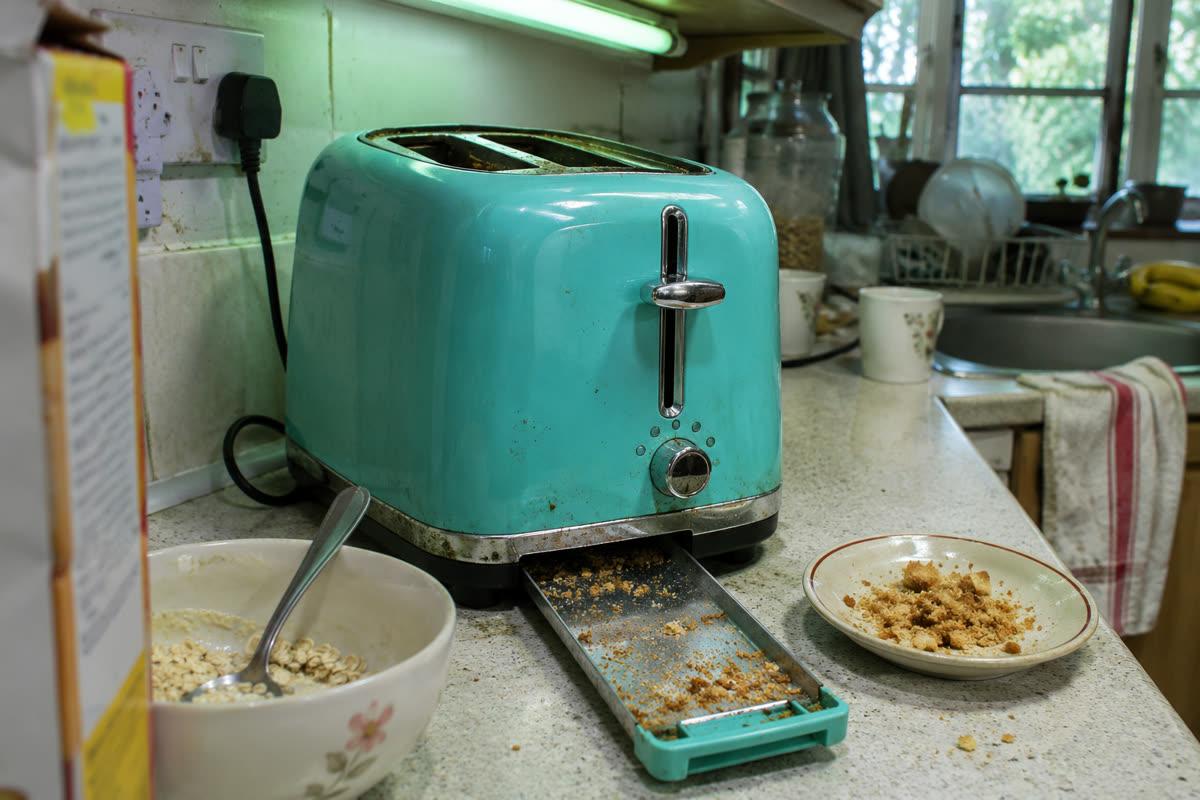 Gluten-free breakfast: what to check on the label and in your kitchenGo through a usual breakfast item by item: what is gluten-free by nature, what needs a label check, and which kitchen habits cause trouble.
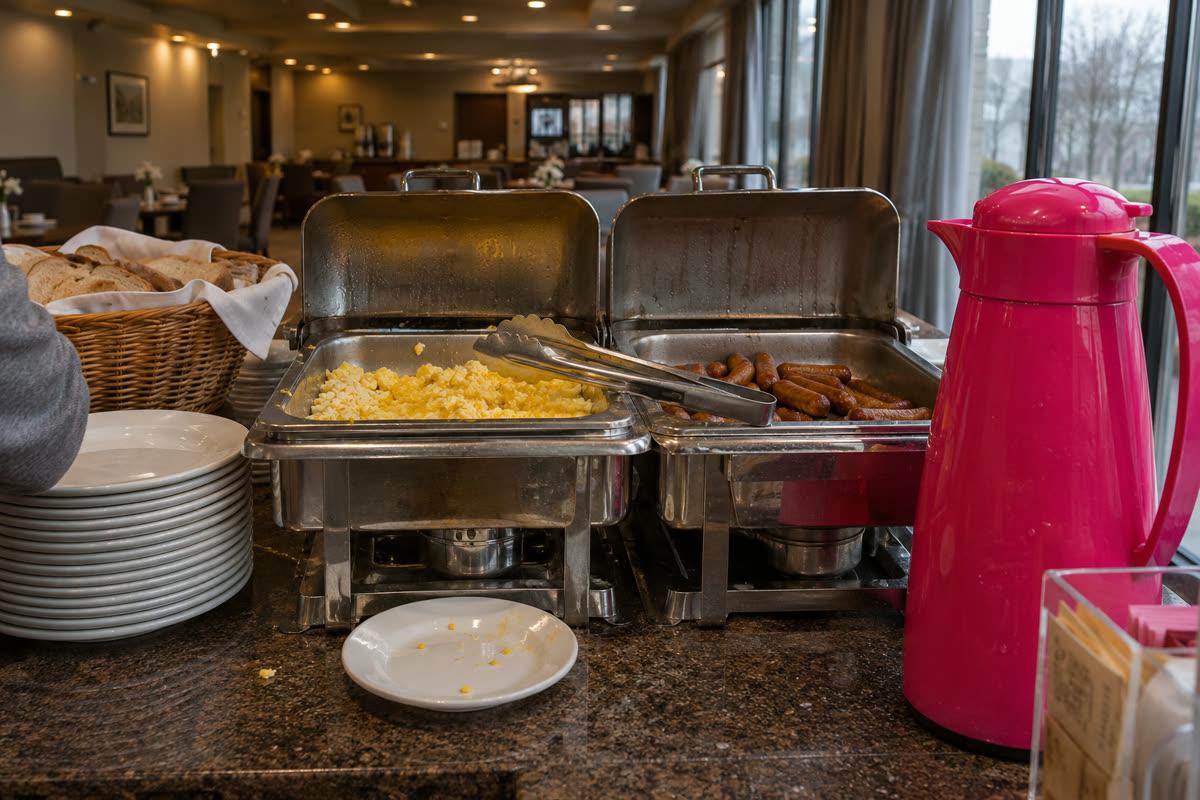 Gluten-free hotel breakfast: what to email ahead and what to ask at the buffetA hotel breakfast buffet can mean shared utensils, toasters and waffle irons. What to write the hotel before you arrive, and what to ask at each station.
 Frozen meals, pizza and nuggets on a gluten-free diet: what to read on the boxCheck a frozen meal, pizza or nugget box for gluten in order: the claim, any certification mark, the ingredient list, the Contains line and facility lines.
Sources
- [1, 4, 7, 14, 15, 19] IHOP, Nutrition FAQ (PDF), checked Nov 17, 2026.
- [2, 13, 16, 30] Panera Bread, Allergen and Nutrition Information, checked Nov 17, 2026.
- [3, 10, 17] Tim Hortons (US), Allergen Information (US PDF), checked Nov 17, 2026.
Read on 2026-11-17: in the Breakfast section of the chart (key: x = Contains, o = May Contain), every row for the Classic Breakfast Sandwiches (biscuit, English muffin and croissant), the Bagel Breakfast Sandwiches and the Grilled Breakfast Wraps has an x in the Wheat & Gluten column; the Hash Brown row has no mark in any column; the three Omelette Bite rows have no mark in the Wheat & Gluten column.
- [5, 20] Gluten Intolerance Group, Eating Out: 7 Tips For Staying Gluten-Free, checked Nov 17, 2026.
- [6, 12, 18, 29] Gluten Intolerance Group, What are some of the most important questions to ask in a restaurant? (FAQ), checked Nov 17, 2026.
- [8, 9, 21, 22] Nutrients (PubMed), Shared Fryers May Not Always Be as Risky for Gluten Cross-Contact in Celiac Disease as Dietary Guidance Suggests (2026), checked Nov 17, 2026.
- [11] US Food and Drug Administration, Questions and Answers on the Gluten-Free Food Labeling Final Rule, checked Nov 17, 2026.
- [23] Gluten Intolerance Group, Appliances: Risks of Cross-Contact, checked Nov 17, 2026.
- [24, 25, 31] Clinical Nutrition (PubMed), Gluten cross-contact from common food practices and preparations (2021), checked Nov 17, 2026.
- [26, 27] Nutrients (PubMed), Risk of Gluten Cross-Contamination Due to Food Handling Practices: A Mini-Review (2024), checked Nov 17, 2026.
- [28] Gluten Intolerance Group, Questions to Ask When Eating Out, checked Nov 17, 2026.