Flavored coffee, pods and creamers: where gluten can enter a cup you make at home
Short answer
Folgers says coffee is not a source of gluten and Lavazza says coffee beans naturally do not contain it1, 2, so the open questions are the flavoring added to a bean, pod or instant mix3, 11 and what the creamer maker says17, 18, 19. Folgers adds that its roast and ground coffee may contain trace amounts of grain-based ingredients from shared farm equipment4. Makers answer on their own pages, and the answers differ by product line8, 11, so read the statement for the exact one you buy.
Part of Drinks and alcohol, 18 guides
Key points
- Folgers says coffee is not a source of gluten, and also says its flavored coffee products may contain added ingredients that are not gluten free1, 3.
- Flavorings may be declared as a class27. GIG says a natural flavor that contains wheat must be stated on the label of an FDA-regulated product16; barley is not on the 2004 law’s list of major allergens13.
- Instant coffees differ by product: NESCAFÉ’s unflavored, unsweetened instant has no gluten-containing ingredients, while Starbucks’ Salted Caramel Crema Collection instant says it contains wheat8, 11.
- For creamers, read the maker’s own answer: International Delight’s FAQ says International Delight does not contain gluten, but for its iced coffee it says it does not run the tests that would allow a gluten-free label17, 18.
Why the flavoring is the variable, not the coffee
Folgers answers the gluten question for its products with “Coffee is not a source of gluten”1; the same answer carries a trace-amount caveat, covered under shared equipment below4. Lavazza says “coffee beans naturally do not contain gluten”2. Our coffee verdict collects what the makers say about plain coffee.
The same Folgers answer goes on to say that its flavored coffee products may contain added ingredients that are not gluten free3. That is the pattern to check for: on a flavored product, the added ingredients are the question, not the bean.
How a flavoring shows up on a label
The findings of the 2004 US allergen law note that ingredients may be declared as a class, including spices, flavorings and certain colorings27. The law itself says a flavoring, coloring or incidental additive that is, or contains, a major food allergen has to follow the allergen labeling rules12.
Wheat is on the 2004 law’s list of major food allergens as FDA prints it; barley and rye are not on that list13. The Gluten Intolerance Group (GIG) says that on a product not labeled or certified gluten-free, a “natural flavors” entry could be made with a gluten-containing ingredient such as yeast extract grown on barley14. It adds that if a natural flavor in an FDA-regulated product contains wheat, the label must say so16.
GIG also says its GFCO certification program confirms that every natural flavor used in certified products does not contain yeast extract grown on barley or other gluten sources15. Our natural flavors entry and caramel color entry show what the makers and charities we read say about two ingredients that appear in the lists in the next section: natural flavors on the Starbucks instant10 and caramel color on the NESCAFÉ Hazelnut9.
A flavoring entry on a coffee label is a reason to read the maker’s statement for that product. GIG’s wording is that a natural flavor “could be made using” a gluten-containing ingredient, not that it is14.
Beans, pods and instant coffee: what each maker says
These are the statements and ingredient lists we read on 2026-11-17, each on the maker's own page. Formulations and statements change, so the package in your hand has the final word.
| Maker and product | What its own page says |
|---|---|
| Folgers, roast and ground and flavored | Says coffee is not a source of gluten1, and that its flavored coffee products may contain added ingredients that are not gluten free3. |
| Lavazza coffee | Says its coffee is not certified gluten-free but that beans naturally do not contain gluten2, and that its products contain only one ingredient, coffee7. |
| Lifeboost | Says its coffee is gluten free, including its flavored coffee5. |
| Café Bustelo Vanilla Horchata (ground; a pods version is listed on the same page) | The page describes the flavor but shows no ingredient list and no gluten statement6. |
| NESCAFÉ unflavored, unsweetened instant | Says it has no gluten-containing ingredients and is not certified gluten free8. |
| NESCAFÉ Hazelnut instant packets | The ingredient list on its page is instant coffee, caramelized sugar, caramel color, acesulfame potassium and artificial flavor9. |
| Starbucks at Home Salted Caramel Crema Collection instant | Its ingredient list carries “Contains: Milk, wheat”10, and its page answers that the product contains wheat11. |
Two things to take from the table. First, a flavored product can carry a different answer from the same company's plain one: Folgers separates them in its own statement3, and NESCAFÉ's unflavored instant and Starbucks' flavored instant sit at opposite ends8, 11. Second, a page can say nothing at all, as the Café Bustelo page does6. A maker's silence is a reason to check the package or ask the maker, not a result.
We could not read Keurig's or Coffee mate's pages: both returned an access-denied response to automated requests on 2026-11-17, so neither is in this guide. Our instant coffee verdict lists the instant products we have read.
Creamers: dairy, plant-based and oat
Creamer makers answer the question in different ways, so compare the exact statement.
| Maker and product | What its own page says |
|---|---|
| International Delight (brand FAQ) | Its FAQ answers “Does International Delight contain gluten?” with “No, International Delight does not contain gluten.”17 |
| International Delight Iced Coffee | Says it does not make the iced coffee with any wheat, wheat gluten, rye, oat, barley or malt ingredients, and that it does not conduct the tests that would allow it to label it gluten-free18. |
| Califia Farms products in general | Says its products, with the exception of its Organic Oatmilk, are gluten free according to FDA guidelines, which require less than 20 ppm of gluten19. |
| Califia Farms Oat Barista Blend | Its page says it blends into hot or iced coffee without dairy, soy, or gluten20, and lists “Gluten free oats” among its reasons to love it21. |
Oat-based creamers
FDA’s rule treats oats like any other non-gluten-containing grain: oats labeled “gluten-free” must contain less than 20 ppm gluten, and they do not have to be certified22. That is why an oat creamer’s own statement matters more than the word “oat”. Califia’s FAQ names its Organic Oatmilk as the one product left out of its gluten-free answer19, while its Oat Barista Blend page says it blends without gluten20 and lists “Gluten free oats”21. Our oat milk verdict lists what the oat milk makers we read say.
For plain dairy and nut milks, see our milk verdict and almond milk verdict; flavored or sweetened versions of either are products like any other and need their own statement.
A gluten-free claim, a certification, or no claim
The three look alike on a shelf and mean different things.
- A “gluten-free” claim on a food FDA regulates means the food is inherently gluten free or contains no gluten-containing grain and no ingredient derived from one, unless that ingredient was processed to remove gluten and still leaves the food under 20 ppm; any unavoidable gluten must also be under 20 ppm24.
- A third-party certification is the certifier’s own program. GFCO says it requires ongoing testing of ingredients, shared equipment and finished products for established brands25, and that GFCO-certified brands must report any result above 10 ppm in a product or its ingredients before the product leaves the production facility26.
- A maker statement with no claim sits in between: Lavazza says its coffee is not certified gluten-free2, NESCAFÉ says the same of its unflavored, unsweetened instant8, and International Delight says it does not run the tests that would allow a gluten-free label on its iced coffee18.
Neither “not certified” nor “no gluten-containing ingredients” is a gluten-free claim. If the package carries the claim, FDA's definition applies to it24; if it does not, you are relying on the maker's statement and the ingredient list.
Shared equipment at the maker
Folgers says it produces its roast and ground coffee in a dedicated facility, but that because of common equipment used across agriculture to harvest, store and transport crops, its roast and ground products may contain trace amounts of grain-based ingredients4. Lavazza says its products are made in facilities that exclusively make coffee7.
FDA describes a similar mechanism for grains, legumes and seeds in general: shared harvesting and transport equipment and storage silos often bring gluten-containing grains into contact with other grains, legumes and seeds that are naturally free of gluten, and facilities that use shared production equipment for foods with and without gluten could result in gluten cross-contact23.
Verdicts in this guide
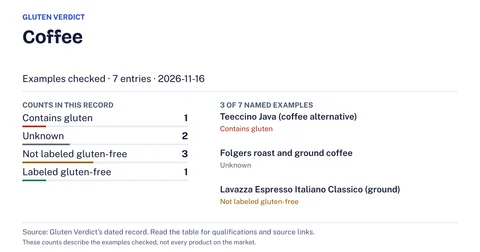 CoffeeDepends on the product1 of 7 products we checked contains gluten: Teeccino Java (coffee alternative)checked Nov 16, 2026
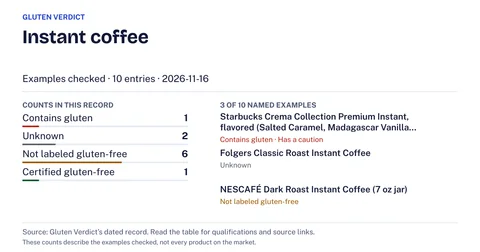 Instant coffeeDepends on the product1 of 10 products we checked contains gluten: Starbucks Crema Collection Premium Instant, flavored (Salted Caramel, Madagascar Vanilla, Molten Chocolate, Pumpkin Spice)checked Nov 16, 2026
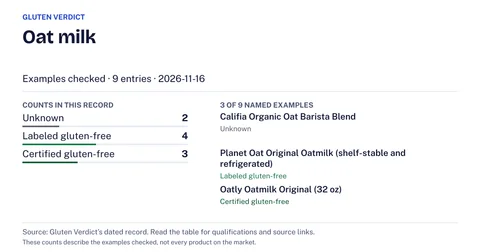 Oat milkDepends on the productchecked Nov 16, 2026
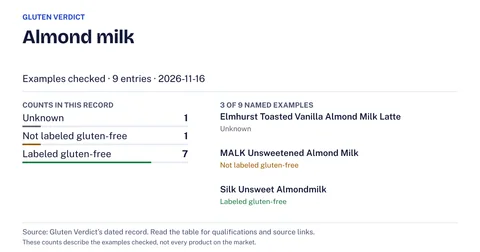 Almond milkNaturally gluten-freechecked Nov 16, 2026
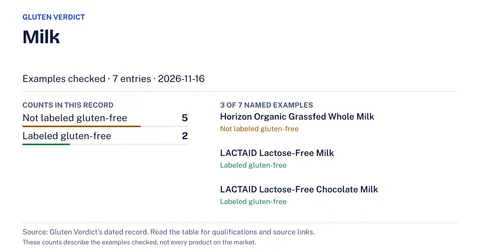 MilkNaturally gluten-freechecked Nov 16, 2026
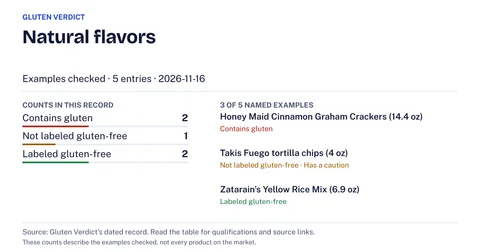 Natural flavorsDepends on the product2 of 5 products we checked contain gluten: Honey Maid Cinnamon Graham Crackers (14.4 oz) and Chex Mix Sour Cream & Onionchecked Nov 16, 2026
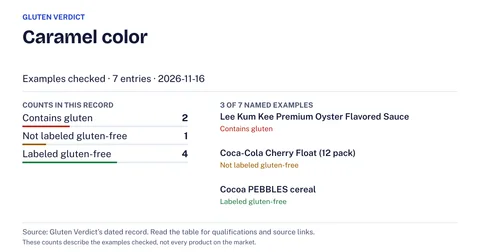 Caramel colorDepends on the product2 of 7 products we checked contain gluten: Lee Kum Kee Premium Oyster Flavored Sauce and Chex Mix Traditionalchecked Nov 16, 2026
Questions people ask
Is flavored coffee gluten-free?
It depends on the maker and the product. Folgers says its flavored coffee products may contain added ingredients that are not gluten free3, while Lifeboost says its coffee is gluten free, flavored coffee included5.
Does International Delight contain gluten?
Its FAQ answers “No, International Delight does not contain gluten.”17 For its Iced Coffee, it says it does not conduct the tests that would allow a gluten-free label18.
More in Drinks and alcohol
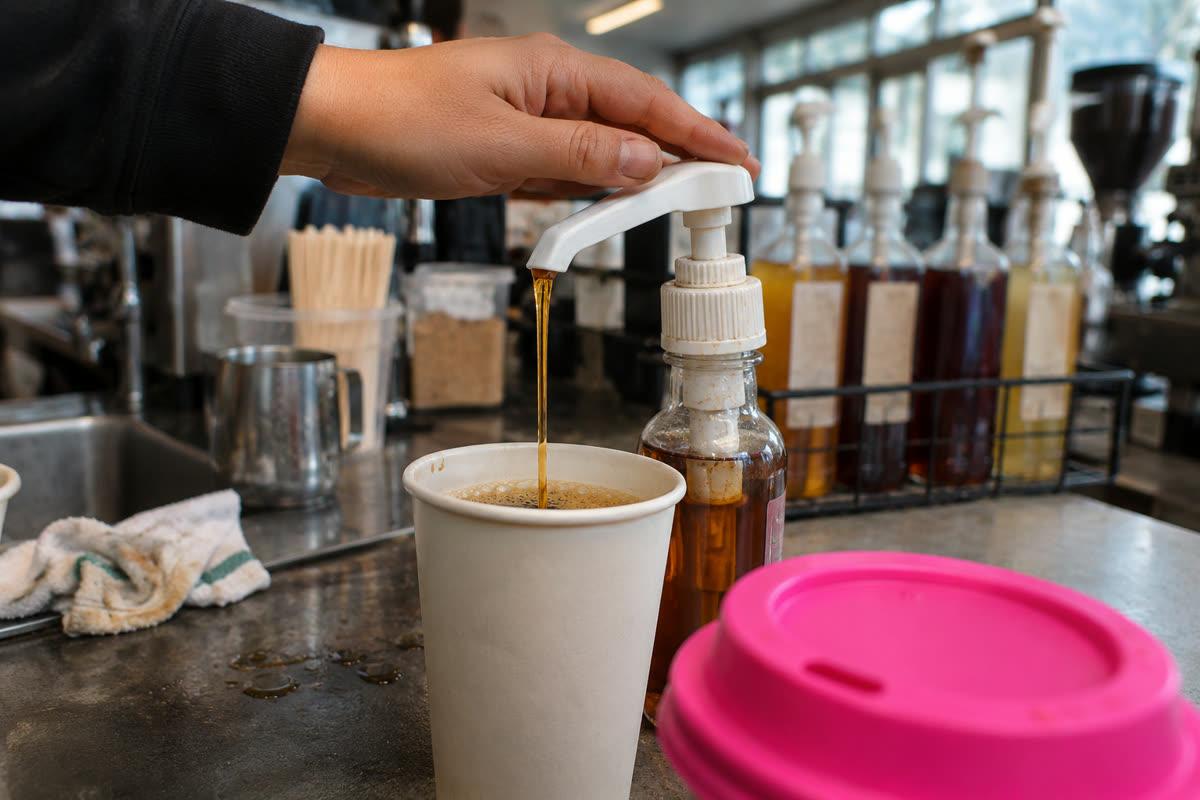 Reading the label of a flavored syrup, sauce or cookie topping for glutenHow to read coffee and bar syrup, sauce and cookie-topping labels for gluten, and what Torani, Monin and DaVinci Gourmet say on their own pages.
 Gluten in coffee-shop drinks: milk, syrups, toppings and shared toolsTake a coffee-shop drink apart: base, milk, syrup, topping and shared tools. See which label or maker page to read for each part.
 Instant coffee, tea, cocoa and malted drink mixes: what to read for glutenWhere gluten turns up in instant coffee, tea blends, chai, cocoa and malted drink mixes, and what to read on each label before you buy.
 Liqueurs and cream liqueurs: what a maker’s page can and cannot tell youSplit a liqueur into base spirit, flavors, sugar and cream, read what each maker’s own page says about gluten, and know what to ask when it says nothing.
 Whiskey, vodka and gin: what makers say about grain, distillation and added flavorsHow to read a maker’s gluten statement on vodka, whiskey and gin, tell plain bottles from flavored ones by label wording, and know what to ask.
 Oat milk and other plant milks: what to check for glutenWhy oat milk is the plant milk to check for gluten, what a gluten-free claim and a certifier’s mark mean, and how almond, soy and other milks compare.
Related guides
 Egg and dairy substitutes in gluten-free baking: what each one doesWhich job an egg or dairy ingredient does in a bake, which substitutes makers and bakers describe for it, and how to check each one's gluten-free status.
 Gluten-free and dairy-free: how to check a US label for bothUS labels treat milk and gluten under different rules. How to read for both, which makers state both claims, and what to ask when eating out.
 Vitamin D with celiac disease: reading a result and checking a supplement for glutenWhat a vitamin D blood result measures, the published reference levels and upper intake level, and how to check a supplement label for gluten.
 Natural flavors, caramel color and modified food starch: which can carry glutenWhich additives on a US label can come from a gluten grain, which sources describe as gluten free, and what the maker has to disclose.
Sources
- [1, 3, 4] The Folger Coffee Company (Folgers), Folgers FAQs, checked Nov 17, 2026.
- [2, 7] Lavazza USA, Lavazza FAQs, checked Nov 17, 2026.
- [5] Lifeboost Coffee, Lifeboost Coffee FAQ, checked Nov 17, 2026.
- [6] Café Bustelo (J.M. Smucker), Ground Vanilla Horchata Artificially Flavored Coffee, checked Nov 17, 2026.
Read on 2026-11-17: the page describes the Vanilla Horchata flavor and lists a “Vanilla Horchata Artificially Flavored Coffee Pods” product, but shows no ingredient list and no gluten statement.
- [8] NESCAFÉ (Nestlé USA), NESCAFÉ US FAQ: Is NESCAFÉ instant coffee gluten-free?, checked Nov 17, 2026.
- [9] NESCAFÉ (Nestlé USA), NESCAFÉ Hazelnut Instant Coffee 16 Packets, checked Nov 17, 2026.
- [10, 11] Starbucks at Home, Salted Caramel Crema Collection Premium Instant Coffee, checked Nov 17, 2026.
- [12, 13, 27] US Food and Drug Administration, Food Allergen Labeling and Consumer Protection Act of 2004 (FALCPA), checked Nov 17, 2026.
- [14, 15, 16] Gluten Intolerance Group, Are “natural flavors” a concern if I’m gluten-free?, checked Nov 17, 2026.
- [17, 18] International Delight (Danone), International Delight FAQs, checked Nov 17, 2026.
- [19] Califia Farms, Califia Farms FAQs, checked Nov 17, 2026.
- [20, 21] Califia Farms, Oat Barista Blend, checked Nov 17, 2026.
- [22, 23, 24] US Food and Drug Administration, Questions and Answers on the Gluten-Free Food Labeling Final Rule, checked Nov 17, 2026.
- [25, 26] Gluten Intolerance Group, How Does GFCO Certify Gluten-Free Food?, checked Nov 17, 2026.