Egg and dairy substitutes in gluten-free baking: what each one does
Short answer
In most whole-egg recipes an egg binds, lifts and moistens a bake1, and King Arthur says there is no perfect replacement that meets all of an egg’s needs2. Work through it in this order:
- Find the job the egg does in your recipe. When you cannot tell, the University of Wyoming Extension says to assume it does all three jobs3.
- Match a substitute to that job: flax or chia gel binds but does not build structure4, fruit purée adds moisture5, and one maker says its replacer powder can be used in cakes, cookies, muffins, pancakes and quick breads6.
- For milk and butter, King Arthur says to use a plant-based milk and notes vegan butter is almost indistinguishable from butter in most recipes7, 8; expect differences in custards and cream fillings9.
- Check each substitute’s own label: on a food FDA regulates, a gluten-free claim means less than 20 parts per million of gluten10.
Part of Gluten-free baking technique, 11 guides
Key points
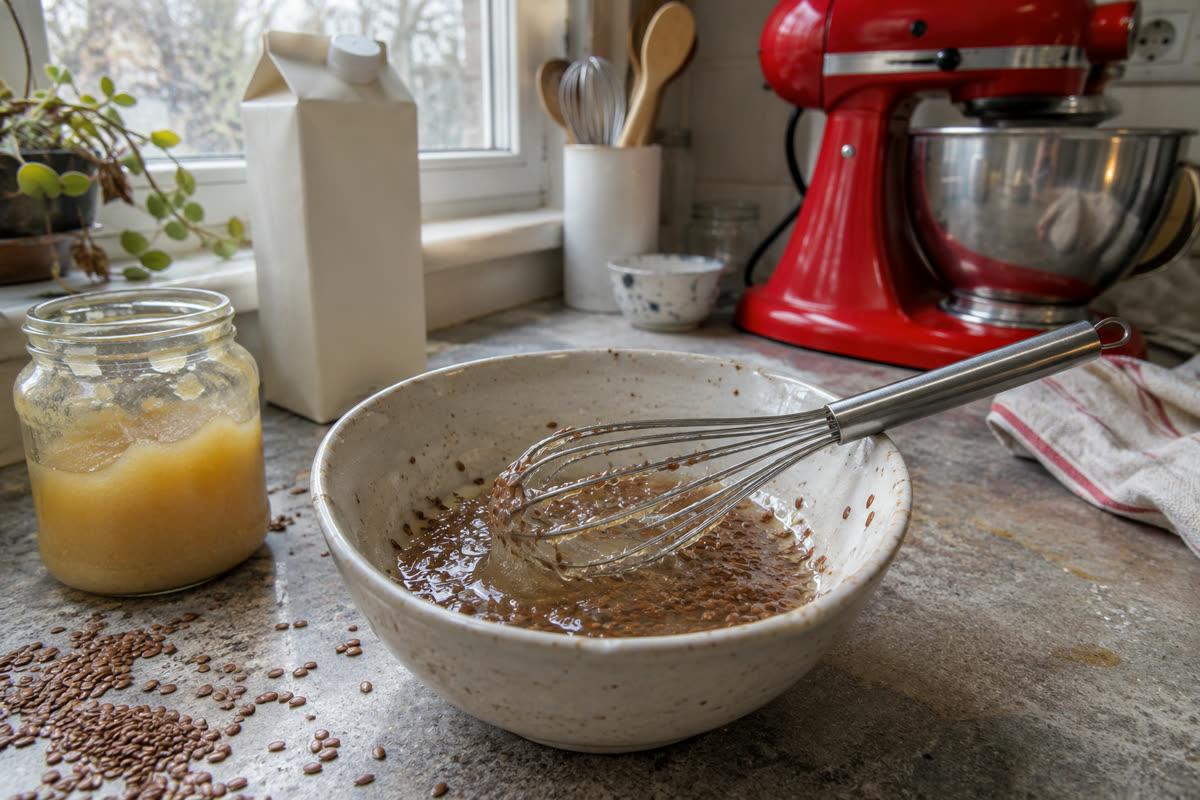
- King Arthur says eggs usually play a major structure-building role in gluten-free recipes, and recommends recipes written without eggs before trying to replace them11.
- Choose a substitute by the job it covers, because nothing replaces everything an egg does2.
- Makers give different flax amounts per egg: Bob’s Red Mill says 2 tablespoons of ground flax to 3 tablespoons of water12, King Arthur says 1 tablespoon to 3 tablespoons13.
- King Arthur says soy milk equals dairy milk in protein level, an area where most other vegan milks fall far short14.
- A gluten-free claim means less than 20 parts per million on a food FDA regulates10; read each substitute’s own label.
What is the egg doing in your recipe?
The University of Wyoming Extension says eggs contribute to the consistency, color, flavor and structure of baked goods15. King Arthur lists structure, emulsifying, binding and leavening16. Three of those jobs decide which substitute fits:
- Lift: eggs trap pockets of air that expand as they heat17.
- Binding: eggs help combine ingredients and hold them together18.
- Moisture: the liquid from eggs is absorbed by the other ingredients and helps keep the finished product moist19.
Yolk and white do different work. The extension says the yolk is fatty and helps bind, while the white provides leavening and moisture, and that in most whole-egg recipes the egg does all three jobs1.
Clues for reading your recipe
The extension gives rules of thumb. If the recipe has no baking powder or baking soda, assume the egg is the leavener; a recipe that calls only for whites most likely uses them to lift and moisten; one that calls only for yolks uses them to bind20. If you cannot tell, it advises assuming all three jobs and choosing a substitute, or a combination, that covers them3.
The number of eggs matters too: the fewer eggs a recipe calls for, the easier they are to substitute21. King Arthur says an egg-heavy recipe, such as a soufflé or quiche, is nearly impossible to pull off without eggs22.
Why gluten-free batters make egg swaps harder
King Arthur says skipping eggs in gluten-free baking can often be a challenge, because eggs usually play a major structure-building role in gluten-free recipes. Its advice is to bake gluten-free recipes that do not include eggs to begin with, rather than replace them11.
It has had some success with a flax egg in some gluten-free recipes, and its Gluten-Free Sandwich Bread recipe carries a tip for an egg-free version made with flax23.
Binding is the other half of the problem. The Gluten Intolerance Group notes that a gluten-free flour without xanthan gum or another binding agent needs one added24. Our guide to xanthan gum, guar gum, psyllium and flax covers those binders, and gluten-free baking troubleshooting is the place to start when a bake has failed.
Egg substitutes, by the job they do
Amounts are per egg, as each source gives them. Treat each row as a starting point and test it in your own gluten-free batter.
| Substitute | Amount per egg, as the source gives it | What the source says it does |
|---|---|---|
| Flax or chia gel | 1 tablespoon flax meal or whole chia seeds with 3 tablespoons water, rested 5 to 10 minutes13. Bob’s Red Mill gives 2 tablespoons ground flax to 3 tablespoons water12. | Adds body and helps bind but does not build structure, so it is not ideal for light, fluffy cakes4. |
| Fruit purée: banana, pumpkin, applesauce | 1/4 cup of mashed banana, pumpkin purée or applesauce, or a similar purée such as sweet potato25. | Adds a lot of moistness5. Can make cookies cakey and cakes or muffins denser26. |
| Plain Greek yogurt (a dairy ingredient) | 1/4 cup27. | Adds moisture and tenderness28. Not for vegan baking, and large amounts can add gumminess29. |
| Aquafaba, the liquid from canned chickpeas | 2 tablespoons for about 1 egg white; 1/4 cup for about 1 whole egg30. | Too delicate for baked goods that rely on whipped eggs or whites for structure, such as angel food cake, chiffon cake or macarons31. |
| Starch slurry | 2 tablespoons cornstarch, arrowroot powder, potato starch or tapioca starch with 3 tablespoons water32. | King Arthur calls it less reliable than the options listed above it on its page33. |
| Lift without an egg | 1/4 cup carbonated water; or 2 tablespoons water, 1 tablespoon oil and 2 teaspoons baking powder; or 1 tablespoon vinegar and 1 teaspoon baking soda; or 2 tablespoons lemon juice and 1 teaspoon baking soda34. | The extension’s suggestions for a recipe where the egg acts as the leavening agent34. |
When you are unsure which job the egg has, the extension suggests combining substitutes, for example carbonated water for lift and a chia gel for binding35.
What a ready-made egg replacer powder is, and is not
King Arthur notes that commercial egg replacers are all different36, and says to follow the measurements and instructions on the product package37.
Bob’s Red Mill’s Gluten Free Egg Replacer lists four ingredients, potato starch, tapioca flour, baking soda and psyllium husk fiber, with no grains, soy, gluten or beans38. The maker says it can be used in cakes, cookies, muffins, pancakes and quick breads6, and that you add water in varying amounts depending on whether you are replacing a white, a yolk or a whole egg39.
The maker also says not to try to scramble it or make an egg white meringue40. Other brands differ, so read each one’s own ingredient list and label.
What milk, butter and cream do, and what replaces them
King Arthur says the protein, fat and sugar in milk can affect a baked good’s structure, mouthfeel, flavor and browning, sometimes barely and sometimes a lot41. Soy milk matches dairy milk at 8 grams of protein per 8-ounce serving, and most other plant milks fall far short14.
In King Arthur’s tests, all the milks performed well in a yeast bread. Soy gave the loaf closest to the dairy one, while the other plant milks produced bread that rose higher42 but was prone to crumbling43. In basic muffins, rise, texture, mouthfeel, flavor and browning were the same across the milks44.
Custards and cream fillings were where the milks differed. Only soy milk came close to the dairy version’s set, with oat milk second9. Coconut milk thickened and then fell apart as it cooled, and almond milk never thickened45. Treat these results as a starting point in a gluten-free batter.
Buttermilk, cream and butter
- Buttermilk: stir 1 tablespoon lemon juice or white vinegar into 1 cup of plant milk46.
- Heavy cream: use full-fat (not “lite”) canned coconut milk, or canned unsweetened coconut cream47.
- Butter: King Arthur found vegan butter almost indistinguishable from butter in most recipes8. In its gluten-free chocolate chip cookie test, the vegan butter cookies were a bit cakier and less chewy than the butter ones48.
For a dairy-free fat in gluten-free baking, King Arthur suggests choosing the fat that most resembles the one in the original recipe49, and warns that the result will not necessarily be the same50. Its general rule for dairy-free baking is that the fewer adjustments you make to a recipe, the more likely it is to turn out as expected51.
Checking each substitute’s gluten-free status
A substitute can be gluten-free in its plain form and still need a label check in the version you buy. On a food FDA regulates, “gluten-free” is a voluntary claim a maker may choose to use52, and the labels “gluten-free,” “no gluten,” “free of gluten” and “without gluten” all mean less than 20 parts per million of gluten10.
Our verdicts cover most of the ingredients named here. Each shows what makers’ own pages and labels said, with the date we read them:
- Egg and dairy: eggs, milk, butter, yogurt, cream cheese.
- Plant milks: oat milk, almond milk, coconut milk, soy milk, rice milk, flax milk.
- Egg-swap ingredients: cornstarch, tapioca, chickpeas, tofu, bananas, baking powder, vinegar.
Our oat milk verdict says the answer depends on the brand, and our rice milk verdict says the carton decides, so read the carton before it goes in the batter. For a replacer powder, read that product’s own page: Bob’s Red Mill’s lists its four ingredients and says no gluten38. Flax meal and aquafaba from a can have no verdict of ours yet, so read their labels too.
Verdicts in this guide
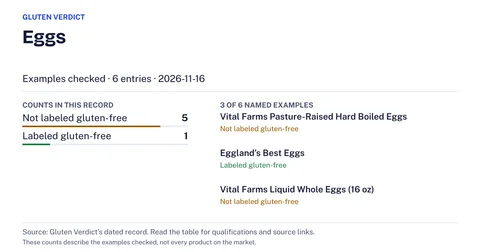 EggsNaturally gluten-freechecked Nov 16, 2026
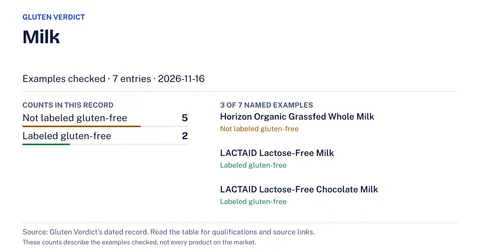 MilkNaturally gluten-freechecked Nov 16, 2026
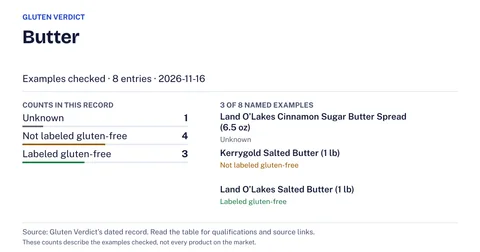 ButterNaturally gluten-freechecked Nov 16, 2026
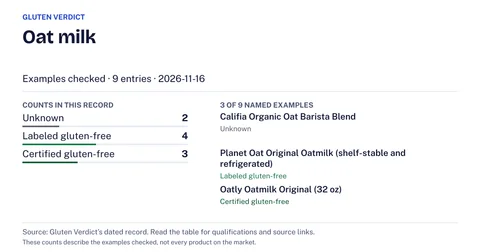 Oat milkDepends on the productchecked Nov 16, 2026
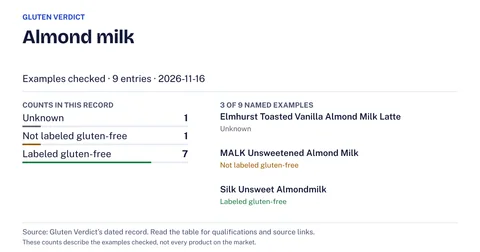 Almond milkNaturally gluten-freechecked Nov 16, 2026
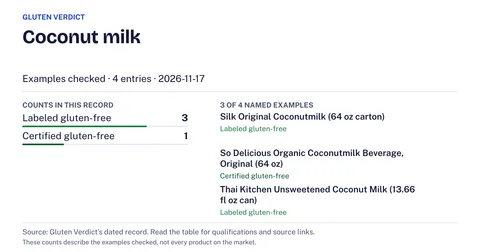 Coconut milkNaturally gluten-freechecked Nov 17, 2026
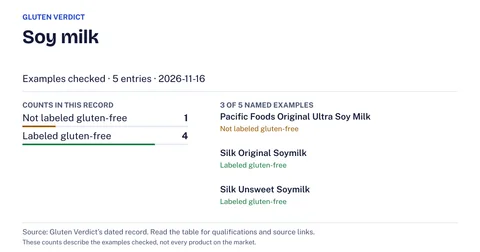 Soy milkNaturally gluten-freechecked Nov 16, 2026
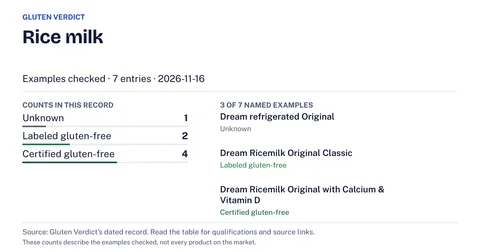 Rice milkDepends on the productchecked Nov 16, 2026
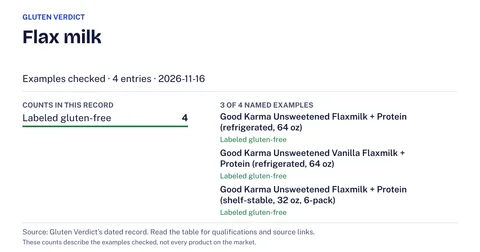 Flax milkNaturally gluten-freechecked Nov 16, 2026
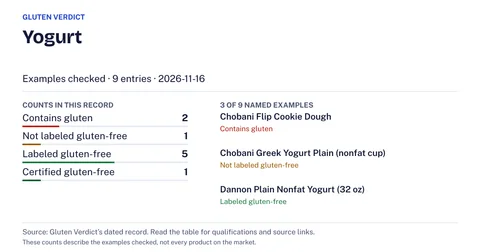 YogurtDepends on the product2 of 9 products we checked contain gluten: Chobani Flip Cookie Dough and Chobani Flip Cookies & Creamchecked Nov 16, 2026
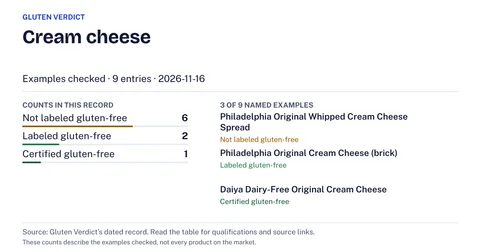 Cream cheeseNaturally gluten-freechecked Nov 16, 2026
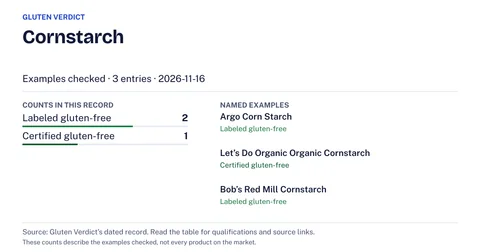 CornstarchNaturally gluten-freeBuy it labeled gluten-freechecked Nov 16, 2026
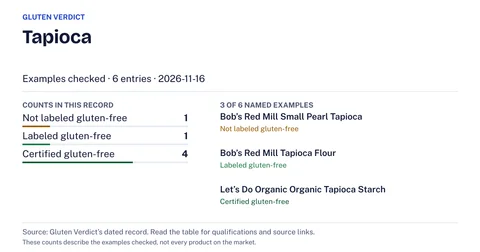 TapiocaNaturally gluten-freeBuy it labeled gluten-freechecked Nov 16, 2026
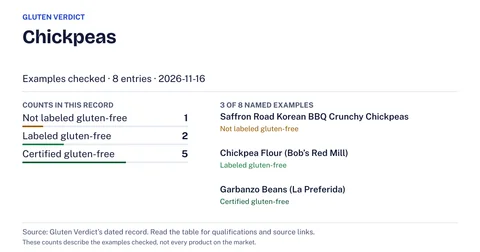 ChickpeasNaturally gluten-freechecked Nov 16, 2026
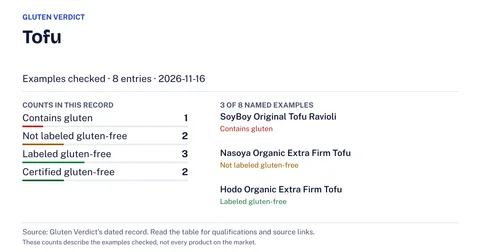 TofuDepends on the product1 of 8 products we checked contains gluten: SoyBoy Original Tofu Raviolichecked Nov 16, 2026
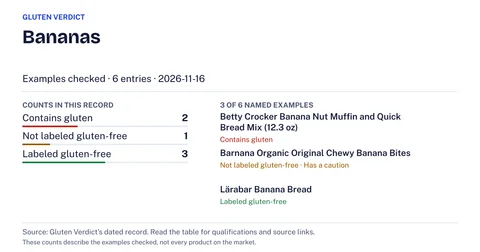 BananasNaturally gluten-free2 of 6 products we checked contain gluten: Betty Crocker Banana Nut Muffin and Quick Bread Mix (12.3 oz) and Bob’s Red Mill Chocolate Chip & Banana Pancake & Waffle Mixchecked Nov 16, 2026
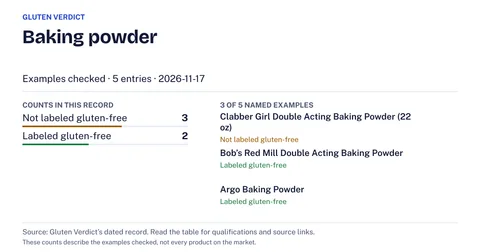 Baking powderDepends on the productchecked Nov 17, 2026
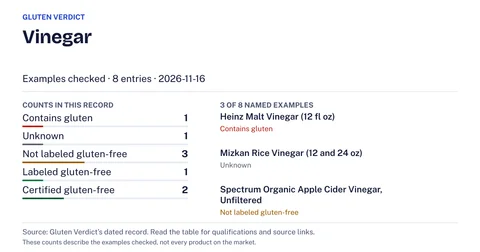 VinegarDepends on the product1 of 8 products we checked contains gluten: Heinz Malt Vinegar (12 fl oz)checked Nov 16, 2026
Questions people ask
Can I use a flax egg in a gluten-free cake?
King Arthur says flax and chia eggs add body and help bind but do not build structure, so they are not ideal for light, fluffy cakes4. It has had some success with flax in some gluten-free recipes, such as its sandwich bread23.
Is it better to replace the egg or choose an egg-free recipe?
King Arthur recommends baking gluten-free recipes that do not include eggs to begin with, instead of trying to replace them11.
More in Gluten-free baking technique
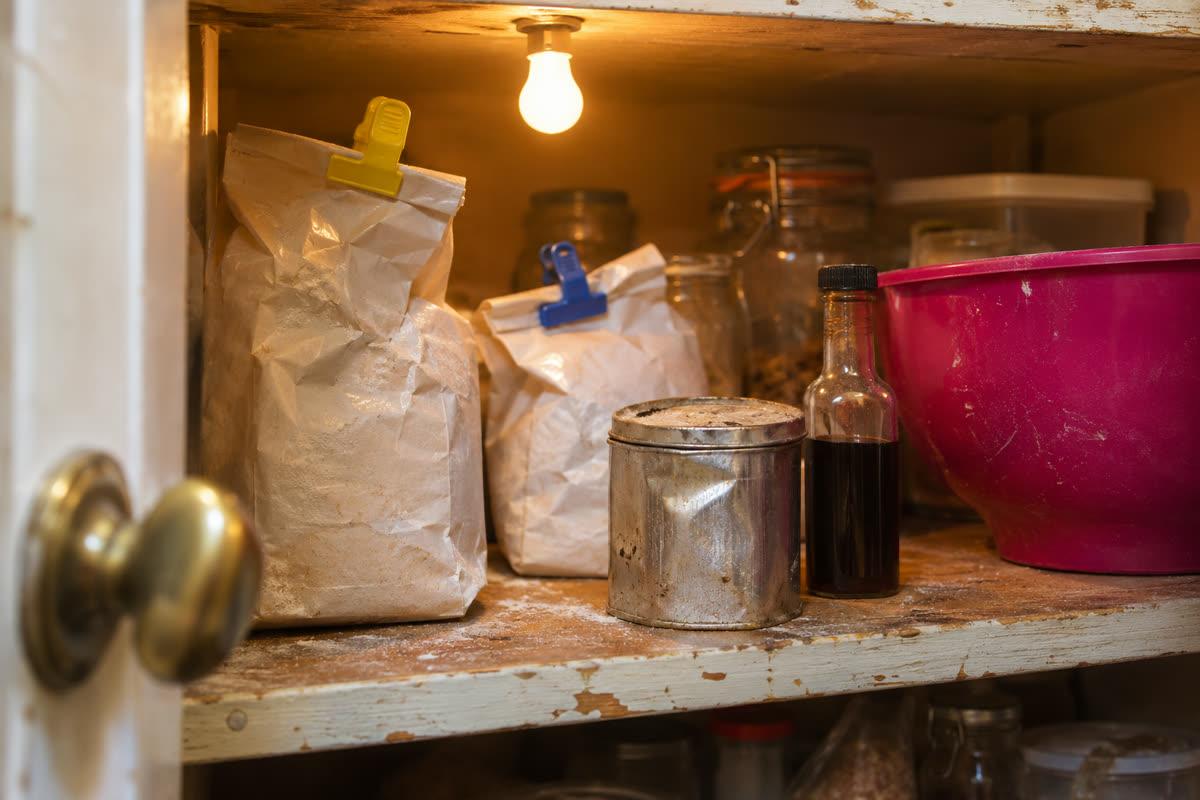 Baking pantry items that can carry glutenBaking powder, cornstarch, powdered sugar, chocolate chips, sprinkles and food coloring: what to read on each label and what the makers say.
 Gluten-free flours for baking: what rice, sorghum, tapioca, almond and coconut flour each doWhat makers say rice, sorghum, millet, tapioca, potato starch, almond and coconut flour do in a bake, and which bags say gluten-free on the label.
 Gluten-free pizza crust, pie crust and cookie problems: what the makers sayMatch a gummy pizza, cracking pie dough or flat cookies to hydration, heat, fat or chill, with what flour and mix makers say and where they stay silent.
 High-altitude gluten-free baking: what extension services and flour makers sayWhat Colorado State Extension, King Arthur and Bob's Red Mill publish for baking above 3,000 feet, and where no source covers gluten-free flours.
 Gluten-free baking gone wrong: dense, gummy, crumbly, gritty or sunkenMatch a dense, gummy, dry, gritty or sunken gluten-free bake to the causes flour makers name, see where their advice differs, and pick one change.
 Gluten-free flour cups to grams: the weights makers print on their labelsGrams per cup for gluten-free flours, copied from King Arthur’s chart and the Bob’s Red Mill, Krusteaz and Pamela’s panels, with where each figure sits.
Related guides
 Gluten-free and dairy-free: how to check a US label for bothUS labels treat milk and gluten under different rules. How to read for both, which makers state both claims, and what to ask when eating out.
 Gluten-free and vegan: where wheat hides in plant-based foodSpot wheat gluten in vegan meat substitutes and sauces, ask the right questions at a restaurant, and see where the charities send you for nutrition.
 Gluten-free binders: what makers say about xanthan, guar, psyllium and flaxWhich gluten-free flours already list xanthan gum, what makers say about adding more, and how xanthan, guar, psyllium and flax are each described.
 Reading a US label for gluten and another food allergyHow to read a US food label for gluten and a second allergen: what the Contains line, gluten-free claim and may-contain lines each cover.
Sources
- [1, 3, 15, 17, 18, 19, 20, 21, 34, 35] University of Wyoming Extension, Egg Substitutes in Baking and Cooking, checked Nov 17, 2026.
- [2, 4, 5, 13, 16, 22, 25, 26, 27, 28, 29, 32, 33, 36, 37] King Arthur Baking, No eggs? Here’s your guide for substituting, checked Nov 17, 2026.
- [6, 38, 39, 40] Bob’s Red Mill, Gluten Free Egg Replacer, checked Nov 17, 2026.
- [7, 8, 51] King Arthur Baking, How to bake dairy-free, checked Nov 17, 2026.
- [9, 14, 41, 42, 43, 44, 45, 46, 47] King Arthur Baking, Non-dairy milk for baking: what’s the best choice?, checked Nov 17, 2026.
- [10, 52] US Food and Drug Administration, Gluten and Food Labeling, checked Nov 17, 2026.
- [11, 23, 30, 31] King Arthur Baking, How to bake egg-free, checked Nov 17, 2026.
- [12] Bob’s Red Mill, Golden Flaxseed Meal, checked Nov 17, 2026.
- [24] Gluten Intolerance Group, Replacing Gluten When Cooking and Baking, checked Nov 17, 2026.
- [48, 49, 50] King Arthur Baking, Fat substitutes in gluten-free baking, checked Nov 17, 2026.