Vitamin D with celiac disease: reading a result and checking a supplement for gluten
Short answer
Three things to sort out, and only the third is on the package:
- The result: blood 25OHD is a useful integrated marker of vitamin D exposure, and the Institute of Medicine committee that set North American intake values in 2011 said 20 ng/ml (50 nmol/liter) covers the requirements of at least 97.5% of the population1, 2.
- The ceiling: the committee’s upper intake level for ages 9 and older is 4000 IU a day, and it is not a target3, 4. Its intake values were developed for “normal healthy persons”, not for individuals with specific disease states45. Coeliac UK says a pharmacist, GP or dietitian can provide advice on vitamin D supplements43.
- The label: FDA’s gluten-free rule covers dietary supplements, so look for a “gluten-free” claim and read the Other Ingredients line for fillers6, 7.
Part of Nutrition and combining diets, 24 guides

Key points
- Serum 25OHD reflects vitamin D from sunlight, food, fortified products and supplements together, so a result is one number built from all of them1.
- The IOM committee left guidelines for managing an individual patient outside its charge, and said some groups had used cut-points that greatly exceed its levels8, 9.
- One meta-analysis found 25(OH)D lower in people with celiac disease than in controls, and higher in treated than untreated patients; it could not confirm which way the link runs10, 11, 12.
- FDA’s gluten-free rule applies to dietary supplements, but the claim is voluntary, so a supplement with no claim needs its ingredient list read6, 13.
- A wheat-free supplement is not necessarily gluten-free14.
What does a vitamin D blood test measure?
One marker is serum 25-hydroxyvitamin D, written 25OHD or 25(OH)D. The Institute of Medicine (IOM) committee that updated the North American intake values in 2011 called it a useful integrated marker of vitamin D exposure: it takes in what the skin makes from sunlight, what comes from foods and fortified products, and what comes from supplements1. That is why one number cannot say where the vitamin D came from1.
Where the line for “low” sits is not settled by one rulebook. The committee said guidelines on using serum markers for an individual patient’s medical management, and for screening, were beyond its charge and that evidence-based consensus guidelines were not available8. It also said some groups had overestimated how common inadequacy is by using cut-points that greatly exceed the levels in its report9. So cut-points used elsewhere may differ from the levels below9; your clinician reads the result.
NIH’s Office of Dietary Supplements, in its fact sheet for health professionals, says the serum concentrations of 25(OH)D associated with vitamin D deficiency have not been definitively identified, and reports that the Food and Nutrition Board states that levels of 50 nmol/L (20 ng/mL) or more are sufficient for most people and that the risk of deficiency increases at serum concentrations of less than 30 nmol/L (12 ng/mL)44. The Gluten Intolerance Group also points readers to that office for age- and sex-specific recommendations15. We took this passage from the fact sheet on 2026-11-17 and did not compare the rest of it with this guide; the tables below come from the open-access summary of the IOM report and carry its 2011 date.
Which levels and intake values has the IOM committee published?
These are population reference values, not a diagnosis. The committee’s intake values were developed for “normal healthy persons” in North America, not for individuals with specific disease states45. It gave serum levels in both units, and the table keeps both2.
| Level | What the committee said |
|---|---|
| 16 ng/ml (40 nmol/liter) | Covers the requirements of approximately half the population2. |
| 20 ng/ml (50 nmol/liter) | Covers the requirements of at least 97.5% of the population2. |
| Above 50 ng/ml (125 nmol/liter) | Should raise concerns among clinicians about potential adverse effects16. |
The same report lists intake values by age. The RDA is the intake that covers the needs of at least 97.5% of the population, and the UL is the level above which there is risk of adverse events17.
| Age | RDA | UL |
|---|---|---|
| 19 to 50 years | 60017 | 400017 |
| 51 to 70 years | 60017 | 400017 |
| 71 years and older | 80017 | 400017 |
These are population values from a committee charged with determining the population needs for these nutrients in North America18. Amounts used to treat a low result are not in the table; the committee left medical management of individual patients outside its charge8.
What is the upper intake level, and is it a target?
For vitamin D the committee set the upper intake level (UL) at 4000 IU a day for ages 9 and older, with lower values for infants and young children3. It says the UL is not intended as a target intake; the risk for harm begins to increase once intakes surpass it4.
The committee described the UL as intended to reflect long-term chronic intake and to be used for public health purposes, and it corrected the value for uncertainty based on chronic disease outcomes and all-cause mortality, as well as emerging concerns about risks at serum 25OHD levels above 50 ng/ml19.
Other countries state their own figures in their own units. Coeliac UK, a UK charity, reports that the UK Scientific Advisory Committee on Nutrition recommends 10 micrograms of vitamin D per day for the general population aged 4 years and older20. That is a UK recommendation in micrograms; it is not the US upper intake level and we do not convert between them.
Why does vitamin D come up with celiac disease?
The Gluten Intolerance Group (GIG) explains that celiac disease can damage the small intestine, reducing the absorption of certain vitamins and minerals21. Its list of nutrients that may not absorb as well includes the fat-soluble vitamins A, D, E and K22, and it adds that an increased risk of these deficiencies only occurs when there is fat malabsorption23.
Two meta-analyses of published studies point the same way, and both are about groups of studies rather than any one person:
- A 2021 meta-analysis found average 25(OH)D in people with celiac disease 8.36 nmol/L lower than in controls10.
- A 2025 meta-analysis reported lower vitamin D levels in people with celiac disease than in controls (standardized mean difference -0.4011, 95% CI -0.8020 to -0.0001, P = 0.0499), alongside lower iron, ferritin, folic acid and zinc24.
The 2021 analysis also compared treated and untreated patients. After gluten-free diet treatment, average 25(OH)D in treated patients was 15.6 nmol/L higher than in untreated patients and close to that of healthy controls11. Its authors add that the directionality of the association cannot be confirmed from cross-sectional studies12. GIG says that once the diet has been adapted, the intestine generally heals and absorption should improve25.
Diet can add a second route. GIG notes that some people with celiac disease also have lactose intolerance early in treatment, and that cutting out dairy could reduce calcium, magnesium and vitamin D26. Coeliac UK adds that the body needs vitamin D to absorb enough calcium27.
Which foods carry vitamin D, and what do our verdicts cover?
The IOM committee names fortified dairy products, fortified foods and fatty fish as the primary sources28. Coeliac UK lists oily fish, eggs, margarine and fortified breakfast cereals for the UK29, and GIG says there are only a few food sources and that, especially in a northern climate, a supplement may be needed30. GIG’s own food list for vitamin D names salmon, sardines, shrimp and cod31.
A fortified food still has to be checked for gluten like any other. Our verdicts show what the sources we read said about each food, with the date we read them: milk, yogurt, cheese, orange juice, soy milk, almond milk and oat milk. Our oat milk verdict, for example, depends on the brand. Whether a given carton or tub is fortified with vitamin D is something its own label shows.
How do you check a supplement label for gluten?
Start with what the law covers. FDA’s gluten-free rule applies to FDA-regulated packaged foods, including dietary supplements6. It sets conditions for the voluntary use of “gluten-free” claims13, so a missing claim is not a statement that the product contains gluten, and a claim is a statement the rule governs. The rule defines the term to include a limit of less than 20 parts per million for any unavoidable gluten32.
Then read the ingredients, because that is where fillers show up. GIG says many supplements use excipients, or fillers, that may contain gluten, and that the source may be wheat or a gluten-free source such as corn33. GIG adds that gluten can be found in herbal, vitamin and mineral supplements34, and that in a pill or capsule gluten could be a fiber or binding agent35. GIG also says gluten is not a common ingredient in medications but is more prevalent in supplements36.
On a US supplement, FDA’s labeling guide counts binders, colors, excipients, fillers, flavors and sweeteners as ingredients37. The list is headed “Other Ingredients” when some ingredients are shown as sources inside the Supplement Facts panel7, and no ingredient statement is needed when everything is listed in the panel and there are no excipients or fillers38. In practice that means reading both the panel and the Other Ingredients line.
- Look for a “gluten-free” claim on the package. If it is there, FDA’s rule applies to it6.
- Read the Other Ingredients line for wheat, barley, rye and malt. Our guide to how to read a food label for gluten lists the names. A wheat-free supplement is not necessarily gluten-free14.
- If you are still in doubt, GIG suggests checking with your pharmacist or the manufacturer of the supplement39.
- If there is no claim and no certification, GIG’s advice is to read the label to know what ingredients are used to manufacture the supplement40.
Certification marks are a separate layer. GIG says it can only vouch for supplements certified by its own GFCO program41. We name no brand and rank none: a product’s own label and maker page are the evidence, and our gluten scanner can read an ingredient list from a photo or pasted text.
What do the sources say a doctor or dietitian can help with?
- NIDDK says a doctor and a registered dietitian can help you plan a healthy, balanced diet to make sure you get the nutrients you need42.
- Coeliac UK says that if you feel you may need supplements, you should speak to your doctor or dietitian, who will provide further advice and prescribe them if necessary5, and that a pharmacist can also advise on vitamin D supplements43.
- Published levels come in two units: the IOM committee gave 25OHD in both ng/ml and nmol/liter2, and said some groups had used cut-points that greatly exceed its levels9.
Verdicts in this guide
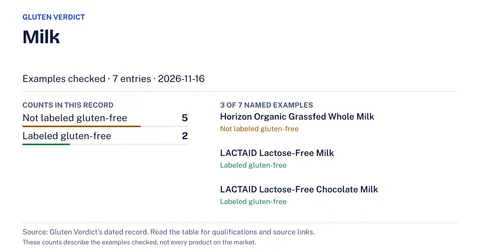 MilkNaturally gluten-freechecked Nov 16, 2026
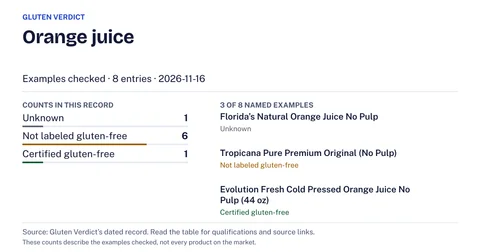 Orange juiceDepends on the productchecked Nov 16, 2026
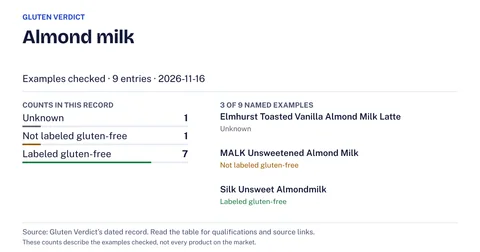 Almond milkNaturally gluten-freechecked Nov 16, 2026
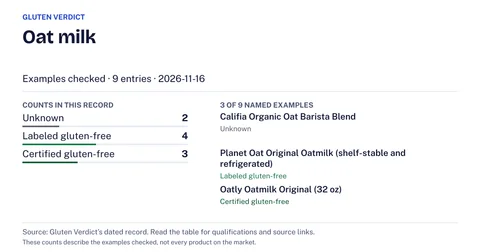 Oat milkDepends on the productchecked Nov 16, 2026
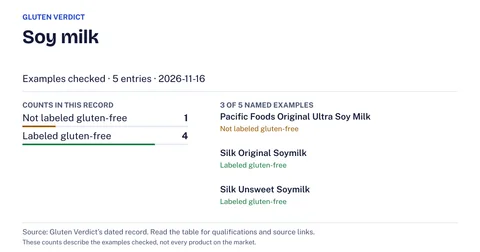 Soy milkNaturally gluten-freechecked Nov 16, 2026
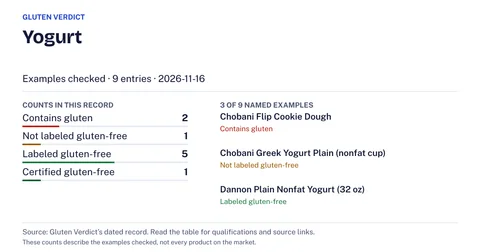 YogurtDepends on the product2 of 9 products we checked contain gluten: Chobani Flip Cookie Dough and Chobani Flip Cookies & Creamchecked Nov 16, 2026
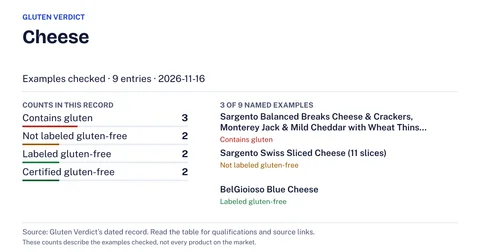 CheeseNaturally gluten-free3 of 9 products we checked contain gluten: Sargento Balanced Breaks Cheese & Crackers, Monterey Jack & Mild Cheddar with Wheat Thins Mini (6-pack); Farm Rich Mozzarella Sticks; and Farm Rich Cheddar Cheese Curdschecked Nov 16, 2026
Questions people ask
More in Nutrition and combining diets
 Calcium and magnesium on a gluten-free, dairy-free dietWhere calcium and magnesium come from without dairy or gluten, and how to read a plant milk’s panel and ingredient list for added calcium.
 Gluten-free and dairy-free: how to check a US label for bothUS labels treat milk and gluten under different rules. How to read for both, which makers state both claims, and what to ask when eating out.
 What to eat after a celiac diagnosis: what the sources document and what they do notBone broth, collagen, glutamine or plain staples? What NIDDK, ACG and celiac charities document after a diagnosis, and what no page we read names.
 Reading a US label for gluten and another food allergyHow to read a US food label for gluten and a second allergen: what the Contains line, gluten-free claim and may-contain lines each cover.
 Gluten-free for older adults: swallowing difficulty, small appetite and thickenersHow to check thickeners, nutrition drinks and soft foods for a gluten statement, what the IDDSI texture levels are, and whom to ask about swallowing.
 Gluten-free and low FODMAP: what to check when symptoms continueHow gluten and FODMAPs differ, what guidelines list for persistent symptoms on a gluten-free diet, and FODMAP ingredients to look for on labels.
Related guides
 Nutrient deficiencies in celiac disease: what the guidance names for checkingWhich nutrients a celiac guideline and a charity's clinician page name for checking, where reported deficiency figures differ, and questions to bring.
 Celiac disease and bone density: who is scanned, how to read the report and what recovery looks likeWhen guidelines advise a bone density scan in celiac disease, how a T-score or Z-score is read by age, and what published studies show about recovery.
 Gluten in medications: what the label, DailyMed and a pharmacist can showFDA’s gluten-free food rule does not cover drugs. Use the ingredient list, DailyMed, the maker and a pharmacist, and know what each can show.
 Certified or naturally gluten-free: when a seal mattersWhich naturally gluten-free foods are worth buying with a claim or seal: produce, grains, flours, oats and processed foods, with FDA rules and test data.
Sources
- [1, 2, 3, 4, 8, 9, 16, 17, 18, 19, 28, 45] Ross AC et al., Journal of Clinical Endocrinology and Metabolism (summary of the 2011 Institute of Medicine report), The 2011 Report on Dietary Reference Intakes for Calcium and Vitamin D from the Institute of Medicine: What Clinicians Need to Know, checked Nov 17, 2026.
Read on 2026-11-17: Table 1 of the article lists, for vitamin D, an RDA of 600 IU/d and a UL of 4000 IU/d for ages 19–30, 31–50 and 51–70 (men and women), and an RDA of 800 IU/d and a UL of 4000 IU/d for ages 71 and older. Its column heading describes the RDA as the intake that covers the needs of at least 97.5% of the population, and its footnote says the UL is the level above which there is risk of adverse events and is not intended as a target intake.
- [5, 20, 27, 29, 43] Coeliac UK, Calcium and vitamin D: gluten free diet guide, checked Nov 17, 2026.
- [6, 13, 32] US Food and Drug Administration, Questions and Answers on the Gluten-Free Food Labeling Final Rule, checked Nov 17, 2026.
- [7, 37, 38] US Food and Drug Administration, Dietary Supplement Labeling Guide: Chapter V. Ingredient Labeling, checked Nov 17, 2026.
- [10, 11, 12] PubMed (Lu et al., Critical Reviews in Food Science and Nutrition, 2021), Vitamin D status and vitamin D receptor genotypes in celiac disease: a meta-analysis, checked Nov 17, 2026.
- [14, 15, 33, 39] Gluten Intolerance Group, Supplementing a Gluten-Free Diet, checked Nov 17, 2026.
- [21, 22, 23, 25, 26, 30, 31] Gluten Intolerance Group, Gluten-Free Diet Nutrient Deficiencies (updated July 2021), checked Nov 17, 2026.
Read on 2026-11-17: the list under “The most commonly affected nutrients that may not absorb as well if you have CD are:” names iron, calcium, folate, vitamin B12 and fat-soluble vitamins such as A, D, E and K.
Read on 2026-11-17: under “Fat-Soluble Vitamins”, the line “Vitamin D” lists salmon, sardines, shrimp and cod as food sources.
- [24] PubMed (Lamjadli et al., International Journal of Immunopathology and Pharmacology, 2025), Micronutrient deficiencies in patients with celiac disease: A systematic review and meta-analysis, checked Nov 17, 2026.
- [34, 35, 36, 40, 41] Gluten Intolerance Group, Are Your Medications and Supplements Gluten-Free?, checked Nov 17, 2026.
- [42] National Institute of Diabetes and Digestive and Kidney Diseases (NIDDK), Celiac Disease: Eating, Diet, & Nutrition, checked Nov 17, 2026.
- [44] NIH Office of Dietary Supplements, Vitamin D: Fact Sheet for Health Professionals, checked Nov 17, 2026.