Oat milk and other plant milks: what to check for gluten
Short answer
Oat milk is the plant milk to check, because GIG says there is a significant risk of oats coming into cross-contact with gluten-containing grains while they are grown, transported, stored and processed6. Almond, soy, coconut, cashew, rice and pea milks start from nuts, legumes and grains that GIG lists as naturally gluten-free, though GIG says processed or flavored versions may have gluten-containing ingredients20, 21. For an oat milk carton, check:
- A “gluten-free” claim, which for oats FDA says means less than 20 parts per million of gluten1.
- A third-party mark such as GFCO’s, which GIG names as an option for additional assurance7, looked up in the certifier’s directory35.
- The maker’s own page, which can differ between two cartons of one brand32, 33 and between countries22.
- The ingredient list, for barley or malt18.
Part of Drinks and alcohol, 18 guides

Key points
- Oats are the exception among plant milks: GIG and NCA both describe cross-contact with gluten grains in oat supply6, 15.
- FDA’s limit for a gluten-free claim on oats is under 20 ppm1; GIG says a gluten-free label is not third-party verified11.
- GIG says GFCO requires 10 ppm or less, and GFCO says a listed product is only certified if its package carries the mark9, 35.
- Lines within one brand differ: Califia’s Oat Barista page lists Gluten Free, its Organic Oat Barista Blend page makes no gluten claim32, 33.
- For the other plant milks, GIG says processed or flavored versions may contain gluten-containing ingredients, so each carton still gets a label check20.
Why oat milk is the plant milk to check
The Gluten Intolerance Group (GIG) says that for people who need to be gluten-free, oat milk has to be assessed the way whole oats are: oats are inherently gluten-free, but there is a significant risk of cross-contact with gluten-containing grains while they are grown, transported, stored and processed6.
The National Celiac Association (NCA) says a lot of sources of oats have had cross-contact with gluten-containing grains, even some that are labeled gluten-free15. That is why this guide treats oat milk differently from the other plant milks below.
Oats raise a second question that a gluten-free claim does not address. NCA says a small number of people with celiac disease react to avenin, a protein in oats16, and NIDDK says to talk with a doctor or registered dietitian about whether to include oats and how much17.
What a “gluten-free” claim on a carton promises
In the US the claim is voluntary4. FDA says oats labeled “gluten-free” must contain less than 20 parts per million (ppm) of gluten, and that oats do not have to be certified to carry the claim1. For any grain other than wheat, rye, barley and their hybrids, the limit applies to unavoidable gluten from cross-contact2.
The claim is the maker’s statement that the product meets FDA’s rule. One condition of that rule is that any unavoidable presence of gluten in the food must be less than 20 ppm3. GIG adds that a product labeled gluten-free should comply with FDA’s definition, but that this is not third-party verified11.
FDA says producers of foods that are by nature free of gluten (it names bottled spring water, fresh fruits and vegetables, and fresh seafood) may choose not to label them5. Oat milk is a different case: GIG’s advice to people who need to be gluten-free is that oats and oat milk should not be consumed unless labeled gluten-free under FDA’s rules or, for additional assurance, GFCO-certified7.
What a certifier’s mark adds
A certifier’s mark involves a third party, not only the maker7, 11. GIG says that to be certified, oat milk has to be made with oats that meet its certification standard8, and that GFCO certification audits all procedures involved in oat processing and tests the oats multiple times10. GIG also says GFCO requires 10 ppm or less of gluten, against FDA’s less than 20 ppm9.
GIG describes two main ways oat processors avoid or remove gluten grains from oats12: Purity Protocol, which takes place during growing, harvesting, transporting, storage, processing and manufacturing13, and mechanical sorting, which takes place during processing14. Our guide on mechanically sorted and purity-protocol oats looks at what makers say about each.
Check the mark in the certifier’s own directory. GFCO’s Product Finder says a product is certified if it appears on the list and carries a certification mark34, and that a listed product whose packaging has no mark is not certified35. When we searched it for “oat milk” on 2026-11-17, the first of three result pages named products under the brands Ghost Town Oats: Oatmilk, Elmhurst, Good & Gather, Edenesque, Inc., Dream and OATLY36. A brand missing from one search is not a finding about that brand. Steps are in how to check a gluten-free seal in the certifier’s directory, and certified or naturally gluten-free covers when a seal matters.
What oat milk makers say on their own pages
A carton’s front panel is short; the maker’s page and FAQ are where a claim, a certificate or a country difference shows up. This is what each page said when we read it.
| Maker | What its page says | What to notice |
|---|---|---|
| Oatly | The Original Oatmilk (32 oz) page lists a “Gluten Free” product certificate24. Its FAQ says US products are made from certified gluten-free oats and labelled gluten-free22. | The same FAQ says that in Europe and Asia its products can contain a small amount of gluten, so a carton bought abroad is a different case22. |
| Planet Oat | Its FAQ says all Planet Oat Oatmilks are gluten free26, and the Original Oatmilk page lists Gluten Free among its reasons to love27. | This is the maker’s claim; GIG says a gluten-free label is not third-party verified11. |
| Silk | Its FAQ answers “Is Silk Oatmilk gluten-free?” with yes28, and says all Silk products are gluten-free and that it has protocols to prevent and detect contamination by gluten29. | That second sentence covers every Silk line, so it also speaks for Silk’s almond, soy, coconut and cashew milks29. |
| Califia Farms | The Oat Barista Blend page says it blends “without dairy, soy, or gluten”31; the Oat Barista page lists Gluten Free32; the Organic Oat Barista Blend page makes no gluten claim33. | Lines from one brand can differ. Read the page for the exact carton. |
| Pacific Foods | Its FAQ says Pacific does not make a gluten-free claim on its oat beverages, and gives the risk of oats commingling with other grains as its reason37. | A maker saying outright that it makes no claim. Read the carton you are holding for what it says today. |
Our oat milk verdict covers the same brands, with the date we checked. For whole oats, see oatmeal and our guide on gluten-free oats vs regular oats.
Barista, flavored and organic cartons
Each carton has its own page and its own claim. Oatly’s Barista Edition page lists a “Gluten Free” certificate25, as the Original does24, while Califia’s Organic Oat Barista Blend page makes no gluten claim33. GIG warns that processed or flavored versions of naturally gluten-free foods may have gluten-containing ingredients20, so a flavored carton gets its own label check.
A word like “malt” is a separate question from oats. NIDDK lists barley as a gluten grain that may be found in malt, malt extract, malt vinegar and brewer’s yeast18. Oatly says the sugar in its unflavored oatmilk comes from enzymes that break oat starch into maltose, “aka malt sugar”23. The ingredient list is where to tell the two apart: look for barley or malt as a named ingredient.
Almond, soy, coconut, rice, pea and other plant milks
None of the sources we read names plant milks as a category; they speak of foods in their pure forms. GIG says legumes, nuts and seeds in their pure forms are gluten-free and that processed or flavored versions may have gluten-containing ingredients20. Its list of naturally gluten-free grains and flours includes rice, soy, coconut and flax21, and NIDDK lists rice among the foods that, without additives or some seasonings, are naturally gluten-free19.
| Milk | Starts from | What the sources say |
|---|---|---|
| Almond milk | Almonds (a nut) | Nuts in their pure forms are gluten-free20. Silk says all its products are gluten-free29. |
| Cashew milk | Cashews (a nut) | Nuts in their pure forms are gluten-free20. Silk’s FAQ says Silk Cashewmilk is gluten-free30. |
| Soy milk | Soy | Soy is on GIG’s list of naturally gluten-free grains and flours21. Silk says all its products are gluten-free29. |
| Coconut milk | Coconut | Coconut is on GIG’s list of naturally gluten-free grains and flours21. Silk says all its products are gluten-free29. |
| Rice milk | Rice | NIDDK lists rice among foods that, without additives or some seasonings, are naturally gluten-free19. Dream’s Ricemilk Original page lists “Certified Gluten Free”39. |
| Pea milk | Peas (a legume) | Legumes in their pure forms are gluten-free20. Ripple’s FAQ says all Ripple products are made without gluten38. |
| Hemp milk, flax milk, macadamia milk | Seeds and a nut | Seeds and nuts in their pure forms are gluten-free20; flax is on GIG’s list21. |
One brand’s statement says nothing about another’s: Silk speaks for Silk and Ripple for Ripple. Each milk in the table links to our verdict for it.
Verdicts in this guide
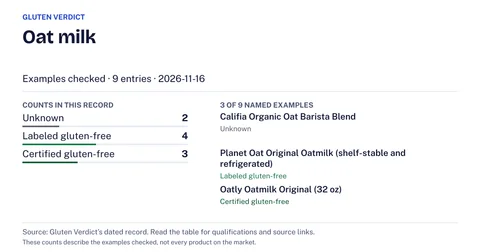 Oat milkDepends on the productchecked Nov 16, 2026
 OatmealDepends on the productchecked Nov 16, 2026
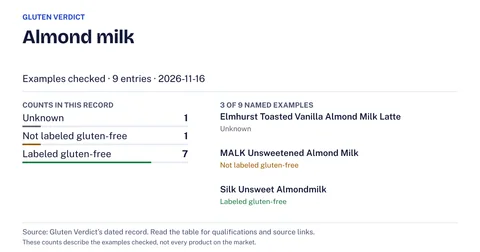 Almond milkNaturally gluten-freechecked Nov 16, 2026
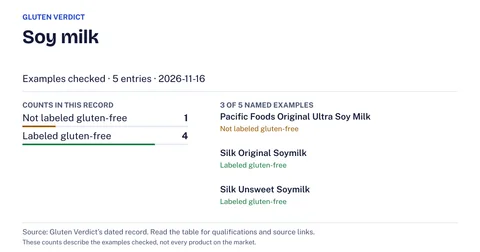 Soy milkNaturally gluten-freechecked Nov 16, 2026
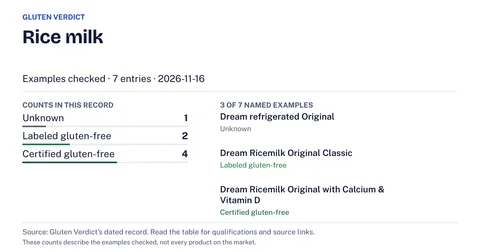 Rice milkDepends on the productchecked Nov 16, 2026
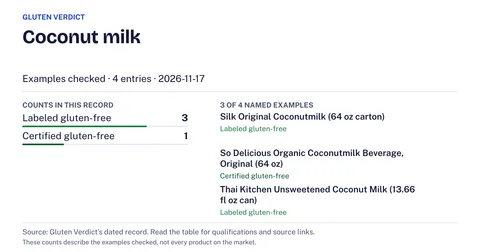 Coconut milkNaturally gluten-freechecked Nov 17, 2026
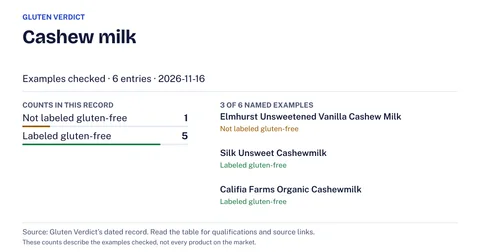 Cashew milkNaturally gluten-freechecked Nov 16, 2026
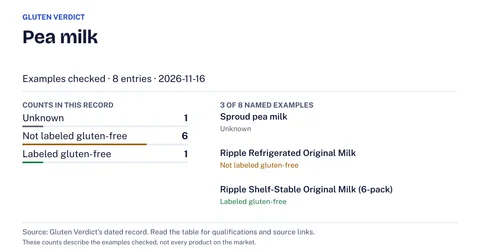 Pea milkNaturally gluten-freechecked Nov 16, 2026
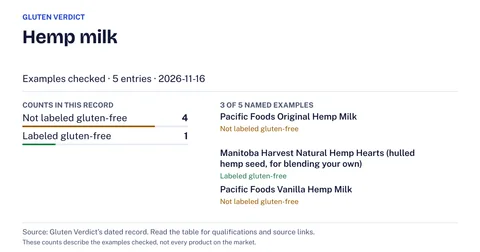 Hemp milkNaturally gluten-freechecked Nov 16, 2026
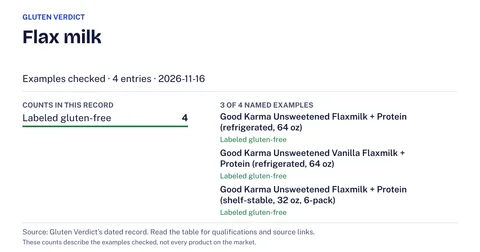 Flax milkNaturally gluten-freechecked Nov 16, 2026
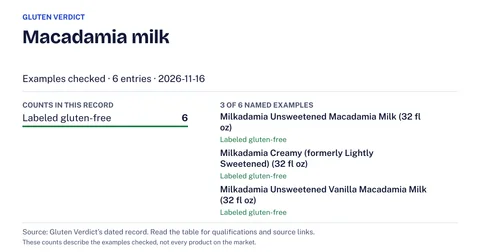 Macadamia milkNaturally gluten-freechecked Nov 16, 2026
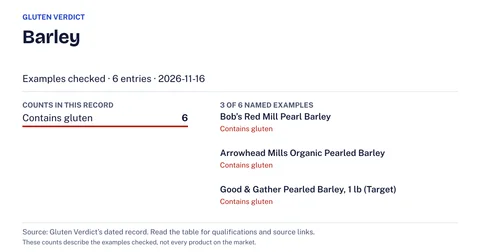 BarleyContains glutenchecked Nov 16, 2026
Questions people ask
Is oat milk gluten-free?
It depends on the carton. GIG’s advice to people who need to be gluten-free is that oats and oat milk should not be consumed unless labeled gluten-free under FDA’s rules or GFCO-certified7, and FDA says oats labeled gluten-free must contain less than 20 ppm1.
Does an oat milk have to be certified to say gluten-free?
FDA’s answer for oats is no: they do not have to be certified to be labeled gluten-free, but oats labeled gluten-free must contain less than 20 ppm1. Certification is a separate step: GIG says GFCO requires 10 ppm or less9.
Why does Oatly’s page mention “malt sugar”?
Oatly says it adds enzymes that break oat starch into maltose, “aka malt sugar”23. Barley is the gluten grain that may be found in malt and malt extract18, so look for those words as named ingredients.
Are almond, soy and coconut milk gluten-free?
Their source foods are gluten-free in their pure forms, but GIG says processed or flavored versions may have gluten-containing ingredients20. Read the carton you are holding.
Is the same oat milk gluten-free in every country?
Not necessarily. Oatly says its US products are made from certified gluten-free oats, while in Europe and Asia its products can contain a small amount of gluten22.
More in Drinks and alcohol
 Gluten in coffee-shop drinks: milk, syrups, toppings and shared toolsTake a coffee-shop drink apart: base, milk, syrup, topping and shared tools. See which label or maker page to read for each part.
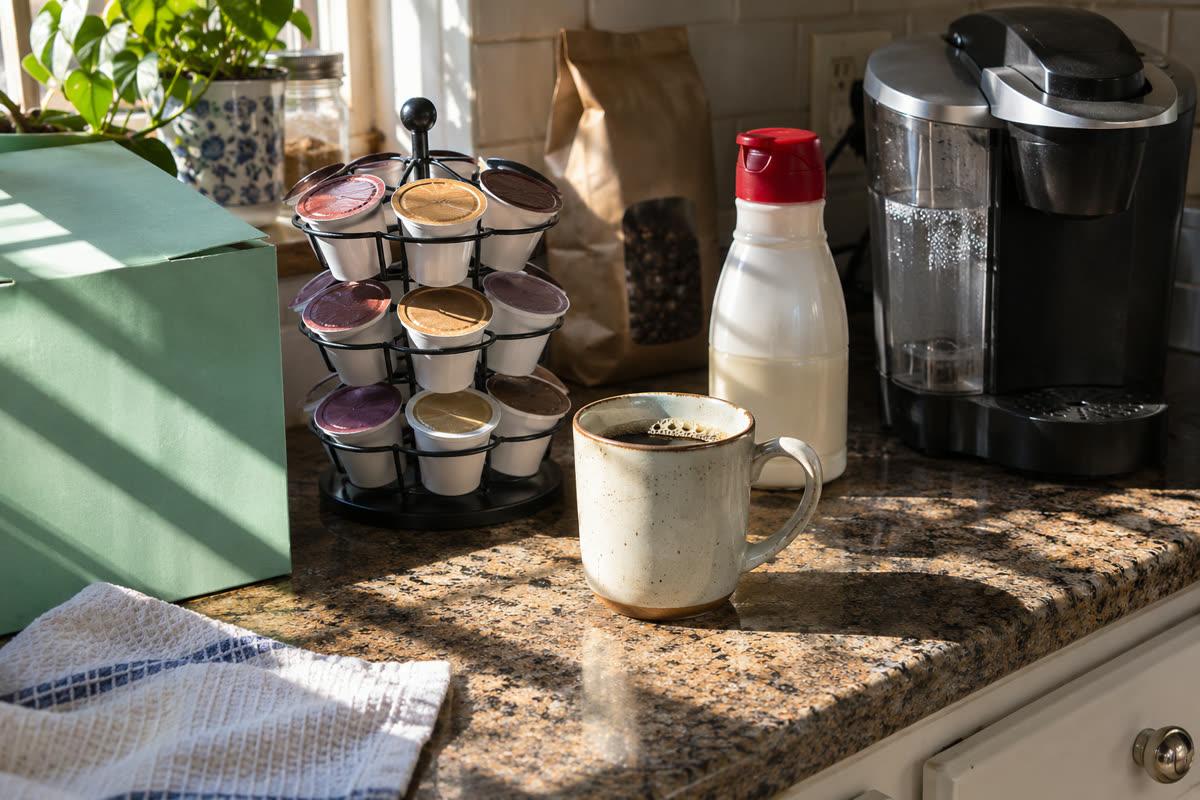 Flavored coffee, pods and creamers: where gluten can enter a cup you make at homeCheck a flavored bean, pod, instant mix or creamer against the maker's own statement; eight makers' pages read on 2026-11-17.
 Whiskey, vodka and gin: what makers say about grain, distillation and added flavorsHow to read a maker’s gluten statement on vodka, whiskey and gin, tell plain bottles from flavored ones by label wording, and know what to ask.
 Sake, soju, mead and shochu: what each is made from and what to askWhat sake, soju, mead, shochu and makgeolli are made from, which come in grain-based versions, and what to ask a server or maker.
 Non-alcoholic beer, kvass and malta: what the grain means for glutenHow non-alcoholic beer, kvass and malta are made, what US labels let them say about alcohol and gluten, and what to check on each can or bottle.
 Wheatgrass, green powders and smoothie add-ins: what to check for glutenHow to check wheatgrass, barley grass, green powders, granola, cookie pieces and protein boosts for gluten on a smoothie menu or label.
Related guides
 Gluten-free oats by country: where the claim is allowed and where it is barredWhether oats can carry a gluten-free claim in the US, Canada, EU, UK, Australia and New Zealand, in each regulator’s own words.
 Certified or naturally gluten-free: when a seal mattersWhich naturally gluten-free foods are worth buying with a claim or seal: produce, grains, flours, oats and processed foods, with FDA rules and test data.
 How to check a gluten-free seal in the certifier's own directorySearch GFCO's Product Finder by brand, product or UPC, read what an entry shows, and learn what a missing listing means for the seal on your pack.
 Gluten-free and dairy-free: how to check a US label for bothUS labels treat milk and gluten under different rules. How to read for both, which makers state both claims, and what to ask when eating out.
Sources
- [1, 2, 3, 4, 5] US Food and Drug Administration, Questions and Answers on the Gluten-Free Food Labeling Final Rule, checked Nov 17, 2026.
- [6, 7, 8] Gluten Intolerance Group, Is oat milk okay to include in a gluten-free diet?, checked Nov 17, 2026.
- [9, 10, 11, 12, 13, 14] Gluten Intolerance Group, Are Oats and Oat Flour Gluten-Free?, checked Nov 17, 2026.
- [15, 16] National Celiac Association, Why can I NOT tolerate GF oats?, checked Nov 17, 2026.
- [17, 18, 19] National Institute of Diabetes and Digestive and Kidney Diseases (NIDDK), Eating, Diet, & Nutrition for Celiac Disease, checked Nov 17, 2026.
Read on 2026-11-17: the list under “What foods and drinks contain gluten?” names wheat and types of wheat, barley “which may be found in malt, malt extract, malt vinegar, and brewer’s yeast”, rye, and triticale.
- [20, 21] Gluten Intolerance Group, Getting Started on a Gluten-Free Diet (PDF), checked Nov 17, 2026.
- [22, 23] Oatly, Random Answers & FAQ (gluten), checked Nov 17, 2026.
- [24] Oatly, Oatmilk Original (32 oz), checked Nov 17, 2026.
- [25] Oatly, Oatmilk Barista Edition (32 oz), checked Nov 17, 2026.
- [26] Planet Oat, Frequent Questions, checked Nov 17, 2026.
- [27] Planet Oat, Original Oatmilk (refrigerated), checked Nov 17, 2026.
- [28, 29, 30] Silk (Danone), FAQs, checked Nov 17, 2026.
- [31] Califia Farms, Oat Barista Blend, checked Nov 17, 2026.
- [32] Califia Farms, Oat Barista, checked Nov 17, 2026.
Read on 2026-11-17: the list headed “Reasons to Love” names Gluten Free, Made to Froth & Steam Lattes and No Gums.
- [33] Califia Farms, Organic Oat Barista Blend, checked Nov 17, 2026.
Read on 2026-11-17: no gluten-free claim and no gluten line anywhere on the page; its list headed “Reasons to Love” names steams and froths for the perfect latte and creamy and delicious.
- [34, 35, 36] Gluten-Free Certification Organization, GFCO Product Finder, checked Nov 17, 2026.
Read on 2026-11-17: the first of three pages of results for the search “oat milk” lists oat milk products under the brands Ghost Town Oats: Oatmilk, Elmhurst, Good & Gather, Edenesque, Inc., Dream and OATLY.
- [37] Pacific Foods, FAQs (plant-based beverages), checked Nov 17, 2026.
- [38] Ripple Foods, FAQs, checked Nov 17, 2026.
- [39] Dream (SunOpta), DREAM Ricemilk Original with Calcium & Vitamin D, checked Nov 17, 2026.