High-altitude gluten-free baking: what extension services and flour makers say
Short answer
Colorado State University Extension says elevation problems remain when wheat flour is replaced with gluten-free flour, and that there are no set guidelines on how to compensate1. The altitude charts from King Arthur and Bob's Red Mill, the two flour makers we read, name no gluten-free flour2, 3, so treat any chart as a starting point for a test bake, not a gluten-free rule17.
Part of Gluten-free baking technique, 11 guides
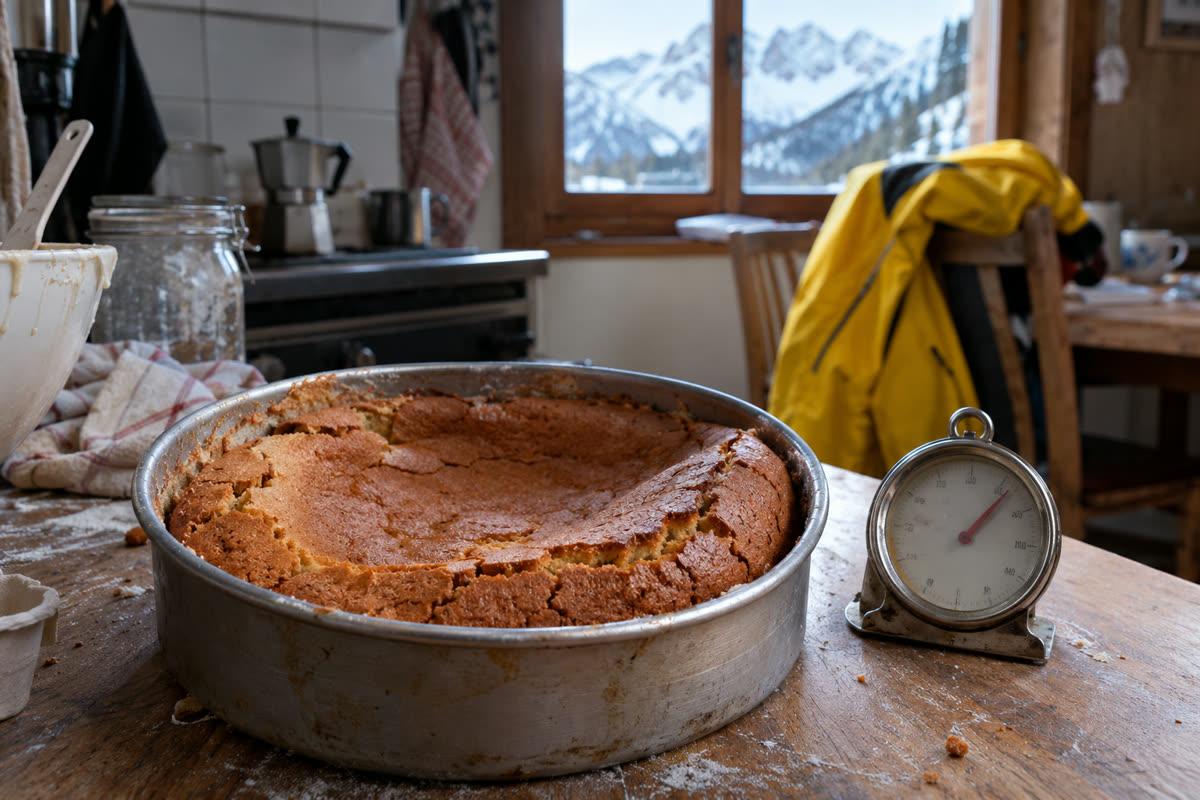
Key points
- For baking, high altitude is generally considered to be above 3,000 to 3,500 feet4.
- CSU says that at altitude leavening gases expand more quickly and liquids evaporate faster5, 6.
- The published numbers differ between sources and none is labeled for gluten-free flour7, 8.
- CSU says to make the elevation adjustments first and then adjust further for the gluten-free flours1.
- Betty Crocker's gluten-free cake mix page has its own high-altitude line; Bob's Red Mill's gluten-free flour pages and King Arthur's gluten-free baking guide, which we also read, do not10, 33, 11.
Why altitude changes a bake
Colorado State University (CSU) Extension says that at 3,000 feet above sea level and higher, preparing food may require changes in time, temperature and ingredients because of lower atmospheric pressure12. It gives the pressure as 14.7 pounds per square inch (psi) at sea level, 12.3 psi at 5,000 feet and 10.2 psi at 10,000 feet13. King Arthur says that for baking, high altitude is generally considered to be above 3,000 to 3,500 feet4.
CSU names two effects of the lower pressure: leavening gases in breads and cakes expand more quickly5, and water and other liquids evaporate faster6.
Here is how CSU describes a cake that fails: above 3,000 feet, the lower pressure may result in excessive rising, which stretches the cell structure of the cake, making the texture coarse, or breaks the cells, causing the cake to fall14. It explains the sugar side this way: excessive evaporation of water leads to a high concentration of sugar, which weakens the cell structure15. King Arthur names the dry result: too-dry cake is a common issue at high altitude16.
What each source gives as a starting point
King Arthur says its charts are meant as a starting point: it may take a few tries, and where possible adjust only one ingredient at a time17. Bob's Red Mill says its charts rest on its test kitchens and on CSU and New Mexico State University Extension recommendations and are intended as general guidelines18.
| What to change | CSU Extension (cakes) | King Arthur | Bob’s Red Mill |
|---|---|---|---|
| Baking powder or baking soda | Table 3 (baking powder): decrease each teaspoon by 1/8 teaspoon at 3,500 to 6,500 ft., 1/8 to 1/4 teaspoon at 6,500 to 8,500 ft., 1/4 teaspoon at 8,500 to 10,000 ft.7 | Chart: 1 teaspoon becomes 7/8, 1/2 and 1/4 teaspoon at 3,000-5,000, 5,000-6,500 and 6,500-8,000 ft.8 | Decrease each teaspoon by ⅛ to ¼ teaspoon19 |
| Sugar | Decrease each cup by 0-1 Tbsp., 0-2 Tbsp. and 1-3 Tbsp. in the same three bands7 | Decrease by 1 tablespoon per cup20 | Decrease by 1–3 tablespoons per cup19 |
| Liquid | Add per cup 1-2 Tbsp., 2-4 Tbsp. and 3-4 Tbsp. in the same three bands7 | Increase by 1 to 2 tablespoons at 3,000 feet and 1 1/2 teaspoons for each additional 1,000 feet20 | Increase by 1–2 tablespoons at 3,000 feet, then 1½ teaspoons for each additional 1,000 feet19 |
| Oven temperature | Increase by 15 to 25 °F21 | Increase by 15°F to 25°F20 | Increase by 25°F19 |
| Flour | Not in Table 37 | At 3,500 feet add 1 more tablespoon per recipe, then one more for each additional 1,500 feet20 | Increase by 1–3 tablespoons19 |
The sources do not agree in size at every altitude. At 5,000 to 6,500 feet King Arthur's chart takes 1 teaspoon of leavener down to 1/2 teaspoon8, while CSU's cake table decreases each teaspoon by 1/8 teaspoon at 3,500 to 6,500 feet7. Neither chart names a gluten-free flour. Our verdict on baking powder covers one of the leaveners these charts adjust.
How the sources say to use the numbers
Where the guidance talks about protein and gluten
Some of the advice is about flour protein or gluten development. The pages say so in these places:
- CSU's yeast-bread advice is to use flour with at least 12% protein, and it says bread flour or whole-wheat flour usually have higher protein content than other types25.
- King Arthur suggests considering high-protein bread flour for extra strength and structure in bread and pizza dough26.
- CSU's bread-machine suggestions include a longer mixing cycle: “To allow gluten to develop more fully”27.
- Bob's Red Mill's mixing tip says excess air or gluten development makes baked goods rise too quickly and sink as they cool28.
None of these four points says how to apply it to a flour blend that has no gluten grain in it. The King Arthur and Bob's Red Mill altitude pages name no gluten-free flour2, 3. CSU's page on baking at elevation does not name one in its yeast-bread, quick-bread or cookie sections29.
What CSU Extension says about gluten-free baking at elevation
The CSU High Elevation Food Preparation Guide has a section headed “Gluten Free Baking”. In it CSU says that when wheat flour is replaced with gluten-free flour, the high-elevation challenges remain, and that there are no set guidelines on how to compensate1. For the home cook, CSU advises two steps, in this order:
- Make any necessary adjustments for the elevation change1.
- Then alter the recipe further as needed for the properties of gluten-free flours1.
A 2026 review of gluten-free bread texture says the absence of a gluten framework negatively impacts the dough structure and texture30. Its abstract does not mention altitude31.
What gluten-free flour and mix makers say
Bob's Red Mill says its Gluten Free 1-to-1 Baking Flour replaces wheat flour cup for cup in non-yeast recipes32. The product page has no mention of altitude or elevation10; neither does the page for its Gluten Free All Purpose Baking Flour33, or King Arthur's Gluten-Free Baking guide11. Our verdict on the flour: Bob’s Red Mill Gluten Free 1-to-1 Baking Flour.
Some gluten-free mixes carry their own altitude line. Betty Crocker's page for its Gluten Free Yellow Cake Mix has a line that reads “High Altitude (3500-6500 ft):. Mix on low speed 30 seconds, then on medium speed 1 minute. Make 18 cupcakes.”9 It lists no altitude change to oven temperature, bake time, liquid or leavening34. Its Gluten Free Chocolate Brownie Mix page says “High Altitude (3500-6500 ft): No change.”35
Bob's Red Mill's altitude article says most of its baking mixes can be adapted for high-altitude baking with a few adjustments36: increase the oven temperature by 25°F, avoid overmixing the batter, and begin checking for doneness 5–7 minutes earlier than the recipe suggests37. The article does not say which mixes it means3.
CSU says cake mix boxes usually give high-elevation adjustments, and that these usually add all-purpose flour and liquid because the leavener cannot be decreased38. That describes cake mixes in general, not gluten-free ones.
Cakes, cookies and quick breads
Cakes
For a cake CSU lists a higher oven temperature so the batter sets before the cells formed by the leavening gas expand too much21, and, for rich cakes, more egg to strengthen the cell structure39. Bob's Red Mill's cake table adds 1 extra egg to enriched cakes and whipped egg whites to soft peaks for angel food and sponge cakes40.
Cookies
CSU says many sea-level cookie recipes give acceptable results at high elevation, and that they are often improved by one or more small changes41: a slight decrease in baking powder or soda, a slight decrease in fat and/or sugar, a slight increase in liquid and flour, and a slight increase in baking temperature42. CSU adds that chilling the dough or using parchment may help decrease spread43. King Arthur says many bakers report making sea-level cookie recipes at altitude with minimal to no changes44. Both are written about cookie recipes in general.
Quick breads and muffins
CSU says that without adjustments a biscuit or muffin-type quick bread may taste bitter or alkaline from inadequate neutralization of baking soda or baking powder, and that slightly reducing these leaveners will usually improve results45. King Arthur says banana and zucchini breads tend to be pretty resilient at high altitude46.
CSU also says baked goods have a higher tendency to stick to pans at higher elevations47.
Yeast bread at altitude
CSU says decreased atmospheric pressure lets yeast dough rise too fast, hurting texture and flavor; less yeast may be used, or the dough punched down and allowed to rise a second time48. It adds that over-proofing can give a heavy, dry loaf or a misshapen or collapsed loaf49. King Arthur says to decrease yeast by 25% to slow proofing50; Bob's Red Mill says by ¼ teaspoon, if needed51.
CSU also says flours tend to be drier and absorb more liquid in high, dry climates, so less flour or additional liquid may be needed52. CSU's Baking at Elevation page and the King Arthur and Bob's Red Mill altitude pages name no gluten-free flour29, 2, 3. Bob's Red Mill says its 1-to-1 flour is for non-yeast recipes32, and CSU says there are no set guidelines for compensating when the flour is gluten-free1. For gluten in ordinary bread, see our bread verdict; for why gluten-free loaves crumble at any altitude, see why gluten-free bread crumbles.
What no source gives
- A gluten-free altitude chart. CSU says there are no set guidelines1; the King Arthur and Bob's Red Mill altitude pages name no gluten-free flour2, 3; and the gluten-free flour pages we read give no altitude directions10, 33, 11.
- A study. Our PubMed search for high altitude baking cake returned no results on the day we ran it53. That is one search, not proof that none exists.
- New Mexico State University's high-altitude guidance. King Arthur points readers to it54, and Bob's Red Mill draws on it18. We could not open it, so this guide does not report what it says.
For a failed gluten-free bake, troubleshooting dense, gummy, crumbly or sunken results covers causes that do not depend on altitude, and converting cups to grams from labels helps when you change flour amounts.
Verdicts in this guide
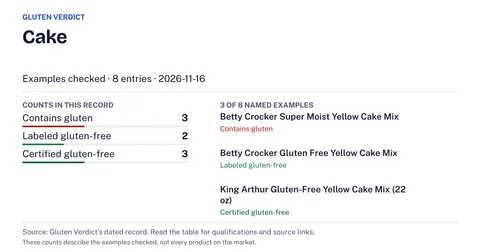 CakeContains glutenchecked Nov 16, 2026
 BreadContains glutenchecked Nov 16, 2026
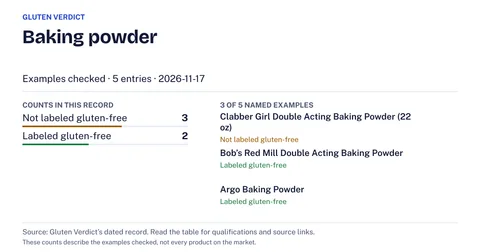 Baking powderDepends on the productchecked Nov 17, 2026
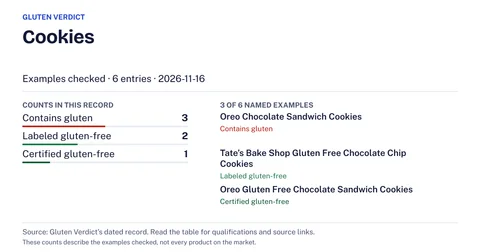 CookiesContains glutenchecked Nov 16, 2026
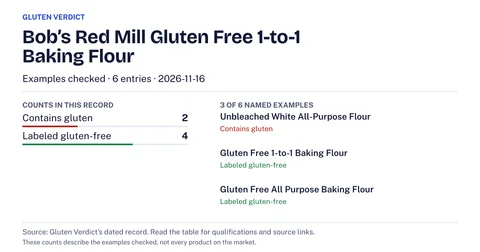 Bob’s Red Mill Gluten Free 1-to-1 Baking FlourLabeled gluten-free2 of 6 varieties we checked contain gluten: Unbleached White All-Purpose Flour and Whole Wheat FlourBob’s Red Mill Natural Foods · checked Nov 16, 2026
Questions people ask
Do I need to change a gluten-free recipe at high altitude?
CSU says the elevation challenges remain with gluten-free flours and that there are no set guidelines; it advises experimenting, with the elevation adjustments first1. Its general baking notes also say not to assume a sea-level recipe will fail, and to try it first22; that note is not written for gluten-free recipes.
What counts as high altitude for baking?
King Arthur says high altitude is generally considered to be above 3,000 to 3,500 feet4. CSU says that at 3,000 feet and higher, preparing food may require changes12.
More in Gluten-free baking technique
 Gluten-free baking gone wrong: dense, gummy, crumbly, gritty or sunkenMatch a dense, gummy, dry, gritty or sunken gluten-free bake to the causes flour makers name, see where their advice differs, and pick one change.
 Baking pantry items that can carry glutenBaking powder, cornstarch, powdered sugar, chocolate chips, sprinkles and food coloring: what to read on each label and what the makers say.
 Why gluten-free bread crumbles: binder, rise, oven and storageWhat flour, mix and yeast makers and a 2026 review say about crumbly gluten-free bread: binder, rise, oven setting, cooling and storage.
 Gluten-free flour cups to grams: the weights makers print on their labelsGrams per cup for gluten-free flours, copied from King Arthur’s chart and the Bob’s Red Mill, Krusteaz and Pamela’s panels, with where each figure sits.
 Egg and dairy substitutes in gluten-free baking: what each one doesWhich job an egg or dairy ingredient does in a bake, which substitutes makers and bakers describe for it, and how to check each one's gluten-free status.
 1-to-1, all-purpose and bread flour blends: what each maker’s page says the bag is forWhat King Arthur and Bob’s Red Mill say their 1-to-1, all-purpose, bread and pizza gluten-free flours are for, and which bakes each sends elsewhere.
Related guides
 Baking gluten-free in a home where someone else bakes with wheat flourA baking-day plan for a shared kitchen: order, counters, flour storage, tools and oven, and which timing rules have no published source.
 Gluten-free at Publix: the shelf icon, GreenWise packs, and the deli and bakery countersWhat Publix says about its gluten free icon, GreenWise packs and the Deli and Bakery, and what to ask at each counter before you order.
 Gluten-free at Price Chopper and Market 32: the blue shelf tag, the ppm figure and the bakery and deliHow to use Price Chopper and Market 32’s gluten-free tag and pages, hold a pack to FDA’s 20 ppm rule, and what the bakery and deli pages leave unsaid.
 Grieving foods after a celiac diagnosis: what people describe and where to get helpSadness or anger about food after a celiac diagnosis: what charities and research report, small steps the sources name, and when to call a provider or 988.
Sources
- [1, 5, 6, 7, 12, 13, 14, 15, 21, 22, 23, 25, 27, 38, 39, 41, 42, 43, 45, 47, 48, 49] Colorado State University Extension, High Elevation Food Preparation Guide, checked Nov 17, 2026.
Read on 2026-11-17: Table 3, “Cake-recipe adjustment guide for high elevation”, gives three columns (3,500 to 6,500 ft., 6,500 to 8,500 ft., 8,500 to 10,000 ft.). Reduce baking powder, for each tsp., decrease: 1/8 tsp., 1/8-1/4 tsp., 1/4 tsp. Reduce sugar, for each cup, decrease: 0-1 Tbsp., 0-2 Tbsp., 1-3 Tbsp. Increase liquid, for each cup, add: 1-2 Tbsp., 2-4 Tbsp., 3-4 Tbsp. The table names no gluten-free flour.
Read on 2026-11-17: the list that follows that sentence names a slight decrease in baking powder or soda, a slight decrease in fat and/or sugar, a slight increase in liquid ingredients and flour, and a slight increase in baking temperature.
- [2, 4, 8, 16, 17, 20, 26, 44, 46, 50, 54] King Arthur Baking, High-Altitude Baking, checked Nov 17, 2026.
Read on 2026-11-17: the article text of “High-Altitude Baking” names no gluten-free flour, mix or adjustment; the only gluten-free link on the page is in the site’s navigation menu.
Read on 2026-11-17: the chart under “How to adjust leavening when baking at high altitude” gives, for baking powder or baking soda, amounts for 3,000-5,000 ft., 5,000-6,500 ft. and 6,500-8,000 ft. For 1 teaspoon the amounts are 7/8, 1/2 and 1/4 teaspoon; for 2 teaspoons, 1 1/2, 1 and 3/4 teaspoon. The chart names no gluten-free flour.
Read on 2026-11-17: the table headed “How to adjust baking for high altitude” says: oven temperature, increase 15°F to 25°F; baking time, decrease by 5 to 8 minutes per 30 minutes of baking time; sugar, decrease by 1 tablespoon per cup; liquid, increase by 1 to 2 tablespoons at 3,000 feet and by 1 1/2 teaspoons for each additional 1,000 feet; flour, at 3,500 feet add 1 more tablespoon per recipe and for each additional 1,500 feet add one more tablespoon.
- [3, 18, 19, 24, 28, 36, 37, 40, 51] Bob's Red Mill, High-Altitude Baking Tips, checked Nov 17, 2026.
Read on 2026-11-17: the article names no gluten-free flour or gluten-free mix and does not say which of its baking mixes the sentence about mixes covers; the word gluten appears once in the article text, in the mixing row quoted above.
Read on 2026-11-17: the table “General High-Altitude Baking Tips” says: baking powder and baking soda, decrease each teaspoon by ⅛ to ¼ teaspoon; liquid, increase by 1–2 tablespoons at 3,000 feet, then 1½ teaspoons for each additional 1,000 feet; flour, increase by 1–3 tablespoons; sugar, decrease by 1–3 tablespoons per cup; oven temperature, increase by 25°F; bake time, begin checking doneness 5–7 minutes earlier for every 30 minutes of baking.
Read on 2026-11-17: the list after that sentence names: increase oven temperature by 25°F; avoid overmixing the batter; begin checking for doneness 5–7 minutes earlier than the recipe suggests, and monitor closely.
Read on 2026-11-17: the table under “How to Bake High-Altitude Cakes” says: decrease each teaspoon of baking powder and baking soda by ⅛ to ¼ teaspoon; increase liquid by 1–2 tablespoons; add up to 2 tablespoons of flour per cup, if needed; decrease fat by 1–2 tablespoons; add 1 extra egg to enriched cakes; for angel food and sponge cakes, whip egg whites to soft peaks rather than stiff peaks; decrease sugar by 1 tablespoon per cup; increase oven temperature by 25°F.
Read on 2026-11-17: the table under “How to Bake High-Altitude Yeast Breads” says: decrease yeast by ¼ teaspoon, if needed; increase liquid by 1–2 tablespoons, as needed; start with up to 25% less flour; cover and refrigerate the dough during the first rise; punch down the dough and let it rise a second time.
- [9, 34] Betty Crocker (General Mills), Gluten Free Yellow Cake Mix (product page), checked Nov 17, 2026.
Read on 2026-11-17: the preparation steps list oven temperature 350°F, bake times by pan size and the High Altitude (3500-6500 ft) line; no altitude change to oven temperature, bake time, liquid or leavening is listed.
- [10, 32] Bob's Red Mill, Gluten Free 1-to-1 Baking Flour (product page), checked Nov 17, 2026.
Read on 2026-11-17: no mention of altitude or elevation anywhere on the page.
- [11] King Arthur Baking, Gluten-Free Baking guide, checked Nov 17, 2026.
Read on 2026-11-17: no mention of altitude or elevation anywhere on the page.
- [29, 52] Colorado State University Extension, Baking at Elevation, checked Nov 17, 2026.
Read on 2026-11-17: the sections on yeast breads, quick breads and cookies name no gluten-free flour; the page contains no mention of gluten-free baking.
- [30, 31] PubMed, Review: problems and approaches in improving gluten-free bread texture (Int J Food Sci, 2026), checked Nov 17, 2026.
Read on 2026-11-17: the abstract does not mention altitude or elevation.
- [33] Bob's Red Mill, Gluten Free All Purpose Baking Flour (product page), checked Nov 17, 2026.
Read on 2026-11-17: no mention of altitude or elevation anywhere on the page.
- [35] Betty Crocker (General Mills), Gluten Free Chocolate Brownie Mix (product page), checked Nov 17, 2026.
- [53] PubMed, Search: high altitude baking cake, checked Nov 17, 2026.
Read on 2026-11-17: the PubMed search for “high altitude baking cake” returned a count of 0 results. This is one search, not proof that no study exists.