1-to-1, all-purpose and bread flour blends: what each maker’s page says the bag is for
Short answer
Read the maker’s page, not the bag’s name: “all-purpose” is King Arthur’s answer for any recipe that already calls for a gluten-free blend18 and Bob’s Red Mill’s answer for yeast breads38. Both makers’ 1-to-1 flours are named for non-yeast bakes12, 34, and King Arthur’s Measure for Measure packaging sends yeasted recipes to its Bread Flour15.
Part of Gluten-free baking technique, 11 guides
Key points
- FDA’s page on its gluten-free rule explains the “gluten-free” claim and does not mention “1-to-1” or “all-purpose”1, 3.
- King Arthur’s Measure for Measure packaging says it is not recommended as a 1:1 substitute for yeasted recipes15.
- Bob’s Red Mill’s 1-to-1 flour includes xanthan gum, while its all-purpose flour is made without xanthan gum or guar gum35, 38.
- King Arthur’s Bread and Pizza flours list gluten-free wheat starch and carry a “CONTAINS: Wheat” statement29, 33.
What “1-to-1”, “all-purpose” and “bread” mean on a gluten-free bag
On these bags, FDA’s rule covers the “gluten-free” claim. The claim is voluntary, and a food that carries it has to meet FDA’s rule, including less than 20 parts per million (ppm) of gluten1, 2. FDA’s page on the rule does not define “1-to-1”, “measure for measure”, “all-purpose” or “bread flour”3. Those words are not terms FDA’s page uses, so what they promise is on the maker’s page.
The Gluten Intolerance Group (GIG) says most gluten-free flour blends are now made to be used measure for measure, swapping the exact amount of gluten-free flour for the gluten-containing flour7. The maker pages below are narrower than that: they name the bakes, and in some cases the bag to pick instead.
What each maker’s page says, side by side
We read these pages on 2026-11-17 and use only what they say about their own bags. King Arthur’s packaging PDFs are linked from its product pages, and several of the statements below appear only there.
| Blend | Bakes the page names | Where the page points elsewhere | Binder in the ingredient list |
|---|---|---|---|
| King Arthur Gluten-Free Measure for Measure Flour | Muffins, cookies, cakes, brownies, pancakes and other non-yeasted recipes13 | Not recommended as a 1:1 substitute for yeasted recipes; points to its Bread Flour for those, and to its All-Purpose Flour for recipes that call for a gluten-free blend15, 16 | Xanthan gum and cellulose gum17 |
| King Arthur Gluten-Free All-Purpose Flour | Any recipe that already calls for gluten-free flour or a gluten-free blend, including yeasted recipes18, 22 | The product page names no other King Arthur flour21 | None: “made without xanthan gum”20; the packaging list names none23 |
| King Arthur Gluten-Free Bread Flour | Artisan-style loaves, sandwich bread, cinnamon rolls, burger buns and other yeasted bakes25 | This is the bag the Measure for Measure packaging points to for yeasted recipes15 | Xanthan gum, plus a cellulose and psyllium fiber blend29 |
| King Arthur Gluten-Free Pizza Flour | Crisp, airy pizza crusts31 | Not applicable: it is the pizza bag | Xanthan gum, plus a cellulose and psyllium fiber blend33 |
| Bob’s Red Mill Gluten Free 1-to-1 Baking Flour | Cookies, cakes, brownies, muffins, pancakes and other non-yeast recipes34 | The product page names no other Bob’s Red Mill flour37 | Xanthan gum35, 36 |
| Bob’s Red Mill Gluten Free All Purpose Baking Flour | Yeast breads first, and also muffins, cookies, pancakes and crackers38 | Not needed: this is the bag the page names for yeast breads38 | None: made without xanthan gum or guar gum38; the list is bean and grain flours and starches39 |
Bakes the 1-to-1 blends are named for
King Arthur’s Measure for Measure page says the flour is best suited to non-yeasted recipes, and tells the baker to swap the same amount of it for the all-purpose flour a recipe calls for12. The packaging says to substitute 1:1 by weight or volume for standard all-purpose or whole wheat flour in non-yeasted recipes14.
Bob’s Red Mill’s 1-to-1 page uses “cup for cup” and the same boundary: non-yeast recipes, such as cookies, cakes, brownies, muffins and pancakes34.
GIG, a charity, offers a wider rule of thumb for any blend: it says cookies, bars, quick breads, fruit cobblers, crisps and crumbles can generally be made with a straight substitution9. For cakes and pie crusts it says straight swaps often work but suggests a test run before baking for a party10.
Same words, different jobs: two “all-purpose” blends
King Arthur’s all-purpose page calls its blend ideal for any recipe that already calls for gluten-free flour or a gluten-free flour blend18, and the packaging adds “including yeasted recipes”22. Bob’s Red Mill’s all-purpose page describes a blend of whole grain and bean flours specially crafted for gluten free yeast breads, and also names muffins, cookies, pancakes and crackers38.
Both are sold without xanthan gum, and both makers say so20, 38. King Arthur’s page asks whether you have xanthan gum in your pantry, and says many gluten-free recipes call for it and that it is important to baking success if you convert a wheat flour recipe19. Its own sandwich bread recipe on the packaging lists xanthan gum among the ingredients you add24. GIG gives the general version: if the flour you use has no xanthan gum or other binding agent, add your own8.
Bakes the makers point to a bread or pizza blend instead
King Arthur makes the split explicit. Its Measure for Measure packaging says it is not recommended as a 1:1 substitute for yeasted recipes (breads, pizza and buns) and sends the baker to the Bread Flour15. The Bread Flour page names artisan-style loaves, sandwich bread, cinnamon rolls, burger buns and other yeasted bakes25; the Pizza Flour page names crisp, airy pizza crusts31. GIG’s general caution points the same way: it says bread recipes can be very touchy and suggests recipes developed specifically for gluten-free bread11.
What is in these two bags
King Arthur’s Bread Flour and Pizza Flour list gluten-free wheat starch first and carry a “CONTAINS: Wheat” statement29, 33. A footnote on each packaging says the wheat starch has been processed to allow the food to meet the FDA’s requirements for gluten-free foods30, 40.
In defining “gluten-free”, FDA’s Q&A names wheat starch as an example of an ingredient from a gluten grain that has been processed to remove gluten, and says any unavoidable presence of gluten in the food must be less than 20 ppm4. For a food that bears a “gluten-free” claim, declares wheat and was made with wheat processed this way, FDA describes a required disclaimer saying so5. Wheat is also one of the major food allergens named in US law6.
Our own pages say more about the starch itself: see wheat starch, and King Arthur’s gluten-free flours for which of its bags we found certified and which we did not.
What each maker says to change, if anything
None of this is a recipe conversion. These are the adjustments the makers print for their own bags:
- King Arthur Measure for Measure: swap the same amount; “no need for additional specialty ingredients”12.
- Bob’s Red Mill 1-to-1: no specialty ingredients required, because the blend includes xanthan gum35.
- King Arthur All-Purpose: no xanthan gum in the bag; the page flags xanthan gum as important when converting a wheat flour recipe19.
- King Arthur Bread Flour: add 2 to 3 tablespoons more liquid per cup of flour26; let the mixed dough rest 20 minutes before kneading27; expect the dough to rise about 50% faster than usual and bake an extra 5 to 15 minutes, in King Arthur’s words28.
- King Arthur Pizza Flour: in a conventional pizza recipe, add about 50% more water for a soft, sticky dough32.
Reading the ingredient list to see what is already in the bag
Two quick checks answer most of the “which bag?” question. First, look for a binder: the Measure for Measure, Bread, Pizza and Bob’s 1-to-1 lists carry xanthan gum17, 29, 33, 36, while the two all-purpose blends say they are made without it20, 38. Second, look at the first ingredient: rice flour leads King Arthur’s Measure for Measure list17 and gluten-free wheat starch leads its bread and pizza lists29, 33; Bob’s all-purpose list opens with garbanzo bean flour39.
For what we found about each bag’s gluten status, use our verdict pages instead of this table: King Arthur gluten-free flours, Bob’s Red Mill 1-to-1 Baking Flour, Krusteaz Gluten Free Flour, Pillsbury gluten-free flour and the general page on flour. Makers change recipes, so the package in your hand has the final word.
Verdicts in this guide
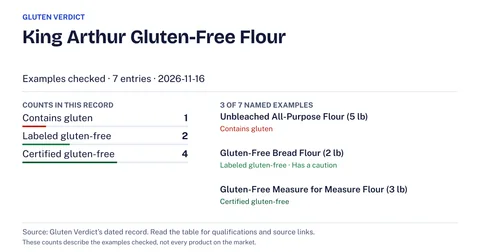 King Arthur Gluten-Free FlourCertified gluten-free1 of 7 varieties we checked contains gluten: Unbleached All-Purpose Flour (5 lb)Wheat warning on 2 of 7 varieties we checkedKing Arthur Baking Company · checked Nov 16, 2026
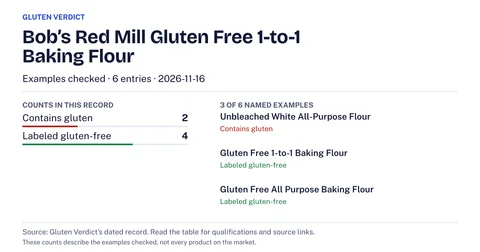 Bob’s Red Mill Gluten Free 1-to-1 Baking FlourLabeled gluten-free2 of 6 varieties we checked contain gluten: Unbleached White All-Purpose Flour and Whole Wheat FlourBob’s Red Mill Natural Foods · checked Nov 16, 2026
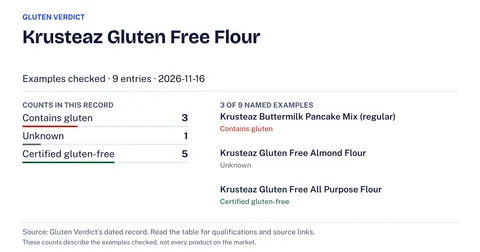 Krusteaz Gluten Free FlourCertified gluten-free3 of 9 varieties we checked contain gluten: Krusteaz Buttermilk Pancake Mix (regular), Krusteaz Honey Cornbread Muffin Mix (regular), and Krusteaz Pie Crust Mix (regular)Krusteaz · checked Nov 16, 2026
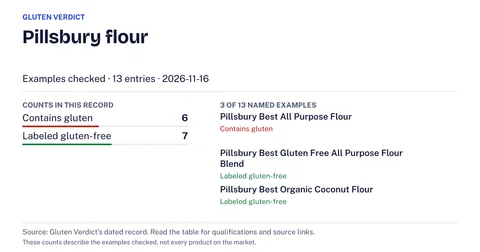 Pillsbury flourLabeled gluten-free6 of 13 varieties we checked contain glutenPillsbury · checked Nov 16, 2026
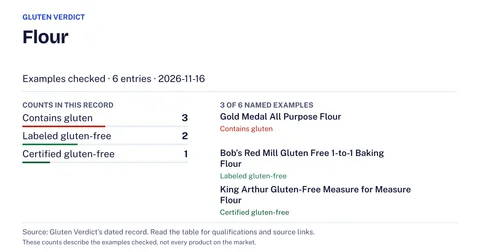 FlourContains glutenchecked Nov 16, 2026
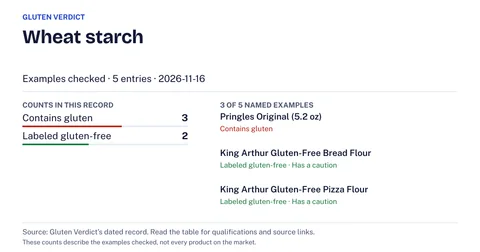 Wheat starchDepends on the product3 of 5 products we checked contain gluten: Pringles Original (5.2 oz), Jiffy Corn Muffin Mix, and Chex Mix Bold Garlic and Herbchecked Nov 16, 2026
Questions people ask
Can I use a 1-to-1 gluten-free blend in yeast bread?
Neither 1-to-1 page we read names it for yeast bread. King Arthur’s packaging says its Measure for Measure flour is not recommended as a 1:1 substitute for yeasted recipes and points to its Bread Flour15. Bob’s Red Mill’s 1-to-1 page names non-yeast recipes34.
Is gluten-free all-purpose flour the same as a 1-to-1 blend?
Not necessarily. King Arthur’s packaging separates them: Measure for Measure for swapping into wheat recipes, All-Purpose for recipes that already call for a gluten-free blend14, 16. Bob’s Red Mill’s all-purpose page names yeast breads first38.
Does FDA define “1-to-1” or “measure for measure”?
FDA’s page on gluten and food labeling covers the “gluten-free” claim and does not mention those terms3. They are the makers’ words.
Do gluten-free blends need xanthan gum added?
It depends on the bag. Some lists include it36, and others are sold without it20. GIG says to add your own if the flour you use has no xanthan gum or other binding agent8.
Why does a gluten-free bread flour say it contains wheat?
King Arthur’s Bread Flour lists gluten-free wheat starch and carries “CONTAINS: Wheat”29. Its footnote says the wheat starch was processed to meet FDA’s requirements for gluten-free foods30, and FDA names wheat starch as an example of such an ingredient4.
More in Gluten-free baking technique
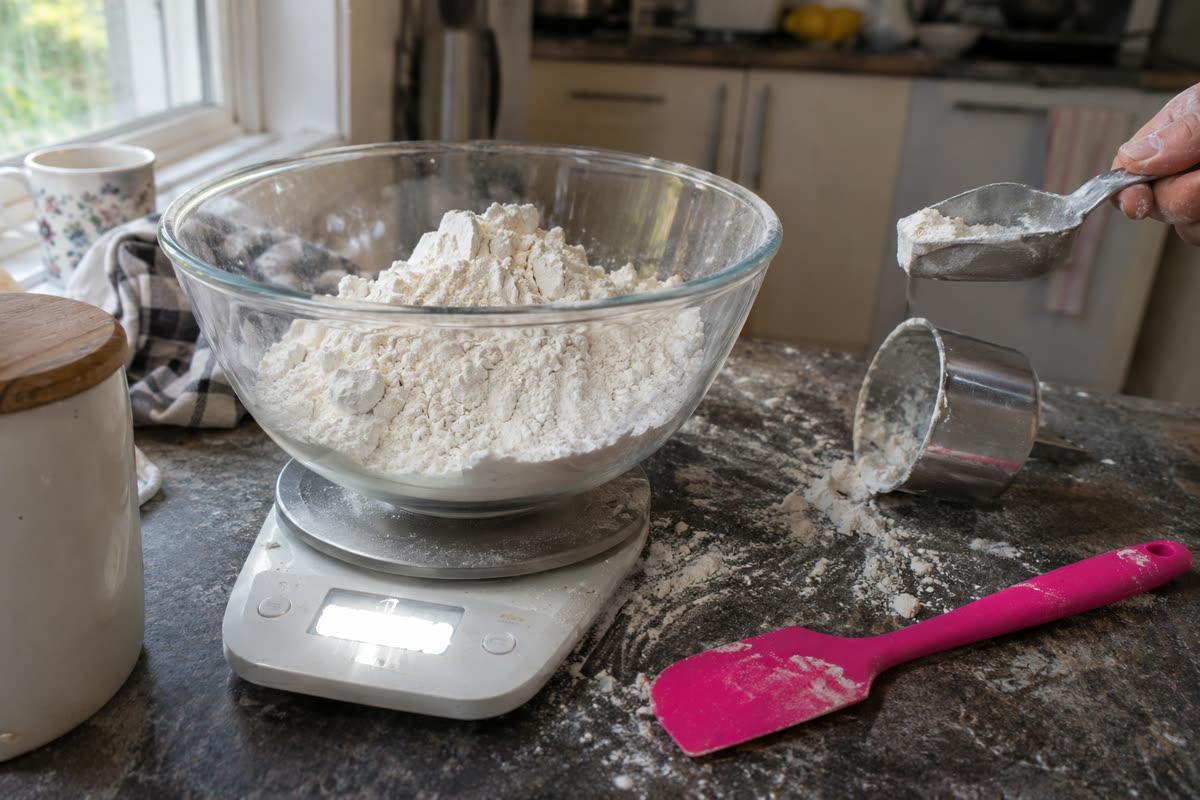 Gluten-free flour cups to grams: the weights makers print on their labelsGrams per cup for gluten-free flours, copied from King Arthur’s chart and the Bob’s Red Mill, Krusteaz and Pamela’s panels, with where each figure sits.
 Gluten-free binders: what makers say about xanthan, guar, psyllium and flaxWhich gluten-free flours already list xanthan gum, what makers say about adding more, and how xanthan, guar, psyllium and flax are each described.
 Gluten-free baking gone wrong: dense, gummy, crumbly, gritty or sunkenMatch a dense, gummy, dry, gritty or sunken gluten-free bake to the causes flour makers name, see where their advice differs, and pick one change.
 Why gluten-free bread crumbles: binder, rise, oven and storageWhat flour, mix and yeast makers and a 2026 review say about crumbly gluten-free bread: binder, rise, oven setting, cooling and storage.
 High-altitude gluten-free baking: what extension services and flour makers sayWhat Colorado State Extension, King Arthur and Bob's Red Mill publish for baking above 3,000 feet, and where no source covers gluten-free flours.
 Gluten-free flours for baking: what rice, sorghum, tapioca, almond and coconut flour each doWhat makers say rice, sorghum, millet, tapioca, potato starch, almond and coconut flour do in a bake, and which bags say gluten-free on the label.
Related guides
 Gluten-free flours and starches: what each one is and how to read the bagWhich flours and starches are gluten-free by nature, what a claim and a certification mark on the bag each mean, and how to read a blend’s list.
 Baking gluten-free in a home where someone else bakes with wheat flourA baking-day plan for a shared kitchen: order, counters, flour storage, tools and oven, and which timing rules have no published source.
 Gluten-free flour and baking mix cost per cup, with each maker’s statementWhat a cup of gluten-free flour or baking mix costs from each maker’s own price and label, shown beside what the maker says about gluten.
 Gluten-free substitutes: the swap for each wheat ingredient and the label check it needsA lookup table of gluten-free swaps for wheat flour, pasta, bread, soy sauce, beer and more, with the one label check each swap needs.
Sources
- [1, 2, 3] US Food and Drug Administration, Gluten and Food Labeling, checked Nov 17, 2026.
Read on 2026-11-17: the page explains FDA’s “gluten-free” rule and the terms it covers (“gluten-free”, “no gluten”, “free of gluten”, “without gluten”); the terms “1-to-1”, “1:1”, “measure for measure”, “all-purpose” and “bread flour” do not appear on it.
- [4, 5] US Food and Drug Administration, Questions and Answers on the Gluten-Free Food Labeling Final Rule, checked Nov 17, 2026.
- [6] US Food and Drug Administration, Food Allergen Labeling and Consumer Protection Act of 2004 (FALCPA), checked Nov 17, 2026.
- [7, 8, 9, 10, 11] Gluten Intolerance Group, Replacing Gluten When Cooking and Baking, checked Nov 17, 2026.
- [12, 13] King Arthur Baking, Gluten-Free Measure for Measure Flour (product page), checked Nov 17, 2026.
- [14, 15, 16, 17] King Arthur Baking Company, Gluten-Free Measure for Measure Flour, packaging PDF, checked Nov 17, 2026.
- [18, 19, 20, 21] King Arthur Baking, Gluten-Free All-Purpose Flour (product page), checked Nov 17, 2026.
Read on 2026-11-17: the product page names no other King Arthur flour for any bake; it links a blog post headed “Which gluten-free flour should I use?”.
- [22, 23, 24] King Arthur Baking Company, Gluten-Free All-Purpose Flour, packaging PDF, checked Nov 17, 2026.
- [25, 26, 27, 28] King Arthur Baking, Gluten-Free Bread Flour (product page), checked Nov 17, 2026.
- [29, 30] King Arthur Baking Company, Gluten-Free Bread Flour, packaging PDF, checked Nov 17, 2026.
- [31, 32] King Arthur Baking, Gluten-Free Pizza Flour (product page), checked Nov 17, 2026.
- [33, 40] King Arthur Baking Company, Gluten-Free Pizza Flour, packaging PDF, checked Nov 17, 2026.
- [34, 35, 36, 37] Bob’s Red Mill Natural Foods, Gluten Free 1-to-1 Baking Flour (product page), checked Nov 17, 2026.
Read on 2026-11-17: the product page says non-yeast recipes and names no other Bob’s Red Mill flour for yeast breads or for any other bake.
- [38, 39] Bob’s Red Mill Natural Foods, Gluten Free All Purpose Baking Flour (product page), checked Nov 17, 2026.