Why gluten-free bread crumbles: binder, rise, oven and storage
Short answer
A 2026 review says gluten-free breads often have a denser, crumbly crumb because the gluten protein matrix is absent or strongly reduced1, 2. The makers’ pages and the review give directions on five things to check, in this order:
- The flour: King Arthur and Bob’s Red Mill describe their 1:1 flours as for non-yeasted recipes, King Arthur advises recipes written for gluten-free ingredients when baking with yeast, and its separate Bread Flour is the one it calls ideal for classic yeasted recipes3, 4, 5, 54.
- The batter: King Arthur’s Gluten-Free Bread Flour needs 2 to 3 tablespoons more liquid per cup than a wheat-flour recipe6.
- The rise and the oven: the makers’ settings differ by product, from 350°F for King Arthur’s mix to 450°F for its Dutch-oven loaf7, 8.
- The cooling: King Arthur’s Dutch-oven directions say to cool completely on a rack before slicing9.
- The age: a review places the firming that reads as dry and crumbly within the first 24 to 72 hours of storage10.
Part of Gluten-free baking technique, 11 guides
Key points
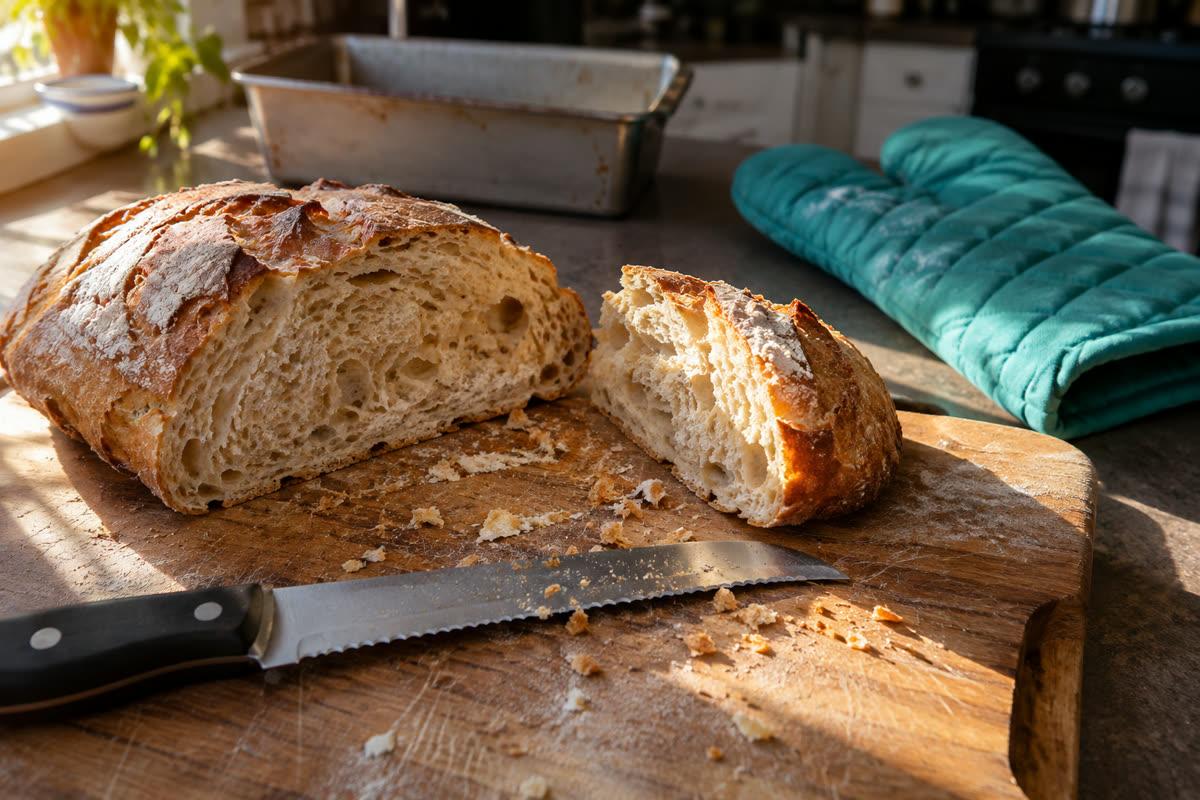
- A 2026 review says gluten-free breads often show a denser, crumbly crumb and lower volume because the gluten protein matrix is absent or strongly reduced1, 2.
- The three King Arthur directions we read give different rise times and two different oven settings (350°F and 450°F), so the page for your own flour or mix is the one to follow7, 11, 8.
- None of those three names a finished internal temperature12, 13, 14; Red Star calls 190°F a general figure for bread that can vary by recipe15.
- Makers’ storage directions for a loaf run from within 5 days of opening (Canyon Bakehouse) to the counter until the best before date (Little Northern Bakehouse)16, 17.
- A crumbly texture is not a labeling question: the gluten-free claim means less than 20 parts per million of gluten under FDA’s rule18.
Which crumbly loaf do you have?
The sources we read describe crumbling in several different ways, and each points somewhere different. Find your loaf in the table, then go to that section.
| How the loaf looks | What the sources tie it to | Where to read more |
|---|---|---|
| Dense, crumbly crumb and low volume | A gluten-free dough lacks the gluten protein matrix, and a 2026 review links that to lower loaf volume and a denser, crumbly crumb1, 2. The review says hydrocolloids partly replace the viscoelastic function of gluten19. | Binder and flour; Liquid, mixing and rest |
| Small, tight loaf | The same review says that if the temperature rise is too rapid, the outer layers set prematurely and restrict expansion, resulting in low loaf volume and a compact crumb20. | Oven setting, bake time and pan |
| Large holes, or a gummy center | The review links heating that is too slow, or a batter that is too weak, to gas cells that coalesce and collapse, leaving large voids or a gummy core20. | Rise; Oven setting, bake time and pan |
| Dry and crumbly a day or more after baking | Staling: the review says crumb firmness rises and elasticity falls typically within the first 24 to 72 hours of storage, and consumers then perceive the bread as dry, crumbly and stale10. | Cooling, slicing and day two; A bought loaf |
| Falls apart when cut warm | No source we read names a cause for this. King Arthur’s directions say to cool the loaf on a rack, and for its Dutch-oven loaf to cool completely before slicing9, 7. | Cooling, slicing and day two |
Binder and flour: is the blend meant for yeast bread?
Gluten is the substance that gives breads and other grain products their shape, strength and texture21. A gluten-free loaf has to get that structure elsewhere: the review says its network is formed mainly by starch gels together with added proteins and hydrocolloids instead of gluten20. Bob’s Red Mill says xanthan gum acts as an emulsifier and a binder and adds volume to gluten free breads22, and King Arthur says it relies on xanthan gum to provide elasticity and stickiness in its doughs and batters23.
Whether your flour already contains one is on its label. Gluten Intolerance Group advises that if the flour has no xanthan gum or another binding agent, you add your own24. The review also warns about the other direction: it lists excessive dough viscosity and a rubbery crumb among the detrimental effects of excessive levels or inappropriate combinations of hydrocolloids25. Our guide to xanthan gum, guar gum, psyllium and flax goes through each binder.
| Product | Binders on the ingredient list |
|---|---|
| King Arthur Gluten-Free Bread Flour | Xanthan gum, and a cellulose and psyllium fiber blend26 |
| King Arthur Gluten-Free Bread and Pizza Mix | Xanthan gum27 |
| Bob’s Red Mill Gluten Free Pizza Crust Mix | Xanthan gum and guar gum28 |
| Bob’s Red Mill Gluten Free 1-to-1 Baking Flour | Xanthan gum29 |
| Canyon Bakehouse Stay Fresh Sourdough, a bought loaf | Xanthan gum, in the group the label gives as 2% or less of each ingredient30 |
The second question is whether the flour is meant for yeast at all. King Arthur says its Measure for Measure flour goes in 1:1 for all-purpose flour in non-yeasted recipes3, and Bob’s Red Mill describes its 1-to-1 baking flour as replacing wheat flour cup for cup in non-yeast recipes4. For yeast breads, King Arthur says it is best not to convert an existing yeast bread recipe and recommends recipes developed for gluten-free ingredients5; Gluten Intolerance Group calls bread recipes very touchy and gives the same advice31. King Arthur’s Gluten-Free Bread Flour is a separate product: its package says to substitute it 1:1 in bread recipes that call for wheat flour55, and its page calls it ideal for classic yeasted recipes54. Our guide to 1-to-1, all-purpose and bread flour blends compares the blends.
Liquid, mixing and rest before the oven
King Arthur’s directions for its Gluten-Free Bread Flour begin with hydration: add 2 to 3 tablespoons more liquid per cup of flour than the wheat-flour recipe calls for6. The dough will look quite wet at first, and King Arthur says that is why it should rest for 20 minutes before kneading32.
Batter strength matters later in the oven too: the review says a batter that is too weak lets gas cells coalesce and collapse20. For its Bread and Pizza Mix, King Arthur recommends an electric hand mixer or stand mixer for the best texture and volume33.
Rise: how many, how long, how warm
Makers’ rise directions differ because their products differ. The table sets out the three King Arthur directions we read, each for a different product, in the maker’s own figures.
| Product and directions | Rise | Oven setting and bake time | Cooling |
|---|---|---|---|
| Gluten-Free Bread and Pizza Mix, loaf pan | 30 minutes in the bowl, stir to deflate, then 20 to 40 minutes in the pan until crowned 1 inch over the rim34 | 350°F, 50 to 60 minutes, until golden brown7 | Turn out of the pan and cool on a rack7 |
| Gluten-Free Sandwich Bread, recipe page | 1 hour for the batter, deflated, then about 45 to 60 minutes in the pan35, 11 | 350°F, 38 to 42 minutes, until golden brown11 | Turn out of the pan and cool on a rack11 |
| Gluten-Free Bread Flour, Dutch-oven artisan loaf | Starter 2 to 24 hours, dough rested 20 minutes, then about 40 more minutes, then 30 to 45 minutes once shaped8 | 450°F with the Dutch oven inside; 40 minutes with the lid on, then 20 to 30 minutes more8, 36 | Cool completely on a rack before slicing9 |
So does gluten-free bread need to rise twice? In these three sets of directions each product has a first rise and a second rise, and the mix and sandwich bread are deflated between them34, 35, 8. That is what these makers wrote for these products. Follow the directions for your own flour or mix.
Rise time also depends on the flour. King Arthur says dough made with its Gluten-Free Bread Flour rises about 50% faster than usual37. A review adds a caution: simply increasing fermentation time or yeast level does not necessarily translate into better texture38. A longer rise is not an automatic fix for a crumbly loaf.
Water and yeast
Water temperature comes from the directions for each product. Red Star’s steps for proofing active dry yeast use warm (110-115°F) water39, and Red Star says never to expose yeast to high temperatures during storage or use40. King Arthur’s Dutch-oven directions use lukewarm water at 100°F41, and its mix directions call for milk at lukewarm 95ºF42. These are different figures from different directions; use the ones that came with your yeast and flour.
Oven setting, bake time and pan
A review explains why gluten-free loaves are touchy about heat. Their structure comes mainly from starch gels with added proteins and hydrocolloids instead of gluten, so the window in which gas expansion is balanced by the matrix setting is much narrower than in wheat doughs. Heat that rises too rapidly sets the outer layers early, giving low volume and a compact crumb; heating that is too slow, or a weak batter, can give large voids or a gummy core20.
The flour matters as well. For its Gluten-Free Bread Flour, King Arthur says to preheat the oven early and to add an extra 5 to 15 minutes of baking, depending on the bread37.
The pan is part of the directions. For its Gluten-Free Sandwich Bread, King Arthur recommends a 9" x 4" x 4" gluten-free loaf pan, saying gluten-free breads require more support as they rise and bake43.
What temperature is the loaf done at?
None of the three King Arthur directions in the table names a finished internal temperature; they give bake times and color cues12, 13, 14. The one figure we found comes from the yeast maker. Red Star’s FAQ says to take bread out when an instant-read thermometer in the center reads 190°F, and adds that this is a general final temperature that can vary based on the recipe15.
Because Red Star calls 190°F a general figure, the directions that came with your flour or mix come first.
Cooling, slicing and day two
Cool the loaf before cutting. King Arthur’s Dutch-oven directions say to cool completely on a rack before slicing9, and its mix and sandwich bread directions say to turn the loaf out of the pan and cool it on a rack7, 11. Red Star says to take bread out of the pan immediately after baking and put it on a wire rack to avoid soggy bread44.
Then comes age. The review reports that staling in gluten-free bread typically shows within the first 24 to 72 hours of storage, with firmer crumb and less elasticity, and that consumers perceive such bread as dry, crumbly and stale10. The makers’ storage directions are product-specific. King Arthur says breads made with its Gluten-Free Bread Flour keep for 2 to 3 days at room temperature and can be frozen for longer storage45. For its sandwich bread, it says the loaf has a short shelf life and, for best texture, to reheat or toast it after the first day46.
A bought loaf that crumbles
For a loaf from a store, the maker’s own storage directions come first, and they differ:
- Canyon Bakehouse’s page for its Stay Fresh Sourdough says to enjoy it within 5 days of opening the inner bag16.
- Little Northern Bakehouse says the best place to store its bread at home is on the counter, away from the top of warm appliances or direct sunlight, until the best before date, or in the freezer for up to 6 months17. It adds that its FAQ video recommends against storing the bread in the fridge at home47.
- The same FAQ’s shelf-life answer says its products stay fresh for 14 days at room temperature (post-thaw if purchased fresh, or until the best-before date) and gives up to 12 months for the freezer48. That page therefore gives two freezer limits, 6 months and 12 months; read the date printed on your own pack.
To see which gluten-free loaves we have checked, start with our verdicts for bread, sourdough, bagels, English muffins and tortillas.
A crumbly loaf and the gluten-free claim
Crumbling is a texture matter, and the sources above tie it to structure, heat and age. Whether a flour or loaf is gluten-free is a labeling question. Under FDA’s rule, food that carries the “gluten-free,” “no gluten,” “free of gluten” or “without gluten” label must contain less than 20 parts per million of gluten18. Our guide to reading a food label for gluten covers the rest of the package.
Read the flour’s label rather than assuming. King Arthur’s Gluten-Free Bread Flour package lists gluten-free wheat starch26 and carries a “CONTAINS: Wheat” line49, with a footnote saying the wheat starch has been processed to allow the food to meet FDA’s requirements for gluten-free foods50. Our King Arthur flour verdict sets out which of its flours carry which claim.
Check the yeast too. Red Star says its Active Dry Yeast products, Quick-Rise Yeast products and Saf-Instant Yeast are gluten free51, and that its Platinum, Platinum Instant Sourdough and Organic Instant Yeast products are not52.
For tools, Gluten Intolerance Group says items like colanders, sifters and waffle irons are more difficult to clean thoroughly and, if possible, should not be shared between gluten-free and non-gluten-free use; if they must be, clean them thoroughly between every use53.
Verdicts in this guide
 BreadContains glutenchecked Nov 16, 2026
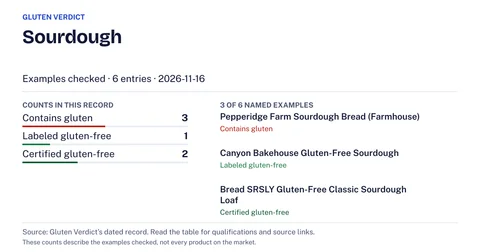 SourdoughContains glutenchecked Nov 16, 2026
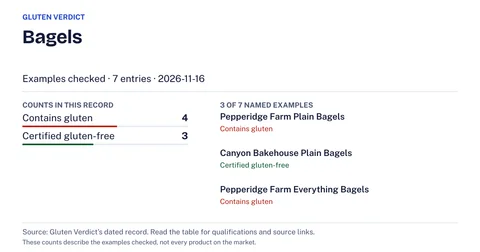 BagelsContains glutenchecked Nov 16, 2026
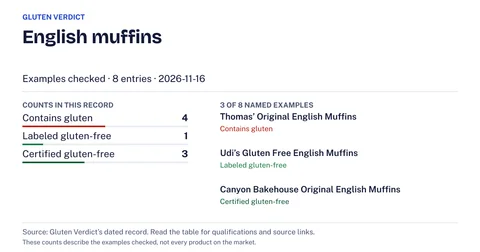 English muffinsDepends on the product4 of 8 products we checked contain glutenchecked Nov 16, 2026
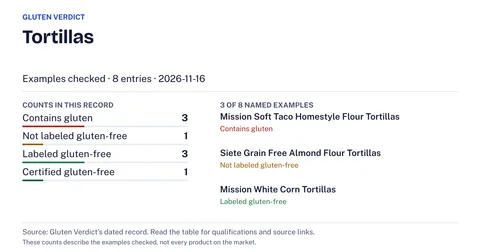 TortillasDepends on the product3 of 8 products we checked contain gluten: Mission Soft Taco Homestyle Flour Tortillas, Guerrero Riquisimas Soft Taco Flour Tortillas (24 ct), and Guerrero Corn and Wheat Tortillaschecked Nov 16, 2026
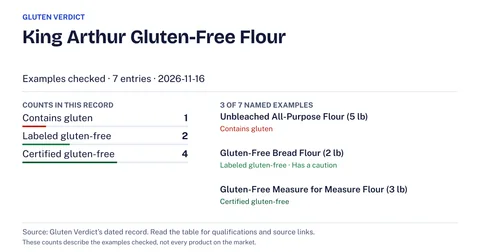 King Arthur Gluten-Free FlourCertified gluten-free1 of 7 varieties we checked contains gluten: Unbleached All-Purpose Flour (5 lb)Wheat warning on 2 of 7 varieties we checkedKing Arthur Baking Company · checked Nov 16, 2026
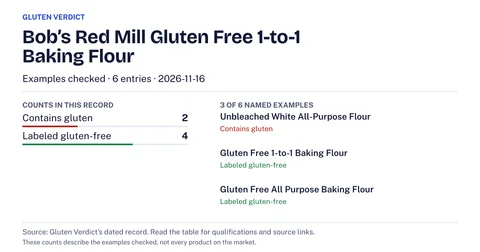 Bob’s Red Mill Gluten Free 1-to-1 Baking FlourLabeled gluten-free2 of 6 varieties we checked contain gluten: Unbleached White All-Purpose Flour and Whole Wheat FlourBob’s Red Mill Natural Foods · checked Nov 16, 2026
Questions people ask
Does gluten-free bread need to rise twice?
The three King Arthur directions we read each include a first rise and a second rise: 30 minutes then 20 to 40 minutes for its mix, 1 hour then about 45 to 60 minutes for its sandwich bread, and about 40 minutes then 30 to 45 minutes for its Dutch-oven loaf34, 35, 11, 8. Another flour or mix may differ, so follow its own directions.
What temperature should gluten-free bread bake at?
It depends on the product: 350°F for King Arthur’s mix and sandwich bread, and 450°F in a preheated Dutch oven for its bread-flour loaf7, 11, 8. A review says gluten-free loaves have a much narrower time and temperature window than wheat doughs20.
What internal temperature is gluten-free bread done at?
None of the three King Arthur directions we read names one12, 13, 14. Red Star gives 190°F as a general final temperature for bread and says it can vary based on the recipe15.
Why does store-bought gluten-free bread crumble?
A review places staling, with firmer and drier-feeling crumb, within the first 24 to 72 hours of storage10. Makers give their own storage directions, such as within 5 days of opening the inner bag (Canyon Bakehouse)16 or the counter until the best before date (Little Northern Bakehouse)17.
More in Gluten-free baking technique
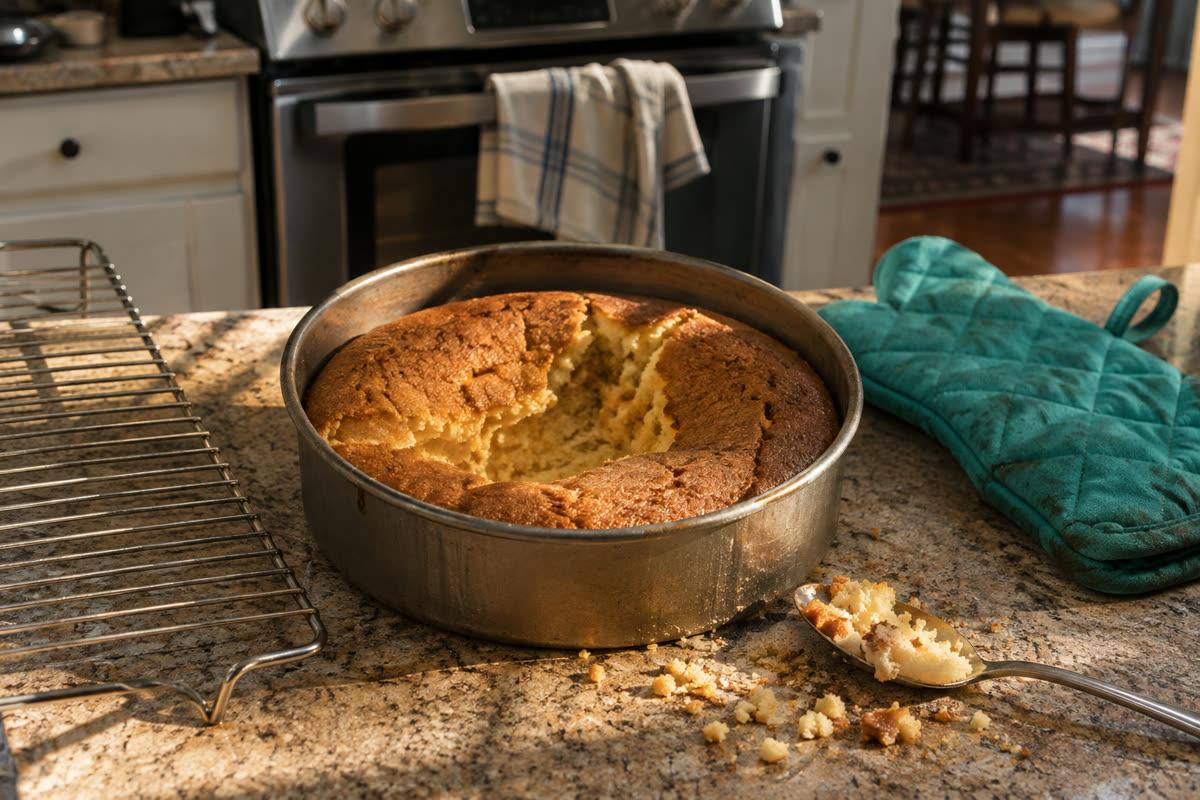 Gluten-free baking gone wrong: dense, gummy, crumbly, gritty or sunkenMatch a dense, gummy, dry, gritty or sunken gluten-free bake to the causes flour makers name, see where their advice differs, and pick one change.
 Is yeast gluten-free? What yeast and sourdough starter labels sayCheck a yeast packet and the maker’s statement, tell baker’s yeast from brewer’s yeast and yeast extract, and read a sourdough starter seller’s page.
 1-to-1, all-purpose and bread flour blends: what each maker’s page says the bag is forWhat King Arthur and Bob’s Red Mill say their 1-to-1, all-purpose, bread and pizza gluten-free flours are for, and which bakes each sends elsewhere.
 High-altitude gluten-free baking: what extension services and flour makers sayWhat Colorado State Extension, King Arthur and Bob's Red Mill publish for baking above 3,000 feet, and where no source covers gluten-free flours.
 Gluten-free binders: what makers say about xanthan, guar, psyllium and flaxWhich gluten-free flours already list xanthan gum, what makers say about adding more, and how xanthan, guar, psyllium and flax are each described.
 Gluten-free flour cups to grams: the weights makers print on their labelsGrams per cup for gluten-free flours, copied from King Arthur’s chart and the Bob’s Red Mill, Krusteaz and Pamela’s panels, with where each figure sits.
Related guides
 Gluten-free bread, buns and wraps: what the package tells youHow to tell a gluten-free bread, bun or wrap from a wheat look-alike: certification mark, maker’s claim or ingredient list, in a fixed order.
 Baking gluten-free in a home where someone else bakes with wheat flourA baking-day plan for a shared kitchen: order, counters, flour storage, tools and oven, and which timing rules have no published source.
 Stomach pain after gluten-free bread: what the label can and cannot tell youWhy gluten-free bread can hurt: ingredients that cause gas, how gluten gets in, a one-change log to tell them apart, and when sources say see a doctor.
 Gluten-free substitutes: the swap for each wheat ingredient and the label check it needsA lookup table of gluten-free swaps for wheat flour, pasta, bread, soy sauce, beer and more, with the one label check each swap needs.
Sources
- [1, 2, 10, 19, 20, 25, 38] International Journal of Food Science (Wiley), via PubMed Central, Problems and Approaches in the Improvement of Gluten-Free Bread Texture: A Comprehensive Review (2026), checked Nov 17, 2026.
- [3, 5, 23, 43] King Arthur Baking, Gluten-Free Baking, checked Nov 17, 2026.
- [4, 29] Bob’s Red Mill, Gluten Free 1-to-1 Baking Flour, checked Nov 17, 2026.
- [6, 32, 37, 45, 54] King Arthur Baking, Gluten-Free Bread Flour, checked Nov 17, 2026.
- [7, 13, 27, 34, 42] King Arthur Baking, Gluten-Free Bread and Pizza Mix package (sandwich bread directions), checked Nov 17, 2026.
Read the sandwich bread directions on 2026-11-17: no internal temperature on the page. They give a bake time (50-60 minutes at 350°F) and a color cue (until golden brown).
- [8, 9, 12, 26, 36, 41, 49, 50, 55] King Arthur Baking, Gluten-Free Bread Flour package (how to bake with it), checked Nov 17, 2026.
Read the Dutch-oven artisan bread directions on 2026-11-17: no internal temperature on the page. They give bake times (40 minutes with the lid on, then 20 to 30 minutes more) and a color cue (until deep brown).
- [11, 14, 35, 46] King Arthur Baking, Gluten-Free Sandwich Bread Recipe, checked Nov 17, 2026.
Read the recipe page on 2026-11-17: no internal temperature on the page. The directions give a bake time (38 to 42 minutes at 350°F) and a color cue (until golden brown).
- [15, 44, 51, 52] Red Star Yeast, Common Yeast Baking Questions & Answers, checked Nov 17, 2026.
- [16, 30] Canyon Bakehouse, Stay Fresh Sourdough, checked Nov 17, 2026.
- [17, 47, 48] Little Northern Bakehouse, Gluten-Free Baking & Product FAQs, checked Nov 17, 2026.
- [18, 21] US Food and Drug Administration, Gluten and Food Labeling, checked Nov 17, 2026.
- [22] Bob’s Red Mill, Xanthan Gum, checked Nov 17, 2026.
- [24, 31] Gluten Intolerance Group, Replacing Gluten When Cooking and Baking, checked Nov 17, 2026.
- [28] Bob’s Red Mill, Gluten Free Pizza Crust Mix (ingredients), checked Nov 17, 2026.
- [33] King Arthur Baking, Gluten-Free Bread and Pizza Mix, checked Nov 17, 2026.
- [39, 40] Red Star Yeast, Active Dry Yeast (product page), checked Nov 17, 2026.
- [53] Gluten Intolerance Group, 25 Ways Cross-Contact Could Happen (And How to Avoid It), checked Nov 17, 2026.