Baking gluten-free in a home where someone else bakes with wheat flour
Short answer
Set the day up in five steps, and know that no source we found gives a tested number of hours to wait after wheat baking1, 2:
- Do not prepare gluten-free food while baking with wheat flour or in a space with a risk of airborne gluten3, 4.
- Wipe the counter with a wet cloth first, to remove crumbs and flour dust5.
- Keep the gluten-free flour in a closed container on a shelf above any wheat flour6, 7.
- Use your own sifter and wooden rolling pin where you can, and line shared baking sheets with parchment paper or foil8, 9, 10.
- Bake on the top oven rack and cover the dish; Beyond Celiac’s blog adds avoiding convection mode in a shared oven11, 12, 13.
Part of Cross-contact and the home kitchen, 19 guides
Key points
- The only waiting time we found is Beyond Celiac’s: flour can stay airborne 12-24 hours, and its page names no study for that14, 2.
- The one distance we found, 2 m from wheat flour use, comes from a pilot study in commercial kitchens, not homes15, 16.
- Coeliac UK and Beyond Celiac both point to ordinary washing, but the charities differ on sponges and on sanitizer17, 18, 19, 20, 21.
- GIG says oven heat does not neutralize gluten, and suggests wiped racks, fresh foil or a clean sheet as a barrier in a shared oven22.
In what order should the baking day run?
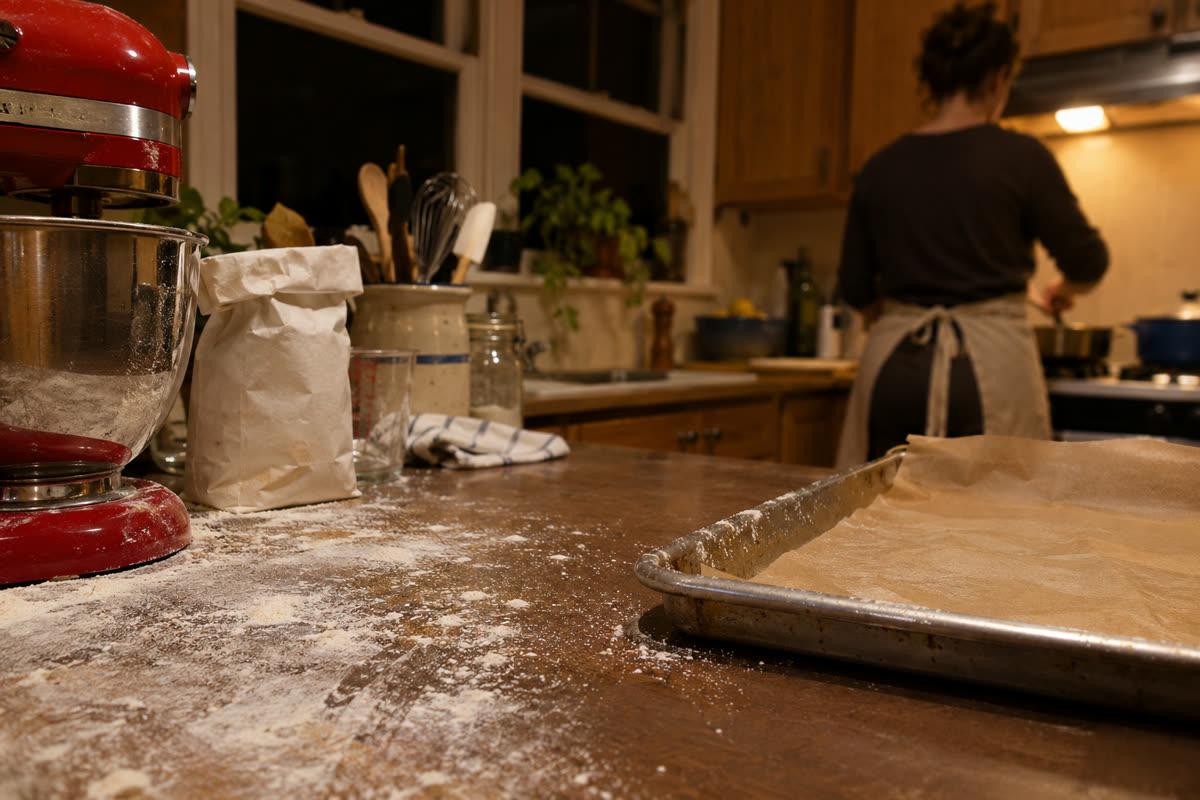
Three pages we checked for this guide publish no baking-day schedule23, 24, 25. What other charity pages say points one way: flour dust carries. Beyond Celiac says flour can stay airborne for 12-24 hours depending on ventilation and quantity14, and the Celiac Disease Foundation says wheat flour can stay airborne for many hours in a bakery or at home26.
Beyond Celiac advises against preparing gluten-free food in spaces with a risk of airborne gluten, because particles settle on the food3. The National Celiac Association names the risk of cross-contact when gluten-free food is prepared while baking with regular flour4.
For a day when both bakes have to happen, this order is our reading of those statements. It is not a published rule.
- Bake gluten-free first, before anyone opens wheat flour, so none is in the air yet.
- Wipe the counter with a wet cloth and put out clean tools5.
- Mix and bake, closing the gluten-free flour container whenever it is not in use6.
- Wash the gluten-free dishes before the wheat baker’s dishes27.
- Only then open the wheat flour.
If wheat baking has already happened today, Coeliac UK, McMaster’s clinic and GIG’s appliance page give no number of hours to wait23, 24, 25. The timing section below sets out the one figure we found and what stands behind it.
What goes on the counter: wiping, washing and barriers
McMaster’s celiac clinic says to wipe the kitchen counter with a wet cloth before preparing gluten-free food, to remove gluten crumbs or flour dust5. Coeliac UK says to wipe down surfaces and clean pots, pans and utensils with hot soapy water29, and that standard washing up liquid or a dishwasher will remove gluten17.
One study tested a floured work surface. In a simulated classroom baking project, children rolled wheat-flour cookie dough on a table dusted with wheat flour30. Gluten-free bread rubbed on the unwashed workspaces afterwards picked up more than 20 ppm in all 30 samples31. After cleaning, 10 of 30 samples still did, and 8 of those 10 followed cleaning with water alone32. The authors found soap and water consistently the most effective method33. The participants were healthy children in a simulated classroom, not adults in a home kitchen34.
Charities split on sanitizer. Beyond Celiac says soap and water is sufficient and that bleach or sanitizer will not “kill” gluten20. GIG’s cohabitation article calls sanitizing the final step after washing21.
Where a tin or tool cannot be cleaned easily, McMaster suggests parchment paper, baking sheets or aluminum foil as a barrier35. GIG suggests cupcake liners and parchment paper for muffin tins and cake pans36. GIG’s tool list does not mention silicone baking mats37, so this page has no charity guidance to give on them.
Where should the gluten-free flour live?
GIG notes that flour or baking mixes could make dust, and advises putting gluten-free packages above gluten-containing ones, securely packaged7. Beyond Celiac suggests closed containers to keep flour dust or crumbs from spreading6, and the top shelf for gluten-free items so crumbs do not fall into them38. McMaster adds a separate cupboard if possible39, and NIDDK says to store and prepare gluten-free foods separately from other family members’ foods that contain gluten40.
Label the container, and the scoop that goes with it: GIG suggests labels on food items, even utensils and cookware41.
A bag’s label describes the flour as sold. In the US, FDA says any unavoidable gluten in a food labeled “gluten-free” is less than 20 ppm42; GIG says GFCO-certified food meets a threshold of 10 ppm of gluten or less43. Neither passage says what happens to flour once the bag is open in a kitchen with wheat flour in it, so the storage steps above still apply.
Our verdicts show how each maker labels these flours: Bob’s Red Mill 1-to-1, King Arthur, Pillsbury and Krusteaz. For single ingredients see rice flour, almond flour, cornstarch and baking powder; for plain wheat flour, read the bag. Other baking staples that can carry gluten are in the pantry guide.
Which tools to wash, line or keep separate
The charities do not give one list. This table puts what each says about baking tools side by side.
| Tool | What is published |
|---|---|
| Flour sifter | GIG: sifters are more difficult to clean thoroughly and should not be shared if possible; if shared, clean thoroughly between every use8. The Celiac Disease Foundation’s quick start guide says flour sifters should not be shared44. |
| Wooden rolling pin | GIG: it is best to shelve a wooden pin that was used on gluten-containing items9. Beyond Celiac’s list of tools to duplicate includes rolling pins45. |
| Baking sheet | Beyond Celiac: the same sheets can be used if parchment paper or aluminum foil goes down each time10. |
| Muffin tin, cake pan | GIG: if a new set is not an option, use cupcake liners and parchment paper36. |
| Oven mitt | GIG: wash potholders before gluten-free baking, or buy a separate one and label it46. |
| Pizza stone | GIG: do not use the same stone for both, or put the gluten-free pizza on parchment paper47. |
| Pots, pans, utensils, baking equipment | Coeliac UK: clean pots, pans and cooking utensils with hot soapy water29. McMaster: scrub baking equipment well, and consider separate gluten-free equipment35. |
| Stand mixer | GIG: thoroughly wash all components that can touch the food after every use48, and wipe the parts that cannot be washed49. |
| Bread machine | GIG: use a dedicated gluten-free bread machine50. |
| Sponge, dish cloth | Coeliac UK: no need for separate cloths or sponges18. Beyond Celiac: separate sponges and dishrags19. McMaster: designate a gluten-free sponge51. |
One lab study checked a common worry. It used a wooden spoon, a colander, a ladle and a knife that had handled gluten-containing food, to prepare gluten-free bread and pasta52. It found gluten below 20 mg/kg, and the cleaning method made no difference53. Sifters and rolling pins were not among the tools tested52.
Shared butter is a baking staple the charities cover too. Coeliac UK suggests separate condiments, or at least clean cutlery for shared butters, jams and spreads54. More in shared butter, jam and spreads.
The oven, the racks and the fan
GIG says to bake gluten-free and gluten-containing items separately when you can; if that is not possible, put the gluten-free items on the higher rack so crumbs do not fall onto them55. Beyond Celiac’s blog also puts gluten-free items on the top rack and gluten-containing items on the bottom racks11.
A convection fan changes the picture. GIG says the fan can blow wheat dust onto food, and to cover a gluten-free item even when it is the only thing in the oven, because dust from earlier oven sessions may still be present12. Beyond Celiac’s two pages differ: its FAQ says the fan can blow gluten particles, and that a convection oven used for gluten-containing food can still be used if the gluten-free food is tightly covered56, while its blog says to avoid convection mode for shared baking13.
Heat does not clean the oven. GIG says crumbs and drips build up on racks and the oven floor, and that the high heat of baking does not neutralize gluten; its steps are to wipe the racks and interior, put a fresh sheet of foil on the rack, or set the dish on a clean baking sheet as a barrier22. In its answer on toaster and convection ovens, Beyond Celiac adds that the oven should be cleaned thoroughly between uses, even with no visible crumbs, and that foil or a clean tray on the rack helps create a barrier from crumbs57.
What the measurements show about flour dust
A pilot study in commercial kitchens16 placed dishes of gluten-free rice pudding at 0.5 to 2 m from a site where wheat flour was in use58. A distance of 2 m was required to keep contamination at or below 20 ppm when wheat flour had been in use for 4.0 hours15. The authors said kitchens vary and must be considered individually, and that a minimum of 2 m plus good hygiene practices was effective at all five study sites59.
That result is a distance, not a waiting time, and it was measured in commercial kitchens. It is a reference point for a home kitchen, not a rule for one. The classroom baking study above is the other measurement we found that involves wheat flour on a work surface30.
Which timing rules have a source, and which do not
| Rule people ask about | What is published | Status |
|---|---|---|
| Stay out of the area for 24 hours after wheat baking | Beyond Celiac says to avoid areas with a risk of flour in the air for the next 24 hours28. | One charity FAQ; no study named on the page2. |
| Flour stays in the air 12-24 hours | Beyond Celiac gives 12-24 hours depending on ventilation and quantity14. The Celiac Disease Foundation says “many hours”26. | No study named for either figure; the Beyond Celiac page names none2. |
| Bake gluten-free before wheat | Three pages we checked do not say which bake goes first23, 24, 25. | Our reading of the airborne-flour statements, not a published rule. |
| Work 2 m away from wheat flour use | A pilot study found 2 m required after 4.0 hours of wheat flour use15. | Commercial kitchens, pilot study16. |
| How long flour dust takes to settle in a home kitchen | A PubMed search on airborne flour and gluten returned three results, none measuring gluten settling onto food1. A search on gluten-free baking cross-contact found one classroom study60. | A gap in the evidence we found. |
| Run the oven hot to burn gluten off | GIG says the high heat of baking does not neutralize gluten22. | Charity statement. |
So there is no tested number to give. If wheat baking has already happened, the only published figure is Beyond Celiac’s, and its page names no study for it28, 2. The controls above (closed flour, a wiped counter, lined sheets, a covered bake) are the ones the charities name that you can act on yourself.
For the cleaning side of the same problem, see cleaning a kitchen after wheat flour exposure and airborne flour and celiac disease. For a whole-kitchen setup, see the gluten-free kitchen setup and the gluten-free flour guide.
Verdicts in this guide
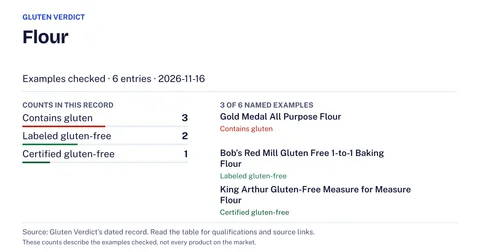 FlourContains glutenchecked Nov 16, 2026
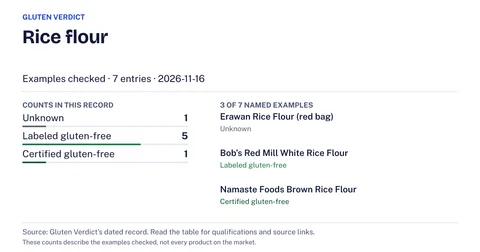 Rice flourNaturally gluten-freeBuy it labeled gluten-freechecked Nov 16, 2026
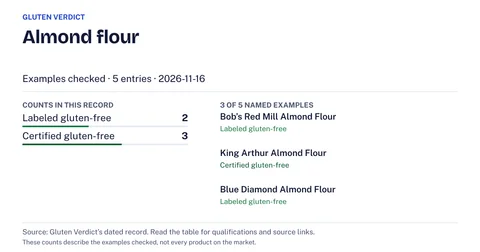 Almond flourNaturally gluten-freeBuy it labeled gluten-freechecked Nov 16, 2026
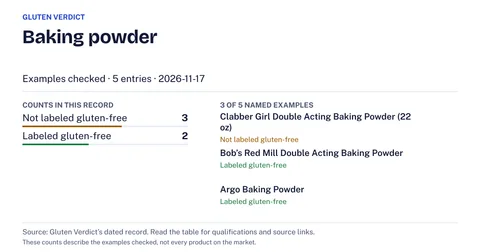 Baking powderDepends on the productchecked Nov 17, 2026
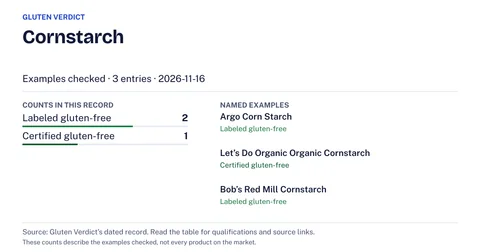 CornstarchNaturally gluten-freeBuy it labeled gluten-freechecked Nov 16, 2026
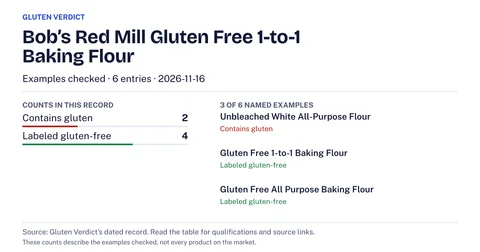 Bob’s Red Mill Gluten Free 1-to-1 Baking FlourLabeled gluten-free2 of 6 varieties we checked contain gluten: Unbleached White All-Purpose Flour and Whole Wheat FlourBob’s Red Mill Natural Foods · checked Nov 16, 2026
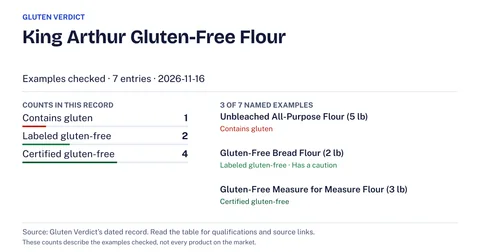 King Arthur Gluten-Free FlourCertified gluten-free1 of 7 varieties we checked contains gluten: Unbleached All-Purpose Flour (5 lb)Wheat warning on 2 of 7 varieties we checkedKing Arthur Baking Company · checked Nov 16, 2026
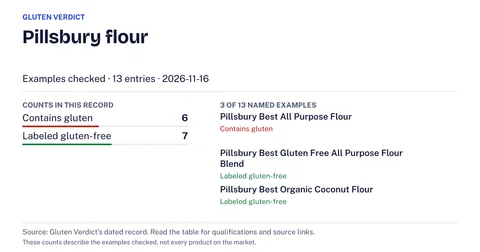 Pillsbury flourLabeled gluten-free6 of 13 varieties we checked contain glutenPillsbury · checked Nov 16, 2026
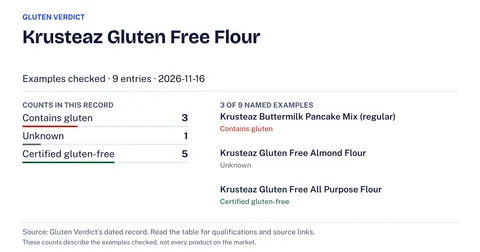 Krusteaz Gluten Free FlourCertified gluten-free3 of 9 varieties we checked contain gluten: Krusteaz Buttermilk Pancake Mix (regular), Krusteaz Honey Cornbread Muffin Mix (regular), and Krusteaz Pie Crust Mix (regular)Krusteaz · checked Nov 16, 2026
Questions people ask
Does baking heat destroy gluten?
No. GIG says the high heat of baking does not neutralize gluten22, and Beyond Celiac says gluten is a protein that cannot be “killed off” by heat or disinfecting agents61.
How long should I wait to bake gluten-free after someone bakes bread?
No source we found gives a tested time. Beyond Celiac says flour can stay airborne for 12-24 hours and to avoid those areas for the next 24 hours, but its page names no study14, 28, 2. Coeliac UK, McMaster’s clinic and GIG’s appliance page give no waiting time23, 24, 25.
Can the wheat baker and I share a baking sheet?
Beyond Celiac says the same sheets can be used if parchment paper or aluminum foil goes down each time10. McMaster suggests parchment paper, baking sheets or foil as a barrier when equipment cannot be easily cleaned35.
More in Cross-contact and the home kitchen
 What to clean after wheat flour lands in a gluten-free kitchenThe order of jobs after wheat flour reaches a gluten-free kitchen, what charities and studies say about each item, and what no source covers.
 Airborne flour and celiac disease: what the sources sayWhat charities and studies say about wheat flour dust in the air, what is only a hypothesis, and the wipe-down and cover steps the charities suggest.
 Gluten cross-contact at home: where it happens and what to do about itHow gluten reaches gluten-free food at home, whether to separate, wash or ask for each route, and which rules have lab data behind them.
 Gluten-free pizza at home: check each part, then keep it apart in the ovenCheck the crust, sauce, cheese and toppings against each maker’s own statement, then set up stone, parchment and oven so a gluten-free pizza stays apart.
 Setting up a gluten-free kitchen: what to replace, wash or shareWalk each kitchen zone and decide, item by item, what to replace, what to wash and what a mixed household can keep sharing, with charity sources.
 A weekly gluten-free kitchen routine: wipe, label, restock, re-checkA one-page weekly pass for a gluten-free kitchen: what to wipe, label, restock and do with leftovers, and where the charities and small studies differ.
Related guides
 Gluten-free flours and starches: what each one is and how to read the bagWhich flours and starches are gluten-free by nature, what a claim and a certification mark on the bag each mean, and how to read a blend’s list.
 Gluten-free flours for baking: what rice, sorghum, tapioca, almond and coconut flour each doWhat makers say rice, sorghum, millet, tapioca, potato starch, almond and coconut flour do in a bake, and which bags say gluten-free on the label.
 Gluten-free flour and baking mix cost per cup, with each maker’s statementWhat a cup of gluten-free flour or baking mix costs from each maker’s own price and label, shown beside what the maker says about gluten.
 Gluten-free baking gone wrong: dense, gummy, crumbly, gritty or sunkenMatch a dense, gummy, dry, gritty or sunken gluten-free bake to the causes flour makers name, see where their advice differs, and pick one change.
Sources
- [1] PubMed, PubMed search: airborne flour gluten, checked Nov 17, 2026.
Searched PubMed on 2026-11-17 for “airborne flour gluten”: 3 results, titled “Occupational buckwheat allergy in a health food store employee: From inhalative exposure to anaphylaxis”, “Physical and biochemical properties of airborne flour particles involved in occupational asthma” and “Effect of dietary proteins and amino acids on the susceptibility of mice to bacterial infections”. None of the three measures gluten settling from airborne wheat flour onto food.
- [2, 3, 14, 19, 28, 38, 56, 57, 61] Beyond Celiac, Cross-Contact: frequently asked questions, checked Nov 17, 2026.
Read on 2026-11-17: the answer headed “Do I need to worry about airborne flour?” gives the 12-24 hour figure and the 24-hour advice, and names no study or reference for either.
- [4] National Celiac Association, Airborne gluten, checked Nov 17, 2026.
- [5, 24, 27, 35, 39, 51] McMaster University Celiac Disease Clinic, Preventing Gluten Cross-Contact, checked Nov 17, 2026.
Read on 2026-11-17: the page gives no time to wait after baking with wheat flour and does not say which bake to do first.
- [6, 10, 11, 13, 20, 45] Beyond Celiac, Creating a gluten-free kitchen after diagnosis (blog, July 2025), checked Nov 17, 2026.
Read on 2026-11-17: the list headed “Duplicate and Separate High-Risk Tools and Foods” names toasters, cutting boards, baking sheets, wooden or plastic utensils, rolling pins, oven mitts, waffle makers, colanders, sifters, sponges, towels used during gluten prep and condiments.
- [7, 8, 41, 43] Gluten Intolerance Group, 25 Ways Cross-Contact Could Happen (And How to Avoid It), checked Nov 17, 2026.
- [9, 36, 37, 46, 47] Gluten Intolerance Group, The Tools to Replace in Your Gluten-Free Kitchen, checked Nov 17, 2026.
Read on 2026-11-17: the page covers wooden utensils, cutting boards, colanders, strainers and flour sifters, pizza stones, wooden rolling pins, cast iron, potholders and oven mitts, muffin tins and cake pans, and non-stick pans. It does not name silicone baking mats.
- [12, 25, 48, 49, 50, 55] Gluten Intolerance Group, Appliances: Risks of Cross-Contact, checked Nov 17, 2026.
Read on 2026-11-17: the page gives no time to wait after baking with wheat flour and does not say which bake to do first.
- [15, 16, 58, 59] PubMed (J Food Prot 2016), Catering Gluten-Free When Simultaneously Using Wheat Flour (Miller, McGough, Urwin), checked Nov 17, 2026.
- [17, 18, 23, 29, 54] Coeliac UK, Cross-contamination: cooking at home, checked Nov 17, 2026.
Read on 2026-11-17: the page lists simple steps to avoid cross-contamination at home; none gives a time to wait after baking with wheat flour or says which bake to do first.
- [21, 22] Gluten Intolerance Group, Your Kitchen, Their Kitchen, Our Kitchen: Navigating Gluten-Free Cohabitation, checked Nov 17, 2026.
- [26, 44] Celiac Disease Foundation, Quick Start: Gluten-Free Diet Guide for Celiac Disease & Non-Celiac Gluten Sensitivity, checked Nov 17, 2026.
- [30, 31, 32, 33, 34] PubMed Central (J Pediatr Gastroenterol Nutr 2020), A Quantitative Assessment of Gluten Cross-Contact in the School Environment for Children with Celiac Disease (Weisbrod et al.), checked Nov 17, 2026.
- [40] National Institute of Diabetes and Digestive and Kidney Diseases (NIDDK), Eating, Diet, & Nutrition for Celiac Disease, checked Nov 17, 2026.
- [42] US Food and Drug Administration, Questions and Answers on the Gluten-Free Food Labeling Final Rule, checked Nov 17, 2026.
- [52, 53] PubMed (J Food Prot 2018), Cross-Contamination with Gluten by Using Kitchen Utensils: Fact or Fiction? (Studerus et al.), checked Nov 17, 2026.
- [60] PubMed, PubMed search: gluten-free baking cross-contact, checked Nov 17, 2026.
Searched PubMed on 2026-11-17 for “gluten-free baking cross-contact”: 1 result, the 2020 classroom study “A Quantitative Assessment of Gluten Cross-contact in the School Environment for Children With Celiac Disease”.