Gluten-free at Food Lion: the shelf-tag symbol, own-brand claims and a first trip
Short answer
Food Lion’s own FAQ says it marks gluten-free products with a symbol on shelf tags1, but it gives no criteria for that symbol3, so use the tag to find items and the pack’s own label to decide. On a first trip, shop two categories and leave the counters for later:
- Naturally gluten-free foods: NIDDK lists meat, fish, fruits, vegetables, rice and potatoes without additives or some seasonings26.
- One packaged item with a “gluten-free” claim on its own label, which on FDA-regulated packaged foods has to meet FDA’s definition, including a limit of less than 20 parts per million14.
- Read that pack’s Contains line and ingredient list, because the allergen law covers wheat but not barley or rye25.
- Skip the deli, bakery, hot bar and bulk bins for now: FDA’s rule applies to packaged foods21, and the Gluten Intolerance Group warns of cross-contact at the deli, hot bar and bulk section29, 31.
Part of Store guides: regional supermarket chains, 15 guides
Key points
- Food Lion’s FAQ says gluten-free products are marked with a shelf-tag symbol, but gives no description or criteria for it1, 3.
- The FAQ is on a legacy page with no date on its gluten entries; read it as Food Lion’s stated approach, not a store check3.
- A “gluten-free” claim on an FDA-regulated packaged food has to meet FDA’s definition, which includes less than 20 ppm14; FDA’s rule does not apply to foods whose labeling USDA regulates, generally meats and poultry22.
- FDA’s rule applies to packaged foods; for unpackaged food FDA says it monitors reports21.
- NIDDK notes packaged gluten-free foods tend to cost more, so start with naturally gluten-free foods plus one labeled item32, 26.
What Food Lion publishes about gluten, and how old it is
Food Lion’s customer-service FAQ has two gluten entries. One repeats the federal definition: FDA defines “gluten-free” as a limit of less than 20 parts per million (ppm)2. The other says Food Lion offers a variety of gluten-free products, marks them with a symbol on shelf tags, and that you should ask a store associate if you need help finding them1.
Both entries sit on a page hosted at legacy.foodlion.com that carries no date for them; another entry on the same page reads “As of March, 31, 2012”3. We read it on 2026-11-17. Treat it as Food Lion’s stated approach, not as a check of any store. The separate Gluten FAQs page on the legacy site would not open for us, so everything here comes from the main FAQ list.
| Food Lion says | Where | What the page does not say |
|---|---|---|
| Gluten-free products are marked with a symbol on shelf tags1 | Legacy FAQ | What the symbol looks like or what a product must meet to get it3 |
| FDA defines gluten-free as less than 20 ppm2 | Legacy FAQ | That the symbol means a product meets this definition; no sentence connects the two3 |
| A Food Lion-brand pack lists “Gluten free.” in its details7, 10 | Product pages | Anything beyond the page itself: the pack in your hand has the final word |
What the shelf-tag symbol is and is not
Food Lion says it uses the symbol to make gluten-free products easy to find1. That is a finding aid, and it is all the page says about it3.
The federal definition is written for the claim on a packaged food’s own label21, 14. A store’s shelf tag is a separate sign, and Food Lion’s FAQ does not say the tag applies that definition3. So use the tag to know where to look, then decide from the pack.
Food Lion-brand packs that say gluten free
We read two Food Lion-brand product pages on 2026-11-17. The Gluten Free Chicken Salad page says “Gluten free.” in its details7 and lists the pack as a 2.6 oz item in Soups & Canned Goods with the direction to store it at room temperature8. Its allergen line reads “Contains: egg, soy.”9.
Because it is a chicken product, FDA’s rule may not be the one that governs its label: FDA’s gluten-free rule does not apply to foods whose labeling USDA regulates, which generally means meat and poultry22.
The Gluten Free Caramel Rice Cakes page also says “Gluten free.”10. Its advisory line reads “Produced in a facility that also processes milk, soy.”11. FDA allows an advisory line next to a gluten-free claim when the statement is truthful and not misleading18.
These pages are Food Lion’s statements about its own products. For what the product types look like across brands, see our verdicts on chicken salad and rice cakes. For questions about a pack, the rice cakes page prints a contact number for Food Lion12.
The label check, in order
- The claim. “Gluten-free”, “free of gluten”, “without gluten” and “no gluten” all have to meet the same requirements15, and on a packaged food FDA regulates that means meeting FDA’s definition, which includes less than 20 ppm14. The claim is voluntary16, and makers of foods that are gluten-free by nature may leave it off17.
- The Contains line. Where the law’s Contains statement is used, it is printed right after or next to the ingredient list24. Wheat is on the allergen law’s list of major food allergens; barley and rye are not25.
- The full ingredient list. Malt extract and similar malt ingredients cannot be in a food labeled gluten-free20, and NIDDK notes that colorings, flavorings, starches and thickeners can be made from grains that contain gluten33. Our verdict on barley covers the grain behind malt.
- Advisory lines. “Made in a facility that also processes wheat” is voluntary and can appear next to a gluten-free claim18.
- Wording that is not the claim. “Made with no gluten-containing ingredients” is not the gluten-free claim; unless the label also carries the claim, FDA says not to assume the food meets the rule19.
The full walk-through is in How to read a US food label for gluten.
Deli, bakery, hot bar and bulk bins
FDA’s gluten-free rule applies to packaged foods; for unpackaged food, FDA says it monitors reports21. Food Lion’s FAQ says many bakery products are baked fresh daily, including Italian and French breads6, and it says nothing about gluten at the bakery, deli or any other counter3.
NIDDK defines cross-contact as foods or products that contain gluten coming into contact with gluten-free foods27. The Gluten Intolerance Group (GIG) says prepared foods from a store’s deli, hot bar or salad bar are at risk for cross-contact29, and that gluten-containing foods could be prepared on the same surfaces or with the same utensils as “gluten-free” items30. GIG also advises staying clear of the bulk section, where gluten-containing ingredients could linger on scoops or surrounding bins31.
For a first trip, leave the counters out. A packaged loaf of bread or a pack of sliced deli meat has its own label, so it goes through the label check above; FDA’s gluten-free rule does not apply to foods whose labeling USDA regulates, generally meats and poultry22.
Pickup and delivery: the pack that arrives may differ
Food Lion’s FAQ says the shopper can communicate about out-of-stock and substitute issues through Instacart’s mobile app5, and that you may add substitution preferences while placing an item in your basket4. That page is the legacy copy, so check the current ordering screens for what they offer.
Set a preference on each item you chose for its label. When a substitute arrives, treat it as a new pack and run the label check on it. Food Lion’s online “Pasta Alternatives” aisle is one way to preview packs at home: it lists Ronzoni and It's Skinny pastas with gluten free in their names13. Our pasta verdict covers what the category looks like.
A first trip in two categories
NIDDK says packaged gluten-free foods tend to cost more than the same foods that have gluten32, so a short first trip can start with naturally gluten-free foods.
- Category one: foods that are naturally gluten-free. NIDDK lists meat, fish, fruits, vegetables, rice and potatoes, without additives or some seasonings26. FDA notes that products made from grains, legumes and seeds are by nature free of gluten but at higher risk of cross-contact, so a “gluten-free” claim on them gives the expectation that any gluten present is under 20 ppm23.
- Category two: one packaged item with the claim on its own label. A Food Lion-brand pack from the section above works, as does any item that passes the label check.
- Leave for later: deli, bakery, hot bar and bulk bins, where FDA’s rule applies to packaged foods only21 and GIG warns of cross-contact at the deli, hot bar and bulk section29, 31.
Our gluten-free grocery list and the guide to store-brand claims on the shelf go further.
What to ask
- At the shelf: ask a store associate to help you find gluten-free items, as Food Lion’s FAQ suggests1. Ask what the shelf-tag symbol requires, because the FAQ does not say3.
- At a counter: ask what is prepared on the same surfaces and with the same utensils30.
- About a pack: NIDDK advises not eating foods if you aren’t sure whether they contain gluten and, if possible, contacting the company that makes the food28.
Verdicts in this guide
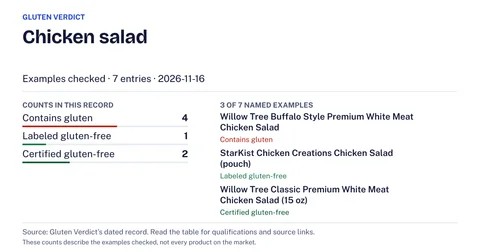 Chicken saladDepends on the product4 of 7 products we checked contain glutenchecked Nov 16, 2026
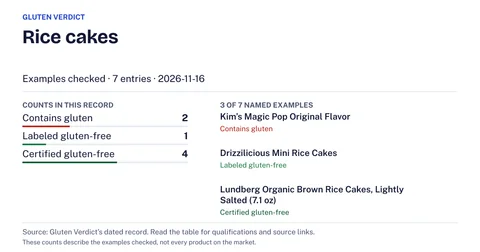 Rice cakesDepends on the product2 of 7 products we checked contain gluten: Kim’s Magic Pop Original Flavor and Kim’s Magic Pop Whole Wheat Flavorchecked Nov 16, 2026
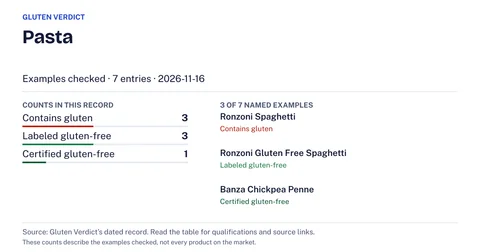 PastaContains glutenchecked Nov 16, 2026
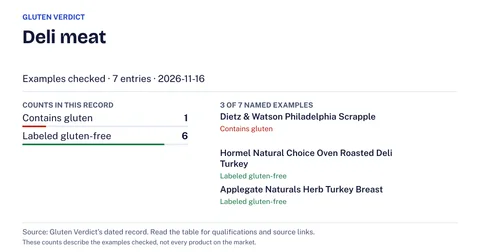 Deli meatDepends on the product1 of 7 products we checked contains gluten: Dietz & Watson Philadelphia Scrapplechecked Nov 16, 2026
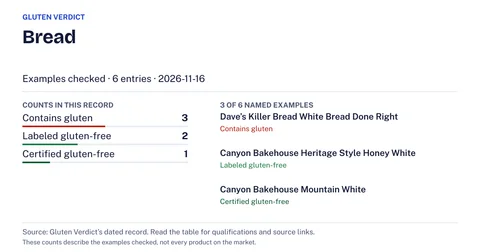 BreadContains glutenchecked Nov 16, 2026
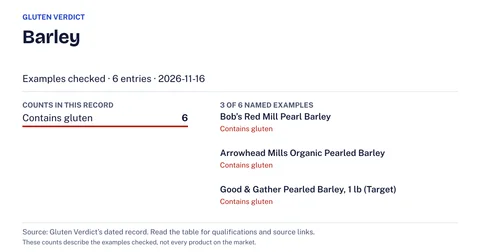 BarleyContains glutenchecked Nov 16, 2026
Questions people ask
Does the gluten-free symbol on Food Lion shelf tags mean the product meets FDA’s rule?
Food Lion’s FAQ does not say3. The FDA definition applies to the claim on a packaged food’s label21, 14.
Is the Food Lion Gluten Free Chicken Salad a deli item?
Food Lion’s page lists it under Soups & Canned Goods with a direction to store it at room temperature8.
More in Store guides: regional supermarket chains
 Gluten-free at Safeway and Albertsons: own-brand packs, counters and pickup substitutionsHow to read Signature Select and O Organics packs, what the online Gluten Free tag covers, and how to check a pickup substitution before you accept it.
 Gluten-free at Kroger and Harris Teeter: reading own-brand packs and the counters the label rule does not coverHow to read a Kroger or Harris Teeter pack for gluten, what FDA's claim covers, and which counters sit outside it, with Kroger's own advice.
 Gluten-free at Publix: the shelf icon, GreenWise packs, and the deli and bakery countersWhat Publix says about its gluten free icon, GreenWise packs and the Deli and Bakery, and what to ask at each counter before you order.
 Gluten-free at Stop & Shop and Giant: shelf tags, website highlights and own-brand packsWhat a gluten-free shelf tag or website highlight at Stop & Shop and Giant stands behind, how to read an own-brand pack, and a substitution checklist.
 Gluten-free at ShopRite: check your branch, read the pack, ask at the countersHow to check a ShopRite branch’s gluten-free items online, read a Wholesome Pantry pack against FDA’s rule, and what to ask at the deli and bakery.
 Gluten-free at Schnucks: the app filter, the counters and the pharmacyWhat the Schnucks Rewards app’s Gluten Free filter is built on, how to check a pack, and why the counters and pharmacy need their own checks.
Related guides
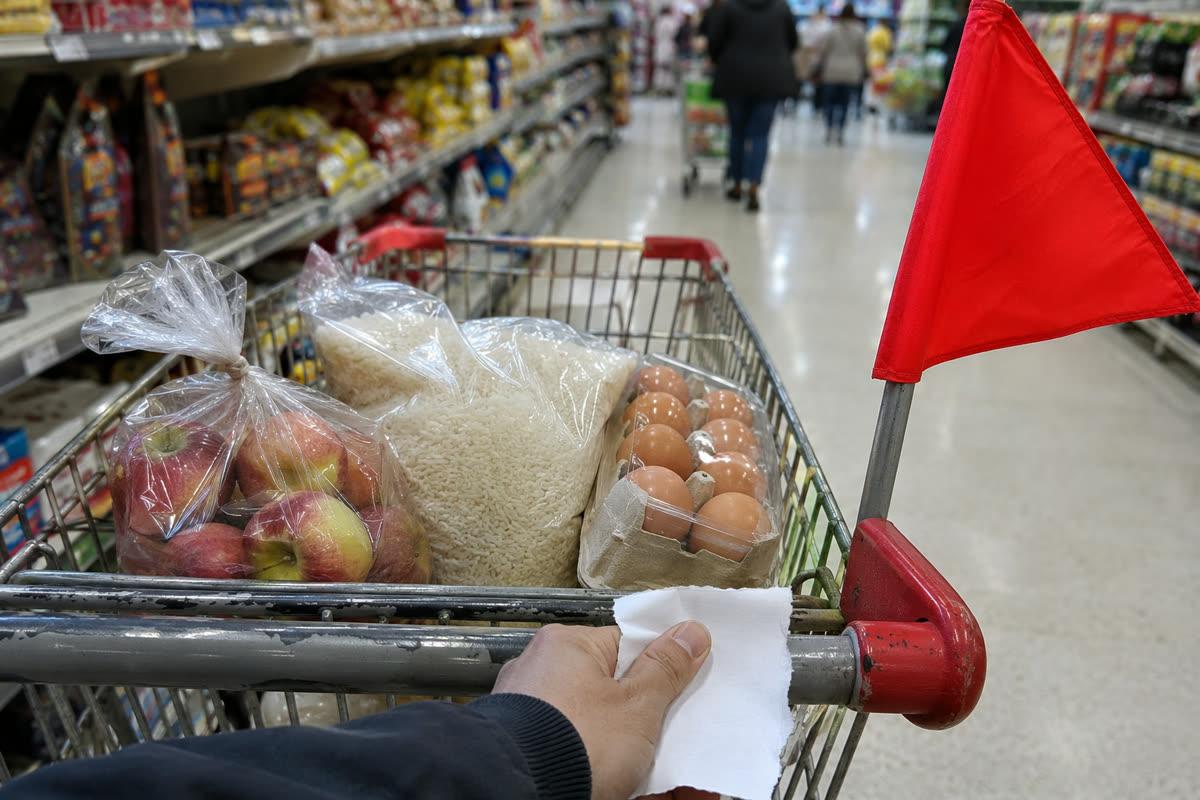 A gluten-free grocery list by aisle for US supermarketsAn aisle-by-aisle gluten-free grocery list for US stores: what needs no label, what needs a check, and what stays off the list.
 Store-brand gluten-free: what the tag, claim or seal rests onSort a store-brand item into certified, maker-stated or ingredient-only, see what each lets you conclude, and know what to ask the store.
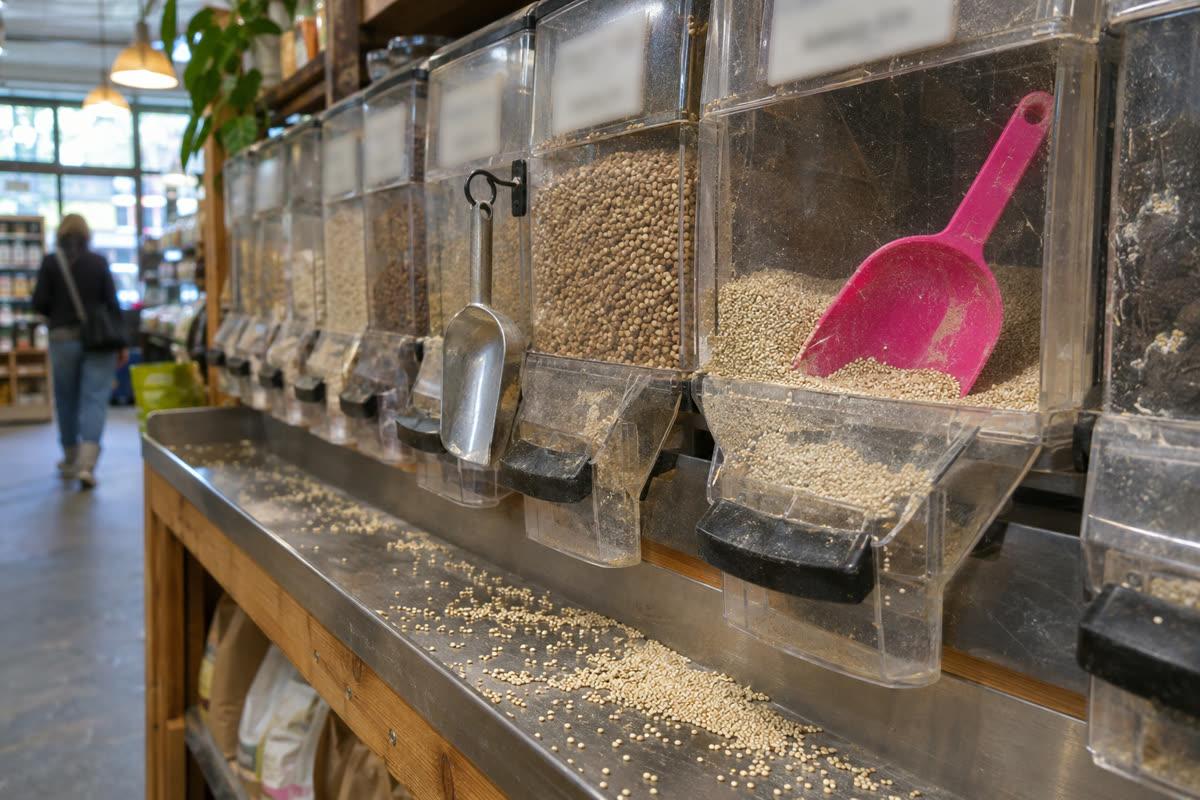 Deli, bakery and bulk-bin counters on a gluten-free dietFor each store counter (deli, bakery, bulk bins, bars): skip it, ask first, or buy the packaged item, and what a store’s own statement tells you.
 How to read a US food label for glutenWhere gluten shows up on a US food label: the gluten-free claim, the Contains line, the ingredient list and may-contain lines, and what each means.
Sources
- [1, 2, 3, 4, 5, 6] Food Lion, Customer Service FAQs (legacy site), checked Nov 17, 2026.
Read on 2026-11-17: the page has two gluten entries, “What does "gluten-free" on a food label mean?” and “How can I find gluten-free foods in my local Food Lion?”, and the word gluten appears in no other entry. The entries give no description of the symbol, no criteria for placing it, no sentence tying it to the 20 parts per million definition, and no date. The page is hosted on legacy.foodlion.com, and another entry on it reads “As of March, 31, 2012”.
- [7, 8, 9] Food Lion, Food Lion Gluten Free Chicken Salad (product page), checked Nov 17, 2026.
Read on 2026-11-17: the page lists “Department: Soups & Canned Goods” and a size of 2.6 oz pkt, and its directions read “Best served chilled. Store at room temperature. Do not freeze.”
- [10, 11, 12] Food Lion, Food Lion Gluten Free Caramel Rice Cakes (product page), checked Nov 17, 2026.
- [13] Food Lion, Pasta Alternatives (online aisle), checked Nov 17, 2026.
Read on 2026-11-17: the page headed “Pasta Alternatives” lists, among other items, Ronzoni Gluten Free Rotini, Spaghetti, Penne Rigate and Thin Spaghetti pasta, and It's Skinny Gluten Free Vegan Paleo & Keto Fettuccine, Angel Hair and Spaghetti pasta.
- [14, 15, 16, 17, 18, 19, 20, 21, 22, 23] US Food and Drug Administration, Questions and Answers on the Gluten-Free Food Labeling Final Rule, checked Nov 17, 2026.
- [24, 25] US Food and Drug Administration, Food Allergen Labeling and Consumer Protection Act of 2004 (FALCPA), checked Nov 17, 2026.
- [26, 27, 28, 32, 33] National Institute of Diabetes and Digestive and Kidney Diseases, Eating, Diet, & Nutrition for Celiac Disease, checked Nov 17, 2026.
- [29, 30, 31] Gluten Intolerance Group, 7 Tips for Avoiding Gluten Cross-Contact at Home (page dated Updated January 8, 2021), checked Nov 17, 2026.