Gluten-free at Stop & Shop and Giant: shelf tags, website highlights and own-brand packs
Short answer
A gluten-free shelf tag or website highlight at Stop & Shop or Giant points you to a product; the label on the pack decides. A Supermarket News item on Stop & Shop’s shelf tags says the identified products rest on a commitment from the manufacturer1, and FDA does not require makers to test before making a gluten-free claim2. Check the pack in this order:
- The claim: “gluten-free”, “free of gluten”, “without gluten” or “no gluten” on a food FDA regulates means less than 20 parts per million of unavoidable gluten, and no gluten grain used on purpose3, 4.
- The ingredient list, for wheat, rye, barley and malt in any form, including malted barley flour5, 6.
- The Contains line, which can name wheat without naming barley or rye7.
- Any may-contain or shared-facility line, which FDA allows beside a gluten-free claim8.
- For delivery, set your substitution choice before checkout and read the pack of anything that arrives in place of an item9.
Part of Store guides: regional supermarket chains, 15 guides
Key points
- No current Stop & Shop or Giant Food page we could open explains the shelf tag. Stop & Shop’s brochure announced the tags as “Coming Soon!”10, and its product list is dated January 1, 200711.
- On the product pages we read, “Gluten Free” is one entry in a Highlights list, and the Details text varies between “Certified gluten free.”, “Gluten free.” and “No gluten.”12, 13, 14.
- Giant Food and The GIANT Company are two Ahold Delhaize USA brands, and Giant Eagle is a separate family-owned retailer15, 16.
- Stop & Shop’s terms say an out-of-stock online item is in most cases substituted automatically, and that you can change this in your account’s shopping preferences9.
- Stop & Shop’s terms say its product descriptions often depend on information given to it by others17.
What Stop & Shop and Giant publish about gluten, and how old each piece is
We read the items below on 2026-11-17. We found no current Stop & Shop or Giant Food page that explains what the shelf tag stands for, so the table keeps what each item says apart from when it was written.
| What we read | Its date | What it says |
|---|---|---|
| “Living Gluten-free” brochure, a PDF on static.stopandshop.com18 | No date in the text18 | Announces gluten-free shelf tags as “Coming Soon!”10. Says to read every label every time19, and to avoid products from bulk bins20. |
| Stop & Shop gluten-free product list, a PDF | Last updated January 1, 200711 | Compiled from information the manufacturers provided; Stop & Shop says it did not independently verify the gluten status of the products21. |
| Progressive Grocer report on the shelf tags | April 25, 201222 | Giant Food, Giant-Carlisle/Martin’s and Stop & Shop put labels below about 3,000 private-label and national-brand products the chains identified as gluten-free22. |
| Supermarket News item on Stop & Shop’s shelf labels | Page dated January 1, 20181 | Reports that the identified products rest on a commitment from the manufacturer1. |
| Stop & Shop and Giant Food product pages | Read 2026-11-17 | Each shows a Highlights list, a Warnings line and a Details text; the next section lays out nine of them. |
| Stop & Shop Terms & Conditions | Last updated 1/31/202423 | Says its product descriptions often depend on information given to it by others17, and sets the default for substitutions9. |
The brochure and the 2007 list are old. Use them for what Stop & Shop told shoppers at the time, and not for what is on the shelf now.
What a gluten-free shelf tag does and does not tell you
When the Ahold USA banners introduced the tags in 2012, the labels sat below products the chains had identified as gluten-free22. For Stop & Shop, Supermarket News reported that the identified products rest on a commitment from the manufacturer1. FDA’s rule does not require makers to test for gluten before using the claim, though makers are responsible for meeting it2.
So read the tag as a way to find candidates in an aisle you do not know. The claim on the pack is the maker’s own statement under FDA’s rule24, and the ingredient list is where you check it. In 2012 the labels were described as blue and green22, and the brochure called the new tag a “GLUTEN-FREE logo”10; we could not find a current description of how it looks.
What the website’s Highlights list shows
On the product pages we read, “Gluten Free” is one entry in a Highlights list, apart from the Warnings line and the Details text. Nine pages, read 2026-11-17:
| Product page | Highlights list | Warnings line | Details text |
|---|---|---|---|
| Rummo gluten-free rigatoni, Stop & Shop12 | Gluten Free, Kosher12 | No warnings available.12 | Certified gluten free.12 |
| Schar gluten-free sourdough bread, Stop & Shop25 | Gluten Free, Lactose Free, Wheat Free25 | Contains: soy. May Contain: sesame.25 | Certified gluten free.25 |
| Nature’s Promise gluten-free flour blend, Stop & Shop26 | Dairy Free, Gluten Free, Kosher, Sustainable Rating26 | No warnings available.26 | Gluten free. Dairy free. Certified gluten free. gfco.org.26 |
| Nature’s Promise organic gluten-free granola, Stop & Shop27 | Organic, Gluten Free, Kosher, Guiding Stars27 | Produced in a facility that uses peanuts, tree nuts, soy, wheat, sesame, and milk.27 | NSF: Certified gluten free.27 |
| King Arthur gluten-free 1:1 bread flour, Stop & Shop28 | Gluten Free, Kosher, Guiding Stars28 | Contains: wheat.28 | Gluten free.28 |
| Stop & Shop deli Muenster cheese block13 | Gluten Free13 | Contains: milk.13 | Gluten free.13 |
| Stop & Shop American cheese deli-style slices29 | No Highlights list on the page29 | Contains: milk.29 | No statement about gluten29 |
| Giant gluten-free spaghetti, Giant Food30 | Gluten Free, Kosher30 | No warnings available.30 | Certified gluten free.30 |
| Nature’s Promise gluten-free chickpea and corn rotini, Giant Food14 | Kosher, Sustainable Rating, Guiding Stars; no Gluten Free entry14 | Produced in a facility that processed Soy.14 | No gluten.14 |
- The words do not always travel together. The rotini page has no Gluten Free highlight, but its text says “No gluten.”14, which FDA treats as equivalent to “gluten-free”4. The cheese-slices page says nothing about gluten29. A missing highlight is neither a warning nor a clearance.
- “Certified gluten free.” is sometimes backed by a name on the page, gfco.org26 or NSF27, and sometimes appears with no certifier named12, 25, 30. Look for the mark on the pack, and see how to check a seal in the certifier’s directory.
- A shared-facility line can sit beside a gluten-free highlight. The granola page shows both27, and FDA allows a voluntary advisory statement on a food that also carries a gluten-free claim, provided the statement is truthful and not misleading8.
- A Contains: wheat line can sit beside one too. King Arthur’s bread flour lists gluten-free wheat starch, with a footnote that it was processed to meet FDA’s gluten-free requirements28. FDA’s definition allows an ingredient derived from a gluten grain and processed to remove gluten, such as wheat starch, when the food stays under 20 ppm3. Our verdicts: wheat starch and King Arthur gluten-free flour.
Stop & Shop’s terms say it does not warrant that its product descriptions or other information on the site are accurate, complete or current31, and that the descriptions often depend on information given to it by others17. That is why the pack in your hand has the last word.
Own brands: Stop & Shop, Giant and Nature’s Promise packs
On the pages we read, Stop & Shop and Giant own-brand products carry an “Our Brand” heading32, 30, and their Manufacturer lines read Adusa Distribution, LLC32, 30. Nature’s Promise turns up on a Stop & Shop page26, a Giant Food page14 and a GIANT Company page33. The flour blend’s Details text reads the same on the Stop & Shop and GIANT Company pages: “Certified gluten free. gfco.org.”26, 33.
What an own-brand pack does not do is settle the question for you. The Giant gluten-free spaghetti page says “Certified gluten free.” and names no certifier30, while the Nature’s Promise rotini says “No gluten.” and shows no Gluten Free highlight14. In both cases the pack and its ingredient list, not the brand name, are the evidence.
For the kinds of products these brands sell, our verdicts show what makers’ own pages say: bread, pasta, flour and granola.
The label check, in order
- The claim. “Gluten-free”, “free of gluten”, “without gluten” and “no gluten” all mean the food has to meet FDA’s definition, including less than 20 parts per million for any unavoidable gluten4, 3. “Wheat-free” is a different statement: the Celiac Disease Foundation says wheat-free products are not necessarily gluten-free34.
- The ingredient list. A food labeled gluten-free cannot be intentionally made with wheat, rye, barley or their crossbred hybrids like triticale, or an ingredient from them that was not processed to remove gluten5. The Celiac Disease Foundation lists malt in various forms, including malted barley flour6; see our malt extract verdict. Stop & Shop’s multigrain panini loaf, for example, lists rye meal, rye flour, rye flakes and malted barley extract35.
- The Contains line. Wheat is on the list of major food allergens in the 2004 allergen-labeling law; barley and rye are not7. The same panini loaf’s Contains line reads wheat, soy and sesame while its ingredients carry rye and malted barley35. A Contains line, when used, is printed immediately after or adjacent to the ingredient list and names the food source of the allergen36; it does not replace reading the list.
- May-contain and shared-facility lines. They are voluntary8, so their absence tells you little; FDA’s rule does not prohibit one beside a gluten-free claim, provided it is truthful and not misleading8.
- The pack against the listing. If a website’s Highlights, Warnings and Details differ from the pack, go with the pack: the store does not warrant its site information to be accurate or current31.
Our gluten scanner looks for these names in a photo of a label or pasted text, and how to read food labels covers the rule in full.
Deli, bakery and prepared foods
These are departments where there may be no pack to read. What the sources say:
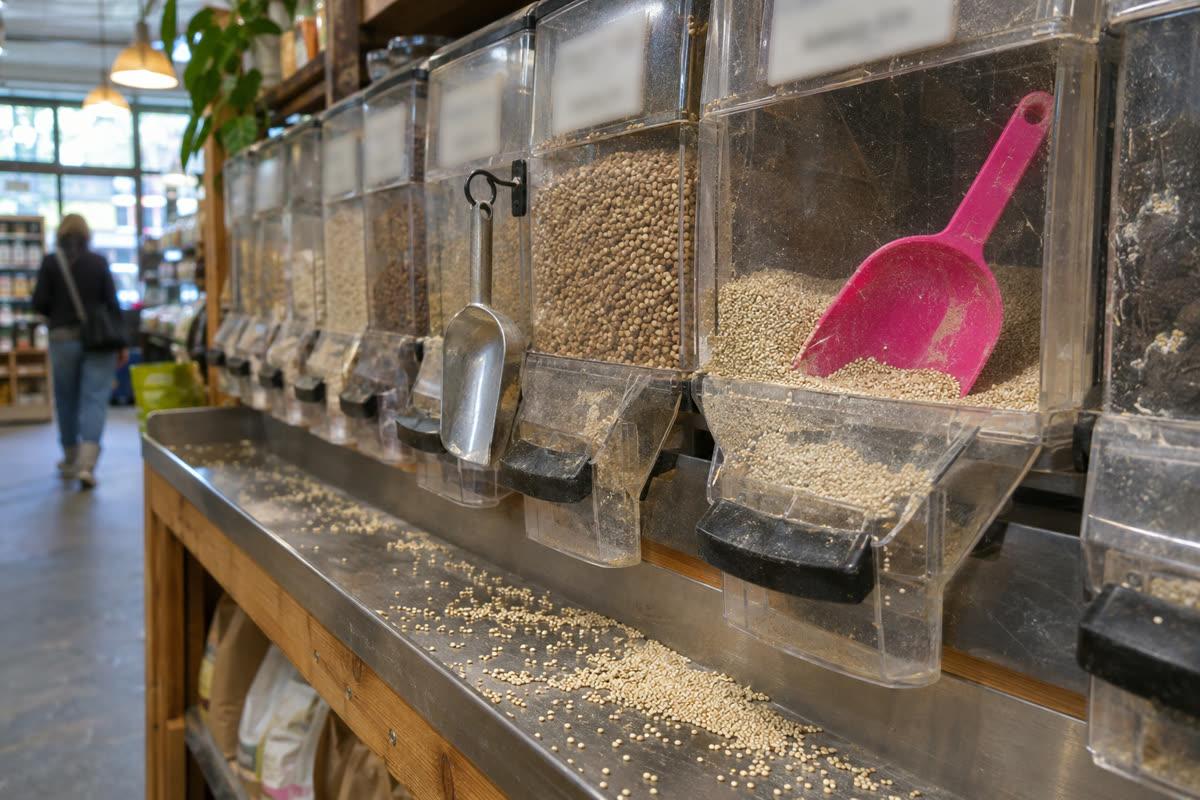
- Bulk bins. Stop & Shop’s brochure tells shoppers to avoid products from bulk bins20, and the Celiac Disease Foundation lists foods bought from bulk bins at grocery stores among the places cross-contact can occur37.
- Deli meats. The Foundation lists processed lunch meats among foods that may contain gluten and says to verify them by reading the label or checking with the manufacturer or kitchen staff38. FDA says its gluten-free rule does not cover foods whose labeling USDA regulates, generally meats and poultry39, so a gluten claim on a meat pack may not fall under that rule. Our deli meat verdict covers what makers say.
- Bakery. Stop & Shop’s own Bakery Bialys page says “May contain other allergens due to shared production area.”40. The Foundation lists non-certified baked goods, such as “gluten-free” goods from otherwise gluten-containing bakeries, among easily contaminated foods41. Online, Stop & Shop lists the Schar gluten-free bread under Bread & Bakery25, so the department name does not say who baked a loaf.
- Prepared foods. An undated Stop & Shop “Holiday Dinner Ingredients” sheet gives most dishes an ingredient block, an allergens line and a heading reading Gluten Free or Not Gluten Free. For the Carando spiral ham the allergens line reads None and the heading reads Not Gluten Free42, so an allergens line is not a gluten answer.
At a counter, ask to see the ingredient information or the sealed pack, and buy sealed packs where you can. Our counters guide lists the questions to ask.
Giant Food, The GIANT Company, Martin’s and Giant Eagle
Ahold Delhaize USA lists five grocery brands: Food Lion, Giant Food, The GIANT Company, Hannaford and Stop & Shop15. Giant Eagle is not among them43.
| Name | What the sources say |
|---|---|
| Stop & Shop | One of the five Ahold Delhaize USA brands15. |
| Giant Food | An Ahold Delhaize USA brand15. In 2012 Progressive Grocer described Giant Food of Landover, Md., as operating supermarkets in Virginia, Maryland, Delaware and the District of Columbia44. Its product pages we read are titled “| Giant Food”30. |
| The GIANT Company, GIANT and MARTIN’S | An Ahold Delhaize USA brand15. GIANT Food Stores announced the new company name in 202045; its headquarters is in Carlisle46, and its banners are GIANT, MARTIN’S, GIANT Heirloom Market, GIANT DIRECT and MARTIN’S DIRECT47. A product page we read on giantfoodstores.com is titled “| GIANT Food Stores”33. |
| Giant Eagle | A family-owned retailer in northern Ohio, western Pennsylvania, West Virginia, Maryland and Indiana16, not named among Ahold Delhaize USA’s brands43. Kroger announced on July 1, 2026 an agreement to acquire it, expected to close in 2027, subject to regulatory clearance16, 48. |
Stop & Shop, Giant Food and the Giant-Carlisle/Martin’s division launched gluten-free shelf tags together in 201222, which is why this guide reads their tags the same way. It is not a reason to assume the three stock or label the same things, and it says nothing about Giant Eagle’s own tags or brands.
Delivery and pickup: substitutions as a checklist
- Decide before you order. Stop & Shop’s terms say that when an online item is out of stock, in most cases it is automatically replaced with a similar item, and that you can change whether substitutions are permitted in your shopping preferences in your online account settings9.
- Add a note to any item you need exactly as ordered. On the Instacart help page for Stop & Shop’s storefront, item instructions can be added from the cart, on the checkout page, or after you order but before the shopper starts49.
- Pick a replacement rule per item. That page lists three choices: best match50, a specific item you pick from the catalog or from up to 3 suggestions51, or a refund52.
- Treat a “gluten-free” preference as a request, not a check. The page lists it among the preferences you can select for a best match50, but the shopper still chooses the item. Even with a refund, the shopper may suggest a replacement for you to approve or decline52.
- When the bags arrive, treat any replacement as a new product and read its claim, ingredient list and Contains line in the order above. Instacart’s page for the Stop & Shop storefront says the nutritional information it displays is not a substitute for checking product labels53.
On that storefront, the “gluten free” label is defined as products that identify as free of gluten on the packaging or product description54, so the label there repeats what the pack or description says. We could not open a Giant Food substitution page, so these steps rest on Stop & Shop’s terms and the Instacart help pages. For the general version, see our pickup and substitutions guide.
A first shop
- Start from our gluten-free grocery list and write down the specific products you want.
- Search each product on the store’s website and read its Highlights, Warnings and Details before you leave home; note anything that differs from what you expected.
- In the aisle, use the tag to find candidates, then check the pack in the order above rather than going by the tag.
- Buy sealed packs for the deli and bakery, and ask for ingredient information on anything cut or wrapped to order.
- If you order for delivery or pickup, set your substitution choices before you check out.
Verdicts in this guide
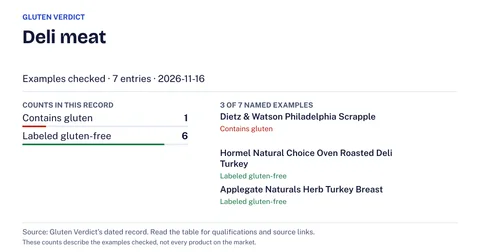 Deli meatDepends on the product1 of 7 products we checked contains gluten: Dietz & Watson Philadelphia Scrapplechecked Nov 16, 2026
 BreadContains glutenchecked Nov 16, 2026
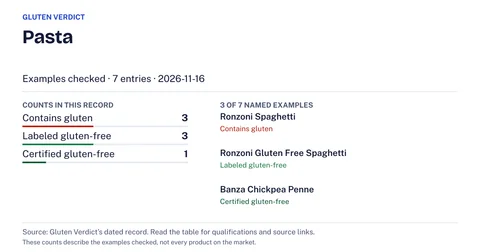 PastaContains glutenchecked Nov 16, 2026
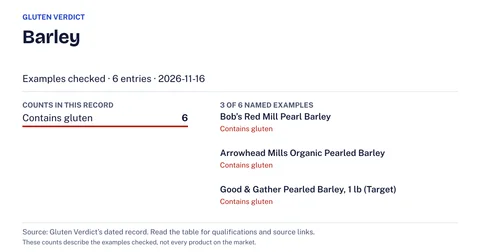 BarleyContains glutenchecked Nov 16, 2026
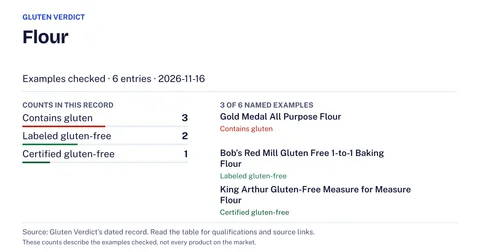 FlourContains glutenchecked Nov 16, 2026
 GranolaDepends on the product1 of 6 products we checked contains gluten: Honey Bunches of Oats Honey Roasted Granolachecked Nov 16, 2026
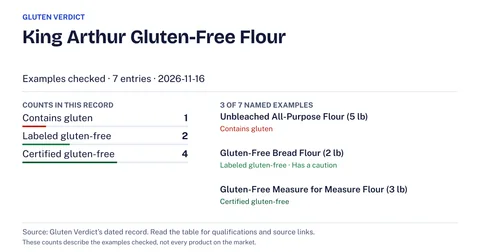 King Arthur Gluten-Free FlourCertified gluten-free1 of 7 varieties we checked contains gluten: Unbleached All-Purpose Flour (5 lb)Wheat warning on 2 of 7 varieties we checkedKing Arthur Baking Company · checked Nov 16, 2026
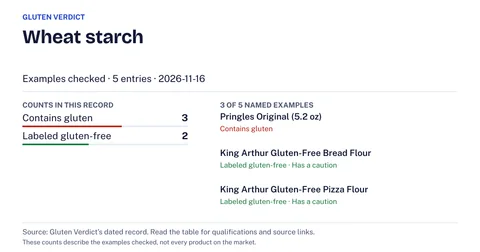 Wheat starchDepends on the product3 of 5 products we checked contain gluten: Pringles Original (5.2 oz), Jiffy Corn Muffin Mix, and Chex Mix Bold Garlic and Herbchecked Nov 16, 2026
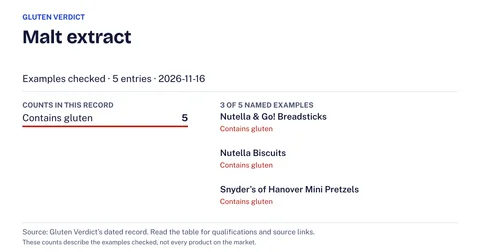 Malt extractContains glutenchecked Nov 16, 2026
Questions people ask
Does the gluten-free shelf tag at Stop & Shop mean the product was tested?
Supermarket News reported that the identified products rest on a commitment from the manufacturer1, and FDA’s rule does not require makers to test for gluten, though they are responsible for meeting it2. We found no current Stop & Shop page that describes testing behind the tag.
Is Giant Food the same company as Giant Eagle?
No. Giant Food is an Ahold Delhaize USA brand15. Giant Eagle is a separate family-owned retailer16 that is not named on Ahold Delhaize USA’s list of brands43.
Can I turn off substitutions at Stop & Shop?
Stop & Shop’s terms say you can change whether substitutions are permitted in your shopping preferences in your online account settings9.
More in Store guides: regional supermarket chains
 Gluten-free at Safeway and Albertsons: own-brand packs, counters and pickup substitutionsHow to read Signature Select and O Organics packs, what the online Gluten Free tag covers, and how to check a pickup substitution before you accept it.
 Gluten-free at Publix: the shelf icon, GreenWise packs, and the deli and bakery countersWhat Publix says about its gluten free icon, GreenWise packs and the Deli and Bakery, and what to ask at each counter before you order.
 Gluten-free at Price Chopper and Market 32: the blue shelf tag, the ppm figure and the bakery and deliHow to use Price Chopper and Market 32’s gluten-free tag and pages, hold a pack to FDA’s 20 ppm rule, and what the bakery and deli pages leave unsaid.
 Gluten-free at Big Y: the support groups and the label checkWhat Big Y publishes for gluten-free shoppers, how to treat a shelf tag as a pointer, and where its Living Gluten Free support groups meet.
 Gluten-free at Kroger and Harris Teeter: reading own-brand packs and the counters the label rule does not coverHow to read a Kroger or Harris Teeter pack for gluten, what FDA's claim covers, and which counters sit outside it, with Kroger's own advice.
 Gluten-free at Food Lion: the shelf-tag symbol, own-brand claims and a first tripWhat Food Lion says about gluten: the shelf-tag symbol, Food Lion-brand claims, and a two-category first trip that leaves the counters for later.
Related guides
 A gluten-free grocery list by aisle for US supermarketsAn aisle-by-aisle gluten-free grocery list for US stores: what needs no label, what needs a check, and what stays off the list.
 Store-brand gluten-free: what the tag, claim or seal rests onSort a store-brand item into certified, maker-stated or ingredient-only, see what each lets you conclude, and know what to ask the store.
 Deli, bakery and bulk-bin counters on a gluten-free dietFor each store counter (deli, bakery, bulk bins, bars): skip it, ask first, or buy the packaged item, and what a store’s own statement tells you.
 How to read a US food label for glutenWhere gluten shows up on a US food label: the gluten-free claim, the Contains line, the ingredient list and may-contain lines, and what each means.
Sources
- [1] Supermarket News, Stop & Shop Launches Health & Wellness Initiatives, checked Nov 17, 2026.
- [2, 3, 4, 5, 8, 24, 39] US Food and Drug Administration, Questions and Answers on the Gluten-Free Food Labeling Final Rule, checked Nov 17, 2026.
- [6, 34, 37, 38, 41] Celiac Disease Foundation, Sources of Gluten, checked Nov 17, 2026.
Read on 2026-11-17: under the heading “Foods That May Contain Gluten”, which says “These foods must be verified by reading the label or checking with the manufacturer/kitchen staff.”, the list includes “Processed lunch meats”.
- [7, 36] US Food and Drug Administration, Food Allergen Labeling and Consumer Protection Act of 2004 (FALCPA), checked Nov 17, 2026.
- [9, 17, 23, 31] Stop & Shop, Terms & Conditions, checked Nov 17, 2026.
- [10, 18, 19, 20] Stop & Shop, Living Gluten-free brochure (PDF), checked Nov 17, 2026.
Read on 2026-11-17: the PDF text carries no date or revision line.
- [11, 21] Stop & Shop, Stop & Shop gluten free product list (PDF), checked Nov 17, 2026.
- [12] Stop & Shop, Rummo Imported Gluten Free Rigatoni Pasta with Brown Rice & Corn, checked Nov 17, 2026.
- [13] Stop & Shop, Stop & Shop Deli Muenster Cheese Block, checked Nov 17, 2026.
- [14] Giant Food, Nature's Promise Gluten Free Chickpea & Corn Rotini Pasta, checked Nov 17, 2026.
- [15, 43] Ahold Delhaize USA, Ahold Delhaize USA home page, checked Nov 17, 2026.
Read on 2026-11-17: the page names Food Lion, Giant Food, The GIANT Company, Hannaford and Stop & Shop as its five grocery brands; Giant Eagle is not named.
- [16, 48] The Kroger Co., Kroger Announces Agreement to Acquire Giant Eagle, checked Nov 17, 2026.
- [22, 44] Progressive Grocer, Ahold USA Banners Debut Gluten-free Shelf Tags, checked Nov 17, 2026.
- [25] Stop & Shop, Schar Gluten Free Sourdough Deli Style Bread, checked Nov 17, 2026.
- [26] Stop & Shop, Nature's Promise Gluten Free All Purpose Flour Blend, checked Nov 17, 2026.
- [27] Stop & Shop, Nature's Promise Organic Gluten Free Cranberry Maple Granola, checked Nov 17, 2026.
- [28] Stop & Shop, King Arthur Gluten Free 1:1 Substitute Bread Flour, checked Nov 17, 2026.
- [29] Stop & Shop, Stop & Shop American Cheese Deli Style Slices - 10 ct, checked Nov 17, 2026.
Read on 2026-11-17: the page lists the department as “Dairy & Eggs” and has Nutrition, Ingredients, Warnings (“Contains: milk.”) and Details sections but no Highlights list; the Details text makes no statement about gluten.
- [30] Giant Food, Giant Gluten Free Spaghetti Pasta, checked Nov 17, 2026.
- [32] Stop & Shop, Stop & Shop Split Top Wheat Bread Sliced, checked Nov 17, 2026.
- [33] GIANT Food Stores (The GIANT Company), Nature's Promise Gluten Free All Purpose Flour Blend, checked Nov 17, 2026.
- [35] Stop & Shop, Stop & Shop The Bakery Authentic Multigrain Panini Sliced Bread Loaf, checked Nov 17, 2026.
- [40] Stop & Shop, Stop & Shop Bakery Bialys - 6 ct, checked Nov 17, 2026.
- [42] Stop & Shop, Holiday Dinner Ingredients (PDF), checked Nov 17, 2026.
Read on 2026-11-17: the undated PDF, headed “Holiday Dinner Ingredients”, gives most dishes an INGREDIENTS block, an ALLERGENS line and a heading reading “Gluten Free” or “Not Gluten Free”. For “Carando Spiral Ham” the ALLERGENS line reads “None” and the heading reads “Not Gluten Free”; for “Butterball Fresh Baked Turkey (10-12 lbs)” the ALLERGENS line reads “None” and the heading reads “Gluten Free”.
- [45, 46, 47] Ahold Delhaize, Giant Food Stores Introduces new name and modern logos, checked Nov 17, 2026.
- [49, 50, 51, 52] Instacart (Stop & Shop storefront help), Adding instructions for specific items, replacements, or delivery, checked Nov 17, 2026.
- [53, 54] Instacart (Stop & Shop storefront help), Nutritional Information on Instacart, checked Nov 17, 2026.
Read on 2026-11-17: the page's table of labels defines “Free, ingredient-based (ex. gluten free, lactose free)” as “Products that identify as being free of the reference ingredient on the product packaging or product description.”