Gluten-free at Kroger and Harris Teeter: reading own-brand packs and the counters the label rule does not cover
Short answer
FDA’s gluten-free rule applies to a Kroger-family pack as it does to any FDA-regulated packaged food1, and four checks settle what the label tells you, in this order:
- A “gluten-free” claim on the pack: on foods FDA regulates, any unavoidable gluten must be less than 20 parts per million, and the claim is voluntary4, 5.
- The Contains line: wheat is on the allergen law’s list, barley and rye are not11.
- The full ingredient list, which Kroger’s own dietitians tell shoppers to read13.
- Counters and bulk bins: FDA’s rule covers packaged foods, and USDA generally regulates the labeling of meat and poultry3, 2.
Part of Store guides: regional supermarket chains, 15 guides
Key points
- Kroger’s dietitians say that if a label does not state “gluten-free”, shoppers should assume the product contains gluten until they have inspected the ingredients12.
- USDA generally regulates the labeling of meats and poultry, and FDA’s gluten-free rule does not apply to foods whose labeling USDA regulates2.
- FDA’s rule applies to packaged foods, so unpackaged deli, bakery and bulk-bin items call for questions at the counter rather than a label check3, 23.
- Harris Teeter’s Product Tag Attributes page lists a Gluten Free tag, but the text we retrieved gives no definition for it26.
Which stores this covers
The Kroger Co. says it merged with Harris Teeter in 201420, and describes itself as operating nearly 2,800 stores in 35 states under two dozen banners22. Its own press release names Fred Meyer, Ralphs and Harris Teeter among the banners21.
This guide is written for any of them. The label rules below are FDA’s and USDA’s, and they apply to a pack whatever the banner on the store1, 2.
What Kroger’s own dietitians tell shoppers
Harris Teeter’s site carries a gluten-free eating post by Kroger Registered Dietitians, dated April 26, 202312. Its first step is to look for “gluten-free” on the label. If a label does not state it, the post says to assume the product contains gluten until the ingredients have been inspected12.
The second step is to read the full ingredient list, watching for the main gluten sources and for less familiar ones: malt, textured vegetable protein and yeast extract13. The post also advises looking for gluten-free certification on oats and other naturally gluten-free foods that may be processed alongside gluten-containing grains17.
Kroger’s shop-by-diet page for gluten-free groceries says shoppers can “shop a wide variety of gluten-free foods, or video chat with a registered dietitian”27. The text we retrieved from it states no label rule, so the label steps here come from FDA and the dietitians’ post.
How to read an own-brand pack, in order
- Find the claim. FDA’s definition of “gluten-free” includes less than 20 ppm of any unavoidable gluten in the food4. Makers are not required to use the claim5.
- Treat “made with no gluten-containing ingredients” as a different statement. Unless the label also carries “gluten-free”, FDA says consumers should not assume the food meets the claim’s requirements7.
- Read the Contains line. When a pack uses a Contains line, the allergen law has it printed immediately after or adjacent to the ingredient list10, but its list of major allergens names wheat and not barley or rye11. A Contains line without wheat says nothing about barley or rye11.
- Read every word of the ingredient list. Kroger’s dietitians name wheat, rye, triticale, barley and oats, and less familiar sources such as malt13.
- Look at any may-contain line last. FDA allows a voluntary advisory such as “made in a facility that also processes wheat” on a pack that also says gluten-free, if it is truthful and not misleading6.
Our gluten scanner reads a photo or pasted text of an ingredient list for these names, and how to read food labels goes through each part of a US label in more depth.
Ingredient names worth stopping on
| Name on the label | What a source says | Our verdict |
|---|---|---|
| Wheat starch | FDA’s definition of “gluten-free” excludes an ingredient such as wheat starch, derived from a grain and processed to remove gluten, if its use results in 20 ppm or more gluten in the food9. Kroger’s dietitians list it among ingredients that contain gluten14. | Wheat starch |
| Malt extract | FDA: malt extract is derived from barley that has not been processed to remove gluten8. | Malt extract |
| Brewer’s yeast | Kroger’s dietitians list brewer’s yeast among ingredients that contain gluten14. | Brewer’s yeast |
| Barley | Barley is not on the allergen law’s list, so it can appear in the ingredient list without being named on the Contains line11. | Barley |
Harris Teeter’s Gluten Free tag: what its page says
Harris Teeter publishes a page headed Product Tag Attributes. It lists a tag named Gluten Free, and for other tags, such as Low Fat, it gives a one-line definition; the text we retrieved on 2026-11-17 gives none under Gluten Free26. We therefore make no claim about what the Gluten Free tag covers, who decides it, or how it relates to the maker’s label.
What we can say comes from the rule itself: the pack in your hand is what FDA’s claim definition applies to1. If you rely on a tag, read it against the pack, and ask Harris Teeter what the tag means before you treat it as meaning more than the pack’s own label.
Packaged food versus meat and poultry
FDA’s gluten-free rule does not apply to foods whose labels USDA regulates, and USDA generally regulates labeling of meats, poultry and certain egg products2. A packaged food that FDA regulates is covered1.
Kroger’s dietitians add a practical point: if seasonings have been added to meat, such as broth injected into chicken breasts, the label must list the ingredients16. For the plain products, our chicken and deli meat verdicts show what we found.
Deli, bakery, rotisserie and bulk bins
FDA’s rule applies to packaged foods. For unpackaged food, FDA says it will monitor reported information and share complaints with state and local government partners3. An unpackaged deli slice or bakery loaf has no pack label to check against the rule, and USDA generally regulates the labeling of meat and poultry2.
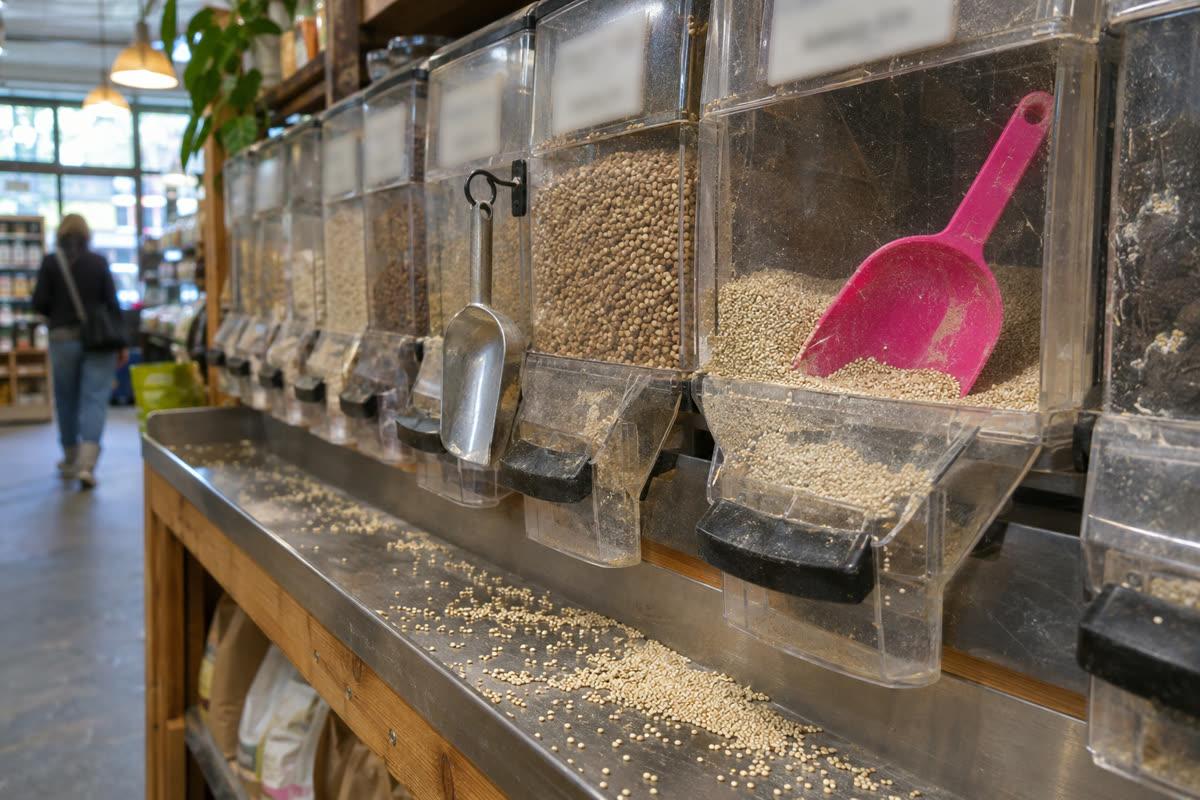
The Kroger dietitians’ list of likely or potential gluten sources names hot dogs, lunch meat and baked goods, among other items15. Gluten Intolerance Group tells shoppers to stay clear of the bulk section, because gluten-containing ingredients could linger on scoops or surrounding bins23.
We did not read any Kroger or Harris Teeter page on how their deli, bakery or rotisserie counters handle gluten, so we say nothing about their practices. At the counter, ask to see the package or ingredient list for the product, and ask what it was prepared or sliced on. If the answer is unclear, a packaged product with a label is the better choice.
A first trip: two aisles
Pick two aisles and do them fully before moving on. In both, the label does the work: claim first, then the ingredient list.
| Aisle | What to check | Our verdict |
|---|---|---|
| Pasta and sauce aisle | The dietitians’ post names Simple Truth Organic Gluten Free Red Lentil Penne Pasta in a dinner suggestion19. Find the claim on the pack, then the ingredient list. Our Barilla verdict separates the classic pasta from Barilla’s separate gluten-free ones. | Pasta, Barilla pasta |
| Baking aisle | The dietitians’ post names Simple Truth gluten-free all-purpose flour mix as a substitute for all-purpose flour18. Check that the pack carries the claim rather than assuming a flour or mix does. | Flour, Bread |
Gluten Free Watchdog lists five Kroger products with gluten test results, shown with dates between 2016 and 202224, 25. Each is a result for that product, not a rating of the store.
If you shop by pickup, check the label of any substitute again at home; a substitute is a different product with its own label.
Verdicts in this guide
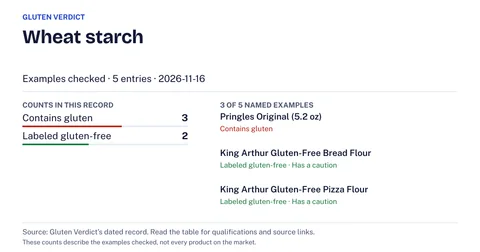 Wheat starchDepends on the product3 of 5 products we checked contain gluten: Pringles Original (5.2 oz), Jiffy Corn Muffin Mix, and Chex Mix Bold Garlic and Herbchecked Nov 16, 2026
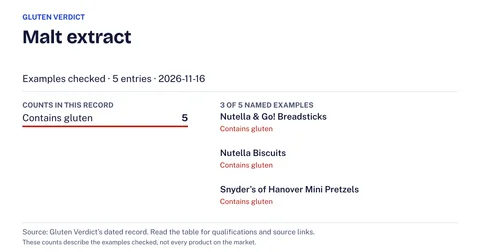 Malt extractContains glutenchecked Nov 16, 2026
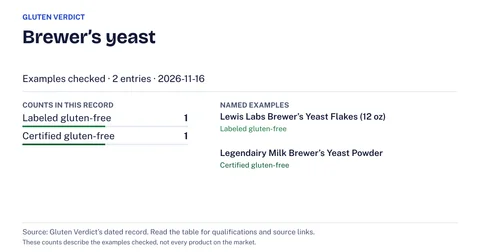 Brewer’s yeastDepends on the productchecked Nov 16, 2026
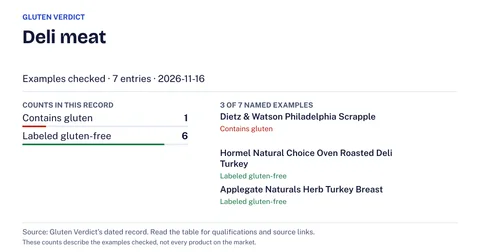 Deli meatDepends on the product1 of 7 products we checked contains gluten: Dietz & Watson Philadelphia Scrapplechecked Nov 16, 2026
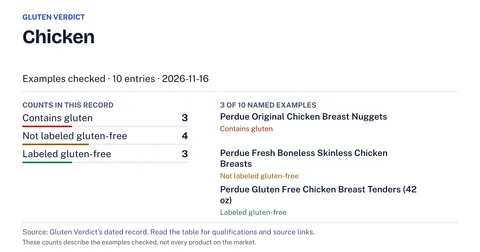 ChickenNaturally gluten-free3 of 10 products we checked contain gluten: Perdue Original Chicken Breast Nuggets, Bell & Evans Breaded Chicken Tenders, and Foster Farms Chicken Nuggets (33.6 oz)checked Nov 16, 2026
 BreadContains glutenchecked Nov 16, 2026
 PastaContains glutenchecked Nov 16, 2026
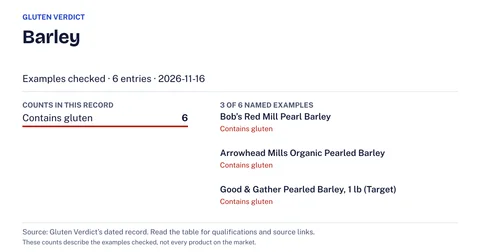 BarleyContains glutenchecked Nov 16, 2026
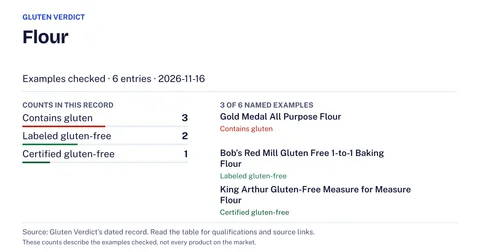 FlourContains glutenchecked Nov 16, 2026
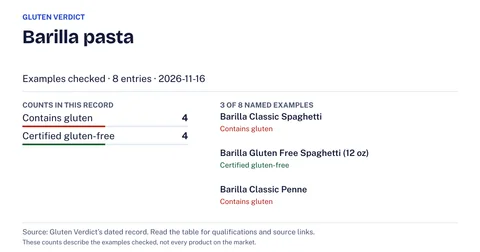 Barilla pastaContains glutenBarilla America, Inc. · checked Nov 16, 2026
Questions people ask
Does FDA’s gluten-free rule cover Kroger’s own brands?
Yes, when the pack is an FDA-regulated packaged food that carries the claim. The rule applies to FDA-regulated packaged foods1, and FDA’s definition of “gluten-free” includes less than 20 ppm of any unavoidable gluten in the food4.
Can a gluten-free pack also carry a may-contain line?
Yes. FDA does not prohibit a voluntary advisory such as “made in a facility that also processes wheat” on a pack that also bears a gluten-free claim, if it is truthful and not misleading6.
Does the rule cover rotisserie chicken or a deli counter?
FDA’s regulation applies to packaged foods3, and USDA generally regulates the labeling of meat and poultry2. We did not read any Kroger or Harris Teeter page on how its counters handle gluten, so ask at the counter.
What does Harris Teeter’s Gluten Free tag mean?
Harris Teeter’s Product Tag Attributes page lists a Gluten Free tag, but the text we retrieved on 2026-11-17 gives no definition for it26. Read the pack’s own label.
More in Store guides: regional supermarket chains
 Gluten-free at Safeway and Albertsons: own-brand packs, counters and pickup substitutionsHow to read Signature Select and O Organics packs, what the online Gluten Free tag covers, and how to check a pickup substitution before you accept it.
 Gluten-free at Publix: the shelf icon, GreenWise packs, and the deli and bakery countersWhat Publix says about its gluten free icon, GreenWise packs and the Deli and Bakery, and what to ask at each counter before you order.
 Gluten-free at Food Lion: the shelf-tag symbol, own-brand claims and a first tripWhat Food Lion says about gluten: the shelf-tag symbol, Food Lion-brand claims, and a two-category first trip that leaves the counters for later.
 Gluten-free at Stop & Shop and Giant: shelf tags, website highlights and own-brand packsWhat a gluten-free shelf tag or website highlight at Stop & Shop and Giant stands behind, how to read an own-brand pack, and a substitution checklist.
 Gluten-free at Hy-Vee: what the dietitians offer and how to read Good Graces claimsWhat Hy-Vee says its dietitians do, how a gluten-free claim on a Good Graces pack is judged, and how GFCO’s list differs from FDA’s 20 ppm rule.
 Gluten-free at Price Chopper and Market 32: the blue shelf tag, the ppm figure and the bakery and deliHow to use Price Chopper and Market 32’s gluten-free tag and pages, hold a pack to FDA’s 20 ppm rule, and what the bakery and deli pages leave unsaid.
Related guides
 A gluten-free grocery list by aisle for US supermarketsAn aisle-by-aisle gluten-free grocery list for US stores: what needs no label, what needs a check, and what stays off the list.
 Store-brand gluten-free: what the tag, claim or seal rests onSort a store-brand item into certified, maker-stated or ingredient-only, see what each lets you conclude, and know what to ask the store.
 Deli, bakery and bulk-bin counters on a gluten-free dietFor each store counter (deli, bakery, bulk bins, bars): skip it, ask first, or buy the packaged item, and what a store’s own statement tells you.
 How to read a US food label for glutenWhere gluten shows up on a US food label: the gluten-free claim, the Contains line, the ingredient list and may-contain lines, and what each means.
Sources
- [1, 2, 3, 4, 5, 6, 7, 8, 9] US Food and Drug Administration, Questions and Answers on the Gluten-Free Food Labeling Final Rule, checked Nov 17, 2026.
- [10, 11] US Food and Drug Administration, Food Allergen Labeling and Consumer Protection Act of 2004 (FALCPA), checked Nov 17, 2026.
- [12, 13, 14, 15, 16, 17, 18, 19] Harris Teeter, Gluten-Free Eating, a post by Kroger Registered Dietitians on Harris Teeter’s blog, April 26, 2023, checked Nov 17, 2026.
- [20] The Kroger Co., History, checked Nov 17, 2026.
- [21] The Kroger Co., Kroger Customers Can Shop for Groceries and Prescriptions in a Single Order (press release), checked Nov 17, 2026.
- [22] The Kroger Co., About Kroger, checked Nov 17, 2026.
- [23] Gluten Intolerance Group, 25 Ways Cross-Contact Could Happen (And How to Avoid It), checked Nov 17, 2026.
- [24, 25] Gluten Free Watchdog, Kroger: Are they gluten free?, checked Nov 17, 2026.
Read on 2026-11-17: the product list on the page names five Kroger products with report dates: Kroger Gluten Free 7 Grain Bread (Sep 22, 2016); Simple Truth Gluten Free Chocolate Cake Baking Mix (Apr 9, 2019); Simple Truth Gluten Free Spaghetti (Mar 3, 2020); Simple Truth Gluten-Free Chocolate Sandwich Cookie (Dec 4, 2019); and Simple Truth Oatmilk (Not Labeled GF) (Apr 25, 2022).
- [26] Harris Teeter, Product Tag Attributes, checked Nov 17, 2026.
Read on 2026-11-17 (page text via Exa): the page headed “Product Tag Attributes” lists tag names including Gluten Free and gives one-line definitions for others, for example Low Fat: “Less than 3 grams of total fat per serving (or per 100g for meals/main dishes).” The text we retrieved gives no definition under Gluten Free.
- [27] Kroger, Gluten-Free Groceries (shop-by-diet page), checked Nov 17, 2026.