Store-brand gluten-free: what the tag, claim or seal rests on
Short answer
A store’s gluten-free tag can rest on different things (Target’s covers either a certification or an on-pack statement9), so sort the item by what the pack shows:
- Certified: a third-party certification mark on the pack, which you can look up in the certifier’s directory; GFCO’s own page says a listed product is certified only when its packaging carries the mark1, 2.
- Maker-stated: a “gluten-free” claim on the pack, which on food FDA regulates includes a limit of below 20 parts per million on unavoidable gluten, and which the manufacturer is responsible for3, 4.
- Ingredient-only: no seal and no claim, so a conclusion drawn from the ingredient list alone; the Gluten Intolerance Group (GIG) names oats, lentils and milled grain, bean and seed products as riskier5.
Part of Grocery shopping and meal planning, 15 guides

Key points
- A store-brand name is not a tier: GFCO, for one, certifies individual products, not brands or manufacturing facilities6.
- On a food FDA regulates, “gluten-free” on a store-brand pack is held to the same rule as on any other pack: a food that bears the claim and does not meet the rule is misbranded7.
- FDA does not endorse any certification program, so check a seal in that certifier’s own directory8.
- A shelf tag is the store’s wording: Target defines its Gluten Free badge as an independent third-party certification or an on-pack statement, so the tag alone does not say which9.
- In one market survey by FDA scientists, 3 of 275 foods labeled gluten-free were mislabeled, while 36 of 186 foods with no wheat, rye or barley on the ingredient label and no gluten-free label had more than 20 ppm of gluten by at least one test kit10, 11.
The three tiers on one pack
Store-brand shelves put three kinds of evidence under one logo. The tier belongs to the single pack in your hand, not to the brand: GFCO, for one, certifies products6, and a manufacturer who uses the claim on some foods has not made every food gluten-free12.
| Tier | What shows on the pack | Who stands behind it | What you can conclude |
|---|---|---|---|
| Certified | A certification mark, and a listing in that certifier’s directory | A third-party certifier. GFCO says it audits, in person and every year, each manufacturing facility where its certified products are made13 | A third party reviewed this product. GFCO says its mark confirms 10 ppm or less of gluten14. Nothing about the maker’s other products6. |
| Maker-stated | The words “gluten-free” (or “no gluten”, “free of gluten”, “without gluten”) on the pack | The manufacturer. FDA checks claims through sampling, inspections, label review and complaint follow-up15 | A legal claim: unavoidable gluten below 20 ppm3. A food that bears any of the four phrases and misses the rule is misbranded7, 16. FDA does not require the maker to test17. |
| Ingredient-only | Neither. Sometimes a line such as “made with no gluten-containing ingredients” | Nobody has made a gluten-free promise. | An inference from the list. FDA says that where a label carries a line such as “made with no gluten-containing ingredients” but no “gluten-free” claim, consumers should not assume the food meets the rule18. |
Who stands behind a claim on a store-brand pack?
A store-brand pack still names a company. FDA’s rule on package labels requires the name and place of business of the manufacturer, packer or distributor, and when that company did not make the food, the name must be qualified by a phrase such as “Manufactured for” or “Distributed by”49, 19.
Walmart says its Great Value brand is sourced and packaged for Walmart by a variety of suppliers20, and points to the packaging or customer service for the supplier of a specific product21. FDA says manufacturers that label their foods gluten-free are responsible for using the claim accurately4.
What a shelf tag or website filter adds
Tags and filters are the store’s own wording. Target publishes what its Gluten Free badge means: “a product that has an unqualified independent third-party certification, or carries an on-pack statement relating to the finished product being gluten-free”9. That is two different tiers behind one badge, and the badge does not say which applies.
Target’s Good & Gather Gluten Free Penne page shows the badge and a Dietary Needs line reading “Gluten-Free, Certified Gluten-Free”22. Good & Gather Quick Oats, from the same brand in the same store, has no gluten-free wording on its page and carries the warning “MAY CONTAIN WHEAT”23. Same brand, different tiers: the pack decides.
Walmart’s Great Value page says to check the nutrition facts and ingredient list on the packaging24, and also offers website filters for dietary needs such as gluten-free25. Use a filter to start a search, then read the pack.
Certified: how to check a seal
- Find the certification mark on the pack. FDA lets a maker print a certification program’s logo if its use is truthful and not misleading, and does not endorse or recommend any program8.
- Search that certifier’s directory. GFCO’s Product Finder says products are considered certified if they appear on its list and carry one of its marks1.
- A listing without the mark does not count: GFCO says that if a listed product’s packaging does not carry the mark, that product is not certified2.
- If the pack carries the mark and you cannot find the product, GFCO asks you to contact it26.
Spelling changes what the directory shows. On 2026-11-17 the free-text search “Good & Gather” returned no products27, the search “Gather” returned one28, the brand filter “Good & Gather” returned many29, and the separate brand “Good and Gather” returned six more30. A search with no result is not proof that a store-brand item is uncertified: try the brand filter, spelling variants and the barcode number before you decide.
Store-brand items can also be listed under another company’s brand name. The search “kirkland” lists rows whose brand is Kettle Brand but whose names begin “Kirkland Signature”31, and the search “Great Value” returned three rows, two of them cookies under the brand Great Value32. GFCO also samples hundreds of certified products a year from retail stores, online stores and maker sites33. For the full directory walk-through, see how to check a seal in the certifier’s directory; for other programs, see certification programs compared.
Maker-stated: what the claim requires and leaves out
Under FDA’s rule, any unavoidable gluten in a food bearing the claim must be below 20 ppm, which the rule also states as below 20 mg of gluten per kg of food3. The claim is voluntary34. FDA does not require makers to test for gluten to make it, but they remain responsible for compliance17.
Two checks give numbers for foods labeled gluten-free in general. FDA reports a 2017 analysis of 702 samples from more than 250 products labeled gluten-free in which only one product did not comply35. A survey by FDA scientists of 275 foods labeled gluten-free found 3 mislabeled at the 20 ppm threshold10. We found no figure that covers store brands alone.
A may-contain line does not cancel the claim: FDA allows a voluntary advisory statement such as “made in a facility that also processes wheat” on a food that also carries the claim, if the statement is truthful and not misleading36. The rule covers foods FDA regulates; meat, poultry and certain egg products generally fall to USDA37. For the rest of the label, see how to read a US food label for gluten.
Ingredient-only: when it is a reasonable read
With no seal and no claim you are inferring from the list. FDA’s advice to consumers with celiac disease is to read and scrutinize labels to avoid gluten ingredients38. What the charities add:
- The National Celiac Association (NCA) lists six words to watch for on a product not labeled gluten-free: wheat, rye, barley, malt, brewer’s yeast and oats39.
- GIG names oats, lentils and milled products made from grains, beans, seeds or legumes as riskier products5.
- GIG’s label-reading guide says that for yeast extract on a US product, you choose one labeled gluten-free or contact the manufacturer40, and that “gray area” ingredients on a product with no gluten-free label need to be looked into before eating it41.
- NCA recommends that processed foods and naturally gluten-free grain products such as cereal and flours be labeled gluten-free, because of their high risk of cross-contact42.
The same survey puts numbers on the gap. It also analysed 186 foods with no wheat, rye or barley on the ingredient label and no gluten-free label43. Of the 186, 36 (19.4%) had more than 20 ppm of gluten by at least one test kit, and 19 of them more than 100 ppm11. Among foods without a gluten-free label, the presence of oats was strongly correlated with a positive test result44. It is one survey, not a ranking of store brands.
So for oatmeal, cereal, bread, pasta, crackers and granola bars, look for a claim or a seal on the store-brand pack before you rely on its ingredient list. Our verdict pages sort store-brand variants the same way: chicken broth lists a Good & Gather item that GFCO’s directory carries, and honey lists a Good & Gather item with no claim we could read.
How four chains word their own store-brand pages
Read on 2026-11-17, from each chain’s own pages:
| Chain and brand | What its page says | What it leaves open |
|---|---|---|
| Target (Good & Gather) | Defines its Gluten Free badge as an independent third-party certification or an on-pack statement9 | Which of the two a given item rests on |
| Walmart (Great Value) | Great Value is sourced and packaged by a variety of suppliers; the supplier is on the packaging or from customer service20, 21 | Whether a given item carries a claim or a seal |
| Costco (Kirkland Signature) | The brand page calls it Costco’s exclusive private label brand; it never uses the words “gluten” or “allergen”45 | Any gluten policy: the page states none, so read the pack and ask the store |
| Hy-Vee (Good Graces) | A November 2021 press release announces a private brand whose first line is a full range of gluten-free products46; the release does not say what the claims rest on47 | Whether each pack carries a mark. GFCO’s directory lists products under the brand Good Graces48, and a listing counts only with the mark on the pack2 |
Pages from some other chains did not load for us on 2026-11-17, so they are not covered here.
What to ask the store or the maker
Name the exact item so the store has something to look up. Our suggested wording:
- The full product name, size and barcode number from the pack.
- Is this exact product labeled gluten-free on the pack, or certified by a third party? If certified, by which program, and what is the listing or certificate number?
- Whose name is on the “Distributed by” or “Manufactured for” line, and who makes it?
- If it carries no gluten-free label, is it made on lines or equipment shared with wheat, barley or rye?
- Is the pack I am holding the current recipe?
How to read the reply:
- A named program and a listing you can find in its directory: certified. Check it, because a listing counts only with the mark on the pack2.
- “Yes, it is gluten-free” with no program: maker-stated, and the manufacturer is responsible for the claim4.
- “It has no gluten ingredients”: ingredient-only, which FDA says is not the same as a gluten-free claim18.
- No clear answer, or a pointer back to the label: record it as ingredient-only.
For a longer question list, see what to ask a manufacturer about gluten.
Recording the tier next to each item
On your list, write a letter beside each store-brand item the first time you check it: C for certified, M for maker-stated, I for ingredient-only, with the date you read the pack. Read the pack again when you rebuy. Our grocery list and grocery shopping tips pair well with it.
Verdicts in this guide
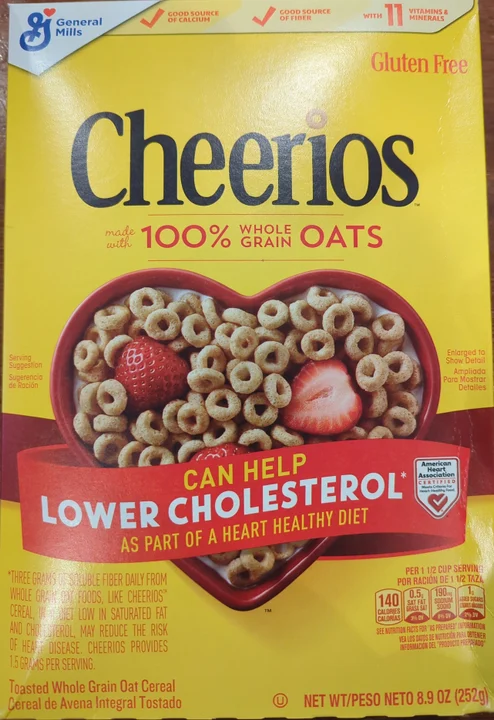 CheeriosLabeled gluten-freeWheat warning on 1 of 8 varieties we checkedGeneral Mills · checked Nov 16, 2026
 OatmealDepends on the productchecked Nov 16, 2026
 PastaContains glutenchecked Nov 16, 2026
 BreadContains glutenchecked Nov 16, 2026
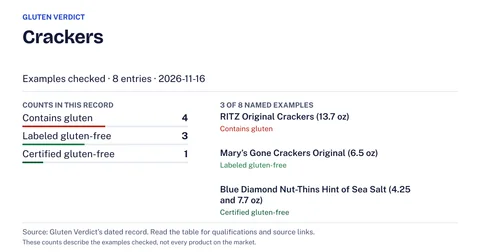 CrackersDepends on the product4 of 8 products we checked contain glutenchecked Nov 16, 2026
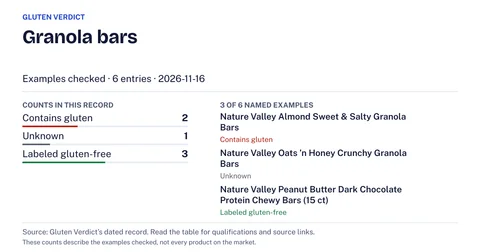 Granola barsDepends on the product2 of 6 products we checked contain gluten: Nature Valley Almond Sweet & Salty Granola Bars and Nature Valley Cinnamon Brown Sugar Soft-baked Oatmeal Squareschecked Nov 16, 2026
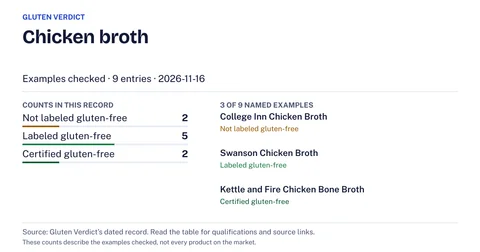 Chicken brothDepends on the productchecked Nov 16, 2026
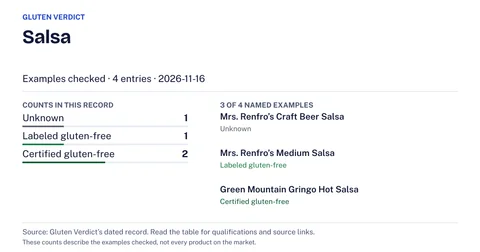 SalsaDepends on the productchecked Nov 16, 2026
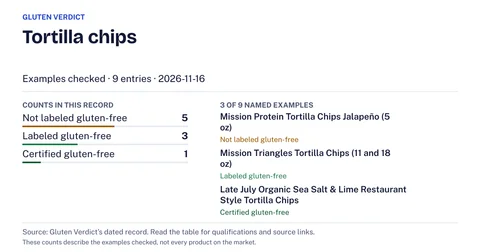 Tortilla chipsDepends on the productchecked Nov 16, 2026
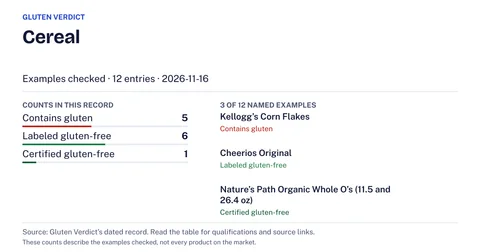 CerealDepends on the product5 of 12 products we checked contain glutenchecked Nov 16, 2026
 Soy sauceDepends on the product3 of 7 products we checked contain gluten: Kikkoman Soy Sauce (Non-GMO), 20 oz; San-J Organic Shoyu Soy Sauce; and Lee Kum Kee Premium Soy Sauce (No Preservatives Added)checked Nov 16, 2026
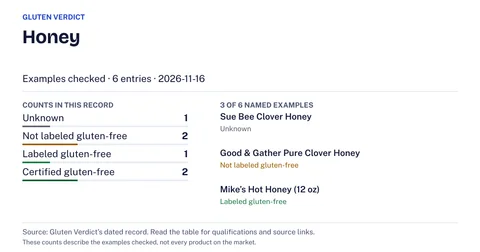 HoneyDepends on the productchecked Nov 16, 2026
Questions people ask
Does “store brand” or “private label” mean a product is certified?
No. GFCO certifies physical products that display its mark, not brands or manufacturing facilities6. Check the pack and the directory.
Is a gluten-free claim on a store brand held to the same rule as on a name brand?
For foods FDA regulates, the rule applies to any food that bears the claim: a food that bears it and fails the rule is misbranded7.
Can a store-brand pack carry a third-party logo?
Yes, if the logo’s use is truthful and not misleading. FDA does not endorse any particular certification program8.
The store’s website says gluten-free but the pack has no claim. What now?
Target, for one, defines its tag as an independent third-party certification or an on-pack statement9. Look on the pack for the mark or the statement; if you find neither, ask the store what the tag rests on.
More in Grocery shopping and meal planning
 How to check a grocery listing for gluten before you orderRead an online grocery listing for gluten in a fixed order, tell a store tag from a maker claim and a certifier mark, and re-check on reorders.
 Gluten-free grocery shopping: what to check at the shelf, the bulk bins and the checkoutOne reading order for any US supermarket pack, plus what to do about bulk bins, frozen cases, wheat starch and storage once the bags are home.
 Gluten-free grocery pickup and delivery: setting substitutions and checking swapsHow to set no-substitution choices on Instacart, Target and Whole Foods orders, check each swapped item at the door, and report a swap that fails.
 A gluten-free meal plan as a shopping template, by meal slotA weekly gluten-free shopping template: staples for each meal slot, the check each packaged item needs, and a ledger of when you last read each label.
 A starter gluten-free pantry: 30 shelf items and the label check for eachThirty shelf items for a first gluten-free pantry, tagged by the label check each needs, plus how to keep jars, toaster and colander apart at home.
 Packing a gluten-free work lunch from shelf-stable foodsWhat to pack for a gluten-free office lunch, which packaged items to label-check once, and how to use a shared fridge, microwave and toaster.
Related guides
 Certified or naturally gluten-free: when a seal mattersWhich naturally gluten-free foods are worth buying with a claim or seal: produce, grains, flours, oats and processed foods, with FDA rules and test data.
 Gluten-free certification programs compared: limit, testing and auditsHow GFCO, GFFP, NSF and the BRCGS-based marks differ on gluten limit, testing and audits, set against FDA’s 20 ppm rule for every claim.
 How to check a gluten-free seal in the certifier's own directorySearch GFCO's Product Finder by brand, product or UPC, read what an entry shows, and learn what a missing listing means for the seal on your pack.
 What to ask a food maker about gluten, and how to read the replyHow to write to a food maker about gluten: what to include, questions that get a usable answer, and how to sort the reply.
Sources
- [1, 2, 26] Gluten-Free Certification Organization, GFCO Product Finder, checked Nov 17, 2026.
- [3, 7, 16] Electronic Code of Federal Regulations, 21 CFR 101.91 Gluten-free labeling of food (text as of 2026-11-01), checked Nov 17, 2026.
- [4, 35] US Food and Drug Administration, Gluten and Food Labeling, checked Nov 17, 2026.
- [5] Gluten Intolerance Group, GIG FAQ: products judged by their ingredient list when not certified or labeled gluten-free, checked Nov 17, 2026.
- [6, 13, 33] Gluten Intolerance Group, How Does GFCO Certify Gluten-Free Food?, checked Nov 17, 2026.
- [8, 12, 15, 17, 18, 34, 36, 37, 38] US Food and Drug Administration, Questions and Answers on the Gluten-Free Food Labeling Final Rule, checked Nov 17, 2026.
- [9, 22] Target, Good & Gather Gluten Free Penne, 12 oz (product page): the Gluten Free tag definition, checked Nov 17, 2026.
- [10, 11, 43, 44] Food Chemistry (PubMed record, Sharma, Pereira and Williams), Gluten detection in foods available in the United States - a market survey, checked Nov 17, 2026.
- [14] Gluten Intolerance Group, Gluten Intolerance Group Highlights Importance of Food Label Transparency During Celiac Awareness Month (press release, May 25, 2022), checked Nov 17, 2026.
- [19, 49] Electronic Code of Federal Regulations, 21 CFR 101.5 Food; name and place of business of manufacturer, packer, or distributor (text as of 2026-11-01), checked Nov 17, 2026.
- [20, 21, 24, 25] Walmart, Great Value Food (Walmart.com brand page, FAQ): who makes Great Value, checked Nov 17, 2026.
- [23] Target, Good & Gather Quick Oats, 18 oz (product page), checked Nov 17, 2026.
Read the page on 2026-11-17: its Dietary Needs line reads “100 Percent Whole Grain”, its warning reads “MAY CONTAIN WHEAT”, and the word “gluten” appears nowhere on the page.
- [27] Gluten-Free Certification Organization, GFCO Product Finder, search “Good & Gather”, checked Nov 17, 2026.
Read on 2026-11-17: the free-text search for “Good & Gather” returns no rows; the page shows “No products found”.
- [28] Gluten-Free Certification Organization, GFCO Product Finder, search “Gather”, checked Nov 17, 2026.
Read on 2026-11-17: the free-text search for “Gather” returns one row: “Good and Gather Organic Variety Pack: Strawberry, Wildberry, Mango”, brand “Good & Gather”.
- [29] Gluten-Free Certification Organization, GFCO Product Finder, brand “Good & Gather”, checked Nov 17, 2026.
Read on 2026-11-17: the brand filter “Good & Gather” returns many rows with the brand “Good & Gather”, among them “(Frozen Cooked) Organic Basmati Rice”, “Almond Flour” and “8oz Kettle Chips”.
- [30] Gluten-Free Certification Organization, GFCO Product Finder, brand “Good and Gather”, checked Nov 17, 2026.
Read on 2026-11-17: the brand filter “Good and Gather” returns six rows with the brand “Good and Gather”, among them “Buffalo Ranch Crunchy Curls” and “Organic Veggie Straws”.
- [31] Gluten-Free Certification Organization, GFCO Product Finder, search “kirkland”, checked Nov 17, 2026.
Read on 2026-11-17: the first page of the search for “kirkland” lists rows with the brand “Kettle Brand” whose product names begin “Kirkland Signature Kettle Pink Salt”, and a row with the brand “Kirkland Signature” named “44/3.3oz Kirkland Natural”, category Popcorn.
- [32] Gluten-Free Certification Organization, GFCO Product Finder, search “Great Value”, checked Nov 17, 2026.
Read on 2026-11-17: the search for “Great Value” returns three rows: “GREAT VALUE CORN FLOUR TORT MIX 40.0 LBS” (brand Maseca), “Great Value Vanilla Crème Sandwich Cookie 10.5oz” and “Great Value Chocolate Crème Sandwich Cookie 10.5oz” (both brand Great Value).
- [39, 42] National Celiac Association, Can I eat a product that is not labeled gluten free but does not contain ingredients with gluten?, checked Nov 17, 2026.
Read on 2026-11-17: under the line “If something is not labeled GF watch out for these six words on the label:” the page lists Wheat, Rye, Barley, Malt, Brewer’s yeast and Oats.
- [40, 41] Gluten Intolerance Group, Advanced Label-Reading Tips, checked Nov 17, 2026.
- [45] Costco Wholesale, About Kirkland Signature, checked Nov 17, 2026.
Read the page on 2026-11-17: it calls Kirkland Signature Costco’s exclusive private label brand; the words “gluten” and “allergen” appear nowhere on the page.
- [46, 47] Hy-Vee, Press release, 4 November 2021: Hy-Vee launches new private brand “Good Graces” with gluten-free line, checked Nov 17, 2026.
Read the release on 2026-11-17: the words “certified” and “certification” do not appear in it, so it does not say what the gluten-free claims rest on.
- [48] Gluten-Free Certification Organization, GFCO Product Finder, brand “Good Graces”, checked Nov 17, 2026.
Read on 2026-11-17: the brand filter “Good Graces” returns rows with the brand “Good Graces”, among them “GF White Cheddar Pretzels”, “Almond Flour”, “Coconut Flour” and “Fruit & Nut Granola”.