Deli, bakery and bulk-bin counters on a gluten-free diet
Short answer
Decide each counter on its own:
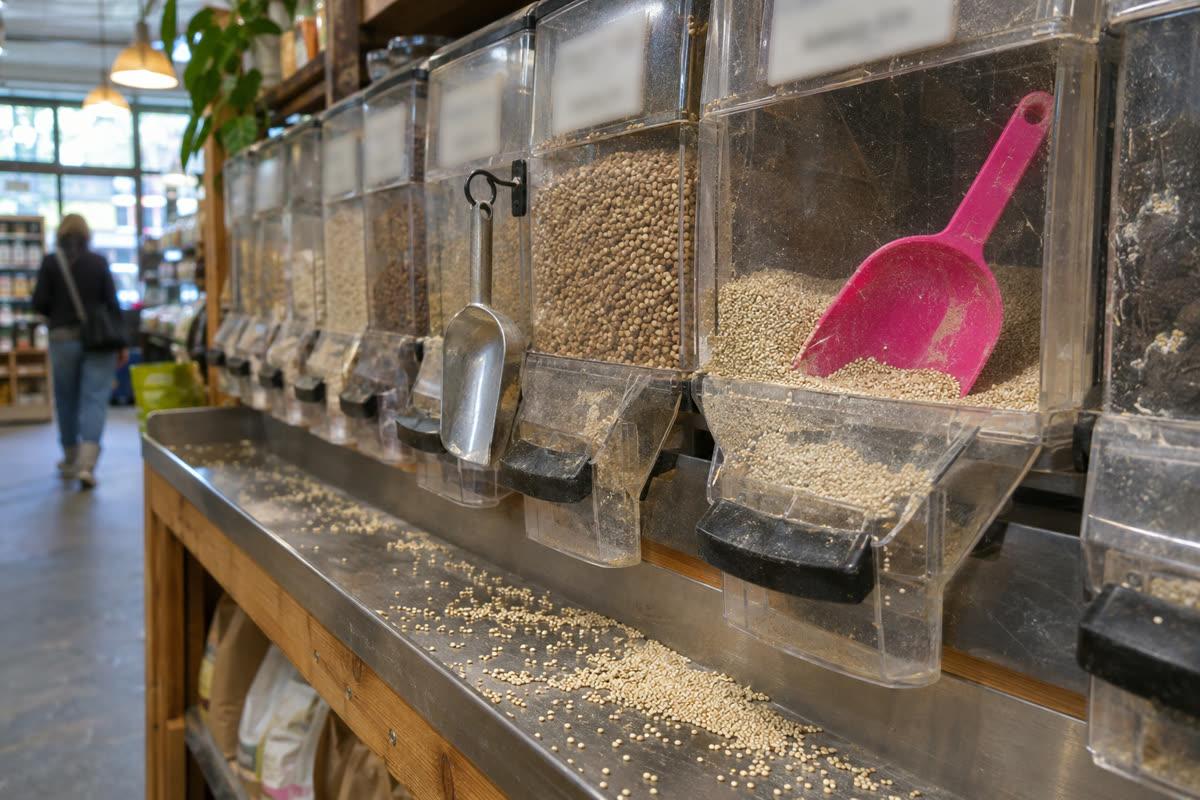
- Bulk bins: skip them. GIG advises staying clear of the bulk section1, and Whole Foods says people with food-ingredient allergies should not consume its bulk products24.
- Salad, hot and other self-serve bars: skip them. GIG says prepared foods on the deli, hot and salad bars are at risk of cross-contact from the kitchen to the bar5.
- Deli meat and cheese: ask first. NCA advises asking to see the ingredient label and for a clean slicer and new gloves13, 16; GIG suggests pre-packaged lunch meat labeled or certified gluten-free6.
- Bakery: buy the packaged item with a gluten-free claim; “made with no gluten-containing ingredients” is not that claim21.
Part of Grocery shopping and meal planning, 15 guides
Key points
- FDA says its gluten-free regulation applies to packaged foods; complaints about unpackaged foods go to state and local government partners20.
- “Made with no gluten-containing ingredients” is not a gluten-free claim21.
- GIG says sliced deli meats may contain thickeners such as wheat-derived dextrin or modified food starch, and some of these additives are derived from gluten-containing grains6.
- Natural Grocers says its bulk products are all prepackaged and not sold out of bulk bins30.
Why a counter is not a packaged food
FDA’s gluten-free rule is a rule about packaged foods. FDA says it will monitor reports about unpackaged food, such as food served in restaurants, and share any complaints with state and local government partners20.
That leaves the store’s own words and the charities’ advice. Whole Foods’ product FAQ says that, because of the possibility of cross contact with bulk products, prepared foods and baked goods, salad bars, hot bars and in-store eating venues, people with food-ingredient allergies should not consume these products24. On prepared foods, Wegmans says its stores have different layouts that make it difficult to implement companywide protocols to prevent cross-contact with gluten26.
The Gluten Intolerance Group (GIG) says prepared foods from a store’s deli, hot bar or salad bar are at risk for cross-contact from the production kitchen to the food bar5.
Deli counter: the slicer, the gloves and the packed alternative
Sliced deli meat raises two separate questions: what is in the meat, and what touched it on the way to your bag.
What is in the meat
GIG says sliced deli meats may contain thickeners such as wheat-derived dextrin or modified food starch, and that these additives are not always derived from gluten-containing grains, but some are6. The Academy of Nutrition and Dietetics also lists deli meats among foods where gluten may appear, and advises checking the label18.
GIG says deli meats are regulated by USDA and not FDA7, and FDA says USDA generally regulates the labeling of meats, poultry and certain egg products22. The National Celiac Association (NCA) says the allergen-labeling law FALCPA does not apply to foods that fall under USDA, which are not required to list the top allergens like FDA-regulated foods14. GIG’s advice is to contact the manufacturer with questions7. NCA says USDA follows FDA’s 20 ppm guideline for any food that claims to be gluten free15.
Plant-based deli slices are a separate case: GIG says meatless or vegan deli meats, pre-sliced and packaged, are often made with wheat gluten8.
What touched it
For deli meats ordered at the counter, NCA advises asking to see the ingredient label and asking staff to clean the slicer and change gloves before preparing your order13. Its cheese page gives similar advice for deli cheese: a clean slicer and surface, and new gloves16.
GIG names the machine as the concern: even if deli meats are gluten-free, deli workers may use the same slicing machines for all products. One way around that, it says, is pre-packaged lunch meat labeled or certified gluten-free6.
Our verdicts for these foods: deli meat, salami, ham, turkey and cheese.
Bakery: what “no gluten-containing ingredients” means
Whole Foods lists baked goods among the items with a possibility of cross contact24. Wegmans, on its prepared food items, says its wording “Made with No Gluten Containing Ingredients” does not mean the item is gluten-free: it means no ingredient came from wheat, rye or barley, and the item may still contain gluten because of shared preparation areas such as ovens, cutting boards, utensils, grills and fryers27.
FDA draws the same line on labels: for a statement like “made with no gluten-containing ingredients”, unless the label also bears a “gluten-free” claim, consumers should not assume the food meets all FDA requirements for the use of that claim21.
That is why the packaged swap is the usual answer here. On a packaged food FDA regulates, a gluten-free claim means less than 20 parts per million of gluten23. Start with gluten-free bread, buns and wraps on the shelf, and see our verdicts for bread, bagels and croissant.
Bulk bins: scoops, spills and the bin next door
GIG’s advice is to stay clear of the store’s bulk section, where gluten-containing ingredients could linger on scoops or surrounding bins. It adds that even a scoop sitting in the bin of a gluten-free food could carry gluten particles from a previous bin or from a gluten-containing food elsewhere in the bulk bin area1.
| Bin item | What the sources say | Our verdicts |
|---|---|---|
| Nuts | GIG: plain, packaged nuts don’t typically contain gluten, but avoid nuts from bulk bins due to possible cross-contact9. | — |
| Oats and granola | The Academy of Nutrition and Dietetics: oats are by nature gluten-free but are often contaminated with other gluten-containing grains during processing19. | oatmeal, granola |
| Rice, lentils, quinoa, couscous | GIG’s advice is about the whole bulk section1. | rice, lentils, quinoa, couscous |
| Flour | GIG’s advice is about the whole bulk section1. | flour |
What the stores’ bulk pages say is mostly nothing. Whole Foods’ Bulk Department page describes bins of grains, beans, nut butters, nuts, seeds and more, and has no sentence about gluten, allergens or cross-contact25. Sprouts’ “How to Buy in Bulk” page gives four steps, including “Scoop as much or as little as you like”, with no allergen or cross-contact wording28. Natural Grocers’ bulk standards page says its bulk products are prepackaged and not sold out of bulk bins30, and has no allergen or cross-contact wording either29. A page that is silent is not a statement that a bin is free of gluten.
What about rinsing?
GIG has a page on washing beans and grains, but it is written for ones that cannot be found certified or labeled gluten-free, and the word “bulk” does not appear on it12. For dry beans, it says washing and visually sorting for anything that is not a bean works very well10. For rice and sorghum, it says a fine sieve or colander can rinse them, with a visual sort too11. The page does not say that rinsing addresses contact in a bulk bin.
Salad bars, olive bars and hot bars
GIG says a salad bar typically puts naturally gluten-free vegetables and fruit beside croutons, crackers and some salad dressings, and that even when they are kept apart, the serving utensils might be used in both2. For prepared food on display, GIG adds spills and accidental swapping of utensils from gluten-containing foods into gluten-free ones5.
GIG’s list of places where cross-contact happens names bulk bins and salad bars; the word “olive” does not appear on it4. The reasons it gives for other bars, shared utensils and spills, are the things to look for at an olive bar. For jarred olives, see our verdict on olives.
What a store’s own statement can and cannot tell you
| Store | What the page says | What it tells you |
|---|---|---|
| Whole Foods Market | Product FAQ: possible cross contact with bulk, prepared and baked goods, salad bars and hot bars; people with food-ingredient allergies should not consume these products24. The Bulk Department page is silent on gluten25. | A written warning that covers these counters. |
| Wegmans | Stores differ in layout, so companywide protocols are hard26. “Made with No Gluten Containing Ingredients” does not mean gluten-free27. | What its prepared-food wording does and does not mean. |
| Sprouts Farmers Market | Bulk how-to page: steps only, no allergen or cross-contact wording28. | Nothing about gluten. |
| Natural Grocers | Bulk standards page: says its bulk products are prepackaged, not sold out of bulk bins30; no sentence on gluten, allergens or cross-contact29. | Nothing about gluten; the page says its bulk is prepackaged. |
A written warning tells you to skip. A statement that spells out what a counter does tells you what its wording means. A page or a clerk that says nothing about gluten has not told you the counter is free of it. We did not find or read counter statements for other chains here; our store guides for other chains: Whole Foods, Kroger, Sprouts, Hy-Vee, Meijer, Schnucks and Price Chopper.
Questions to ask at the counter
- Deli: “Can you clean the slicer and change gloves before you cut mine?” NCA advises this for deli meat and deli cheese13, 16.
- Deli: “Can I see the ingredient label?” NCA advises this for deli meat13.
- Bakery: “Is this labeled gluten-free, or only made without gluten-containing ingredients?” Wegmans’ prepared-food wording shows the two are different27.
- Bars: “Does each dish keep its own serving utensil?” Shared utensils are the risk GIG names for salad bars2.
If the answer is vague, or nobody can say what the counter does, buy the packaged version. “It should be fine” describes a hope, not a practice.
The packaged swaps that cover most of it
| At the counter | Packaged swap | What to check |
|---|---|---|
| Sliced deli meat | Pre-packaged lunch meat labeled or certified gluten-free6. | The claim; NCA says USDA follows FDA’s 20 ppm guideline for any food that claims to be gluten free15. |
| Sliced deli cheese | Packaged cheese, with its ingredient label read. | NCA, on ricotta, cottage, cream and shredded cheeses: some may have additives, so check the ingredient label17. |
| Bakery bread, bagels, pastry | Packaged bread or bakery items with a gluten-free claim. | On a packaged food FDA regulates, less than 20 ppm of gluten23. |
| Bulk nuts, grains, flour | The same food in a labeled package. | Plain, packaged nuts don’t typically contain gluten9; for oats, the Academy says they are often contaminated during processing19. |
One caveat from GIG: a “gluten-free” label should mean a food under FDA’s standard of less than 20 ppm, but nothing ensures those foods are properly tested; GFCO-certified food meets a threshold of 10 ppm or less3.
For the full shopping routine, see gluten-free grocery shopping and the gluten-free grocery list.
Verdicts in this guide
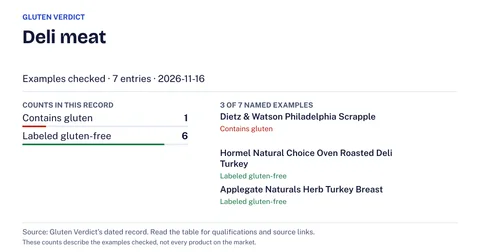 Deli meatDepends on the product1 of 7 products we checked contains gluten: Dietz & Watson Philadelphia Scrapplechecked Nov 16, 2026
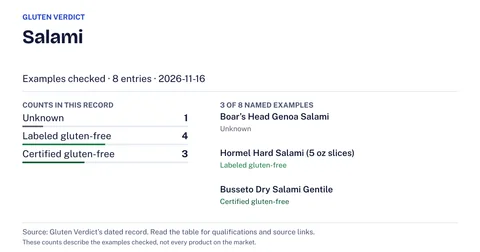 SalamiDepends on the productchecked Nov 16, 2026
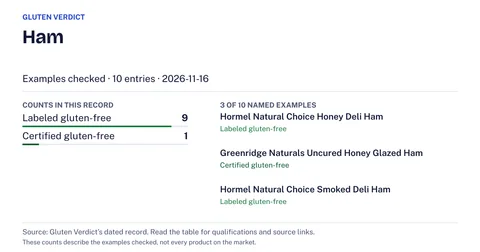 HamDepends on the productchecked Nov 16, 2026
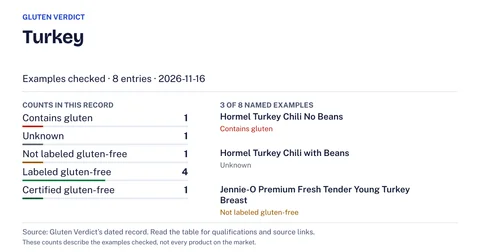 TurkeyNaturally gluten-free1 of 8 products we checked contains gluten: Hormel Turkey Chili No Beanschecked Nov 16, 2026
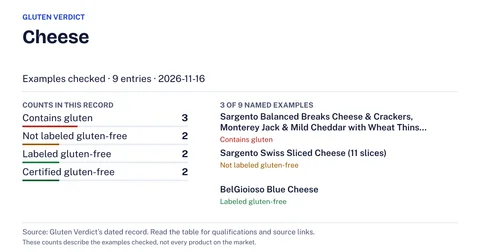 CheeseNaturally gluten-free3 of 9 products we checked contain gluten: Sargento Balanced Breaks Cheese & Crackers, Monterey Jack & Mild Cheddar with Wheat Thins Mini (6-pack); Farm Rich Mozzarella Sticks; and Farm Rich Cheddar Cheese Curdschecked Nov 16, 2026
 BreadContains glutenchecked Nov 16, 2026
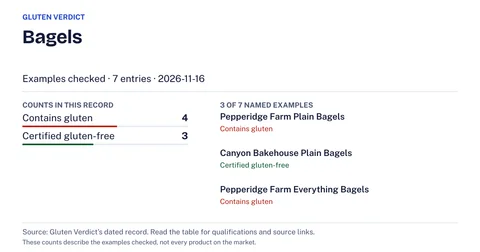 BagelsContains glutenchecked Nov 16, 2026
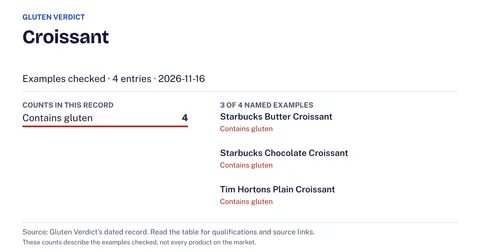 CroissantContains glutenchecked Nov 16, 2026
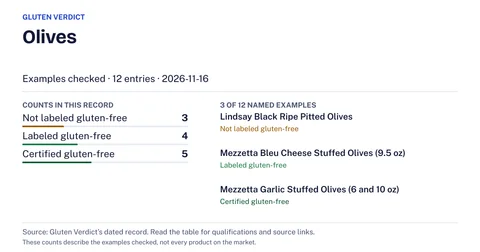 OlivesNaturally gluten-freechecked Nov 16, 2026
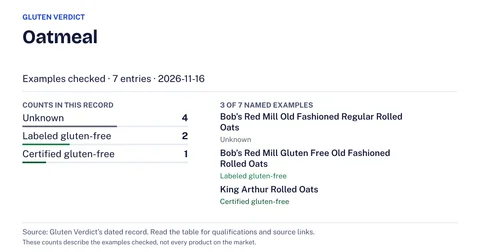 OatmealDepends on the productchecked Nov 16, 2026
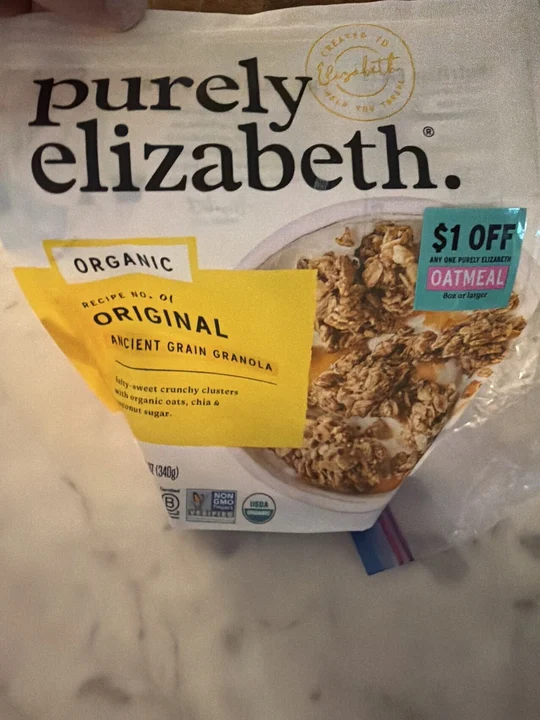 GranolaDepends on the product1 of 6 products we checked contains gluten: Honey Bunches of Oats Honey Roasted Granolachecked Nov 16, 2026
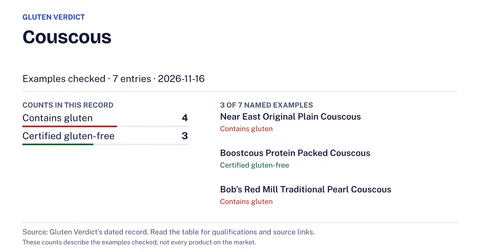 CouscousContains glutenchecked Nov 16, 2026
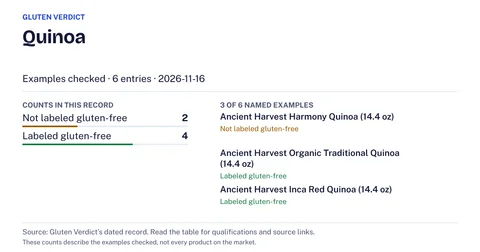 QuinoaNaturally gluten-freeBuy it labeled gluten-freechecked Nov 16, 2026
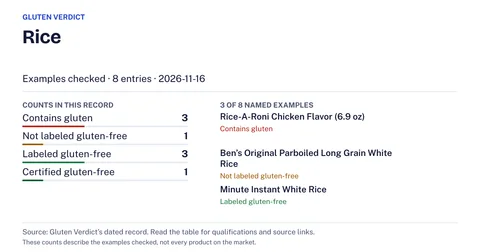 RiceNaturally gluten-free3 of 8 products we checked contain gluten: Rice-A-Roni Chicken Flavor (6.9 oz), Near East Original Rice Pilaf, and Ben’s Original Ready Rice Rice PilafBuy it labeled gluten-freechecked Nov 16, 2026
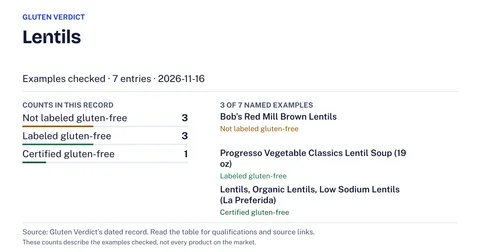 LentilsDepends on the productchecked Nov 16, 2026
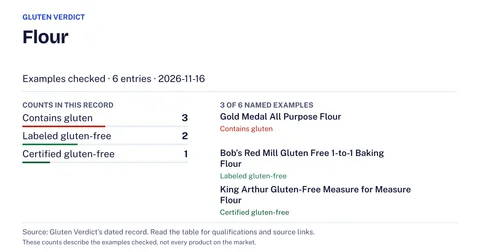 FlourContains glutenchecked Nov 16, 2026
Questions people ask
Is the deli counter ever an option?
On its meat and cheese pages, NCA advises asking to see the ingredient label and asking staff to clean the slicer and change gloves13. GIG names the shared slicing machine as the concern and suggests pre-packaged lunch meat labeled or certified gluten-free6.
If the scoop sits in a gluten-free bin, is it fine?
GIG says even a scoop in the bin of a gluten-free food could contain gluten particles from a previous bin or from a gluten-containing food elsewhere in the bulk bin area1.
Does “made with no gluten-containing ingredients” mean gluten-free?
Not by itself. FDA says that unless the label also bears a “gluten-free” claim, consumers should not assume the food meets all FDA requirements for the use of that claim21. Wegmans says its version of the wording means no ingredient came from wheat, rye or barley, and the item may still contain gluten from shared preparation areas27.
Does FDA’s gluten-free rule cover unpackaged food at a counter?
FDA says its regulation applies to packaged foods, and that it shares complaints about unpackaged foods with state and local government partners20.
More in Grocery shopping and meal planning
 Gluten-free grocery shopping: what to check at the shelf, the bulk bins and the checkoutOne reading order for any US supermarket pack, plus what to do about bulk bins, frozen cases, wheat starch and storage once the bags are home.
 A gluten-free grocery list by aisle for US supermarketsAn aisle-by-aisle gluten-free grocery list for US stores: what needs no label, what needs a check, and what stays off the list.
 Gluten-free bread, buns and wraps: what the package tells youHow to tell a gluten-free bread, bun or wrap from a wheat look-alike: certification mark, maker’s claim or ingredient list, in a fixed order.
 Gluten-free at the farmers market and in a CSA box: what to ask each producerWhich farmers market stalls and CSA add-ons need no label, which need questions, and the order to ask them, with what state cottage food rules cover.
 A gluten-free meal plan as a shopping template, by meal slotA weekly gluten-free shopping template: staples for each meal slot, the check each packaged item needs, and a ledger of when you last read each label.
 Freezing gluten-free food: what holds up, how to thaw it and how to keep it apartHow to freeze, label and thaw gluten-free food, which foods lose texture, and how to keep gluten-free packages apart in a shared freezer.
Related guides
 Gluten in sausage, hot dogs and deli meat: fillers, binders and flavoringsHow to read sausage, hot dog, deli meat and jerky labels for wheat, malt, starch and soy sauce, and which USDA label rules apply to meat.
 Gluten cross-contact at home: where it happens and what to do about itHow gluten reaches gluten-free food at home, whether to separate, wash or ask for each route, and which rules have lab data behind them.
 Whole Foods and gluten: 365 labels, the hot bar, bulk bins and the countersRead a Whole Foods 365 gluten-free claim against FDA’s rule, and see what the store itself states about bulk bins, the hot bar and counters.
 Questions to ask your grocery store manager about glutenA short list of questions for the store manager or counter lead when your grocery chain publishes no gluten page, and how to record and weigh the answers.
Sources
- [1, 2, 3, 4] Gluten Intolerance Group, 25 Ways Cross-Contact Could Happen: the bulk bins, checked Nov 17, 2026.
Read on 2026-11-17: the page names bulk bins and salad bars (and other buffet-style displays) in its list of places where cross-contact can happen; the word “olive” does not appear on it.
- [5] Gluten Intolerance Group, 7 Tips for Avoiding Gluten Cross-Contact at Home: the grocery store paragraphs, checked Nov 17, 2026.
- [6, 7, 8, 9] Gluten Intolerance Group, 38 Foods Where Gluten May Be Hidden: sliced deli meats, checked Nov 17, 2026.
- [10, 11, 12] Gluten Intolerance Group, Washing beans and grains that are not labeled gluten-free: dry beans, checked Nov 17, 2026.
Read on 2026-11-17: the page is written for beans and grains that cannot be found certified or labeled gluten-free at the store; the word “bulk” does not appear on it.
- [13, 14, 15] National Celiac Association, Gluten-free meats (Q&A): the deli counter, checked Nov 17, 2026.
- [16, 17] National Celiac Association, Cheese and celiac disease (Q&A): the deli counter, checked Nov 17, 2026.
- [18, 19] Academy of Nutrition and Dietetics, The Gluten-Free Diet: Building the Grocery List: deli meats, checked Nov 17, 2026.
- [20, 21, 22] US Food and Drug Administration, Questions and Answers on the Gluten-Free Food Labeling Final Rule: unpackaged foods, checked Nov 17, 2026.
- [23] US Food and Drug Administration, Gluten and Food Labeling, checked Nov 17, 2026.
- [24] Whole Foods Market, Product Information FAQ: allergen labeling policy in the U.S. and Canada, checked Nov 17, 2026.
- [25] Whole Foods Market, Bulk Department, checked Nov 17, 2026.
Read on 2026-11-17: the page describes its bins as holding “grains, beans, nut butters, nuts, seeds and more”; the words “gluten”, “allergen” and “cross” do not appear on it.
- [26, 27] Wegmans, Gluten Free FAQs: prepared foods (layouts), checked Nov 17, 2026.
- [28] Sprouts Farmers Market, How to Buy in Bulk, checked Nov 17, 2026.
Read on 2026-11-17: the page gives four steps for in-store bulk shopping (“Grab a bag and a tag”, “Find your favorite item”, “Scoop as much or as little as you like”, “Write PLU on tag”); the words “allergen” and “cross” do not appear on it, and “gluten” appears only in the site’s shop menu.
- [29, 30] Natural Grocers, Bulk Product Standards, checked Nov 17, 2026.
Read on 2026-11-17: the page headed “Bulk Product Standards” has no sentence about gluten, allergens or cross-contact; the words “allergen” and “cross” do not appear on it, and “gluten” appears only in the address of a link to a Thanksgiving menu.