Gluten-free breakfast: what to check on the label and in your kitchen
Short answer
Sort the breakfast table into three groups and treat each differently:
- Gluten-free by nature: plain eggs, fresh fruit and plain potatoes, as long as nothing is added to them1, 2, 3.
- Needs a label check: oats, cereal, granola and bars, bread, mixes, flavored yogurt and protein powder. Look for a gluten-free claim, which on FDA-regulated packaged foods has to meet FDA’s definition, including less than 20 parts per million for any unavoidable gluten4, or read the maker’s own page.
- Needs a kitchen change: the toaster and shared spreads. Use a separate toaster or toaster bags, and keep utensils from gluten-containing food out of the butter, jam and peanut butter5, 6, 7, 14.
Part of Grains, flours and substitutes, 13 guides
Key points
- A “gluten-free” claim is voluntary, so no claim on a food that is gluten-free by nature is not a warning; on a processed item it is the first thing to look for8, 1.
- The Celiac Disease Foundation advises oats with a gluten-free label: oats are often grown and processed alongside wheat, barley and rye9, 10.
- Cereal, granola and bars are common traps: malt flavoring, regular oats and wheat ingredients appear on the Celiac Disease Foundation’s lists11, 12.
- FDA’s gluten-free rule does not apply to foods whose labeling USDA regulates, which generally includes meats and poultry13.
- The toaster and shared spreads can undo a gluten-free breakfast; toaster bags, a separate toaster and clean utensils are the charities’ answers6, 14, 15.
What is gluten-free by nature at breakfast
FDA says foods that are by nature free of gluten, such as fresh fruits and vegetables, may go without a “gluten-free” label even though they fit a gluten-free diet1. NIDDK lists meat, fish, fruits, vegetables, rice and potatoes as naturally gluten-free when they come without additives or some seasonings2. At the breakfast table that covers plain fresh fruit and plain potatoes.
Eggs are on the same footing: the Celiac Disease Foundation says that on their own, eggs are naturally gluten-free, but some restaurants put pancake batter in scrambled eggs and omelets3. The catch for each of these foods is what is added, not the food:
| Item | What to check | Our verdict |
|---|---|---|
| Eggs | Restaurant scrambles and omelets can contain pancake batter3. | Eggs |
| Bacon and breakfast meats | FDA’s gluten-free rule does not apply to foods whose labeling USDA regulates, which generally includes meats13. Read flavored and seasoned products. | Bacon |
| Hash browns | Potatoes alone fit NIDDK’s list2; frozen and restaurant versions differ, so we compare them. | Hash browns |
| Grits | Read the ingredient list on flavored packets; our verdict covers the grits we checked. | Grits |
The label check for every packaged item
Use the same four steps on each packaged item before it goes on the table:
- Look for a “gluten-free” claim. On an FDA-regulated packaged food it means the food is inherently gluten free or has no gluten-grain ingredient (unless that ingredient was processed to remove gluten and the food stays under the limit), and any unavoidable gluten is less than 20 parts per million (ppm)4. “Free of gluten”, “without gluten” and “no gluten” have to meet the same requirements16.
- If there is no claim, read the whole ingredient list. The Celiac Disease Foundation says to read the label of any food you buy when “gluten-free” is not specified17. NIDDK names baked goods, baking mixes, breads and cereals among foods made with gluten grains18, and says colorings, flavorings, starches and thickeners can be made from them19.
- Do not take “wheat-free” or “made with no gluten-containing ingredients” as the claim. A wheat-free product can still contain spelt, rye or barley20, and FDA says a food with the “no gluten-containing ingredients” wording and no gluten-free claim should not be assumed to meet its rule21.
- If the label leaves you unsure, NIDDK’s advice is not to eat the food and, if possible, to contact the maker or read its website22.
The claim is voluntary8, so no claim on a food that is gluten-free by nature is not a warning by itself1. For a naturally gluten-free food with a higher risk of cross-contact, such as products made from grains, legumes and seeds, FDA says a claim on the label gives the reader the expectation that any gluten present is under 20 ppm23. Advisory lines such as “may contain wheat” have their own page: may-contain wheat labels.
Oats and hot cereal
Oats do not contain gluten themselves, but the Celiac Disease Foundation says they are often grown, processed and transported alongside wheat, barley and rye9. The foundation advises picking oat products that bear a gluten-free label10, and NIDDK says that if you eat oats, make sure they are gluten-free24.
FDA does not require oats to be certified to carry the claim, but oats labeled gluten-free must contain less than 20 ppm gluten25. Certification is separate from the claim: Gluten Intolerance Group says its GFCO program requires 10 ppm or less, against FDA’s less than 20 ppm26.
For packaged oatmeal, our oatmeal verdict shows which makers sell oats labeled gluten-free and which regular oats show no claim, and the Quaker Instant Oatmeal verdict shows a flavored packet with no gluten-free claim found.
Whether to eat gluten-free oats at all is a medical decision. The Celiac Disease Foundation says it should be made with input from your doctor and dietitian27. Our guide to sorted and purity-protocol oat labels goes further on the label.
Cereal, granola and bars
The Celiac Disease Foundation’s list of common gluten sources points at three breakfast traps: corn flakes and rice puffs often contain malt extract or flavoring, and granola is often made with regular oats, not gluten-free oats11. The foundation’s list of gluten-containing grains and their derivatives also names malt in various forms28. For energy and granola bars, the foundation says some contain wheat as an ingredient and most use oats that are not gluten-free12.
So a plain-looking box needs the whole ingredient list and, for anything with oats, a look for the gluten-free claim. Our cereal label check walks the cereal aisle; the cereal, granola and granola bars verdicts show brands we read.
Bread, bagels, English muffins and toaster pastries
The Celiac Disease Foundation lists bagels and muffins among breads and pastries that contain gluten, and pancakes, waffles, french toast, crepes and biscuits among breakfast foods that do29. A gluten-free version is a separate product that says so: Canyon Bakehouse’s page for its English muffins, for example, says “Certified Gluten-Free”30.
Our verdicts for bagels, English muffins and Pop-Tarts show what we read for each; for Pop-Tarts, the five varieties we checked all list wheat flour. See also bread. Once the item is chosen, the toaster is the next check (below).
Yogurt and add-ins
FDA’s 2020 final rule on compliance methods for fermented, hydrolyzed and distilled foods labeled gluten-free names yogurt among the foods it covers31. Makers speak for their own lines: Yoplait’s FAQ says its Yoplait Original and Yoplait Enjoy ZERO yogurt products are gluten free32.
What varies is the flavor and the add-in. NIDDK says flavorings, starches and thickeners can be made from grains that contain gluten19, so a flavored yogurt’s list is the thing to read. Our yogurt verdict found no gluten ingredient on the plain yogurts we checked, while cookie mix-in cups such as Chobani Flip declare wheat. Granola and cereal toppings carry the oat and malt risks above.
Pancake and waffle mixes
NIDDK names baking mixes among foods that contain ingredients made from gluten grains18, so read the box. Betty Crocker sells its gluten-free version as its own product: the page for Bisquick Gluten Free Pancake & Baking Mix lists Bisquick Original as a separate product33, which is why the exact box in your hand matters.
Our pancakes, waffles and Bisquick verdicts show which mixes and frozen waffles we read list wheat and which carry a gluten-free claim. A mix with a claim still has to meet the less-than-20-ppm limit4.
Protein powder and shakes
FDA’s gluten-free rule applies to FDA-regulated packaged foods, including dietary supplements34, so a protein powder sold as an FDA-regulated packaged food or supplement and carrying a gluten-free claim would fall under the same rule. The Celiac Disease Foundation’s list of items to verify by reading the label or checking with the manufacturer includes supplements, though it does not name protein powder35.
Our protein powder verdict reports what we read on eight products: six say gluten-free on the maker’s page and two list no wheat, barley, rye, malt or oats but make no claim. Each product’s own page decides, and so does the flavor: a cookie or granola flavor adds the same ingredients as the foods above.
The home kitchen: toaster, spreads and griddle
The toaster
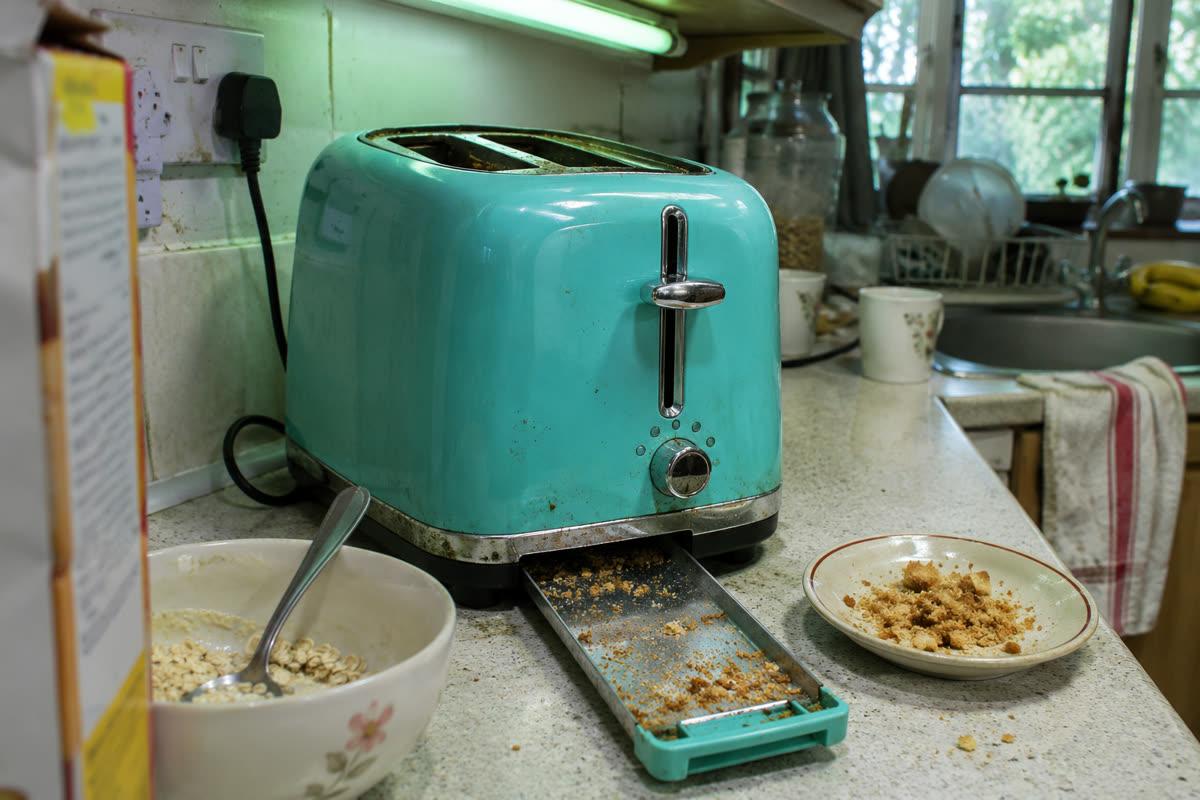
Gluten Intolerance Group says toasters are virtually impossible to thoroughly clean, which is a problem in a shared household or when traveling5. The Celiac Disease Foundation lists toasters used for both gluten-free and regular bread among the places cross-contact happens36. GIG’s alternative to a second toaster is a toaster bag, a barrier between the item and the toaster that works for breads, bagels, waffles and more6. Coeliac UK, the UK charity, gives the same two options: toaster bags or a separate toaster14.
A waffle iron is the same problem with grooves. GIG says unless the plates come out and can go in the dishwasher, you may need to buy another for your gluten-free breakfasts37.
Butter, jam and peanut butter
The Celiac Disease Foundation says condiments such as butter, peanut butter and jam may become contaminated when a utensil used on gluten-containing food is double-dipped7. GIG advises avoiding double-dipping from a reusable jar38, buying a second jar of items like peanut butter and jam in a shared kitchen39, or using squeeze bottles40. Coeliac UK suggests separate condiments or, at least, clean cutlery for shared butters, jams and spreads15. Our butter and peanut butter verdicts cover the products; the utensil is the route the Celiac Disease Foundation names7.
Pan, griddle and board
Coeliac UK says to wipe down surfaces and clean pots, pans and utensils with hot soapy water41, and that standard washing up liquid or a dishwasher will remove gluten42. It also suggests separate bread boards for gluten-free and gluten-containing bread43. For storage, GIG recommends a gluten-free area in the refrigerator or pantry, preferably on a top shelf so crumbs and dust from gluten foods do not fall onto it44.
More on setting up a shared kitchen: gluten-free kitchen setup and cross-contact.
Breakfast out: restaurants and buffets
FDA’s gluten-free rule applies to packaged foods; for restaurants, FDA recommends that a “gluten-free” claim on a menu be consistent with its definition45. A claim on a menu is a statement worth asking the kitchen about.
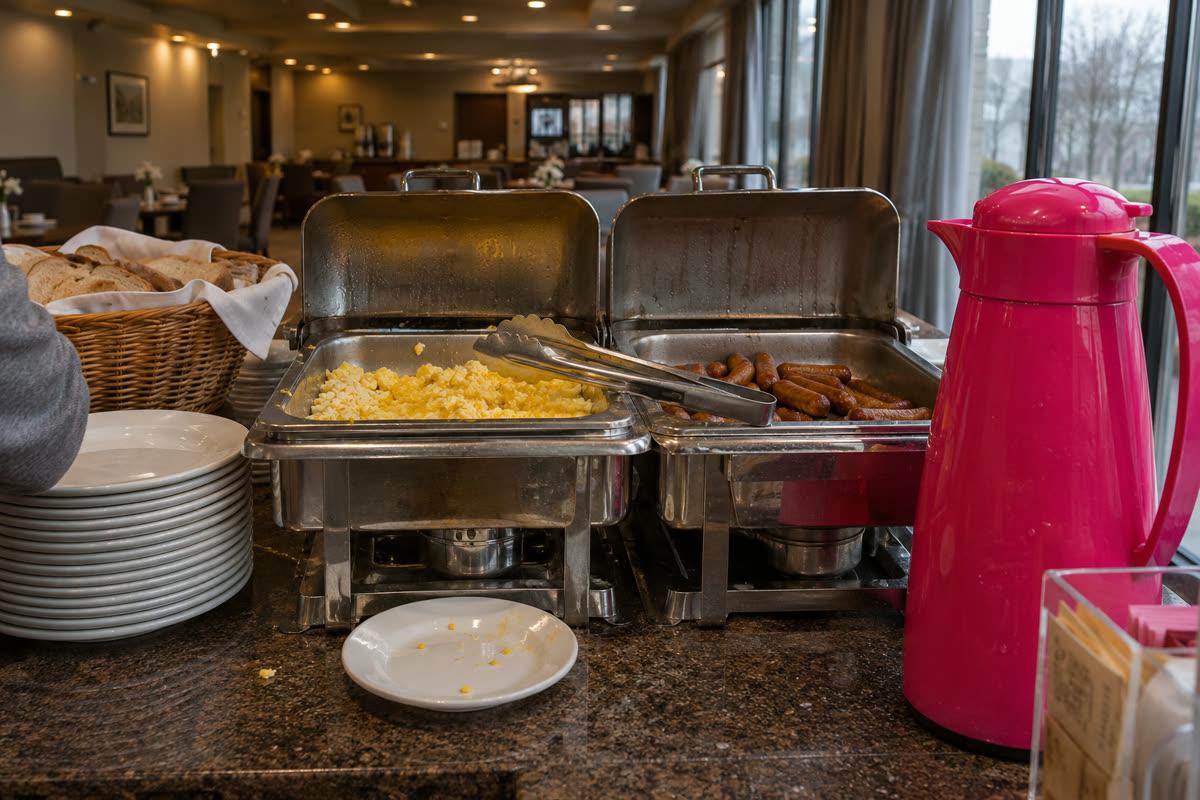
NIDDK’s advice for people with celiac disease at a restaurant is to tell the server and ask about ingredients, how the food is prepared and whether a gluten-free menu is available46. For self-serve bars, GIG says prepared foods from a deli, hot bar or salad bar are at risk of cross-contact from the production kitchen to the food bar47; that passage is about a store’s food bars, so at a hotel buffet ask staff how the dishes are kept apart. Scrambled eggs and omelets are worth a direct question about batter3.
Chain-by-chain notes are in breakfast restaurant chains; the restaurants section lists the chains we have read.
Verdicts in this guide
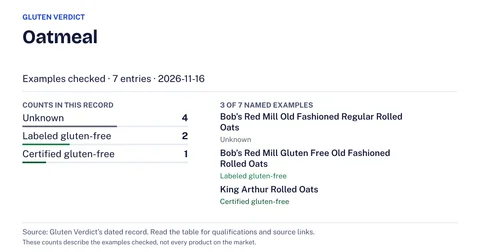 OatmealDepends on the productchecked Nov 16, 2026
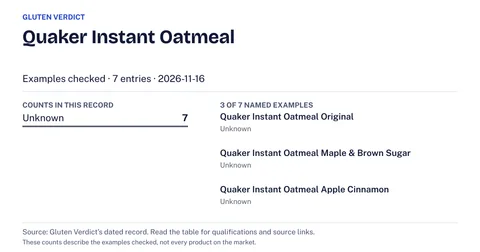 Quaker Instant OatmealUnknownThe Quaker Oats Company · checked Nov 16, 2026
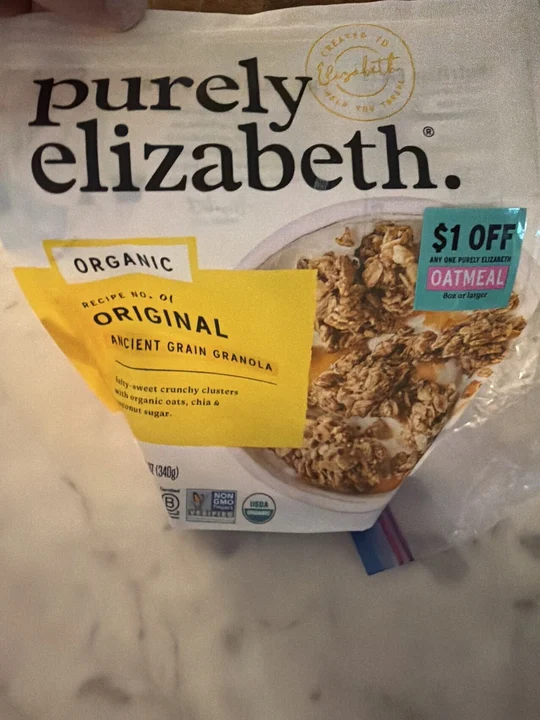 GranolaDepends on the product1 of 6 products we checked contains gluten: Honey Bunches of Oats Honey Roasted Granolachecked Nov 16, 2026
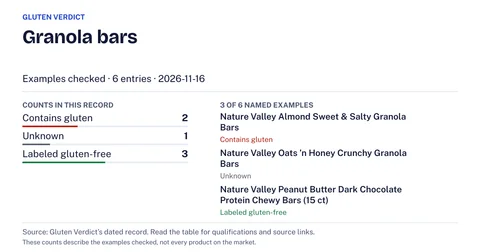 Granola barsDepends on the product2 of 6 products we checked contain gluten: Nature Valley Almond Sweet & Salty Granola Bars and Nature Valley Cinnamon Brown Sugar Soft-baked Oatmeal Squareschecked Nov 16, 2026
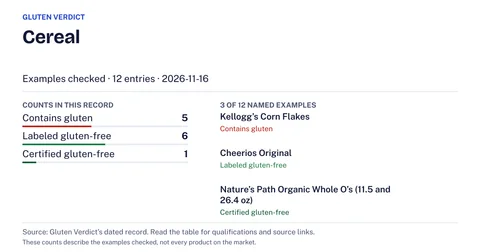 CerealDepends on the product5 of 12 products we checked contain glutenchecked Nov 16, 2026
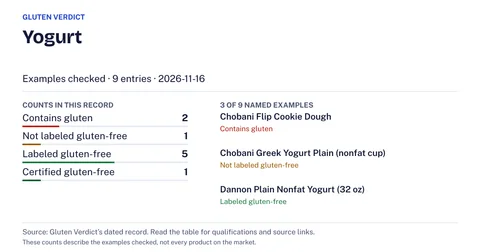 YogurtDepends on the product2 of 9 products we checked contain gluten: Chobani Flip Cookie Dough and Chobani Flip Cookies & Creamchecked Nov 16, 2026
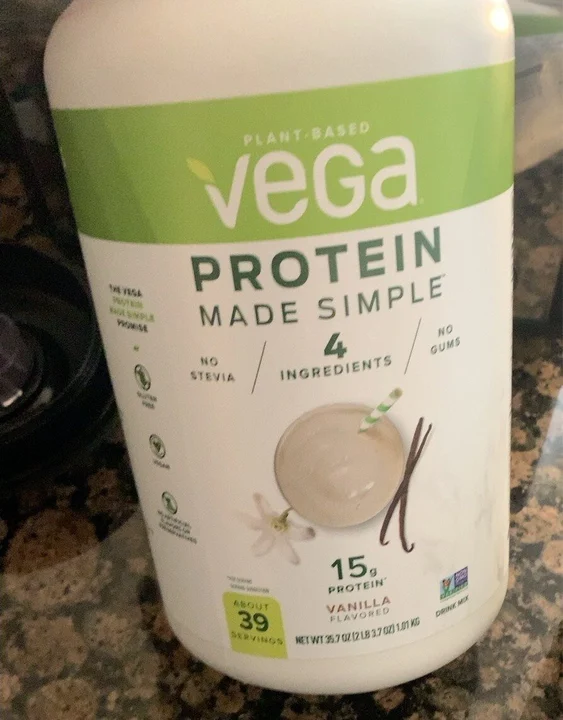 Protein powderDepends on the productchecked Nov 16, 2026
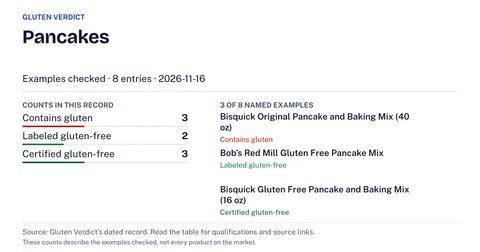 PancakesContains glutenchecked Nov 16, 2026
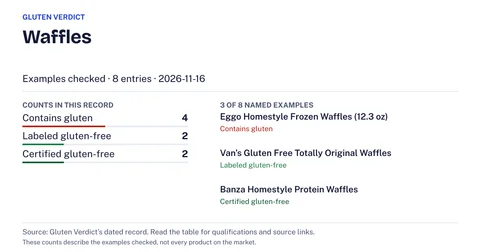 WafflesContains glutenchecked Nov 16, 2026
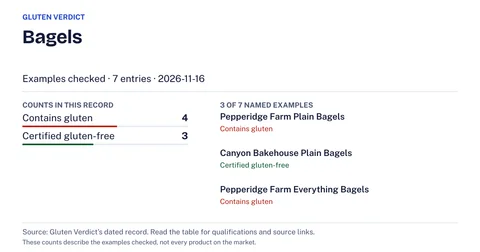 BagelsContains glutenchecked Nov 16, 2026
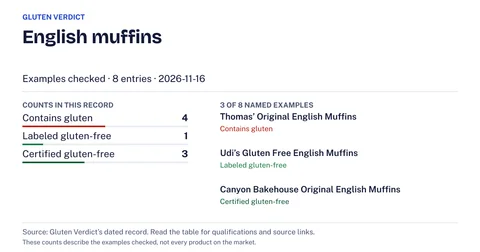 English muffinsDepends on the product4 of 8 products we checked contain glutenchecked Nov 16, 2026
 BreadContains glutenchecked Nov 16, 2026
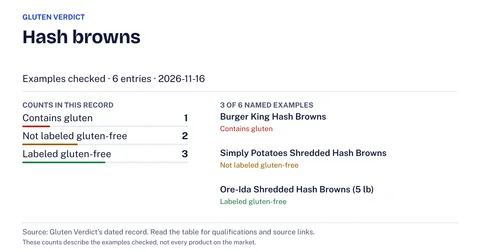 Hash brownsDepends on the product1 of 6 products we checked contains gluten: Burger King Hash Brownschecked Nov 16, 2026
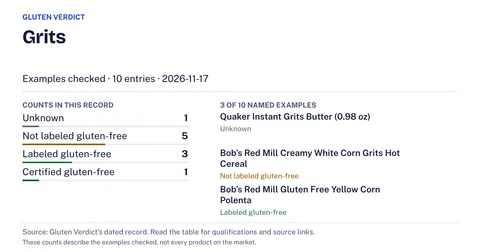 GritsNaturally gluten-freeBuy it labeled gluten-freechecked Nov 17, 2026
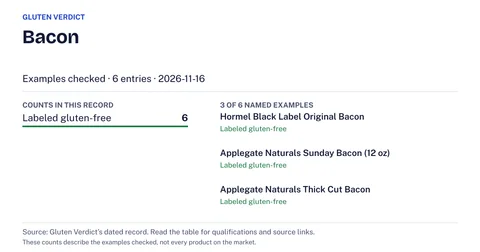 BaconDepends on the productchecked Nov 16, 2026
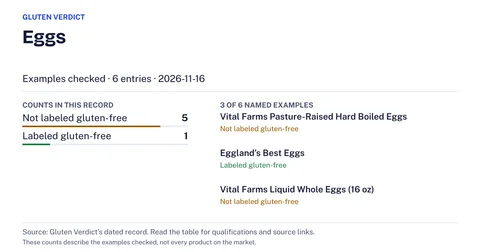 EggsNaturally gluten-freechecked Nov 16, 2026
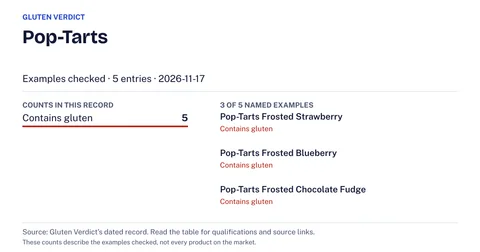 Pop-TartsContains glutenKellogg’s · checked Nov 17, 2026
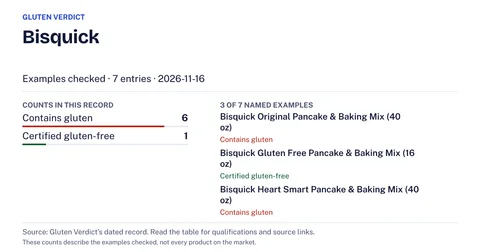 BisquickContains glutenGeneral Mills (Betty Crocker) · checked Nov 16, 2026
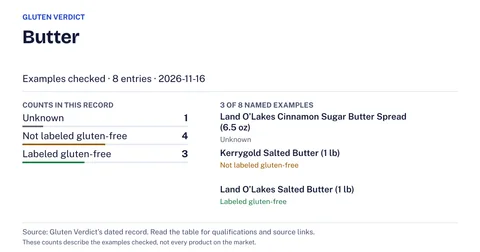 ButterNaturally gluten-freechecked Nov 16, 2026
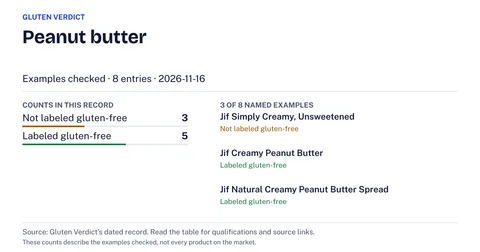 Peanut butterDepends on the productchecked Nov 16, 2026
Questions people ask
Do I need a separate toaster for gluten-free bread?
Gluten Intolerance Group says toasters are virtually impossible to thoroughly clean5 and suggests toaster bags as another option6. Coeliac UK suggests toaster bags or a separate toaster14.
Is oatmeal gluten-free?
It depends on the oats. The Celiac Disease Foundation says oats are often grown and processed alongside wheat, barley and rye9, and advises choosing oat products with a gluten-free label10. FDA does not require certification, but labeled oats must contain less than 20 ppm25.
Are eggs gluten-free?
On their own, yes, according to the Celiac Disease Foundation, but some restaurants add pancake batter to scrambled eggs and omelets3.
Does wheat-free mean gluten-free?
No. A product labeled wheat-free can still contain spelt, rye or barley20.
Does protein powder fall under the gluten-free labeling rule?
FDA says its rule applies to FDA-regulated packaged foods, including dietary supplements34.
More in Grains, flours and substitutes
 Gluten-free substitutes: the swap for each wheat ingredient and the label check it needsA lookup table of gluten-free swaps for wheat flour, pasta, bread, soy sauce, beer and more, with the one label check each swap needs.
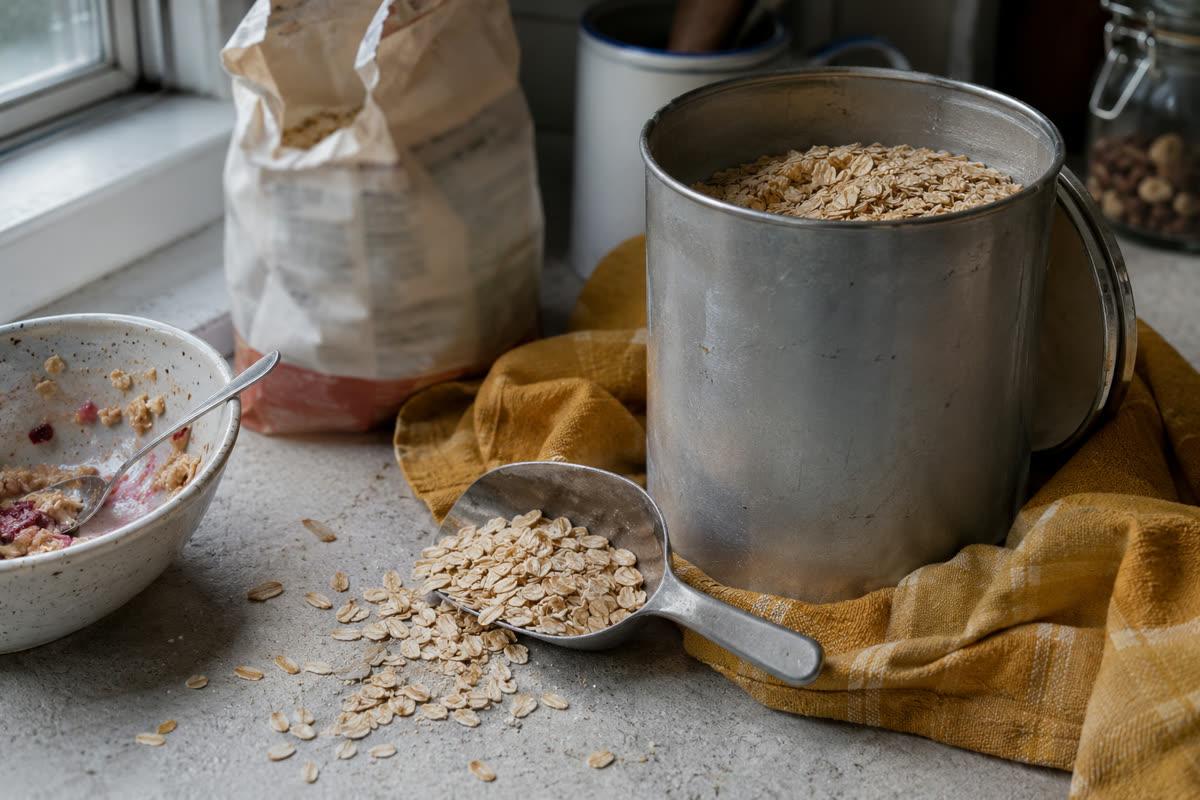 Oats and celiac disease: what a gluten-free oat label does and does not tell youWhat FDA’s rule covers for oats, how makers get oats to the gluten-free limit, what avenin studies found, and what to ask your doctor.
 Mechanically sorted or purity-protocol oats: what the makers' own pages sayTwo routes lead to a gluten-free oat label. See how to sort a pack by the maker's own words, which pages say what, and what they leave out.
 Gluten-free cereal: how to check a cereal boxCheck a cereal box in order: the gluten-free claim, malt and wheat in the ingredient list, the oats, then the maker’s own page for that flavour.
 Millet, sorghum, quinoa, buckwheat, teff, amaranth and wild rice: what the bag has to sayWhich grains and seeds are gluten-free plants, what makers and certifiers say about seven of them, and the cross-contact checks for bags, bins and blends.
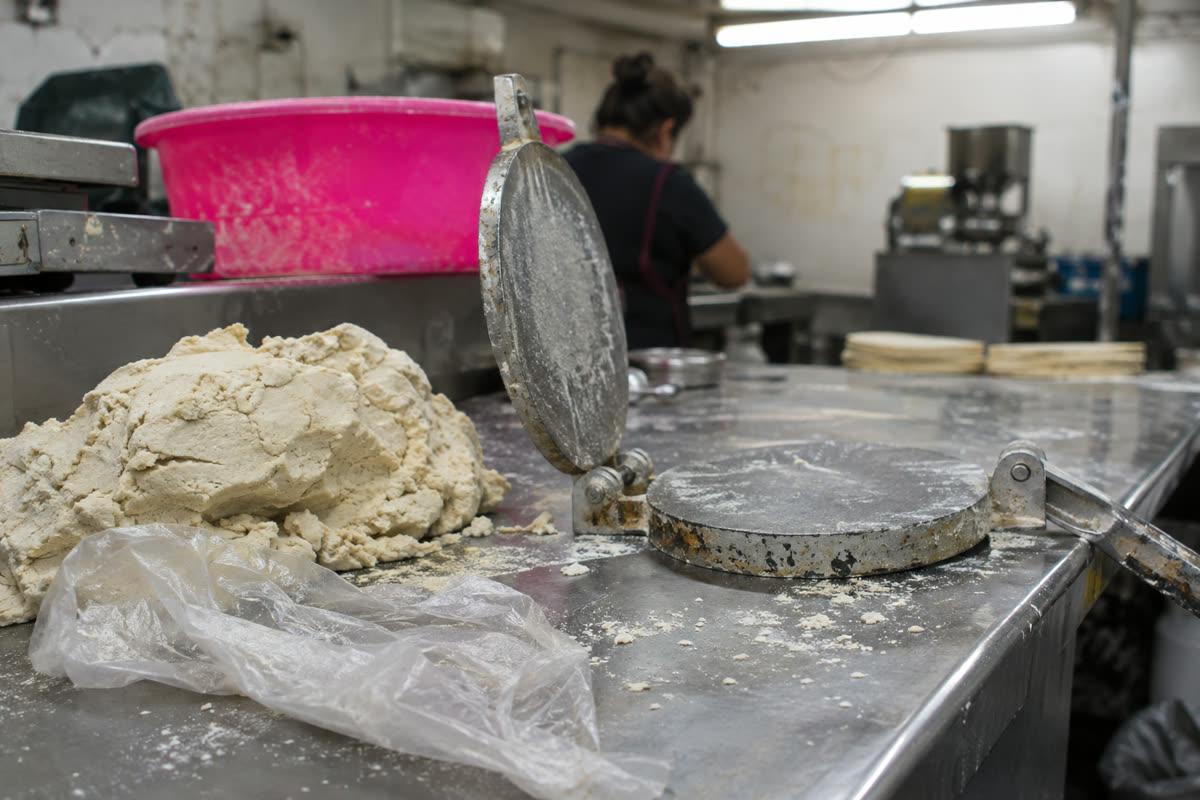 Cornmeal, grits, polenta and masa: where gluten can get inCorn is gluten-free, but mixes, blends and shared mills are not always. How to read cornmeal, grits, polenta, masa and cornbread labels for wheat.
Related guides
 Gluten-free snack bars: reading oats and barley malt on the wrapperRead a snack-bar wrapper in four steps (gluten-free claim, malt, oats, Contains line), with a Clif and a KIND bar worked through.
 What “may contain wheat” and “made in a facility with wheat” mean on a US labelHow to read “may contain wheat”, shared-facility and shared-equipment lines on US labels, with and without a gluten-free claim, and what to check next.
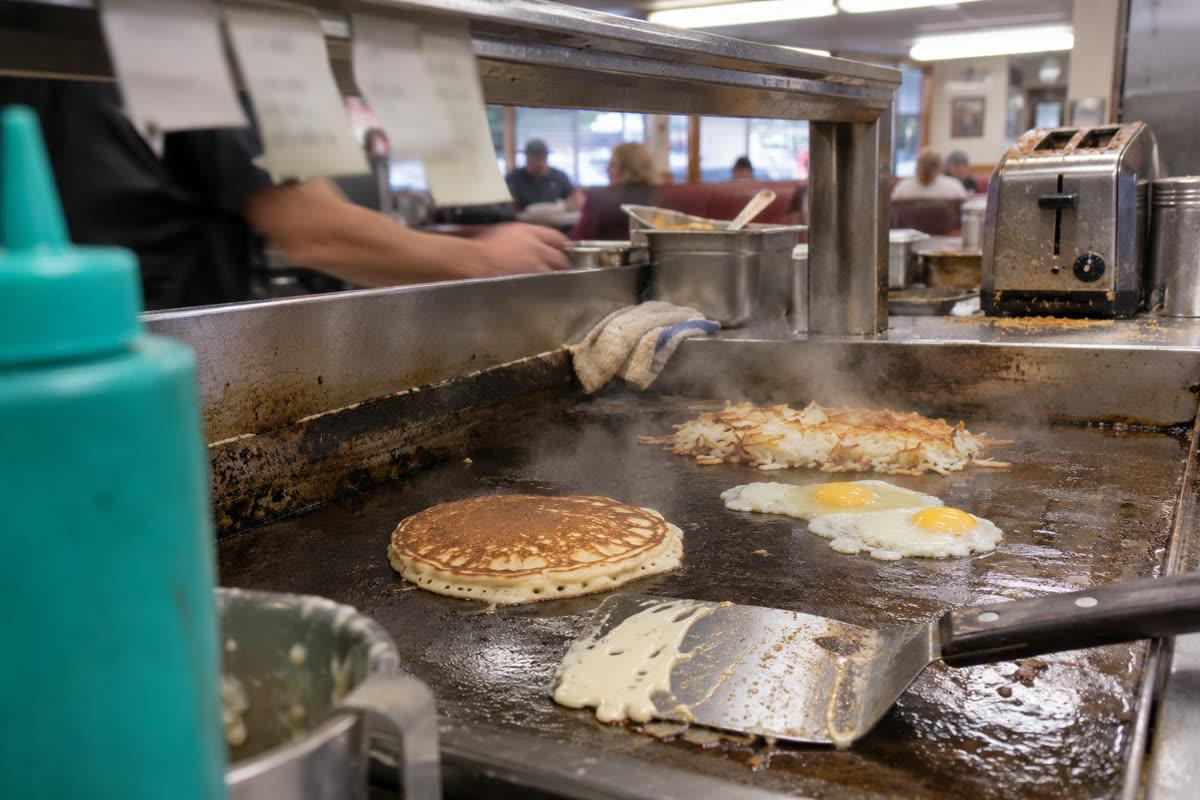 Gluten-free breakfast at restaurant chains: griddles, toasters and batterWhat IHOP, Panera and Tim Hortons say about shared griddles, toasters and fryers, and three questions to ask before you order breakfast out.
 Gluten-free hotel breakfast: what to email ahead and what to ask at the buffetA hotel breakfast buffet can mean shared utensils, toasters and waffle irons. What to write the hotel before you arrive, and what to ask at each station.
Sources
- [1, 4, 8, 13, 16, 21, 23, 25, 31, 34, 45] US Food and Drug Administration, Questions and Answers on the Gluten-Free Food Labeling Final Rule, checked Nov 17, 2026.
- [2, 18, 19, 22, 24, 46] National Institute of Diabetes and Digestive and Kidney Diseases, Eating, Diet, & Nutrition for Celiac Disease, checked Nov 17, 2026.
- [3, 7, 11, 12, 17, 20, 28, 29, 35, 36] Celiac Disease Foundation, Sources of Gluten, checked Nov 17, 2026.
Read on 2026-11-17: under “Common Foods That Contain Gluten”, the list headed “Breads and Pastries” names croissants, pita, naan, bagels, flatbreads, cornbread, potato bread, muffins, donuts and rolls, and the list headed “Breakfast Foods” names pancakes, waffles, french toast, crepes, and biscuits.
Read on 2026-11-17: the list headed “Other Items That Must Be Verified By Reading The Label Or Checking With The Manufacturer” names, among other things, “Herbal or nutritional supplements” and “Vitamins and supplements”; it does not name protein powder.
- [5, 6, 38, 39, 40, 44, 47] Gluten Intolerance Group, 7 Tips for Avoiding Gluten Cross-Contact at Home, checked Nov 17, 2026.
- [9, 10, 27] Celiac Disease Foundation, Gluten-Free Oats: What’s the Deal?, checked Nov 17, 2026.
- [14, 15, 41, 42, 43] Coeliac UK, Cross-contamination at home, checked Nov 17, 2026.
- [26] Gluten Intolerance Group, Are Oats and Oat Flour Gluten-Free?, checked Nov 17, 2026.
- [30] Canyon Bakehouse, Original English Muffins, checked Nov 17, 2026.
- [32] Yoplait (Lactalis US Yogurt), Yoplait FAQ, checked Nov 17, 2026.
- [33] Betty Crocker (General Mills), Bisquick Gluten Free Pancake & Baking Mix, checked Nov 17, 2026.
Read on 2026-11-17: the page for “Bisquick™ Gluten Free Pancake & Baking Mix” lists “Bisquick™ Original Pancake & Baking Mix” and “Bisquick™ Heart Smart™ Pancake & Baking Mix” under Related Products, as separate products.
- [37] Gluten Intolerance Group, Appliances: Risks of Cross-Contact, checked Nov 17, 2026.