Receiving Communion With Celiac Disease: What Each Church Says in Its Own Documents
Short answer
Each church sets its own rule. The Catholic Church requires a wheat host1: low-gluten hosts are valid and completely gluten-free ones are not2, and a layperson with celiac disease who cannot take any host may receive wine only4. The United Methodist Church expects congregations to provide alternatives22.
Part of Holidays, weddings and celebrations, 16 guides
Key points
- Catholic norms, restated by the Vatican in 2017: completely gluten-free hosts are invalid matter, and low-gluten hosts are valid2.
- The Ordinary can permit an individual to use low-gluten hosts, and the permission can be habitual5.
- A US diocesan office tells pastors to consecrate a low-gluten host on a separate paten and, for someone who cannot take any gluten, suggests a separate chalice12, 10.
- Low-gluten is not gluten-free: one maker reports an average of 70 ppm per wafer, against FDA's under-20-ppm limit for a gluten-free claim on food13, 21.
- Ask your priest or pastor early, in writing, and ask the host maker for its current test result.
Whose rule decides what you can receive?
Your own church's documents decide what counts as bread for Communion, and churches differ2, 22, 25. This guide reads the texts of the Catholic Church (two Vatican letters and a US diocesan Office of Worship document), the United Methodist Church, the Evangelical Lutheran Church in America (ELCA) and one Episcopal diocese.
It does not state the rules of Orthodox churches or any other body, because we did not open an official document from them. If that is your church, ask your priest or pastor which document applies.
FDA's gluten-free rule is a rule about claims on food labels20, 21. We use its figure of 20 milligrams per kilogram only as a yardstick for reading a host's gluten figure, in the arithmetic section below.
What the Catholic Church requires of the host
In June 2017 the Vatican's Congregation for Divine Worship wrote to bishops about the bread and wine for the Eucharist. The letter repeats that the bread "must be unleavened, purely of wheat, and recently made"1.
It also repeats norms issued in 2003: hosts that are completely gluten-free are invalid matter, while low-gluten hosts (partially gluten-free) are valid, provided they contain enough gluten to make bread without added foreign materials and without procedures that alter the nature of bread2. The 2003 letter, from the Congregation for the Doctrine of the Faith, states the first of those points in the same words3.
"Low-gluten" is the Church's category for a partially gluten-free host that must still contain a sufficient amount of gluten to make bread2. It is not the same thing as a food labeled gluten-free.
The 2003 letter also lets a layperson with celiac disease who cannot receive Communion under the species of bread, low-gluten hosts included, receive under the species of wine only4. It lists mustum (grape juice that is fresh or preserved by methods that suspend fermentation) as valid matter6.
Who can permit a low-gluten host, and where the hosts come from
Under the 2003 norms the Ordinary is competent to give permission for an individual priest or layperson to use low-gluten hosts or mustum, and permission can be granted habitually for as long as the situation continues5. A diocesan Office of Worship document says the same letter also delegated authority to pastors to permit gluten-intolerant members of the lay faithful to use low-gluten hosts8.
The 2017 letter adds that the Ordinary is bound to remind priests of their responsibility to verify those who provide the bread and wine7.
The same diocesan document, revised in April 2016, says four US suppliers had been approved by the Secretariat of Divine Worship and puts the total gluten content of their products at approximately 0.01%9. We do not rank makers. One of them, the Benedictine Sisters of Perpetual Adoration33, says on its own page that the US Conference of Catholic Bishops has approved its low-gluten breads for use in all dioceses19. Because the diocesan list dates from 2016, ask your diocese which suppliers it accepts today.
What other churches' documents say
These are the documents we could open. Each speaks only for the body named; another diocese, conference or congregation can differ.
| Document | What it says |
|---|---|
| United Methodist Church, Ask The UMC | Congregations are expected to provide alternatives for persons with celiac disease and other allergies22. |
| United Methodist Church, This Holy Mystery | Bread may be made from any grain according to availability, and in congregations where there are people with gluten allergies, gluten-free bread may be offered24, 23. |
| ELCA worship staff FAQ (quoting The Use of the Means of Grace) | For pressing reasons of health, individuals may commune under one element25. |
| Episcopal Diocese of Virginia (one diocese) | Gluten-free hosts or bread may be offered as an alternative but should not be the only offering28. |
The cup, the chalice and intinction
Receiving wine only is the option the Catholic documents name when a person cannot take any host4. The diocesan document says such a person may receive under the species of consecrated wine alone31, and that care is needed so that no particle of the consecrated hosts mixes with the wine32.
It warns that this "could be problematic even if the individual receives from chalices that do not receive the comingled portion of the host": a small amount of gluten could be transferred from the lips of previous communicants to the wine in the chalice11. Its suggestion is a separate chalice for the gluten-intolerant individual10.
The Benedictine Sisters' handling notes say to designate one point of distribution for a chalice that holds no particles of wheat16, and to break only the presider's host over the chalice for the priest or deacon, so that wheat particles do not get into every chalice17.
The ELCA's worship staff makes the same point for Lutheran congregations: if a common cup is used, a separate chalice can be reserved for those with allergies27.
Intinction (dipping the host)
The United Methodist Ask The UMC page describes receiving by dipping the bread into the cup or by drinking from it29. The ELCA notes that pieces of bread floating in the wine are a problem if that chalice is also the drinking chalice30. If your church dips, ask the clergy exactly how the cup you would receive is kept apart from dipped bread.
How much gluten is in one host? The arithmetic
One maker reports its last test, in April 2023, as an average of 70 ppm per wafer, which it equates to 70 micrograms per 0.2 g of product, and says each wafer weighs about 0.2 g13. Those two statements do not agree. In the US rule, 1 ppm is 1 milligram of gluten per kilogram of food20, so the arithmetic below is ours, built from the sources' figures.
| Starting figure | Working | Gluten in one 0.2 g wafer |
|---|---|---|
| 20 ppm (FDA's limit for a gluten-free claim on food)21 | 20 mg/kg × 0.0002 kg | 0.004 mg (4 micrograms) |
| 70 ppm, the maker's reported average13 | 70 mg/kg × 0.0002 kg | 0.014 mg (14 micrograms) |
| 0.01% of the host's weight, the diocesan document's figure for approved suppliers9 | 0.01% = 100 mg/kg; 100 mg/kg × 0.0002 kg | 0.02 mg (20 micrograms) |
| "70 micrograms per 0.2 g", the maker's second statement13 | 70 micrograms ÷ 0.0002 kg = 350 mg/kg | 70 micrograms, which is 350 ppm |
The 0.01% row assumes the figure is a share of the host's weight; the document does not say. On the maker's 70 ppm figure, a host is above the 20 ppm level FDA sets for a gluten-free claim on food21, which fits the Church's rule that a low-gluten host must contain a sufficient amount of gluten to make bread2. Ask the maker which of its two figures is right, and for its latest test result. We do not say what amount any person can tolerate; that is a question for your own medical team.
How hosts are kept apart at the altar
The maker's own notes list what a parish does (its chalice advice is in the section above). These are the maker's practices, not a church rule:
- Store, handle and distribute low-gluten hosts completely separate from typical wheat hosts14.
- Keep a pyx used only for low-gluten hosts15.
The diocesan document adds, for the altar: consecrate the low-gluten host on a separate paten so it does not mix with the regular parish hosts12.
For Lutheran congregations, the ELCA's worship staff says plates or baskets holding the different elements should be kept separate, and that those with allergies should take the bread themselves, to avoid cross-contamination from hands that have touched gluten-containing bread26.
A short request to your priest or pastor
- Find your church's own document: for a Catholic parish, your diocese's Office of Worship; for another church, its worship office or the text the sources above come from.
- Write or call well before the celebration you care about, such as a first Communion, and ask to talk it through with the priest or pastor and whoever distributes Communion.
- Ask three questions: which host or bread will be used, how the cup or chalice will be kept apart from wheat, and who will bring it to you.
- If hosts will be ordered, ask the maker for its current test result and its ordering time; the maker's page says the parish or the parishioner may order18.
A note you can adapt: "Dear Father/Pastor, I have celiac disease. Before [date], could we meet to talk about how I can receive Communion? I would like to understand what our church allows for the host, the cup and a separate chalice, and who will handle them. I can bring the maker's information on any low-gluten host. Thank you."
Verdicts in this guide
 BreadContains glutenchecked Nov 16, 2026
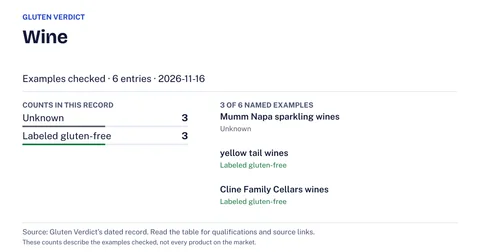 WineNaturally gluten-freechecked Nov 16, 2026
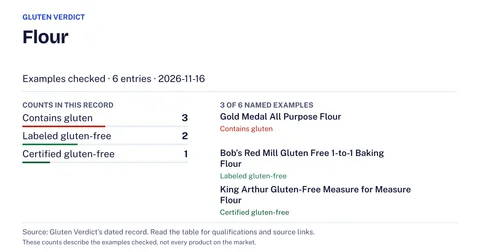 FlourContains glutenchecked Nov 16, 2026
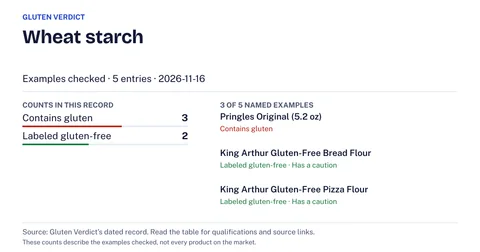 Wheat starchDepends on the product3 of 5 products we checked contain gluten: Pringles Original (5.2 oz), Jiffy Corn Muffin Mix, and Chex Mix Bold Garlic and Herbchecked Nov 16, 2026
Questions people ask
Are completely gluten-free hosts allowed at Catholic Mass?
No. Catholic norms call completely gluten-free hosts invalid matter and low-gluten hosts valid2.
Can a Catholic with celiac disease receive wine only?
The 2003 letter says a layperson with celiac disease who cannot receive Communion under the species of bread, including low-gluten hosts, may receive under the species of wine only4.
Do United Methodist churches offer gluten-free bread?
The UMC's Ask The UMC page says congregations are expected to provide alternatives for persons with celiac disease and other allergies22.
More in Holidays, weddings and celebrations
 Gluten-free at a holiday dinner, potluck or cookout as a guestHow a guest with celiac disease can message the host, bring a dish, serve first at a buffet and decide when to eat only their own food.
 Hosting a gluten-free party: a menu and cross-contact planPlan a mixed party table for a guest with celiac disease: what to ask, which store-bought items to check, and how to keep dishes apart.
 Eating at a wedding with celiac disease: what to write, who to call and what to askA wedding guest with celiac disease: the RSVP line, the caterer call, the questions to ask and when to rely on your own food.
 Gluten-free Thanksgiving: a dish-by-dish check of the menuTurkey, stuffing, gravy, cranberry sauce, casserole and pie: which dishes need a label or maker check, and how to order the work in a shared kitchen.
 Passover and gluten: matzo, matzo meal and what a kosher mark leaves outWheat matzo contains gluten and a kosher-for-Passover mark is not a gluten-free claim. How to check matzo, matzo meal, cake meal and seder dishes.
 Hanukkah and gluten: latkes, gelt and sufganiyotWhat to check at a Hanukkah table on a gluten-free diet: the latke binder, boxed mixes, shared frying oil, gelt wrappers and jelly doughnuts.
Related guides
 Celiac disease vs gluten intolerance: three conditions, three diagnosesHow celiac disease, non-celiac gluten sensitivity and wheat allergy differ in mechanism, diagnosis and diet, with a source behind every point.
 Eating out with celiac disease: what to check, ask and watch forPlan a restaurant meal with celiac disease: what to check before you go, the questions to ask in order, how to read the answers, and what studies measured.
 How to read a US food label for glutenWhere gluten shows up on a US food label: the gluten-free claim, the Contains line, the ingredient list and may-contain lines, and what each means.
 What gluten is, which grains carry it and what “gluten-free” meansA plain definition of gluten, the grains that carry it, look-alike words such as malt and wheat starch, and what a US gluten-free label means.
Sources
- [1, 2, 7] Congregation for Divine Worship and the Discipline of the Sacraments (Vatican), Circular letter to Bishops on the bread and wine for the Eucharist (2017), checked Nov 17, 2026.
- [3, 4, 5, 6] Congregation for the Doctrine of the Faith (Vatican), Circular letter on low-gluten altar breads and mustum (2003), checked Nov 17, 2026.
- [8, 9, 10, 11, 12, 31, 32, 33] Diocese of St. Petersburg, Office of Worship, Gluten Intolerance and the Reception of Holy Communion (rev. 2016), checked Nov 17, 2026.
Read on 2026-11-17: the contact list of four suppliers in the document names the Congregation of Benedictine Sisters of Perpetual Adoration (Clyde, Missouri) among them.
- [13, 14, 15, 16, 17, 18, 19] Benedictine Sisters of Perpetual Adoration, Low-Gluten Information & Storage, checked Nov 17, 2026.
- [20] Electronic Code of Federal Regulations, 21 CFR 101.91 Gluten-free labeling of food, checked Nov 17, 2026.
- [21] US Food and Drug Administration, Gluten and Food Labeling, checked Nov 17, 2026.
- [22, 29] United Methodist Church (Ask The UMC), What do I need to know about communion in the UMC?, checked Nov 17, 2026.
- [23, 24] United Methodist Church, This Holy Mystery: A United Methodist Understanding of Holy Communion, checked Nov 17, 2026.
- [25] Evangelical Lutheran Church in America, What kinds of bread are used for Holy Communion?, checked Nov 17, 2026.
- [26, 27, 30] Evangelical Lutheran Church in America, How do we distribute Holy Communion?, checked Nov 17, 2026.
- [28] Episcopal Diocese of Virginia, Communion Guidelines (revised September 2023), checked Nov 17, 2026.