What gluten is, which grains carry it and what “gluten-free” means
Short answer
Gluten is the name for the storage proteins in wheat, rye and barley, and in crossbred grains such as triticale1, 2. On a US food label, “gluten-free” means FDA’s rule is met, including less than 20 parts per million of gluten: a limit, not a promise of zero3, 4.
Part of Gluten basics and myths, 13 guides
Key points
- Gluten is a general name for proteins found in wheat, rye, barley and triticale, a cross between wheat and rye1.
- In the US rule the gluten-containing grains are wheat, rye, barley and their crossbred hybrids; oats are not on that list, but oats labeled gluten-free still have to meet the limit5, 6.
- The Gluten Intolerance Group says “malt” in an ingredients list means the product is not gluten-free, while maltose and maltodextrin are gluten-free7, 8.
- “Gluten-free” on a US label means less than 20 parts per million of gluten, not zero, and the claim is voluntary3, 9.
- FDA’s gluten-free rule does not apply to foods whose labeling USDA or TTB regulates, generally meat, poultry, certain egg products and most alcoholic drinks10.
What gluten is, in plain words
The Celiac Disease Foundation describes gluten as a general name for the proteins found in wheat, rye, barley and triticale, and says it helps foods keep their shape, acting as a glue that holds food together1. FDA puts the same job in baking terms: gluten gives breads and other grain products their shape, strength and texture11.
In chemistry terms, a review in the Journal of Gastroenterology and Hepatology calls gluten the main storage protein of wheat grains and a complex mixture of hundreds of related but distinct proteins, mainly gliadin and glutenin2. The same review says gluten is heat stable, acts as a binding and extending agent, and is commonly used as an additive in processed foods for texture, moisture retention and flavor12.
FDA says foods that typically contain gluten include breads, cakes, cereals, pastas and many other grain-based foods13. NIDDK adds that many products contain gluten, among them prepackaged foods, lip balms and lipsticks, toothpastes, vitamin and nutrient supplements and, rarely, medicines14.
One word, two definitions. The review above says similar storage proteins exist as secalin in rye, hordein in barley and avenins in oats, and are collectively referred to as “gluten”2. The US regulation draws its line differently: it defines gluten as the proteins that naturally occur in a gluten-containing grain and that may cause adverse health effects in persons with celiac disease15, and its gluten-containing grains are wheat, rye, barley and their crossbred hybrids5. FDA treats oats as a non-gluten-containing grain6. For a US label, the US definition is the one that counts; the oats section below covers the rest.
Which grains carry gluten?
FDA names wheat, rye, barley and crossbreeds of these grains13. The regulation uses the same grains and gives triticale, a cross between wheat and rye, as its example of a crossbred hybrid5.
| Grain | What the sources say | Our verdicts |
|---|---|---|
| Wheat, with its varieties | The Celiac Disease Foundation lists wheatberries, durum, emmer, semolina, spelt, farina, farro, graham, KAMUT® khorasan wheat and einkorn under wheat1. | spelt, farro, bulgur, couscous, flour, seitan |
| Barley | The Celiac Disease Foundation’s list of where barley is commonly found names malt, soups, beer and brewer’s yeast16. | barley, malt extract, malt vinegar, beer |
| Rye | The same page lists rye bread such as pumpernickel, rye beer and cereals17. | No verdict page yet |
| Triticale | A crossbred hybrid of wheat and rye5. The Celiac Disease Foundation calls it a newer grain, grown to have a similar quality to wheat while tolerating a variety of growing conditions like rye18. | No verdict page yet |
The Gluten Intolerance Group tells people eating gluten-free for medical reasons to avoid wheat, barley and rye plus all varieties and derivatives of these grains, such as spelt and malt19. Seitan belongs here too: the Celiac Disease Foundation lists meat substitutes made with seitan (wheat gluten), such as vegetarian burgers, sausage, imitation bacon and imitation seafood, among foods that may contain gluten20.
Which look-alike words trip people up?
Some words sound like gluten grains and are not; some sound harmless and are. Here is what the sources say about the common ones.
| Word on the label | What the sources say | Our verdicts |
|---|---|---|
| Malt | The Celiac Disease Foundation lists malt in various forms (malted barley flour, malted milk or milkshakes, malt extract, malt syrup, malt flavoring, malt vinegar) among gluten sources21. FDA describes malt extract and malt syrup as derived from barley that has not been processed to remove gluten22. The Gluten Intolerance Group says “malt” in an ingredients list means the product is not gluten-free7. | malt extract, malt vinegar |
| Maltose and maltodextrin | The Gluten Intolerance Group says both are gluten-free8, describing them as highly purified substances made from starches and sugars and intentionally processed to remove all proteins, such as gluten23. | No verdict page yet |
| Wheat starch | In the regulation, wheat starch is the example of an ingredient derived from a gluten-containing grain and processed to remove gluten; a food labeled gluten-free cannot contain it if its use results in 20 ppm or more gluten in the food24. The Gluten Intolerance Group says whether wheat starch is gluten-free depends on how extensively it is processed25. | wheat starch |
| Brewer’s yeast | On the Celiac Disease Foundation’s list of gluten-containing grains and their derivatives26. | brewer’s yeast |
| Buckwheat and quinoa | Despite the name, buckwheat is not wheat but a gluten-free member of the rhubarb family, the Gluten Intolerance Group says27. The same page lists quinoa among its gluten-free alternative grains28. | buckwheat, quinoa |
| “Wheat-free” | The Celiac Disease Foundation says products labeled wheat-free are not necessarily gluten-free, because they may still contain spelt (a form of wheat), rye or barley-based ingredients29. | No verdict page yet |
| Soy sauce | FDA says soy sauce is ordinarily made by fermenting a mixture of soybeans and wheat, and that in general, when it is made from soybeans and wheat, it may not bear a “gluten-free” claim30. | soy sauce |
| Oats | FDA treats oats like any other non-gluten-containing grain6. More in the next section. | oatmeal |
Why oats are a special case
The Celiac Disease Foundation says oats themselves do not contain gluten, but they are often grown, processed and transported alongside wheat, barley and rye, which do31.
FDA’s rule treats oats like any other non-gluten-containing grain: oats labeled “gluten-free” must contain less than 20 ppm gluten, and they do not have to be certified to carry the claim6.
The foundation names two ways makers produce gluten-free oats. In sorting, machines and humans remove errant gluten-containing grains32. In purity protocol, a company’s own standards aim to keep oats from coming into contact with gluten at every stage of manufacturing; the foundation notes there is no standard definition of purity protocol and the standards vary by company33.
The Gluten Intolerance Group adds that products labeled gluten-free should comply with the FDA limit of less than 20 ppm but that this is not third-party verified, and that GFCO’s standard for gluten-free certification is 10 ppm of gluten or less34.
On the biology, the Celiac Disease Foundation says the protein in oats (avenin) is similar in structure to the gluten protein, but that several studies have indicated pure, uncontaminated oats do not cause an immune response leading to intestinal damage in patients with celiac disease35. Our oatmeal verdict lists the sources we read for it.
What “gluten-free” means on a US label
FDA’s rule (21 CFR 101.91) sets what the claim means. A food that carries it either inherently contains no gluten, or contains none of these three things36:
- an ingredient that is a gluten-containing grain, such as spelt wheat36;
- an ingredient derived from such a grain that has not been processed to remove gluten, such as wheat flour36;
- an ingredient derived from such a grain and processed to remove gluten, such as wheat starch, if using it leaves the food with 20 ppm or more gluten36.
Either way, any gluten that is unavoidably present must be below 20 ppm, which the regulation writes as below 20 mg of gluten per kg of food37. Four phrases carry the same requirement: “gluten-free”, “no gluten”, “free of gluten” and “without gluten”3.
The claim is voluntary: manufacturers may choose to use it, and FDA’s rule specifies what it means when they do9. Foods that are naturally free of gluten, such as bottled spring water, fruits, vegetables and eggs, may leave it off38.
Why 20 parts per million and not zero?
FDA says the level is the lowest that can be reliably detected in foods using scientifically validated analytical methods3, and that methods validated to detect gluten reliably below 20 ppm were not available when the rule was written39. FDA also says the goal of making any food labeled gluten-free should be for it to contain no gluten or the lowest amount possible that is less than 20 ppm4. A food labeled gluten-free cannot be intentionally made with any amount of a gluten-containing grain, or an ingredient derived from one that was not processed to remove gluten40.
FDA says its 2017 analysis of 702 samples from more than 250 products labeled “gluten-free” found that only one of the products did not comply with the labeling requirements41.
Where the rule stops
The rule does not apply to foods whose labeling the US Department of Agriculture (USDA) or the Alcohol and Tobacco Tax and Trade Bureau (TTB) regulates: generally meat, poultry and certain egg products for USDA, and most alcoholic beverages for TTB10. FDA does not endorse, accredit or recommend any particular third-party gluten-free certification program42.
If a food with a gluten-free claim lists “wheat”, the rule deems it misbranded unless the word “wheat” is followed by an asterisk that points to this statement near the ingredient list: “The wheat has been processed to allow this food to meet the Food and Drug Administration (FDA) requirements for gluten-free foods”43. Reading the rest of a US label is covered in how to read a US food label for gluten.
How a gluten-free grain can still carry gluten
FDA says cross-contact, in the gluten-free rule, generally refers to the unavoidable presence of gluten in a food due to contact with a gluten-containing food44. It names crop rotation and the shared use of harvesting and transport equipment and storage silos as reasons gluten-containing grains often come into contact with grains, legumes and seeds that are naturally free of gluten45, and shared production equipment in factories that make foods both with and without gluten46.
For foods that are naturally free of gluten but at higher risk of cross-contact, such as products made from grains, legumes and seeds, FDA says a gluten-free claim gives consumers the expectation that any gluten present is under 20 ppm in the final product47.
At home, the Celiac Disease Foundation says cross-contact occurs when foods or ingredients come into contact with gluten, generally through shared utensils or a shared cooking/storage environment48.
Who avoids gluten, and why?
NIDDK separates three conditions that get linked to gluten. The table repeats its wording; it is a report of what NIH says, not a way to work out which one a person has, and questions about a person’s own health belong with a clinician.
| Condition | What NIDDK says |
|---|---|
| Celiac disease | A chronic digestive and immune disorder that damages the small intestine, triggered by eating foods containing gluten49. |
| Gluten sensitivity | Symptoms may be like those of celiac disease, such as abdominal pain and tiredness; unlike celiac disease, gluten sensitivity does not damage the small intestine50. |
| Wheat allergy | The immune system reacts to wheat, but some symptoms, such as itchy eyes or a hard time breathing, differ from celiac disease, and wheat allergies do not cause long-term damage to the small intestine51. |
The Celiac Disease Foundation says adopting a strict gluten-free diet is the only known treatment for those with celiac disease52.
How to check a specific food on this site
Each verdict lists the sources we read for it, with the date we read them. Start from every verdict, A to Z or the ingredient index; to check a label you have in hand, use the gluten scanner. The places gluten turns up in packaged foods are in hidden sources of gluten. Recipes change, so the package in your hand has the final word.
Verdicts in this guide
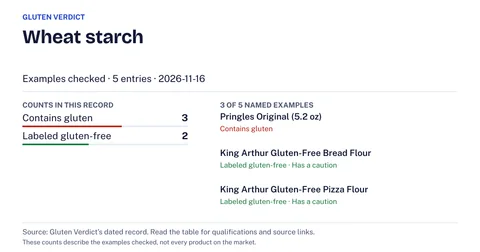 Wheat starchDepends on the product3 of 5 products we checked contain gluten: Pringles Original (5.2 oz), Jiffy Corn Muffin Mix, and Chex Mix Bold Garlic and Herbchecked Nov 16, 2026
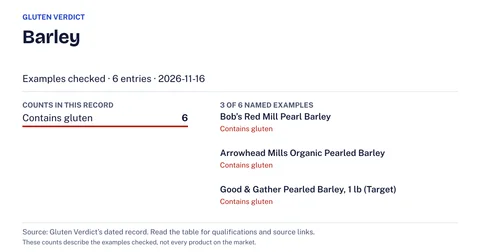 BarleyContains glutenchecked Nov 16, 2026
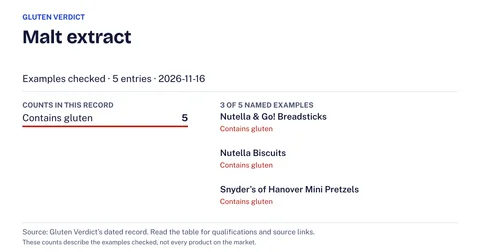 Malt extractContains glutenchecked Nov 16, 2026
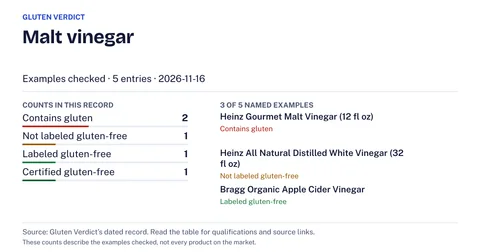 Malt vinegarContains glutenchecked Nov 16, 2026
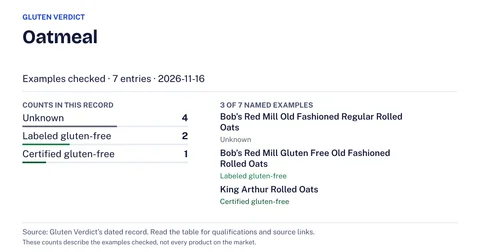 OatmealDepends on the productchecked Nov 16, 2026
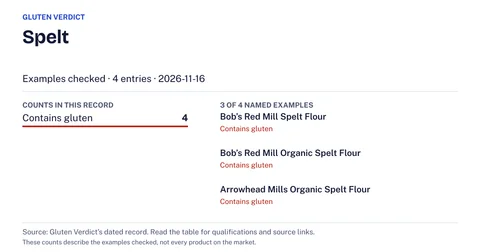 SpeltContains glutenchecked Nov 16, 2026
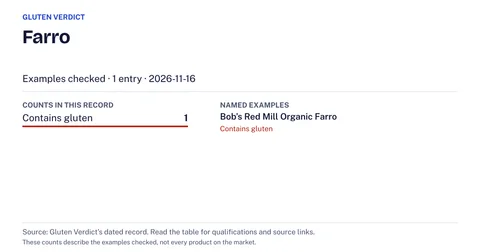 FarroContains glutenchecked Nov 16, 2026
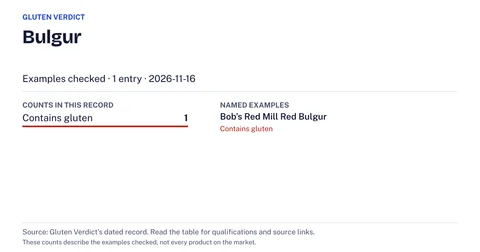 BulgurContains glutenchecked Nov 16, 2026
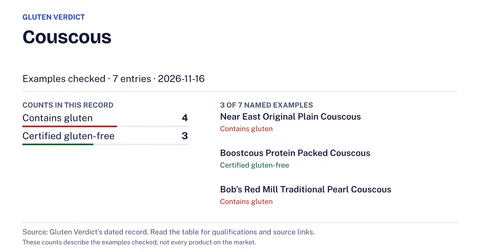 CouscousContains glutenchecked Nov 16, 2026
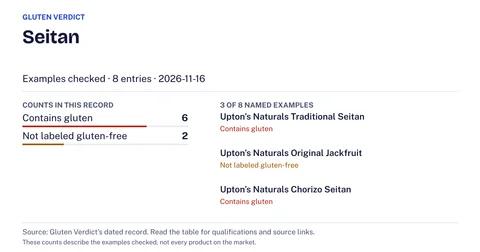 SeitanContains glutenchecked Nov 16, 2026
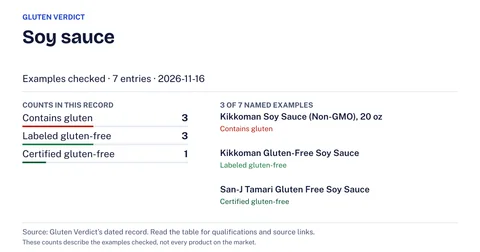 Soy sauceDepends on the product3 of 7 products we checked contain gluten: Kikkoman Soy Sauce (Non-GMO), 20 oz; San-J Organic Shoyu Soy Sauce; and Lee Kum Kee Premium Soy Sauce (No Preservatives Added)checked Nov 16, 2026
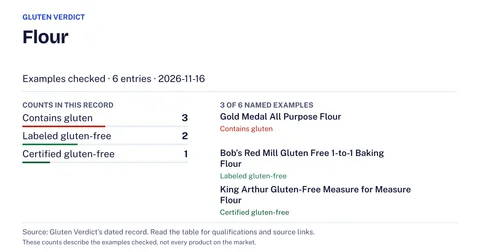 FlourContains glutenchecked Nov 16, 2026
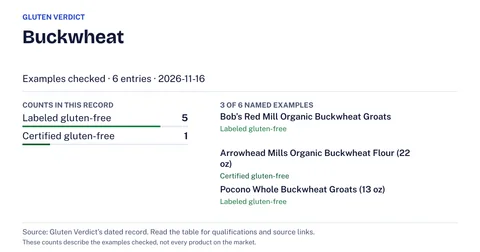 BuckwheatNaturally gluten-freeBuy it labeled gluten-freechecked Nov 16, 2026
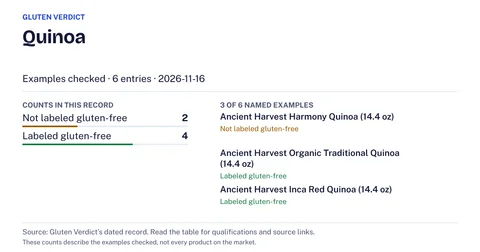 QuinoaNaturally gluten-freeBuy it labeled gluten-freechecked Nov 16, 2026
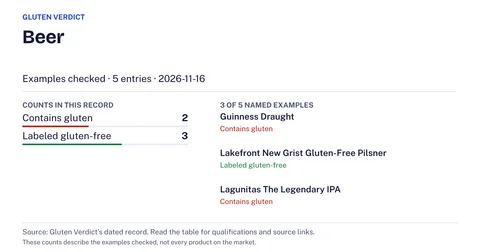 BeerDepends on the product2 of 5 products we checked contain gluten: Guinness Draught and Lagunitas The Legendary IPAchecked Nov 16, 2026
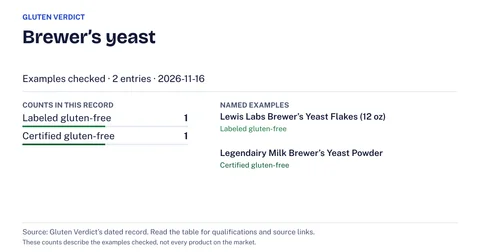 Brewer’s yeastDepends on the productchecked Nov 16, 2026
Questions people ask
Is gluten a protein?
Yes. NIDDK calls gluten a protein found naturally in wheat, barley and rye14, and a review describes it as a complex mixture of hundreds of related but distinct proteins, mainly gliadin and glutenin2.
What is gluten made of?
The review says mainly gliadin and glutenin in wheat, with similar storage proteins in rye (secalin), barley (hordein) and oats (avenins)2. The US regulation names prolamins and glutelins as examples of the proteins it means15.
Does gluten-free mean there is no gluten at all?
Not necessarily. Under FDA’s rule it means less than 20 parts per million3, and FDA says the goal should be no gluten or the lowest amount possible under that limit4.
Is wheat-free the same as gluten-free?
No. The Celiac Disease Foundation says a wheat-free product may still contain spelt, rye or barley-based ingredients29.
What foods contain gluten?
FDA says foods that typically contain gluten include breads, cakes, cereals, pastas and many other grain-based foods13. Packaged foods can carry it in less obvious places; see hidden sources of gluten.
Is gluten bad for you?
The sources we read describe harm in specific conditions. FDA says that for people with celiac disease, consuming gluten damages the lining of the small intestine53. NIDDK says gluten sensitivity may cause symptoms like those of celiac disease, such as abdominal pain and tiredness, but does not damage the small intestine50.
More in Gluten basics and myths
 Did modern wheat get worse? What the variety studies show on glutenWhat studies of old and modern wheat varieties show on gluten, and what they say about spelt, einkorn and ancient wheats and celiac disease.
 Spelt, Kamut, Durum and Einkorn: Every Kind of Wheat Has GlutenDurum, semolina, spelt, einkorn, kamut, farro: which wheat words on a US label count as gluten, and what the FDA rule and the sources say about each.
 What in wheat bothers people if it is not gluten?The non-gluten candidates for wheat symptoms (fructans, ATIs, wheat allergy), the trial or review behind each, and what limits it.
 How the 20 ppm gluten-free limit was chosen, and by whomWho set the 20 ppm gluten-free limit and when: the 2004 law, FDA's 2013 rule and its stated reasons, the 2020 follow-up rule, and Codex and EU wording.
 Gluten-free myths about labels and food, checked against the rulesNatural, organic, zero gluten, fermenting and oats: each gluten-free myth checked against the page that states the rule, with the wording and read date.
 Why gluten problems seem more common: what the evidence separatesGluten problems seem everywhere. Studies separate three things: cases found, cases that exist, and people avoiding gluten.
Related guides
 Celiac disease vs gluten intolerance: three conditions, three diagnosesHow celiac disease, non-celiac gluten sensitivity and wheat allergy differ in mechanism, diagnosis and diet, with a source behind every point.
 Is gluten in everything? Where it starts and where it gets addedSort your pantry into foods that start without gluten, foods where it is added as an ingredient, and foods that pick it up by contact.
 Zein, avenin and gluten: how corn and oats differ from wheatIs zein gluten? How FDA’s rule defines gluten, what “corn gluten” and avenin are, and why a gluten-free label matters for oats.
 How to read a US food label for glutenWhere gluten shows up on a US food label: the gluten-free claim, the Contains line, the ingredient list and may-contain lines, and what each means.
Sources
- [1, 16, 17, 18, 31, 32, 33, 35] Celiac Disease Foundation, What is Gluten?, checked Nov 17, 2026.
Read on 2026-11-17: the list headed “Barley is commonly found in:” on the page names malt (malted barley flour, malted milk and milkshakes, malt extract, malt syrup, malt flavoring, malt vinegar), soups, beer and brewer’s yeast.
Read on 2026-11-17: the list headed “Rye is commonly found in:” on the page names rye bread, such as pumpernickel, rye beer and cereals.
- [2, 12] Journal of Gastroenterology and Hepatology (PubMed), What is gluten? (Biesiekierski, 2017), abstract, checked Nov 17, 2026.
- [3, 9, 11, 13, 38, 41, 42, 53] US Food and Drug Administration, Gluten and Food Labeling, checked Nov 17, 2026.
- [4, 6, 10, 22, 30, 36, 39, 40, 44, 45, 46, 47] US Food and Drug Administration, Questions and Answers on the Gluten-Free Food Labeling Final Rule, checked Nov 17, 2026.
- [5, 15, 24, 37, 43] Electronic Code of Federal Regulations, 21 CFR 101.91 Gluten-free labeling of food, checked Nov 17, 2026.
Read on 2026-11-17: paragraph (a)(1) of 21 CFR 101.91 defines “gluten-containing grain” as wheat (any species of the genus Triticum), rye (genus Secale) or barley (genus Hordeum), or their crossbred hybrids, with triticale, “which is a cross between wheat and rye”, as the example.
- [7, 8, 23, 25] Gluten Intolerance Group, Are Maltose, Maltodextrin, Glucose Syrup, Yeast Extracts, and Wheat Starch Gluten-Free?, checked Nov 17, 2026.
- [14, 49, 50, 51] National Institute of Diabetes and Digestive and Kidney Diseases (NIDDK), Definition & Facts for Celiac Disease, checked Nov 17, 2026.
- [19, 27, 28, 34] Gluten Intolerance Group, 35+ Alternative Gluten-Free Grains and Flour Substitutes, checked Nov 17, 2026.
Read on 2026-11-17: the section headed “Alternative Grains”, introduced as “a list of gluten-free grains that can be eaten whole or milled and used as flour”, names amaranth, rice, buckwheat, cornmeal (with polenta, grits and hominy), millet, oats, quinoa, sorghum and teff.
- [20, 21, 26, 29, 48, 52] Celiac Disease Foundation, Sources of Gluten, checked Nov 17, 2026.
Read on 2026-11-17: the list headed “Gluten-Containing Grains and Their Derivatives” names wheat; varieties and derivatives of wheat (wheatberries, durum, emmer, semolina, spelt, farina, farro, graham, KAMUT® khorasan wheat, einkorn wheat); rye; barley; triticale; malt in various forms; brewer’s yeast; and wheat starch that has not been processed to remove gluten to below 20 ppm.