What a supermarket’s gluten-free shelf tag means
Short answer
A chain’s gluten-free tag is the store’s pointer, and each chain that explains its tag words it differently: several tie it to the manufacturer’s declaration or identification of the product11, 13, 15. The claim FDA’s rule defines is the one on the package, so check it there before you buy1, 2.
- Find your chain’s own definition of its tag in the table below; if it has none, treat the tag as unexplained and ask the store.
- Find the “gluten-free” claim on the package: on a food FDA regulates it means the food meets 21 CFR 101.91, including less than 20 parts per million of unavoidable gluten2.
- Read the Contains line and the full ingredient list, as FDA says consumers with celiac disease should read and scrutinize labels9.
- If the tag and the pack disagree, leave the item and tell the store; FDA says labeling concerns may be reported to it10.
Part of Store guides: regional supermarket chains, 15 guides
Key points
- Publix, Safeway, Weis and Schnucks tie their tag, attribute or filter to the manufacturer’s declaration or identification of the product, and Harmons to what the product itself states11, 13, 15, 18, 19.
- Raley’s describes its own review of packaging and ingredient statements, and Wegmans’ key on its own-brand labels involves supplier verification20, 24.
- Price Chopper’s page gives a limit of 100 ppm where FDA’s rule says less than 20 ppm for unavoidable gluten29, 2.
- Harris Teeter’s tag page, as we read it, lists a Gluten Free attribute with no definition text; we could not open Big Y’s or Food Lion’s pages33, 34, 35.
- A missing tag is not a warning by itself, because the claim is voluntary7.
What FDA’s rule defines, and who answers for it
On a food FDA regulates, any “gluten-free” claim must comply with 21 CFR 101.911. The rule defines the claim by ingredients and by a limit: any unavoidable gluten in the food has to be less than 20 parts per million (ppm)2.
Using the claim is voluntary3. FDA says manufacturers that use it are responsible for using it accurately and for meeting the regulation’s requirements4, and a food whose labeling says “gluten-free” but misses the definition is deemed misbranded5.
A store’s shelf tag or icon is a separate thing: the retailer places it, and the chain writes its own description of what it means. The next section collects those descriptions from the chains’ own pages.
How chains define their gluten-free tag
Each row follows the chain’s own page as we read it on 2026-11-17. A tag is only as strong as the sentence behind it, so the table keeps the basis each chain names, in its words where we quote.
| Chain | Where the page puts it | What the page says it rests on |
|---|---|---|
| Publix | A gluten free icon on shelves12 | “Product has been declared gluten free on the package by the manufacturer in accordance with FDA regulations.”11 Only items declared that way by their manufacturers receive an icon12. |
| Safeway | A Gluten Free entry on its Dietary Definitions page13 | Products “identified by the manufacturer stating they are gluten free or have a gluten-free certification on package”13. |
| Weis Markets | A gluten-free icon on pricing tags15 | Products identified as gluten free by the manufacturer that must contain less than 20 parts per million of gluten as defined by FDA15. A second Weis page mentions the icon on the price tag and does not say what it rests on16, 17. |
| Harmons | A gluten free tag on its Shelf Tags page19 | The tag “is used if the product states ‘no gluten,’ ‘gluten-free,’ ‘without gluten,’ or ‘free of gluten’”19. |
| Raley’s | A Gluten Free icon in its shelf guide20 | Products are reviewed on the information on packaging and ingredient statements20. A product may qualify when it clearly states “Gluten-Free” on the package or holds a recognized certification21 and contains no ingredients derived from gluten-containing grains22; “may contain gluten” and shared-facility statements do not qualify23. |
| Wegmans | A Gluten Free Wellness Key on the label of Wegmans Brand products26 | Before assigning the key, Wegmans works with its suppliers to verify the ingredients and the manufacturing environment24, 25, 26; the key means the final product must have <20 ppm gluten from unavoidable gluten26. |
| Price Chopper / Market 32 | The Know Your Colors Gluten Free shelf tag30 | Items that, per the page, meet FDA ingredient and gluten content standards29 and the FDA regulation standard according to the claim on their packaging30. The page also gives a gluten limit of 100 ppm29; see the next section. |
| Schnucks | A Gluten Free filter in its Rewards app18 | Products “declared gluten free on the package by the manufacturer”18. |
| Harris Teeter | Gluten Free among the attributes on its Product Tag Attributes page33 | No definition text under Gluten Free in the page text we retrieved33. |
| Big Y, Food Lion | Pages we could not open | Not reported here34, 35. |
What the definitions have in common
Where a chain states a basis, it is the manufacturer’s declaration, identification or certification11, 13, 15, 18, the store’s review of the package and ingredient list20, or supplier verification for its own brand24. Several chains point to the claim on the package, which is the claim FDA’s rule defines1.
The wording is not uniform. Raley’s adds a review of ingredients and excludes shared-facility statements22, 23, while Publix, Safeway, Weis and Schnucks name the manufacturer11, 13, 15, 18. Harris Teeter’s page, as we read it, names the attribute without a definition33. For stores where we have a chain page of our own, see Kroger and Harris Teeter and Schnucks; the rest are listed under grocery stores.
Price Chopper’s page gives a different number than FDA’s rule
Price Chopper’s gluten-free page says items labeled gluten free “must not contain more than 100 parts per million (ppm) of gluten”29. FDA’s rule says any unavoidable gluten in a food bearing the claim must be less than 20 ppm2. The two figures differ.
The same page says over 4000 items meet the FDA regulation standard according to the claim on their packaging30. We cannot tell from the page which figure the tag applies. The claim on the pack is the one FDA’s rule covers1, so check it there, and the page itself asks readers to read the entire food label31 and to contact its Consumer Services Department with questions32.
Tag, claim and certification mark are three different things
| What you see | Who puts it there | What it rests on |
|---|---|---|
| A store’s shelf tag, icon or app filter | The retailer | Whatever that chain’s page says; see the table above. |
| A “gluten-free” claim on the package | The manufacturer, which FDA says is responsible for using the claim accurately and meeting the regulation4 | FDA’s definition, including less than 20 ppm of unavoidable gluten2. |
| A certification mark | A certification program; manufacturers may print one, and FDA does not endorse or recommend any particular program6 | That program’s own standard. GFCO, for one, certifies physical products displaying its mark36. |
When a seal matters is covered in certified or naturally gluten-free. How store-brand packs fit these three is in store-brand gluten-free claims, and the rule itself is in the FDA gluten-free rule.
A missing tag, a sibling product and a changed recipe
No tag does not mean gluten. FDA notes that a “gluten-free” claim is not required on a package, so it may be missing even when the food is gluten-free7. Wegmans says some single-ingredient Wegmans Brand items meet its key’s criteria but carry no key27.
A tag on one item says nothing about its neighbors. FDA says a manufacturer that uses the claim on some foods may also make foods that contain gluten8, so a shelf that holds several versions of one brand needs each pack read.
Recipes change too. Wegmans says product formulations can change frequently and encourages shoppers to read the label at each purchase28, and Safeway’s page tells shoppers to always read product labels14.
The check at the shelf
- Find your chain in the table above. If its page names a basis, that is what the tag points to. If it names none, as with Harris Teeter’s page as we read it33 and the Weis recipe-article page17, treat the tag as unexplained and ask the store.
- Turn the pack over and find the “gluten-free” claim or a certification mark. The claim is the part FDA’s rule defines1.
- Read the Contains line and the full ingredient list, which our guide to reading a US food label for gluten walks through. FDA says consumers with celiac disease should read and scrutinize labels to avoid gluten ingredients9.
- Check each pack separately, including other versions of the same brand8. Our gluten scanner reads a label photo or pasted text if you want a second pass.
- If the tag and the pack disagree, leave the item and tell the store. FDA says labeling concerns may be reported to it10.
Which of the products we checked carry a gluten-free claim from their makers is in our verdicts for bread, pasta, cereal and granola bars.
Verdicts in this guide
 BreadContains glutenchecked Nov 16, 2026
 PastaContains glutenchecked Nov 16, 2026
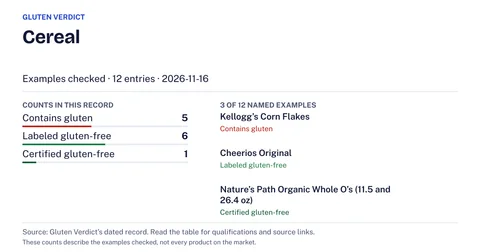 CerealDepends on the product5 of 12 products we checked contain glutenchecked Nov 16, 2026
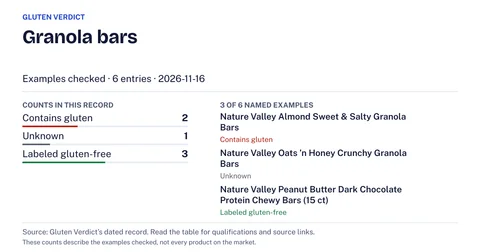 Granola barsDepends on the product2 of 6 products we checked contain gluten: Nature Valley Almond Sweet & Salty Granola Bars and Nature Valley Cinnamon Brown Sugar Soft-baked Oatmeal Squareschecked Nov 16, 2026
Questions people ask
Is a store’s gluten-free tag the same as the FDA gluten-free claim?
FDA’s definition covers the claim a food carries in its labeling1. A chain describes its tag in its own words: Publix, Safeway, Weis and Schnucks tie theirs to the manufacturer11, 13, 15, 18, while Raley’s describes a review of packaging and ingredient statements20.
Who is responsible for a gluten-free claim on a package?
FDA says manufacturers that label their foods as free of gluten are responsible for using the claim accurately and for meeting the regulation’s requirements4.
Does a product without a gluten-free tag contain gluten?
Not necessarily. The claim is voluntary and may be missing from a food that is gluten-free7, and Wegmans says some of its own-brand items meet its key’s criteria without carrying the key27.
Where do I report a package with a wrong gluten-free claim?
FDA says labeling concerns may be reported to it10. Telling the store as well is our advice, not FDA’s.
More in Store guides: regional supermarket chains
 Gluten-free at Price Chopper and Market 32: the blue shelf tag, the ppm figure and the bakery and deliHow to use Price Chopper and Market 32’s gluten-free tag and pages, hold a pack to FDA’s 20 ppm rule, and what the bakery and deli pages leave unsaid.
 Gluten-free at Stop & Shop and Giant: shelf tags, website highlights and own-brand packsWhat a gluten-free shelf tag or website highlight at Stop & Shop and Giant stands behind, how to read an own-brand pack, and a substitution checklist.
 Gluten-free at Hy-Vee: what the dietitians offer and how to read Good Graces claimsWhat Hy-Vee says its dietitians do, how a gluten-free claim on a Good Graces pack is judged, and how GFCO’s list differs from FDA’s 20 ppm rule.
 Gluten-free at Big Y: the support groups and the label checkWhat Big Y publishes for gluten-free shoppers, how to treat a shelf tag as a pointer, and where its Living Gluten Free support groups meet.
 Gluten-free at Kroger and Harris Teeter: reading own-brand packs and the counters the label rule does not coverHow to read a Kroger or Harris Teeter pack for gluten, what FDA's claim covers, and which counters sit outside it, with Kroger's own advice.
 Gluten-free at ShopRite: check your branch, read the pack, ask at the countersHow to check a ShopRite branch’s gluten-free items online, read a Wholesome Pantry pack against FDA’s rule, and what to ask at the deli and bakery.
Related guides
 Store-brand gluten-free: what the tag, claim or seal rests onSort a store-brand item into certified, maker-stated or ingredient-only, see what each lets you conclude, and know what to ask the store.
 How to read a US food label for glutenWhere gluten shows up on a US food label: the gluten-free claim, the Contains line, the ingredient list and may-contain lines, and what each means.
 The FDA gluten-free rule: what 21 CFR 101.91 requires and what 20 ppm measuresWhat FDA’s gluten-free rule requires, which claim words it covers, what 20 ppm means for a portion of food, and how FDA checks that a claim holds.
 Certified or naturally gluten-free: when a seal mattersWhich naturally gluten-free foods are worth buying with a claim or seal: produce, grains, flours, oats and processed foods, with FDA rules and test data.
Sources
- [1, 2, 3, 6, 8, 9, 10] US Food and Drug Administration, Questions and Answers on the Gluten-Free Food Labeling Final Rule, checked Nov 17, 2026.
- [4, 7] US Food and Drug Administration, Gluten and Food Labeling, checked Nov 17, 2026.
- [5] Electronic Code of Federal Regulations, 21 CFR 101.91 Gluten-free labeling of food, checked Nov 17, 2026.
- [11] Publix Super Markets, Shelf Tags & Icons, checked Nov 17, 2026.
- [12] Publix Super Markets, It’s Easy to Shop Gluten Free, checked Nov 17, 2026.
- [13, 14] Safeway, Dietary Definitions, checked Nov 17, 2026.
- [15] Weis Markets, Living Gluten Free, checked Nov 17, 2026.
- [16, 17] Weis Markets, Hosting a Gluten Free Guest (Healthy Bites), checked Nov 17, 2026.
Read on 2026-11-17: the page mentions the Gluten Free icon on the price tag in one sentence; no sentence on the page says what the icon rests on.
- [18] Schnucks, How to Shop for Different Diets Using the Schnucks Rewards App, checked Nov 17, 2026.
- [19] Harmons Grocery, Shelf Tags, checked Nov 17, 2026.
- [20, 21, 22, 23] Raley’s, Gluten Free (shelf guide), checked Nov 17, 2026.
- [24, 25, 26, 27, 28] Wegmans, Gluten Free FAQs, checked Nov 17, 2026.
- [29, 30, 31, 32] Price Chopper / Market 32, Gluten Free Food Products, checked Nov 17, 2026.
- [33] Harris Teeter, Product Tag Attributes, checked Nov 17, 2026.
Read on 2026-11-17: the page headed “Product Tag Attributes” lists a Gluten Free attribute among others (Organic, Non-GMO, Free From, High Protein, No Added Sugar, Low Fat, Vegan, Good Source of Fiber, Low Sodium, Low Calorie, Vegetarian, No Artificial Ingredients). In the page text we retrieved, definition sentences appear under Organic, Non-GMO, No Added Sugar, Low Fat and Low Calorie, and none appears under Gluten Free. A Free From heading also appears with no definition text, and the extracted text does not show whether Gluten Free sits under it. The page may show more than the text we retrieved.
- [34] Big Y, Gluten-Free Shopping, checked Nov 17, 2026.
Tried to open this page on 2026-11-17: a direct request returned a security-service block page, and a second read through a search tool returned not found. We read nothing from it, and this guide does not report what Big Y says about its tags.
- [35] Food Lion, Gluten FAQs (legacy site), checked Nov 17, 2026.
Tried to open this page on 2026-11-17: a direct request failed with a connection error and a second read through a search tool returned an error. We read nothing from it, and this guide does not report what Food Lion says about its tags.
- [36] Gluten Intolerance Group, How Does GFCO Certify Gluten-Free Food?, checked Nov 17, 2026.