The FDA gluten-free rule: what 21 CFR 101.91 requires and what 20 ppm measures
Short answer
Under 21 CFR 101.91, a food labeled “gluten-free”, “no gluten”, “free of gluten” or “without gluten” cannot contain a gluten-containing grain or an ingredient made from one that was not processed to remove gluten, and any unavoidable gluten must be below 20 parts per million (ppm), which the rule writes as below 20 mg of gluten per kg of food1, 2, 3, 4. The rule states that limit per kilogram of food, not per serving3. The claim is voluntary, and FDA checks it through post-market monitoring5, 6.
Part of Label reading and gluten-free claims, 17 guides
Key points
- Four phrases fall under the rule, not just “gluten-free”: “no gluten”, “free of gluten” and “without gluten” must meet the same requirements7.
- A food made on purpose with a gluten grain, or an ingredient from one that was not processed to remove gluten, cannot carry the claim even if it would read under 20 ppm8.
- The rule states its limit per kilogram of food3. At the limit, 100 g of a food holds 2 mg of gluten (our arithmetic, shown below).
- Makers do not have to test their foods9; FDA checks through sampling, inspections, label reviews and complaints6.
- Fermented and hydrolyzed foods are checked through manufacturers’ records, and distilled foods through a test for protein, because a scientifically valid test method is not available for them10, 11, 12.
- The rule covers packaged FDA-regulated foods. Meat and poultry generally fall to USDA and most alcohol to TTB, and FDA only recommends that restaurants match its definition13, 14.
What 21 CFR 101.91 requires
The rule is FDA’s definition of the claim. FDA’s own Q&A says that any food product bearing a “gluten-free” claim must comply with section 101.91 of Title 21 of the Code of Federal Regulations15. We read the current text on eCFR, whose source note lists the 2013 rule and an amendment of 202016.
The rule defines “gluten” as the proteins that naturally occur in a gluten-containing grain and that may cause adverse health effects in persons with celiac disease, such as prolamins and glutelins17. FDA’s Q&A names the grains as wheat, rye and barley, or their crossbred hybrids such as triticale8.
A food that carries the claim has to satisfy three things at once:
- The ingredient test. The food contains none of three kinds of ingredient: a gluten-containing grain itself (the rule’s example is spelt wheat)1; an ingredient derived from one and not processed to remove gluten (its example is wheat flour)2; or an ingredient derived from one and processed to remove gluten (its example is wheat starch), when using it leaves the food at 20 ppm or more gluten18. A food that inherently does not contain gluten also meets this test19.
- The unavoidable-gluten test. Any unavoidable gluten in the food must be below 20 ppm, which the rule gives as below 20 mg of gluten per kg of food3.
- The wheat disclaimer. A food that lists wheat in its ingredients or in a Contains statement and also carries the claim is misbranded unless “wheat” is followed by an asterisk that points to a statement near the ingredient list reading: “The wheat has been processed to allow this food to meet the Food and Drug Administration (FDA) requirements for gluten-free foods.”20
A food that carries the claim and fails these requirements is deemed misbranded21. The ingredient test is separate from the number: FDA says that a food made on purpose with even a small amount of a gluten-containing grain, or an ingredient from one that was not processed to remove gluten, cannot be labeled “gluten-free” even if the food contains less than 20 ppm8. Our wheat starch page covers the ingredient the rule gives as its example of one processed to remove gluten.
Which claim words fall under the rule
Four phrases carry the same requirements: “gluten-free”, “free of gluten”, “without gluten” and “no gluten”7. The rule itself treats a food bearing “no gluten”, “free of gluten” or “without gluten” the same way as one bearing “gluten-free”: if it fails paragraph (a)(3), it is misbranded4.
Other wording about the absence of gluten is judged case by case under FDA’s general misbranding provisions22. A statement such as “made with no gluten-containing ingredients” is not prohibited if it is truthful and not misleading23, but unless the label also carries a “gluten-free” claim, FDA says consumers should not assume the food meets all its requirements for the claim24. Our food label guide shows where each of these sits on a package.
Advisory lines are separate again. FDA says the regulation does not prohibit a voluntary statement such as “made in a facility that also processes wheat” on a label that also carries a gluten-free claim, provided it is truthful and not misleading25, and that any food bearing the claim, with or without such a statement, must comply with 21 CFR 101.9126. What those lines mean is on our may-contain guide.
What 20 ppm measures
Parts per million is a ratio of weights. The Gluten Intolerance Group explains it as 20 weight units of gluten per million weight units of everything in the food, and compares it to, among other things, 1 second in approximately 14 hours and 1 penny in $50027. The rule states the same figure as 20 milligrams of gluten per kilogram of food18.
Why 20 and not zero
FDA gives its reason: when the regulation was written it relied on scientifically validated methods for enforcement, and methods validated to reliably detect gluten below 20 ppm were not available then28. Its consumer page calls 20 ppm the lowest level that can be reliably detected in foods using scientifically validated analytical methods29.
The test behind the number
When FDA decides compliance by analyzing a food, the rule says it will use a scientifically valid method that can reliably detect and quantify 20 ppm gluten in a variety of food matrices, including raw and cooked or baked products30. FDA says it has identified two sandwich ELISA-based methods that it will use in tandem when necessary31.
From ppm to milligrams in a serving
The rule’s limit is 20 mg of gluten per kg of food3, which is 0.02 mg per gram. Multiply by the grams you are looking at: milligrams of gluten = grams of food × ppm ÷ 1,000. The multiplication is ours; the 20 mg per kg is the rule’s.
| Portion of food | Gluten at 20 ppm | Working |
|---|---|---|
| 10 g | 0.2 mg | 10 × 20 ÷ 1,000 |
| 30 g | 0.6 mg | 30 × 20 ÷ 1,000 |
| 50 g | 1 mg | 50 × 20 ÷ 1,000 |
| 100 g | 2 mg | 100 × 20 ÷ 1,000 |
| 250 g | 5 mg | 250 × 20 ÷ 1,000 |
| 500 g | 10 mg | 500 × 20 ÷ 1,000 |
A food that carries the claim has to stay below 20 ppm3, 18, so these figures are ceilings for such a food, not typical contents. A food measured at 5 ppm holds a quarter of each figure (our arithmetic). A maker may also declare the maximum amount of gluten its food may contain, if the statement is truthful and not misleading; FDA says doing so would mean each food bearing the statement does not contain gluten above the amount declared32.
These figures describe the food. What a given amount of gluten does to a person is a separate question that the labeling rule does not answer, and this page does not either.
What is voluntary and what is not
Left to the maker
- Whether to use the claim at all. The regulation sets requirements for the voluntary use of “gluten-free” claims5, and FDA calls it a voluntary claim that makers can use if they meet all the requirements33.
- Whether to label a food that is gluten-free by nature. FDA says producers of such foods, such as bottled spring water, fresh fruits and vegetables and fresh seafood, may choose not to label them34.
- Whether to test. The regulation does not require manufacturers to test starting ingredients or finished foods labeled “gluten-free”9. FDA lists four tools a maker may choose for quality control: in-house testing, a third-party laboratory, certificates of analysis from ingredient suppliers, or a third-party certification program35.
- Whether to show a certifier’s logo. A maker may, provided its use is truthful and not misleading; FDA does not endorse, accredit or recommend any particular third-party program36. Our certification programs compared guide sets those programs side by side.
Fixed once the claim is on the label
- Responsibility. Manufacturers are responsible for ensuring that foods bearing the claim comply with 21 CFR 101.9137, and a food that fails is deemed misbranded21.
- The claim covers that food, not the brand. A maker that uses the claim on some foods has not said that every food it makes is free of gluten38. Our Barilla pasta verdict is one example of a brand selling both kinds.
- The wheat disclaimer, for a gluten-free food that declares wheat20. Our King Arthur Gluten-Free Flour verdict describes flours labeled gluten-free that are made with gluten-free wheat starch and declare wheat, the situation this paragraph addresses.
A claim can be a maker’s own word or sit beside a certifier’s listing; our verdicts show both, for example Cheerios, where the claim is General Mills’ own, and the certified King Arthur flours in that verdict.
How FDA checks a claim
Manufacturers had until August 5, 2014 to comply39. FDA says it enforces the rule through routine post-market monitoring: sampling, periodic inspections of food manufacturing facilities, food label reviews, follow-up on consumer and industry complaints and, when needed, gluten analyses of food samples6. A food labeled “gluten-free” that fails the requirements is subject to regulatory action by FDA40. In an FDA interview page current as of 4 October 2017, a food technologist at the agency said FDA had an ongoing compliance program in which field staff in district offices conduct inspections that include products labeled as gluten-free41.
What FDA’s sampling found
The sampling assignment FDA describes ran from July 2015 to August 201642. FDA tested 702 individual samples from three commodity groups (cereals, grain bars and flours), covering more than 250 types of products43. Five samples from one product source were above 20 ppm, which FDA reports as a product-based rate of compliance greater than 99.5 percent44. A voluntary recall followed45, and FDA’s subsequent sampling did not find levels of gluten that violated the regulation46. That is one assignment covering three food groups; it is not a count of every gluten-free product on the shelf.
Fermented, hydrolyzed and distilled foods
Standard tests do not suit every food. FDA is aware that sandwich ELISA methods do not adequately detect gluten in fermented and hydrolyzed foods10. The 2020 rule covers foods such as yogurt, sauerkraut, pickles, cheese, green olives, FDA-regulated beers and wines, and hydrolyzed plant proteins47; it does not change the definition of “gluten-free”, only the compliance requirements48.
For these foods the maker keeps records instead. FDA describes the records as showing adequate assurance that the food met the definition before fermentation or hydrolysis, that the maker evaluated its processing for gluten cross-contact, and that where a potential for cross-contact was found, measures were put in place to prevent it49. They must be kept for at least 2 years and given to FDA during an inspection on request11.
For distilled foods such as vinegar, FDA evaluates compliance by verifying the absence of protein in the distilled component, using methods that can detect protein or protein fragments12. FDA describes malt vinegar as made by fermentation without distillation of an infusion of barley malt, and says it cannot be used in foods that bear the claim50; our food label guide lists it among the label names to look for. Regular soy sauce, made from soybeans and wheat, generally may not bear the claim51.
Restaurants and menus
The regulation applies to packaged foods, which may be sold in some retail and food-service establishments such as some carry-out restaurants. For a restaurant that makes a gluten-free claim on its menu, FDA recommends that the claim be consistent with its definition14. FDA’s consumer page adds that state and local governments play an important role in oversight of restaurants52.
FDA says it will monitor reported information about unpackaged food and share complaints about such foods, such as those served in restaurants, with state and local government partners53. What a menu’s wording tends to mean in practice is on our restaurant menu guide.
Where the rule stops
- Meat, poultry and most alcohol. The regulation does not apply to foods whose labeling USDA or TTB regulates: USDA generally covers meat, poultry and certain egg products, and TTB covers most alcoholic beverages, including all distilled spirits13. Some beers fall to FDA, such as sorghum beer54. See gluten-free alcohol and our beer verdict.
- Imports. FDA says that if the label of an imported food subject to FDA regulations makes a “gluten-free” claim, the food must comply with the labeling requirements55.
- Drugs. FDA’s Q&A notes that the rule applies only to the labeling of foods, and describes a December 2017 Federal Register notice announcing a draft guidance, “Gluten in Drug Products and Associated Labeling recommendations”56.
- State rules. A state may not set a different requirement for the definition and use of the claims57.
- Other countries. This is the US rule; other countries’ rules are on our labeling rules by country guide.
FDA’s own answer to whether people with celiac disease should look only for the claim is that they should read and scrutinize labels to avoid gluten ingredients58, and its Q&A says that persons with celiac disease who may be sensitive to low levels of gluten, and persons otherwise sensitive to gluten, should seek the advice of their health care providers for selecting appropriate foods59.
FDA’s pending request for information
FDA’s Gluten-Free Labeling of Foods page announces that it is extending the comment period on a Request for Information about labeling and preventing cross-contact of gluten in packaged food, with comments due by April 22, 202660. That date has passed as of 2026-11-17, and the page we read does not say what FDA decided afterwards. We found no later amendment of the rule: the eCFR source note we read lists the 2013 rule and the 2020 amendment16.
Verdicts in this guide
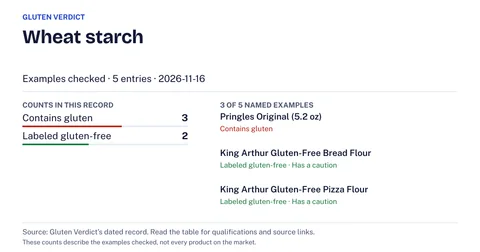 Wheat starchDepends on the product3 of 5 products we checked contain gluten: Pringles Original (5.2 oz), Jiffy Corn Muffin Mix, and Chex Mix Bold Garlic and Herbchecked Nov 16, 2026
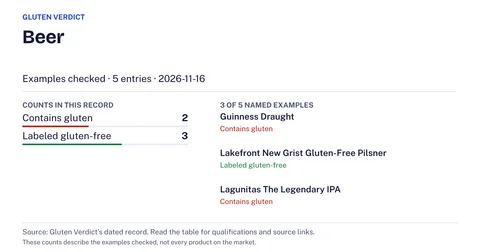 BeerDepends on the product2 of 5 products we checked contain gluten: Guinness Draught and Lagunitas The Legendary IPAchecked Nov 16, 2026
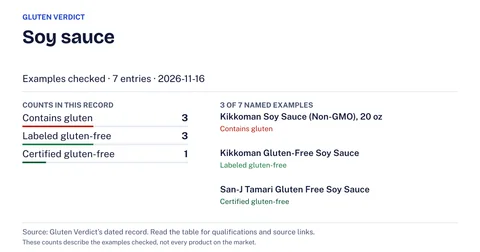 Soy sauceDepends on the product3 of 7 products we checked contain gluten: Kikkoman Soy Sauce (Non-GMO), 20 oz; San-J Organic Shoyu Soy Sauce; and Lee Kum Kee Premium Soy Sauce (No Preservatives Added)checked Nov 16, 2026
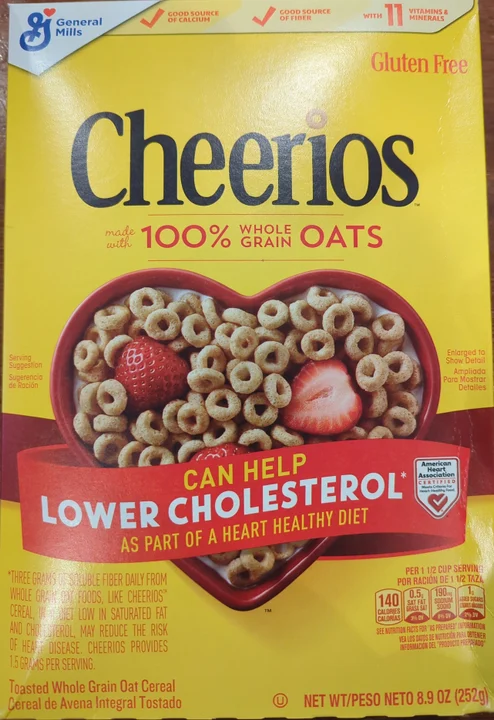 CheeriosLabeled gluten-freeWheat warning on 1 of 8 varieties we checkedGeneral Mills · checked Nov 16, 2026
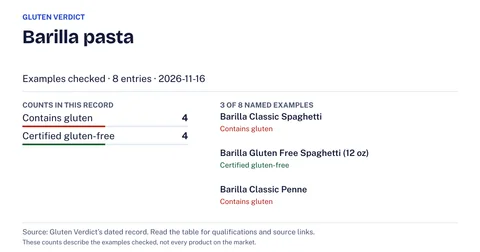 Barilla pastaContains glutenBarilla America, Inc. · checked Nov 16, 2026
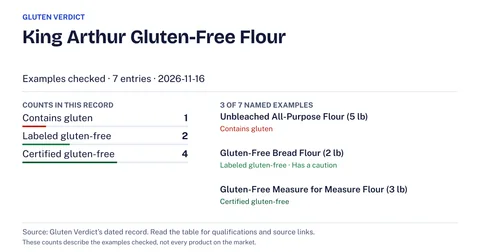 King Arthur Gluten-Free FlourCertified gluten-free1 of 7 varieties we checked contains gluten: Unbleached All-Purpose Flour (5 lb)Wheat warning on 2 of 7 varieties we checkedKing Arthur Baking Company · checked Nov 16, 2026
Questions people ask
Does FDA test gluten-free products before they are sold?
No test is required of manufacturers before sale9. FDA checks afterwards through routine post-market monitoring, including sampling and inspections6.
Is 20 ppm a daily limit?
No. The rule’s figure is below 20 mg of gluten per kg of food3, so it is a concentration in the food. The gluten in a portion depends on the portion size; the table above shows the arithmetic.
Can a gluten-free food contain wheat starch?
Yes, when the starch was processed to remove gluten and using it does not leave the food at 20 ppm or more gluten18. A food that declares wheat and carries the claim must also carry the rule’s wheat statement20. See our wheat starch page.
Do restaurants have to follow the rule?
The regulation applies to packaged foods; for restaurant menus FDA recommends that a gluten-free claim be consistent with its definition14.
More in Label reading and gluten-free claims
 How to read a US food label for glutenWhere gluten shows up on a US food label: the gluten-free claim, the Contains line, the ingredient list and may-contain lines, and what each means.
 When a gluten-free label looks wrong: what to keep, who to tell, where to lookFound wheat, barley or malt in a food labeled gluten-free? What to keep, whom to tell, which US agency takes the report, and where recalls are listed.
 Fermented, hydrolyzed and distilled foods: how a gluten-free claim is checkedHow FDA’s 2020 rule checks a gluten-free claim on fermented, hydrolyzed and distilled foods, why a test cannot settle it, and where TTB takes over.
 Gluten-free certification programs compared: limit, testing and auditsHow GFCO, GFFP, NSF and the BRCGS-based marks differ on gluten limit, testing and audits, set against FDA’s 20 ppm rule for every claim.
 “Low gluten”, “gluten removed” and “gluten friendly” on a labelWhat “low gluten”, “gluten removed” and “gluten friendly” mean on a US label, which phrases FDA or TTB define, and what to ask the maker.
 How to check whether a packaged food is gluten-freeA four-step check for one packaged food: the claim, the ingredient and allergen lines, the maker’s dated page and the certifier’s directory.
Related guides
 How the 20 ppm gluten-free limit was chosen, and by whomWho set the 20 ppm gluten-free limit and when: the 2004 law, FDA's 2013 rule and its stated reasons, the 2020 follow-up rule, and Codex and EU wording.
 How much gluten causes damage: what dose studies show and what 20 ppm meansWhat dose studies in celiac disease measured, how 20 ppm converts to milligrams for a real portion, and what FDA’s limit is and is not.
 Who regulates a gluten-free claim: FDA, USDA or TTBWhich agency sets the rules for a gluten-free claim on packaged food, meat, eggs, beer, wine and spirits, and what to check when a label is unclear.
 Reading US gluten-free labels as a visitor from the UK, EU, Canada or AustraliaWhat a US gluten-free claim, the Contains line, malt and alcohol labels mean if you are used to UK, EU, Canadian or Australian labels.
Sources
- [1, 2, 3, 4, 11, 12, 16, 17, 18, 19, 20, 21, 30, 57] Electronic Code of Federal Regulations (eCFR), 21 CFR 101.91, Gluten-free labeling of food, checked Nov 17, 2026.
- [5, 6, 7, 8, 9, 10, 13, 14, 15, 22, 23, 24, 25, 26, 28, 31, 32, 34, 35, 36, 37, 38, 49, 50, 51, 53, 54, 55, 56, 58, 59] US Food and Drug Administration, Questions and Answers on the Gluten-Free Food Labeling Final Rule, checked Nov 17, 2026.
- [27] Gluten Intolerance Group, FAQ: what 20 ppm looks like in terms a reader can relate to, checked Nov 17, 2026.
Read on 2026-11-17: the page says parts per million means 20 weight units of gluten per million weight units of all components of the food or the product, and compares 20 ppm to 1 second in approximately 14 hours, 1 penny in $500, and 1 teaspoon in approximately 65 gallons of water.
- [29, 40, 52] US Food and Drug Administration, Gluten and Food Labeling, checked Nov 17, 2026.
- [33, 47, 48, 60] US Food and Drug Administration, Gluten-Free Labeling of Foods, checked Nov 17, 2026.
- [39, 42, 43, 44, 45, 46] US Food and Drug Administration, Gluten-Free Food Product Surveillance Sampling, checked Nov 17, 2026.
- [41] US Food and Drug Administration, Three Years Later, What is the Impact of the Gluten-Free Labeling Standard?, checked Nov 17, 2026.