Certified or naturally gluten-free: when a seal matters
Short answer
No food has to carry a gluten-free claim: FDA’s claim is voluntary, so a naturally gluten-free food may go unlabeled1, 3. FDA names crop rotation and the shared use of harvesting and transport equipment and storage silos as ways gluten grains end up touching grains, legumes and seeds that are naturally free of gluten2. Sort the food, then decide:
- Fresh fruit, vegetables and eggs: FDA lists them as naturally gluten-free and says a claim may not appear even if the food is gluten-free3.
- Grains, seeds, flours, starches and oats: in a US pilot study some unlabeled samples had mean gluten at or above 20 ppm4, Health Canada found some flours and starches above 20 mg/kg5, and about 88% of 133 Canadian oat samples were above 20 mg/kg9, so a claim or mark is worth looking for.
- Processed foods: read the ingredient list first; a claim means the maker says FDA’s rule (less than 20 ppm of gluten) is met6, and a certification mark such as GFCO’s adds, as GFCO describes it, the certifier’s testing and plant audits35, 7.
Part of Label reading and gluten-free claims, 17 guides
Key points
- A gluten-free claim is voluntary1; manufacturers may put a certification logo on a label, and FDA does not endorse any certification program8.
- In one US pilot study, 7 of 22 unlabeled grains, seeds and flours had mean gluten levels of 20 ppm or more4; Health Canada found 61 of 640 flours and starches above 20 mg/kg5.
- Two studies reported oat samples on their own: one of the Canadian oat supply found about 88% of 133 samples above 20 mg/kg9, and an Indian study found 85% of its oat samples contaminated12.
- Where the studies also tested labeled or certified products, those were less often contaminated than the rest10, 11, 12.
- A claim promises less than 20 ppm6; GFCO, one certifier, requires 10 ppm or less and audits each plant every year13, 7.
Three kinds of food, and why the question differs
“Naturally gluten-free” describes what a food is. Whether a seal helps depends on more than that. FDA points to crop rotation and the shared use of harvesting and transport equipment and storage silos as ways gluten-containing grains end up touching grains, legumes and seeds that are naturally free of gluten2. The tests below show what can be left behind in grains and flours.
| Kind of food | Examples | What to look for |
|---|---|---|
| Single whole foods | Fresh fruit and vegetables, eggs3 | No claim required; a claim may be absent even on a gluten-free food3. |
| Grains, seeds, flours and starches | Rice, quinoa, buckwheat, rice flour, cornstarch, oatmeal | A gluten-free claim or a certification mark. Tests of these foods found gluten that was not an ingredient in some samples4, 5. |
| Processed foods | Flavored popcorn (see our popcorn verdict), instant oatmeal such as Quaker Instant Oatmeal | The ingredient list, then any claim or mark (see below). |
Single whole foods: what a seal does and does not add
FDA says a food that is free of gluten by nature may carry a gluten-free claim if it meets the rule, and that the claim is voluntary1. FDA lists bottled spring water, fruits, vegetables and eggs as naturally gluten-free, and notes that because the claim is not required, it may not appear even if the food is gluten-free3.
Gluten Intolerance Group (GIG) treats “inherently gluten-free” and “naturally gluten-free” as the same quality, and says even raw fruits and vegetables could come into contact with gluten at some stage between growing and manufacturing14.
Meat, poultry and certain egg products are regulated by USDA, not FDA15. FDA’s gluten-free rule applies to fruits and vegetables, shell eggs and fish, among other foods16. This guide follows FDA’s rule.
Grains, seeds, flours and starches: what the testing studies found
The strongest reason to look for a claim or seal on a dry, milled food is testing. These five studies each measured gluten in commercially sold products. They differ in country, product mix and year, so read each row as that study’s result and not as a rate for any shelf today.
| Study | What was tested | What it reported |
|---|---|---|
| Thompson, Lee and Grace, United States, 2010 | 22 inherently gluten-free grains, seeds and flours not labeled gluten-free, bought in June 200917 | Nine of 22 samples had gluten above the quantification limit, with mean levels from 8.5 to 2,925.0 ppm; seven of 22 (32%) had mean levels of 20 ppm or more4 |
| Koerner and colleagues, Health Canada, 2013 | 640 naturally gluten-free flours and starches bought in eight Canadian cities and online, 2010 to 20125 | 61 of 640 (9.5%) above 20 mg/kg, with a range of 5 to 7,995 mg/kg5. Highest mean levels in higher-fibre ingredients: soy 902, millet 272, buckwheat 153 mg/kg18 |
| Koerner and colleagues, Health Canada, 2011 | 133 oat samples from the Canadian commercial oat supply9 | About 88% above 20 mg/kg; no difference between oat types; the one gluten-free variety analysed tested negative in every analysis9 |
| Verma and colleagues, Italy, 2017 | 200 gluten-free products, naturally and certified, from Italian supermarkets19 | Under 10 ppm in 173 (86.5%), 10 to 20 ppm in 9 (4.5%), over 20 ppm in 18 (9%); contaminated products were most often oat-, buckwheat- and lentil-based20, 11 |
| Raju and colleagues, southern India, 2020 | 160 grain-based products: breakfast products, flours and batters21 | Nearly 9.8% of products labelled gluten-free and 36.7% of products made from naturally gluten-free grain above 20 mg/kg; 35.9% of flour samples and 85% of oat samples contaminated12 |
What the rows have in common
- Gluten turned up in some samples of foods that contain no gluten ingredient: 9 of 22 above the quantification limit in the US study4, and 61 of 640 above 20 mg/kg in Canada5.
- It was not in every sample. In the Italian study most products were under 10 ppm20.
- Labeled products fared better where they were compared: for ingredients labelled gluten-free, Health Canada reported lower contamination, with 3 of 268 samples10, the Indian study found nearly 9.8% of labeled products above 20 mg/kg against 36.7% of products made from naturally gluten-free grain12, and the Italian authors report that certified and higher-cost products were less commonly contaminated11.
- Two of these studies bought their samples before manufacturers’ August 2014 deadline to comply with FDA’s rule22, 17, 5.
For labeled products, FDA reported in 2017 an analysis of 702 samples from more than 250 products labeled gluten-free, and only one of the products did not comply23.
Oats: FDA’s statement and what a claim on oats means
FDA does not require oats to be certified to be labeled gluten-free, but oats that carry the claim must contain less than 20 ppm of gluten24. The same holds for any grain other than wheat, rye, barley and their hybrids: it can be labeled gluten-free if unavoidable gluten from cross-contact is under 20 ppm25.
Oats get their own section because they stand out in the tests above. GIG puts the concern this way: oats come into contact with gluten grains from the field to processing26. One study found about 88% of 133 Canadian oat samples above 20 mg/kg9; the Indian study found 85% of its oat samples contaminated12; and oat products were among the most often contaminated in the Italian study11.
GIG describes two ways oat processors avoid or remove contact with gluten grains, purity protocol, which covers growing through manufacturing27, 28, and mechanical sorting during processing29. We explain both label terms in oat sorting and purity protocol labels.
GIG, which runs the GFCO certification program30, points out that a gluten-free label is not third-party verified31, and that GFCO requires 10 ppm or less where FDA requires less than 20 ppm32. That is a certifier describing its own mark.
More on oats: gluten-free oats vs regular oats, and our verdicts for oatmeal and Quaker Instant Oatmeal.
Processed foods: ingredients, claims and seals
On a processed food, start with the ingredient list. FDA’s definition of gluten-free rules out a gluten-containing grain as an ingredient, and an ingredient derived from one unless it was processed to remove gluten and the food stays under 20 ppm; any unavoidable gluten must also be under 20 ppm6. A gluten-free claim means the maker says the food meets that rule. A food with a gluten-free claim has to comply even if its label also carries an advisory line such as a shared-facility statement33.
A maker that calls a food “naturally gluten-free” is, according to GIG, responsible for making sure any cross-contact leaves the product under 20 ppm13.
A certification logo is a separate thing. FDA allows one on a label if its use is truthful and not misleading, and says it does not endorse, accredit or recommend any particular third-party program8. Our guide to reading a food label for gluten walks through the rest of the package, and the gluten scanner checks a pasted ingredient list.
What one certifier requires: GFCO, read on 2026-11-17
GFCO is the product certification program of Gluten Intolerance Group30. We read GFCO’s own description of its process on 2026-11-17; we have not audited it, and we have not compared it with other certifiers here.
- Limit: GFCO-certified products should contain no more than 10 ppm of gluten, against the less than 20 ppm FDA requires for a claim13, 32.
- Ingredient risk: GFCO says all grains are high-risk, oats get its highest risk level, and high-risk ingredients must be tested per lot before use34.
- Testing: established brands must keep up regular testing of ingredients, shared equipment and finished products35; for whole grain products GFCO also requires visual examination for gluten grains plus antibody-based testing36.
- Audits: GFCO says it checks these steps in annual, in-person audits at every manufacturing facility where certified products are made7.
- Surveillance: GFCO says it samples hundreds of certified products each year from retail stores, online stores and manufacturer websites37.
- Scope: GFCO certifies physical products bearing its mark, not brands or facilities38.
So a plain bag of rice with the mark is a different claim from a plain bag of rice with only a gluten-free statement: the first has ingredient risk levels, testing and plant audits behind it, as GFCO describes them34, 35, 7; the second rests on the maker’s own compliance with FDA’s rule, which GIG notes is not third-party verified31.
No claim and no seal on a grain: what GIG describes for washing and sorting
For beans and grains sold without a gluten-free label or certification, GIG describes steps by food size. Here is its description, not a result we tested:
- Dry beans: washing and visually sorting for anything that is not a bean, such as a stray grain, works very well, GIG says39.
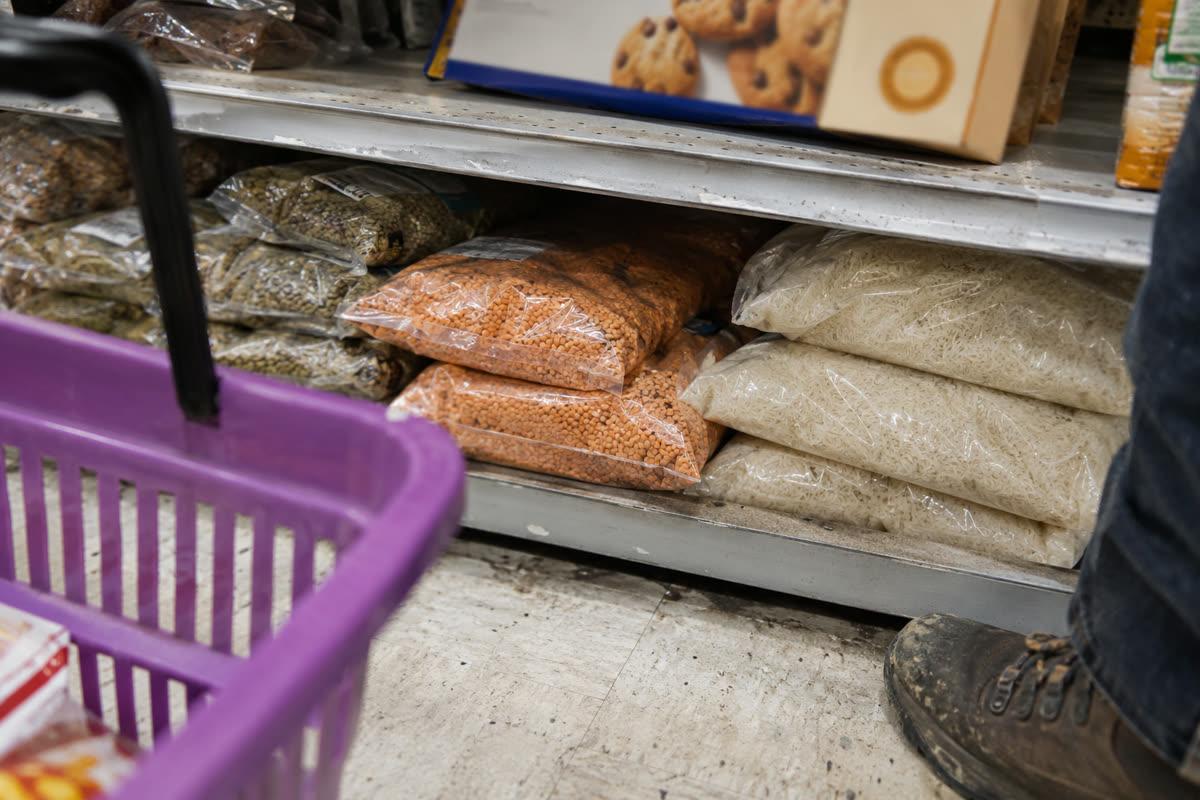
- Rice and sorghum: rinse in a fine sieve or colander and sort by eye40.
- Millet, teff and amaranth: too small to strain, so GIG suggests sorting by eye, then shaking the grain in a lidded jar of water and letting it settle41.
GIG offers these steps for when no labeled or certified version can be found, and its page reports no gluten test results for them42. We did not test them.
A shopping rule of thumb that fits on a card
- Fresh fruit, vegetables and eggs: FDA lists them as naturally gluten-free and says a claim may be absent on a food that is gluten-free3.
- Plain grains, seeds, flours and starches: look for a gluten-free claim or a certification mark. Where studies compared them, labeled products were less often contaminated than unlabeled ones10, 12.
- Oats: look for the claim or mark first, because the two studies that reported oat samples on their own found about 88% above 20 mg/kg9 and 85% contaminated12 (table above).
- Processed foods: read the ingredient list, then the claim6. A mark adds whatever its certifier requires; the GFCO section above shows one example.
- A grain with neither claim nor mark: check our verdict for that food, and see what GIG describes for washing42.
Verdicts in this guide
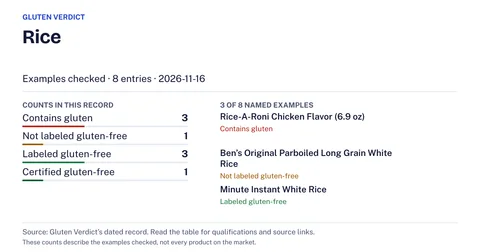 RiceNaturally gluten-free3 of 8 products we checked contain gluten: Rice-A-Roni Chicken Flavor (6.9 oz), Near East Original Rice Pilaf, and Ben’s Original Ready Rice Rice PilafBuy it labeled gluten-freechecked Nov 16, 2026
 OatmealDepends on the productchecked Nov 16, 2026
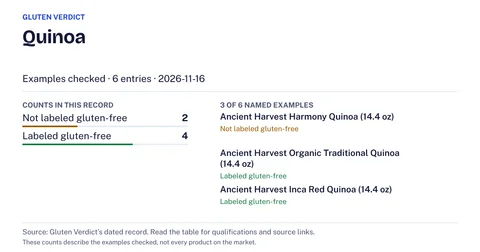 QuinoaNaturally gluten-freeBuy it labeled gluten-freechecked Nov 16, 2026
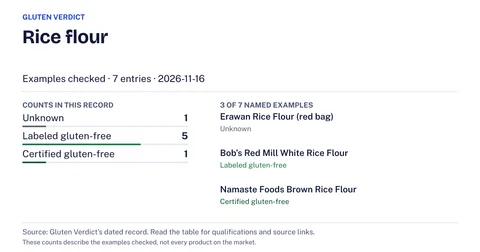 Rice flourNaturally gluten-freeBuy it labeled gluten-freechecked Nov 16, 2026
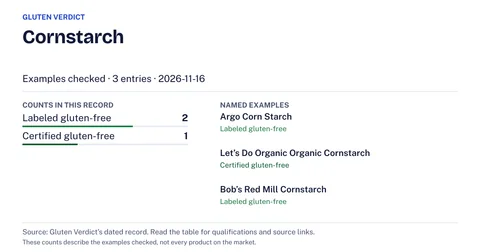 CornstarchNaturally gluten-freeBuy it labeled gluten-freechecked Nov 16, 2026
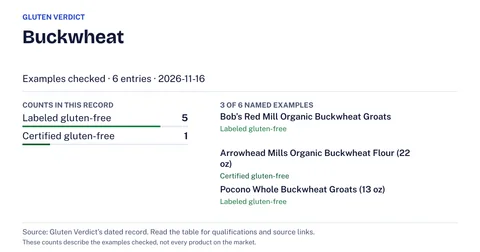 BuckwheatNaturally gluten-freeBuy it labeled gluten-freechecked Nov 16, 2026
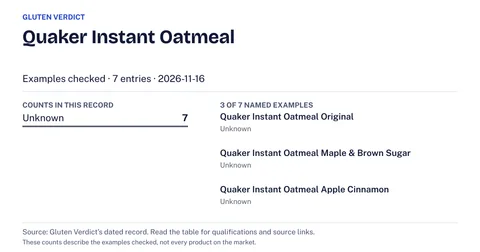 Quaker Instant OatmealUnknownThe Quaker Oats Company · checked Nov 16, 2026
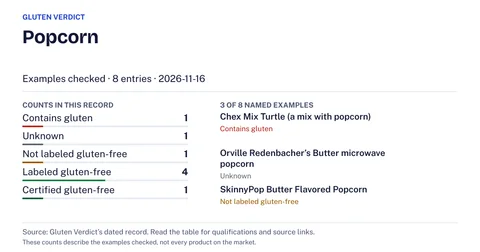 PopcornNaturally gluten-free1 of 8 products we checked contains gluten: Chex Mix Turtle (a mix with popcorn)checked Nov 16, 2026
Questions people ask
Does a naturally gluten-free food need to be certified?
No. FDA’s gluten-free claim is voluntary1, and oats do not have to be certified to carry it24. Whether certification is worth looking for depends on the food: see the testing section.
Is “certified gluten-free” the same as a “gluten-free” label?
No. A claim means the maker says the food meets FDA’s rule, including less than 20 ppm6, and GIG notes that this is not third-party verified31. GFCO-certified products should contain no more than 10 ppm13, and GFCO audits plants every year7.
Which certification seal does FDA recommend?
None. FDA says it does not endorse, accredit or recommend any particular third-party gluten-free certification program8.
Is plain rice gluten-free if the bag has no label?
That depends on the bag. FDA says any grain other than wheat, rye, barley or their hybrids can be labeled gluten-free if unavoidable gluten from cross-contact is under 20 ppm25, and in a US pilot study 7 of 22 unlabeled grains, seeds and flours had mean gluten levels of 20 ppm or more4. Our rice verdict shows what we read.
More in Label reading and gluten-free claims
 Wheat-free, gluten-free and “no gluten ingredients”: what each label statement covers“Wheat-free”, “gluten-free” and “made with no gluten-containing ingredients” are three different statements. What each covers, and what to check.
 How to check whether a packaged food is gluten-freeA four-step check for one packaged food: the claim, the ingredient and allergen lines, the maker’s dated page and the certifier’s directory.
 How to check a gluten-free seal in the certifier's own directorySearch GFCO's Product Finder by brand, product or UPC, read what an entry shows, and learn what a missing listing means for the seal on your pack.
 The Contains line names wheat, not barley or rye: what US allergen labels coverWhat the US allergen Contains line covers, why it names wheat but not barley or rye, and which ingredient-list names stand in for them.
 Gluten-free certification programs compared: limit, testing and auditsHow GFCO, GFFP, NSF and the BRCGS-based marks differ on gluten limit, testing and audits, set against FDA’s 20 ppm rule for every claim.
 The FDA gluten-free rule: what 21 CFR 101.91 requires and what 20 ppm measuresWhat FDA’s gluten-free rule requires, which claim words it covers, what 20 ppm means for a portion of food, and how FDA checks that a claim holds.
Related guides
 Oats and celiac disease: what a gluten-free oat label does and does not tell youWhat FDA’s rule covers for oats, how makers get oats to the gluten-free limit, what avenin studies found, and what to ask your doctor.
 How to read a US food label for glutenWhere gluten shows up on a US food label: the gluten-free claim, the Contains line, the ingredient list and may-contain lines, and what each means.
 Gluten-free flours and starches: what each one is and how to read the bagWhich flours and starches are gluten-free by nature, what a claim and a certification mark on the bag each mean, and how to read a blend’s list.
 Millet, sorghum, quinoa, buckwheat, teff, amaranth and wild rice: what the bag has to sayWhich grains and seeds are gluten-free plants, what makers and certifiers say about seven of them, and the cross-contact checks for bags, bins and blends.
Sources
- [1, 2, 6, 8, 24, 25, 33] US Food and Drug Administration, Questions and Answers on the Gluten-Free Food Labeling Final Rule, checked Nov 17, 2026.
- [3, 15, 16, 22, 23] US Food and Drug Administration, Gluten and Food Labeling, checked Nov 17, 2026.
- [4, 17] J Am Diet Assoc (PubMed abstract), Gluten contamination of grains, seeds, and flours in the United States: a pilot study (Thompson, Lee, Grace, 2010), checked Nov 17, 2026.
- [5, 10, 18] Food Additives & Contaminants Part A (PubMed abstract), Gluten contamination of naturally gluten-free flours and starches used by Canadians with celiac disease (Koerner et al., 2013), checked Nov 17, 2026.
- [7, 30, 34, 35, 36, 37, 38] Gluten Intolerance Group, How Does GFCO Certify Gluten-Free Food?, checked Nov 17, 2026.
- [9] Food Additives & Contaminants Part A (PubMed abstract), Gluten contamination in the Canadian commercial oat supply (Koerner et al., 2011), checked Nov 17, 2026.
- [11, 19, 20] Nutrients (PubMed abstract), Gluten contamination in naturally or labeled gluten-free products marketed in Italy (Verma et al., 2017), checked Nov 17, 2026.
- [12, 21] Food Additives & Contaminants Part A (PubMed abstract), Gluten contamination in labelled and naturally gluten-free grain products in southern India (Raju et al., 2020), checked Nov 17, 2026.
- [13] Gluten Intolerance Group, Is a manufacturer that uses the term “naturally gluten-free” responsible for verifying the FDA definition of < 20 ppm?, checked Nov 17, 2026.
- [14] Gluten Intolerance Group, What is “inherently gluten-free,” and is it the same as “naturally gluten-free?”, checked Nov 17, 2026.
- [26, 27, 28, 29, 31, 32, 43] Gluten Intolerance Group, Are Oats and Oat Flour Gluten-Free?, checked Nov 17, 2026.
- [39, 40, 41, 42] Gluten Intolerance Group, Not Labeled Gluten-Free? Washing Beans and Grains, checked Nov 17, 2026.
Read on 2026-11-17: the page opens by asking what to do if certified or labeled gluten-free versions of beans and grains cannot be found, describes washing and sorting steps for dry beans, rice and sorghum, and millet, teff and amaranth, and reports no gluten test results for those steps.