Gluten in lipstick, lip balm, shampoo and other cosmetics
Short answer
Three celiac organisations say gluten on the skin is not the concern: GIG says the protein is too large to be absorbed through skin1, Coeliac New Zealand says gluten absorbed that way can’t damage the small intestine2, and AIC says gluten is toxic only if swallowed3. Lip products are where they differ: the Celiac Disease Foundation lists them among items to check with the maker4, while Coeliac New Zealand calls a reaction from them unlikely5. Because FDA’s gluten-free definition is a food-labeling rule, a “gluten-free” line on a cosmetic is the maker’s own wording6, 7.
Part of Medications, supplements and non-food products, 13 guides

Key points
- FDA’s gluten-free rule covers food labeling, so a “gluten-free” line on a lipstick or shampoo is the maker’s own wording6, 7.
- The organisations disagree on lip products: the Celiac Disease Foundation says to verify them4, Gluten Intolerance Group calls accidental ingestion the real concern8, Coeliac New Zealand calls a reaction unlikely5 and the Italian association sees no significant intake9.
- One 2019 study of 66 oral hygiene and cosmetic products available in Italy found four above 20 parts per million of gluten, three toothpastes and one lipstick at 27.410.
- Coeliac New Zealand notes that in New Zealand a cosmetic’s ingredient list may not show the grain behind an ingredient such as vitamin E, and that where a maker gives no “free from” or “contains” statement, contacting it directly is the only way to be certain45, 11, 12.
- A rash after a product can have other causes: GIG names wheat allergy and chemical irritants13, 14, and says dermatitis herpetiformis is caused by eating gluten, not by topical contact15.
What do celiac organisations say about cosmetics?
Four celiac organisations address cosmetics on pages we read on 2026-11-17: the Celiac Disease Foundation and Gluten Intolerance Group (GIG) in the US, Coeliac New Zealand, and the Associazione Italiana Celiachia (AIC) in Italy. They are organisations’ positions, not test results, and where they differ we show both.
| Organisation | Gluten on skin | Lip products |
|---|---|---|
| Celiac Disease Foundation (US) | The page we read names no skin product16 | Lists lipstick, lipgloss, lip balm or other cosmetic used near the mouth as items to verify, because they may be unintentionally ingested16, 4 |
| Gluten Intolerance Group (US) | Most people on a gluten-free diet don’t need to be concerned about products applied to the skin, such as lotion or shampoo17; the gluten protein is too large to be absorbed through the skin1 | The real concern is accidental ingestion, especially with lip products8 |
| Coeliac New Zealand | Gluten absorbed through the skin can’t damage the small intestine, so people with coeliac disease or dermatitis herpetiformis need not worry about topical cosmetics2 | Lipstick or lip balm containing gluten is unlikely to trigger a reaction because of the small amount swallowed5 |
| Associazione Italiana Celiachia (Italy) | Cosmetics and products for external use carry no risk for people with celiac disease, because gluten is toxic only if swallowed3 | The amount of lipstick that might be swallowed by accident in daily use is not a significant intake, even if the product contained gluten9 |
Coeliac New Zealand and AIC write for readers in their own countries. We cite them as organisations’ positions, not as US rules.
What the federal gluten-free rule does and does not cover
FDA’s “gluten-free” definition is a food-labeling rule: a food product with the claim must comply with 21 CFR 101.9118. FDA’s own Q&A describes the rule as applying only to the labeling of foods6, and GIG says personal care products are not part of it7.
Cosmetics follow a different law. Apart from color additives, cosmetic products and ingredients do not need FDA approval before they go on the market19. FDA counts lipsticks, skin moisturizers, makeup and cleansing shampoos as cosmetics20. Moisturizers and makeup marketed with sun-protection claims are cosmetic/drug products and must meet the requirements for both21.
A cosmetic is misbranded under the FD&C Act if its labeling is false or misleading in any particular22. That rule is about false or misleading labeling in general, not gluten claims in particular, and FDA’s gluten-free definition is written for foods6, so a maker’s “gluten-free” on a cosmetic is the maker’s own wording. The sections below cover how to check it.
Lip products and other routes to the mouth
Where an organisation urges care with cosmetics, swallowing is the route it names. The Celiac Disease Foundation puts lipstick, lipgloss, lip balm and other cosmetics used near the mouth on its list of items to read or ask the maker about16, 4. GIG says anything put on skin or lips, including lip balms and glosses, could get into the mouth23, and that once something is in or near the mouth you are likely to swallow it, with the amount of gluten possibly or possibly not causing a reaction depending on sensitivity24.
GIG’s wording is general, so on its reasoning hand cream and a face product are the same route as lip balm when they reach the mouth23. It also names two others: shampoo running down the face while washing hair25, and a kiss from someone wearing a gluten-containing product26.
Children’s bath and hair products
Coeliac New Zealand says gluten may be present in shampoo, conditioner, body wash and bubble bath, that some young children drink their bath water, which it calls unlikely to be an issue, and that if a child remains symptomatic on a gluten-free diet or their tTGA antibodies remain high, you might like to try switching to gluten-free bath products27. It adds that plain bar soaps are less likely to contain gluten than body washes28.
What testing of cosmetics has found
Two studies measured gluten in finished products. Both report levels in the products, not reactions in people.
In Italy, a 2019 study collected 66 oral hygiene and cosmetic products labelled gluten-free or with unknown gluten content from supermarkets and pharmacies: 37 toothpastes, 2 dental tablets, 5 mouthwashes, 10 lip balms and 12 lipsticks29. Of the 66, 62 were under 20 parts per million of gluten; four were over, three toothpastes (20.7, 31.4 and 35 parts per million) and one lipstick (27.4)10. None had an ingredient derived from wheat, barley or rye30. The authors concluded that gluten contamination was not an issue in a wide array of such products on the market31.
A 2016 survey in the Journal of AOAC International tested 36 cosmetics with three kinds of ELISA test. None of the nine labeled gluten-free had detectable gluten32. Across the survey, the tests found 15.2 to 1453.5 parts per million in six products with one method, and 11.7 to 572.3 in three with two others33. Gluten or hydrolyzed wheat protein was listed as an ingredient in five of the products with detectable gluten, and the tests recovered gluten poorly from most foundation, blush and powder products34.
Different products, markets and test methods: the two studies do not add up to one rate. Read each as one study of one set of products29, 32.
Ingredient names to look for on a cosmetic label
FDA’s cosmetic labeling rule (21 CFR 701.3) calls for each ingredient to be declared in descending order of predominance, though fragrance or flavor may be listed as fragrance or flavor35. As an alternative, ingredients other than color additives present at more than 1 percent may be listed first in descending order, followed by those at not more than 1 percent in any order36. GIG notes that most products won’t list “gluten”, and many won’t plainly state wheat, barley, rye or oats37.
GIG’s list of names that come from gluten grains in skin care, grouped by grain38:
| Grain | Names on a label |
|---|---|
| Wheat | Hydrolyzed wheat protein, hydrolyzed wheat gluten, hydrolyzed wheat starch, wheat amino acids, wheat bran extract, wheat germ extract, wheat germ oil or tocopherol, wheat peptides, Triticum lipids, Triticum vulgare38. Coeliac New Zealand says wheat ingredients are listed as “wheat” or “Triticum vulgare”39 |
| Barley | Barley extract, Hordeum vulgare extract, malt extract38 |
| Rye | Secale cereal38 |
| Oats | Avena sativa, Avena sativa extract, sodium lauroyl oat amino acid; GIG notes oats because of possible cross contact, and they can also be an allergen38 |
Coeliac New Zealand says wheat and oats are the gluten-containing cereals most commonly used in cosmetics, barley less often and rye rarely40. It also describes a limit of New Zealand labels: the source of an ingredient does not have to be declared, so vitamin E, commonly made from wheat, appears only as “vitamin E”, and “hydrolysed vegetable protein” may carry no sign of its grain45, 11. We have not confirmed what US rules require about naming the grain behind a cosmetic ingredient, so a name that could come from a grain is a reason to ask the maker. Our hydrolyzed vegetable protein page covers the same name in food.
How to read a maker’s gluten statement
A gluten-free line on a cosmetic is the maker’s own wording6, 7. Coeliac New Zealand says some makers add a “free from” or “contains” statement to their packaging or website, and that if they do not, contacting them directly is the only way to be certain12. GIG points to certified versions in the GFCO Product Finder for readers who prefer gluten-free products41.
- Note the exact words, the product, the size and the date.
- Ask whether any ingredient comes from wheat, barley, rye or oats, and whether the maker tests the finished product for gluten.
- Keep the reply with the date: it is the maker’s statement, not a test of your jar.
When a product seems to cause a rash
GIG says some people report skin sensitivities they attribute to gluten in products, and that the reactions could also come from other ingredients42. It names a wheat allergy, which would be a reaction to other parts of the wheat and not to gluten, as one explanation13, and lists common chemical irritants: dyes, fragrance, masking fragrance, lanolin, parabens, formaldehyde and formaldehyde releasers14.
Coeliac New Zealand says some people with coeliac disease report skin reactions to topical products, that this is not thought to be related to coeliac disease specifically, and that it suggests speaking to a GP, because the person may be sensitive to other components or have a co-existing wheat allergy43. A 2000 case report in Allergy describes one case of allergic contact urticaria caused by hydrolyzed wheat in a body cream, and says immediate contact allergy to cosmetics seems to be rare44.
Dermatitis herpetiformis (DH) is a different matter: GIG says it is a skin reaction to eating gluten and does not result from topical contact with a substance15.
Verdicts in this guide
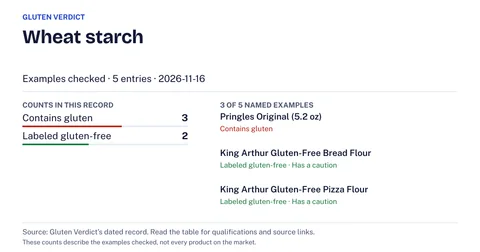 Wheat starchDepends on the product3 of 5 products we checked contain gluten: Pringles Original (5.2 oz), Jiffy Corn Muffin Mix, and Chex Mix Bold Garlic and Herbchecked Nov 16, 2026
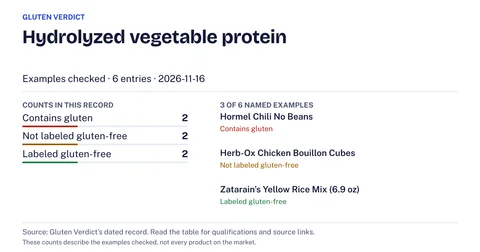 Hydrolyzed vegetable proteinDepends on the product2 of 6 products we checked contain gluten: Hormel Chili No Beans and Pioneer Brown Gravy Mix (1.61 oz)checked Nov 16, 2026
Questions people ask
Can gluten be absorbed through the skin?
GIG says the gluten protein is too large to be absorbed through the skin1, and Coeliac New Zealand says gluten absorbed through the skin can’t damage the small intestine2.
Does lipstick or lip balm need to be gluten-free?
The organisations differ. The Celiac Disease Foundation lists lip products as items to verify with the maker4; Coeliac New Zealand calls a reaction unlikely5; AIC says the amount swallowed is not significant9.
Is shampoo a concern?
GIG says most people on a gluten-free diet need not be concerned about shampoo applied to skin17, and notes it could reach the mouth while washing hair25.
Does “gluten-free” on a cosmetic mean the same as on food?
FDA’s gluten-free definition is a food-labeling rule6, so on a cosmetic the claim is the maker’s own7.
Where can I find certified products?
GIG points to the GFCO Product Finder41.
More in Medications, supplements and non-food products
 Who regulates a gluten-free claim on pills, cosmetics, toothpaste and pet foodWhich products FDA’s 20 ppm gluten-free rule covers, and what a gluten-free line on a medicine, cosmetic, toothpaste or pet food rests on.
 Gluten in medications: what the label, DailyMed and a pharmacist can showFDA’s gluten-free food rule does not cover drugs. Use the ingredient list, DailyMed, the maker and a pharmacist, and know what each can show.
 Are vitamins gluten-free? What a bottle’s claim, mark and ingredient list showWhat “gluten-free” on a vitamin bottle rests on (FDA rule, certifier listing or nothing) and how to read Other Ingredients for binders and fillers.
 How to read a supplement label for glutenWhere gluten can hide on a US supplement label: the Supplement Facts panel, the Other Ingredients list and the allergen line, and what each leaves out.
 How to check a medicine for gluten, from the bottle to the makerFind your exact medicine by NDC in DailyMed, read its inactive ingredients, compare refills, and ask the maker about starch names the label leaves open.
 What gluten wording on an over-the-counter medicine box meansFind the inactive-ingredient line in Drug Facts and see what each kind of gluten wording on an OTC medicine box has behind it, from silence to a mark.
All 13 guides in Medications, supplements and non-food products
Related guides
 Gluten in toothpaste, mouthwash and floss: what the makers say, and what to ask the dentistToothpaste and mouthwash sit outside FDA’s food gluten-free rule. Read each maker’s own statement, and the questions to ask before a dental visit.
 Where wheat, barley and rye hide in processed food: 15 places to checkFifteen processed foods where wheat, barley or rye turn up, the label step that catches each, and what US allergen law does and does not flag.
 Dermatitis herpetiformis: how it is diagnosed and treated, and how other skin conditions link to celiac diseaseWhat NIDDK, Coeliac UK, GIG and published reviews say about dermatitis herpetiformis: the skin biopsy, the diet, dapsone, and weaker skin links.
 Wheat, barley and rye on an ingredient list: the names to look forLook up wheat, barley and rye names on a US ingredient list, from durum to malt, and sort each as contains gluten, depends on the maker, or lookalike.
Sources
- [1, 7, 17, 41, 42] Gluten Intolerance Group, Is there gluten-free labeling on personal care products such as shampoos and conditioners, lotions, cosmetics, etc.? (FAQ), checked Nov 17, 2026.
- [2, 5, 11, 12, 27, 28, 39, 40, 43, 45] Coeliac New Zealand, Coeliac disease and cosmetics, checked Nov 17, 2026.
- [3, 9] Associazione Italiana Celiachia (AIC), FAQ: Le persone celiache possono usare cosmetici e detergenti che contengono glutine? (published 18/12/2019), checked Nov 17, 2026.
- [4, 16] Celiac Disease Foundation, Sources of Gluten, checked Nov 17, 2026.
Read on 2026-11-17: the list headed “Other Items That Must Be Verified By Reading The Label Or Checking With The Manufacturer” names lipstick, lipgloss, lip balm or other cosmetic used near the mouth; oral care and dental products; communion wafers; herbal or nutritional supplements; drugs and over-the-counter medications; vitamins and supplements; and Play-doh. No shampoo, lotion or other skin product is named anywhere on the page.
- [6, 18] US Food and Drug Administration, Questions and Answers on the Gluten-Free Food Labeling Final Rule, checked Nov 17, 2026.
- [8, 37] Gluten Intolerance Group, Skin Health for Beginners, checked Nov 17, 2026.
- [10, 29, 30, 31] PubMed (Journal of Pediatric Gastroenterology and Nutrition), Verma et al. 2019, Contribution of Oral Hygiene and Cosmetics on Contamination of Gluten-free Diet (abstract), checked Nov 17, 2026.
- [13, 14, 15, 23, 24, 25, 26, 38] Gluten Intolerance Group, 5 Facts About Gluten-Free Skin Care, checked Nov 17, 2026.
Read on 2026-11-17: the list headed “5. Common Gluten Ingredients in Skin Care Products” names, under “Wheat or Gluten”, AMP-isostearoyl hydrolzyed wheat protein, enzyme-modified gluten, hydrolyzed wheat protein (HWP), hydrolyzed wheat gluten, hydrolyzed wheat starch, Triticum lipids, Triticum vulgare, wheat amino acids, wheat bran, wheat bran extract, wheat germ extract, wheat germ glyceride, wheat germ oil or tocopherol, wheat hydrolysate, wheat peptides and wheat starch; under “Barley or Malt”, barley extract, Hordeum vulgare extract and malt extract; under “Rye”, Secale cereal; and under “Oats (due to possible cross contact but could also be an allergen)”, Avena sativa, Avena sativa extract and sodium lauroyl oat amino acid. The page notes that names marked with an asterisk are the Latin name for the grain.
- [19, 22] US Food and Drug Administration, FDA Authority Over Cosmetics: How Cosmetics Are Not FDA-Approved, but Are FDA-Regulated, checked Nov 17, 2026.
- [20, 21] US Food and Drug Administration, Is It a Cosmetic, a Drug, or Both? (Or Is It Soap?), checked Nov 17, 2026.
- [32, 33, 34] PubMed (Journal of AOAC International), Gluten Quantitation in Cosmetic Products by Enzyme-Linked Immunosorbent Assay, 2016 (abstract), checked Nov 17, 2026.
- [35, 36] Electronic Code of Federal Regulations (eCFR), 21 CFR 701.3 Designation of ingredients (cosmetics), checked Nov 17, 2026.
- [44] PubMed (Allergy), Varjonen et al. 2000, Immediate contact allergy from hydrolyzed wheat in a cosmetic cream (abstract), checked Nov 17, 2026.