Wheat, barley and rye on an ingredient list: the names to look for
Short answer
FDA says gluten occurs naturally in wheat, rye, barley and crossbreeds of these grains, such as triticale1, 3. Sort each unfamiliar name into one of three groups:
- Contains gluten: a wheat, barley or rye name, or a product made from one, such as durum, semolina and spelt35, malt extract or malt syrup10, or malt vinegar11.
- Depends on the maker: starches, natural flavors and yeast extract, where the source decides17, 19, 23.
- Only looks like gluten: buckwheat, and ingredients the National Celiac Association says are considered gluten free, such as maltodextrin, caramel color and citric acid33, 26, 30, 31.
Part of Hidden gluten in ingredients, sauces and processed foods, 21 guides
Key points
- FDA says gluten occurs naturally in wheat, rye, barley and crossbreeds of these grains1. The NIDDK lists durum, emmer, semolina and spelt as types of wheat35.
- The NIDDK says barley may be found in malt, malt extract, malt vinegar and brewer’s yeast35, and FDA says malt extract and malt syrup cannot be used in a food labeled gluten-free10.
- Wheat is on the US allergen list and barley and rye are not, so a Contains line is not a check for them8, 38.
- Starches, natural flavors and yeast extract depend on the source, and the National Celiac Association says to contact the manufacturer about natural flavors17, 19, 23.
How to use this reference
US rules name three gluten grains: wheat, rye and barley, plus crossbred hybrids such as triticale2, 3. A word on an ingredient list can be another name for one of the three, a product made from one, or a lookalike. The tables below sort them. Where we have checked a food, the name links to our verdict.
In the tables, “Yes” means the name is a gluten grain or made from one, and “Depends” means the source or the processing decides, so the maker has to say.
A “gluten-free” claim changes the picture. FDA says a food labeled gluten-free cannot be intentionally made with any amount of a gluten-containing grain, or an ingredient derived from one that was not processed to remove gluten3.
Wheat and its relatives: label names
| Name on the label | What it is | Contains gluten? |
|---|---|---|
| Wheat, wheat flour | FDA’s gluten-free rule gives wheat flour as its example of an ingredient derived from a gluten-containing grain that has not been processed to remove gluten4. See flour. | Yes4 |
| Durum, semolina | The NIDDK names both as types of wheat35. Durum wheat and semolina are both Triticum durum in FDA’s allergen guidance6. | Yes35 |
| Spelt | A wheat species (Triticum spelta)6. FDA’s gluten-free rule gives “spelt wheat” as its example of a gluten-containing grain4. | Yes4 |
| Emmer, einkorn, Khorasan | Wheat species named in FDA’s allergen guidance6; the NIDDK also names emmer as a type of wheat35. The federal gluten-free rule counts any species of the genus Triticum as wheat40. | Yes35, 40 |
| Couscous | The National Celiac Association says it is made from semolina, which comes from durum wheat9. | Yes9 |
| Triticale | A cross between wheat and rye35. FDA’s allergen guidance counts it within “wheat”6. | Yes35 |
For allergen labeling, FDA defines “wheat” as any species in the genus Triticum5, and the food source of a major food allergen, wheat included8, must be declared in the ingredient list or in a “Contains” statement7. For other grain foods we have checked, see our verdicts for bulgur, farro and seitan.
Barley and malt
| Name on the label | What it is | Contains gluten? |
|---|---|---|
| Barley | A gluten grain1. | Yes1 |
| Malt, malt extract, malt syrup, malt flavoring | FDA says malt extract and malt syrup are derived from barley that has not been processed to remove gluten10. The National Celiac Association says malt is usually made from barley and may be listed as malt, malt flavoring, malt extract or malt syrup, and that any product containing malt is not gluten free14. | Yes10, 14 |
| “Malt syrup” with no other grain named | FDA’s compliance policy guide quotes a 1940 statement that unqualified “malt syrup” means barley malt syrup12. A product made from barley and other cereals would be more appropriately named “malted cereal syrup”13, so barley is in both. | Yes12, 13 |
| Malt vinegar | FDA says it cannot be used in a food that bears a gluten-free claim11. | Yes11 |
| Brewer’s yeast | The NIDDK lists it among the places barley may be found35. The National Celiac Association describes it as spent yeast from beer production that may contain malt or other gluten-containing grains, and says it is not gluten free15. | Not gluten free, per the National Celiac Association15 |
| Beer, ale, lagers, malt beverages | The NIDDK says these drinks may also contain gluten36. | May36 |
| Brown rice syrup | The National Celiac Association says the enzymes added to rice are sometimes derived from barley16. | Depends16 |
Rye and triticale
Rye is a gluten grain1. The NIDDK’s list names rye and triticale and gives no other label names for either35. Triticale is a cross between wheat and rye35, and FDA’s rule covers crossbred hybrids of the gluten grains3.
Oats: the condition on the label
Oats are not one of the grains FDA names: its gluten-free rule lists wheat, rye, barley and crossbred hybrids3. FDA says oats labeled gluten-free do not have to be certified, but they must contain less than 20 ppm of gluten34. See our verdict for oatmeal.
Names that depend on the maker
These words name a type of ingredient, not a grain, so the label alone cannot always settle it.
| Name on the label | What decides it | Contains gluten? |
|---|---|---|
| Wheat starch | FDA’s rule allows a gluten-free claim on a food with an ingredient derived from a gluten grain and processed to remove gluten, but not if the food then holds 20 ppm or more4. The National Celiac Association says food containing wheat starch that is not labeled gluten free can contain high levels of gluten18. | Depends4 |
| Modified food starch | The National Celiac Association says that on FDA-regulated foods, wheat-derived modified food starch is listed in the ingredient list or a “Contains” statement, while on USDA-regulated products containing wheat-based modified food starch, wheat may not be stated19. | Depends19 |
| “Starch” or dextrin | The National Celiac Association says that on USDA-regulated foods the single word “starch” may mean cornstarch or wheat starch21, and that dextrin may or may not be gluten free depending on the starting material20. | Depends21, 20 |
| Natural flavors | The National Celiac Association says that if they contain wheat, FDA-regulated foods must say so, but malt or barley does not have to be disclosed17. | Depends17 |
| Seasonings and spice blends (spices) | The National Celiac Association says wheat starch, wheat flour and malted barley flour are common carrier agents in seasoning blends22. | Depends22 |
| Yeast extract | Some yeast extracts may be grown in barley, according to the Gluten Intolerance Group23. | Depends23 |
| Hydrolyzed wheat protein | FDA gives it as an example of a hydrolyzed food and says hydrolysis is not a process to remove gluten24. For hydrolyzed protein listed without its source, see hydrolyzed vegetable protein. | Yes, wheat3, 24 |
Names that look like gluten and are not
Most rows below come from the National Celiac Association’s ingredient list, so they are that charity’s position, not a rule.
| Name on the label | Why it looks like gluten | What the source says |
|---|---|---|
| Buckwheat | Has “wheat” in the name | FDA’s Q&A names buckwheat among the grains other than wheat, rye, barley and their hybrids that can be labeled gluten-free when unavoidable gluten is under 20 ppm33. |
| Maltodextrin | Starts with “malt” | A starch hydrolysate that may be made from wheat starch but is usually made from cornstarch in the US25. Considered gluten free whatever the starting material26. |
| Glucose syrup | Sometimes made from wheat starch or barley starch27. | The association says the process leaves less than 20 parts per million of gluten28 |
| Caramel color | Can be made from sources including malt syrup and wheat starch hydrolysates29. | Considered gluten free regardless of the starting material30. |
| Citric acid | The charity says it may be made from wheat, barley or rye31. | Considered gluten free because the gluten protein is removed in processing31. |
| Monosodium glutamate (MSG) | “Glut” sounds like gluten | A flavor enhancer that is the salt of the amino acid glutamic acid. The association says wheat starch does not appear to be among its starting materials and that, even if it were, the salt of glutamic acid is highly unlikely to contain traces of gluten32. |
Where the Contains line helps and where it stops
US allergen law lists wheat among the major food allergens; barley and rye are not on the list8. The Gluten Intolerance Group puts it plainly: barley and rye are not allergens, so they are not treated the same way on ingredient labels38. A Contains line is therefore not a check for barley or rye.
Where wheat is declared, it appears either in the ingredient list or in a Contains statement beside it7. The National Celiac Association says that on FDA-regulated foods, malt or barley in a natural flavor does not have to be disclosed on the label17.
The Gluten Intolerance Group says a food can show wheat and a gluten-free claim together only when the wheat ingredient was processed to remove gluten to under 20 ppm37. FDA’s labeling rule then requires a statement near the ingredient list that the wheat has been processed to allow the food to meet FDA’s requirements for gluten-free foods39.
Read the whole list for the names above, and use the Contains line as a check for wheat only. For the other places gluten sits on a package, see how to read a US food label for gluten.
Verdicts in this guide
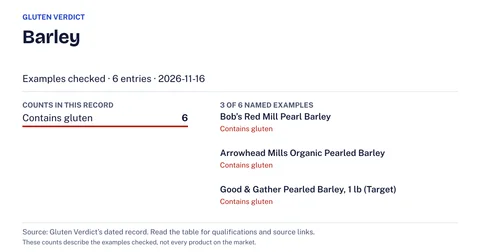 BarleyContains glutenchecked Nov 16, 2026
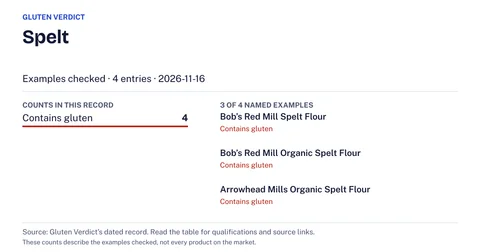 SpeltContains glutenchecked Nov 16, 2026
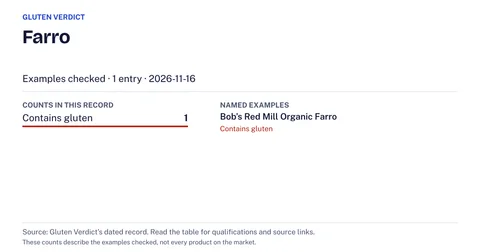 FarroContains glutenchecked Nov 16, 2026
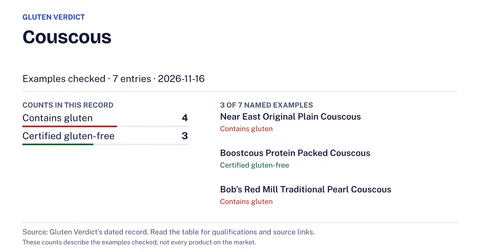 CouscousContains glutenchecked Nov 16, 2026
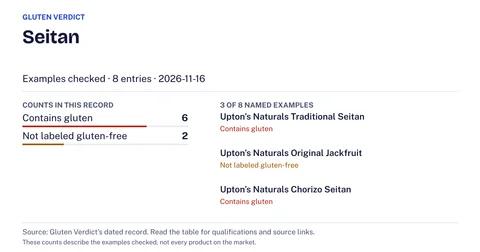 SeitanContains glutenchecked Nov 16, 2026
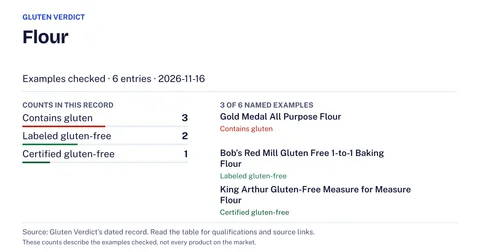 FlourContains glutenchecked Nov 16, 2026
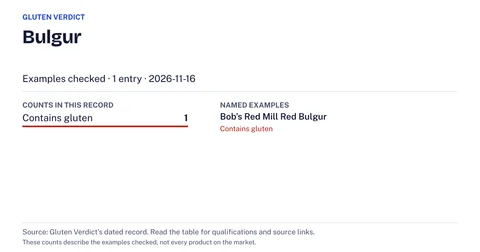 BulgurContains glutenchecked Nov 16, 2026
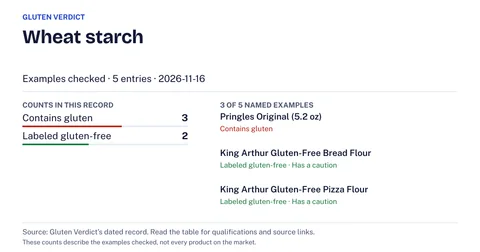 Wheat starchDepends on the product3 of 5 products we checked contain gluten: Pringles Original (5.2 oz), Jiffy Corn Muffin Mix, and Chex Mix Bold Garlic and Herbchecked Nov 16, 2026
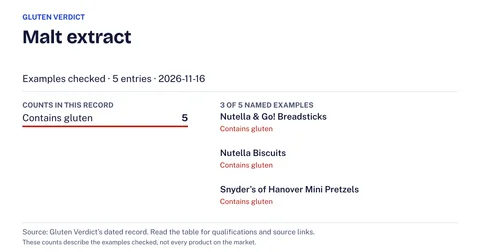 Malt extractContains glutenchecked Nov 16, 2026
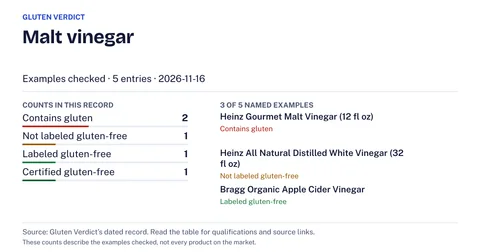 Malt vinegarContains glutenchecked Nov 16, 2026
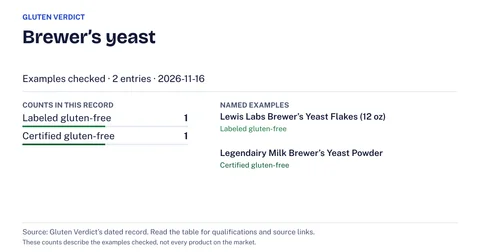 Brewer’s yeastDepends on the productchecked Nov 16, 2026
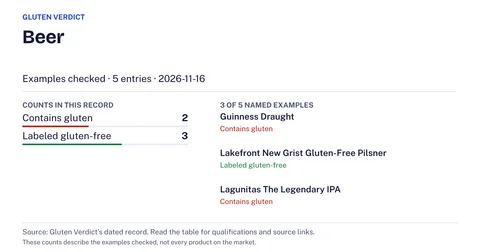 BeerDepends on the product2 of 5 products we checked contain gluten: Guinness Draught and Lagunitas The Legendary IPAchecked Nov 16, 2026
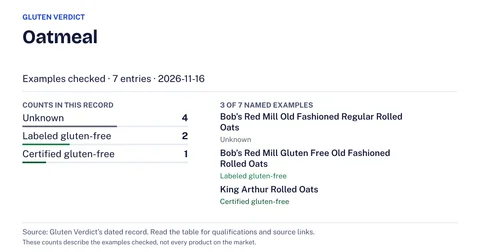 OatmealDepends on the productchecked Nov 16, 2026
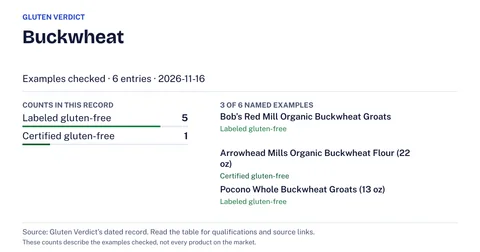 BuckwheatNaturally gluten-freeBuy it labeled gluten-freechecked Nov 16, 2026
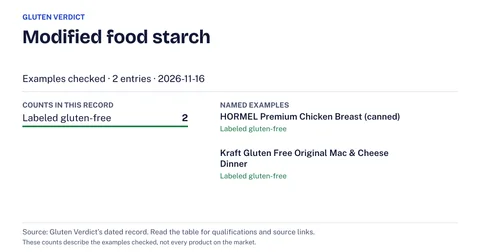 Modified food starchDepends on the productchecked Nov 16, 2026
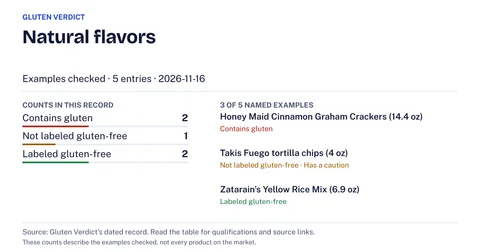 Natural flavorsDepends on the product2 of 5 products we checked contain gluten: Honey Maid Cinnamon Graham Crackers (14.4 oz) and Chex Mix Sour Cream & Onionchecked Nov 16, 2026
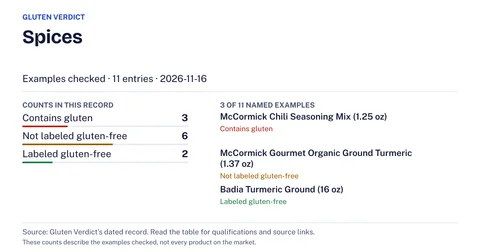 SpicesDepends on the product3 of 11 products we checked contain gluten: McCormick Chili Seasoning Mix (1.25 oz), Lawry’s Chili Spices & Seasonings Mix (1.48 oz), and McCormick Cheesy Taco Seasoning Mix (1.12 oz)checked Nov 16, 2026
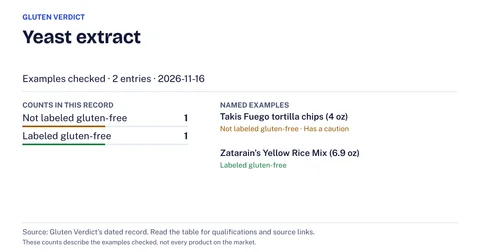 Yeast extractDepends on the productchecked Nov 16, 2026
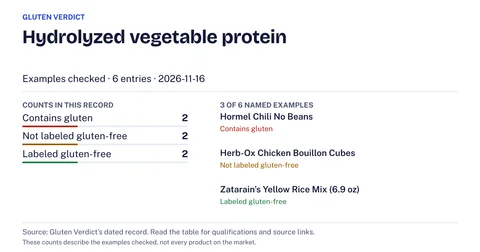 Hydrolyzed vegetable proteinDepends on the product2 of 6 products we checked contain gluten: Hormel Chili No Beans and Pioneer Brown Gravy Mix (1.61 oz)checked Nov 16, 2026
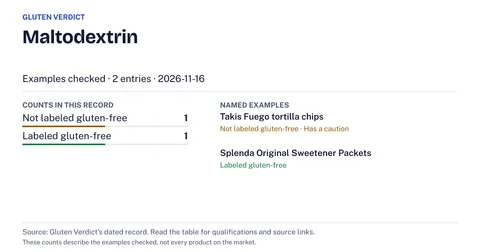 MaltodextrinNaturally gluten-freechecked Nov 16, 2026
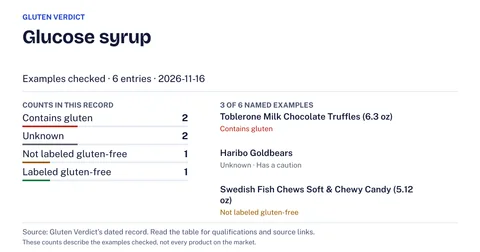 Glucose syrupNaturally gluten-free2 of 6 products we checked contain gluten: Toblerone Milk Chocolate Truffles (6.3 oz) and Darrell Lea Original Black Licorice (7 oz)checked Nov 16, 2026
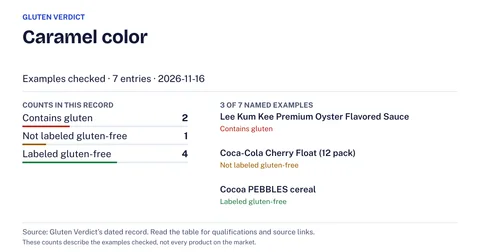 Caramel colorDepends on the product2 of 7 products we checked contain gluten: Lee Kum Kee Premium Oyster Flavored Sauce and Chex Mix Traditionalchecked Nov 16, 2026
Questions people ask
Is spelt the same as wheat?
Yes. FDA’s allergen guidance lists spelt (Triticum spelta) among the species of wheat6, and the NIDDK lists it as a type of wheat35.
Is malt always made from barley?
Usually. The National Celiac Association says malt is usually made from barley14, and FDA’s policy guide says unqualified “malt syrup” means barley malt syrup, while a product from barley and other cereals would be more appropriately named “malted cereal syrup”12, 13.
Is buckwheat a kind of wheat?
No. FDA’s Q&A treats buckwheat as a grain other than wheat, rye, barley or their hybrids33.
More in Hidden gluten in ingredients, sauces and processed foods
 Malt on a food label: which forms are barley and what to checkWhat malt extract, syrup, flavoring and vinegar on a US label mean for gluten, why the Contains line misses barley, and what to check first.
 Where wheat, barley and rye hide in processed food: 15 places to checkFifteen processed foods where wheat, barley or rye turn up, the label step that catches each, and what US allergen law does and does not flag.
 Hydrolyzed protein, yeast extract and wheat starch on a US food labelWhich grain is behind hydrolyzed protein, yeast extract and wheat starch, what a US label must name, and what to ask the maker.
 Maltodextrin, dextrin and glucose syrup made from wheat: what the label rules sayWhat US label law, FDA and the two US celiac charities say about wheat-made maltodextrin, dextrin and glucose syrup, and how to confirm one.
 Gravy, jarred pasta sauce and cheese sauce: where flour and starch thicken the potHow to read a gravy packet, gravy jar, cheese sauce or pasta sauce for wheat flour, wheat gluten and starch, with maker pages read on 2026-11-17.
 Foods that contain gluten, aisle by aisle, and the label words that give them awayA store-order map of foods that contain gluten, which depend on the brand, and which need a cross-contact check, with the label words to look for.
All 21 guides in Hidden gluten in ingredients, sauces and processed foods
Related guides
 How to read a US food label for glutenWhere gluten shows up on a US food label: the gluten-free claim, the Contains line, the ingredient list and may-contain lines, and what each means.
 The Contains line names wheat, not barley or rye: what US allergen labels coverWhat the US allergen Contains line covers, why it names wheat but not barley or rye, and which ingredient-list names stand in for them.
 How to read a supplement label for glutenWhere gluten can hide on a US supplement label: the Supplement Facts panel, the Other Ingredients list and the allergen line, and what each leaves out.
 A gluten-free grocery list by aisle for US supermarketsAn aisle-by-aisle gluten-free grocery list for US stores: what needs no label, what needs a check, and what stays off the list.
Sources
- [1, 2] US Food and Drug Administration, Gluten and Food Labeling, checked Nov 17, 2026.
- [3, 4, 10, 11, 24, 33, 34] US Food and Drug Administration, Questions and Answers on the Gluten-Free Food Labeling Final Rule, checked Nov 17, 2026.
- [5, 6, 7] US Food and Drug Administration, Questions and Answers Regarding Food Allergens, Including the Food Allergen Labeling Requirements (Edition 5), checked Nov 17, 2026.
- [8] US Food and Drug Administration, Food Allergen Labeling and Consumer Protection Act of 2004 (FALCPA), checked Nov 17, 2026.
- [9] National Celiac Association, Couscous: Is couscous gluten-free?, checked Nov 17, 2026.
- [12, 13] US Food and Drug Administration, CPG Sec 515.200 Malt Extract; Malt Syrup; Malted Cereal Syrup; Liquid Malt; Dried Malt, checked Nov 17, 2026.
- [14, 15, 16, 17, 18, 19, 20, 21, 22, 25, 26, 27, 28, 29, 30, 31, 32] National Celiac Association, Confusing Gluten-Free Diet Ingredients, checked Nov 17, 2026.
- [23] Gluten Intolerance Group, Is yeast extract a concern when on a gluten-free diet?, checked Nov 17, 2026.
- [35, 36] NIDDK (NIH), Eating, Diet, & Nutrition for Celiac Disease, checked Nov 17, 2026.
Read on 2026-11-17: the list under “Gluten occurs naturally in certain grains, including” names wheat and types of wheat, such as durum, emmer, semolina, and spelt; barley, which may be found in malt, malt extract, malt vinegar, and brewer’s yeast; rye; and triticale, a cross between wheat and rye.
- [37, 38] Gluten Intolerance Group, Wheat Mentions on Gluten-Free Food Labels, checked Nov 17, 2026.
- [39, 40] Electronic Code of Federal Regulations, 21 CFR 101.91 Gluten-free labeling of food, checked Nov 17, 2026.