How to read a supplement label for gluten
Short answer
A US supplement label can name ingredients in more than one place, and of wheat, barley and rye only wheat has to be named as a major food allergen1, 2, 5. Read these in order:
- The Supplement Facts panel, including any source named in parentheses3.
- The whole Other Ingredients list, where binders, fillers, flavors and artificial sweeteners are listed8, 47.
- Any Contains line. Wheat can be named there, in the panel or in the list, but barley and rye are not major food allergens, so the allergen rules do not make the label name them2, 5.
Part of Medications, supplements and non-food products, 13 guides
Key points
- A supplement label can name ingredients in two places, the Supplement Facts panel and the Other Ingredients list, and FDA says the complete listing of ingredients may be determined by reading both20.
- On an FDA-regulated supplement, wheat in a filler, binder or flavor has to be named in the ingredient list or a Contains statement1; for a dietary ingredient whose name does not show the allergen, the panel is a third place16.
- Barley and rye are not major food allergens, so the allergen rules do not make the label name them2, 5.
- Malt, brewer’s yeast, yeast extract and natural flavor are names GIG singles out as barley-linked or unclear on a US label26, 33, 35.
- A gluten-free claim on a supplement falls under FDA’s gluten-free rule42.
Where gluten can show up on a supplement label
A supplement bottle is not laid out like a food package. The nutrition label is called the “Supplement Facts” panel6, and the ingredients are split between that panel and a separate list3.
| Part of the label | What FDA says goes there | Why it matters for gluten |
|---|---|---|
| Supplement Facts panel | The dietary ingredients. A source can be named in parentheses, as in “Calcium (as calcium carbonate)”, and then does not have to be listed again in the ingredient list3. | FDA’s allergen rules cover ingredients used to make a supplement that are or contain a major food allergen, and wheat is one2, 7. |
| Other Ingredients list | Ingredients that are not dietary ingredients, such as binders, excipients and fillers8. FDA’s definition of “ingredient” also names colors, flavors and sweeteners4. The list is headed “Other Ingredients” when some ingredients are named in the panel as sources9. | The Gluten Intolerance Group (GIG) says that when a mainstream supplement or medicine contains gluten, it comes from inactive ingredients such as fillers and binders10. |
| Contains line, when the maker uses one | When there is an ingredient list, printed immediately after, or adjacent to, it11. | Wheat is a major allergen; barley and rye are not on FDA’s list2, 5. |
Two rules decide what you will find. FDA says a supplement whose ingredients are all named in the panel and that has no excipients or fillers does not need an ingredient statement12. When there is one, it goes immediately below the panel, or beside it on the right when space is short13, and it runs in descending order of weight14, so the first names are the heaviest ingredients.
Where does wheat have to be named?
FDA enforces the allergen labeling law on most packaged foods, and says that includes dietary supplements15. When the name of a dietary ingredient does not itself identify the allergen, FDA’s guidance lists three ways to name the allergen’s food source16, 17, 18. The examples use milk; wheat is on the same list of major allergens2.
- Inside the Supplement Facts panel, in parentheses after the ingredient: FDA’s example is “bovine colostrum (milk)”16.
- In the ingredient list, in parentheses after the ingredient: “Ingredients: bovine colostrum (milk)…”17.
- In a separate Contains statement, as in “Contains Milk”18.
For an ingredient that is neither a dietary ingredient nor a source, such as an excipient, filler, binder or flavor, the allergen’s source has to be named in the ingredient list, in a Contains statement, or both1.
This is why the whole label has to be read. FDA says it will consider the requirements satisfied when the allergen is declared within the Supplement Facts label19, and that the complete list of ingredients comes from reading both the panel and any ingredient list20. A separate Contains line is not needed when every major allergen is named in the panel or the ingredient list21, but if the maker uses one, it has to include them all22. These are FDA’s recommendations in guidance, which is marked “Contains Nonbinding Recommendations”23.
What the allergen rules do not name: barley and rye
FDA’s list of major food allergens is milk, egg, fish, Crustacean shellfish, tree nuts, wheat, peanuts, soybeans and sesame2. Barley and rye are not on it. GIG puts the consequence this way: gluten is not considered a top allergen in the US, so it is easy for gluten to “hide” behind other names in ingredient lists5.
So a Contains line with no wheat in it tells you nothing about barley or rye2, 5. The gluten-free rule treats all three as gluten-containing grains, along with their crossbred hybrids such as triticale24. That is the reason to read the Other Ingredients list in full, not only the allergen line.
Names in the list that need a second look
Some names settle the question and some only raise it. Each cell says whose statement it is. Where we have checked a name, it links to our verdict.
| Name on the label | What the sources say | Our page |
|---|---|---|
| Malt, malt extract, malt syrup, malt flavoring | FDA says malt extract and malt syrup are derived from barley that has not been processed to remove gluten25. GIG lists the malt forms among its barley-derived sources of gluten26. | Malt extract |
| Brewer’s yeast | GIG lists it, traditionally when it is a byproduct of beer brewing, among its barley-derived sources of gluten26. | Brewer’s yeast |
| Wheat starch, hydrolyzed wheat protein, vital wheat gluten | Wheat is named in the ingredient itself. GIG’s wheat-derived list includes all three, with wheat starch carrying the note “unless specifically processed/certified gluten-free”27. FDA’s gluten-free definition allows an ingredient made from wheat and processed to remove gluten only if the food stays under 20 parts per million28. | Wheat starch |
| Modified food starch | The National Celiac Association (NCA) says it is mostly made from corn in the US, but not always29. It says wheat has to be disclosed on foods, beverages and supplements under FDA30. | Modified food starch |
| Dextrin | NCA says it may or may not be gluten-free depending on the starting material31. | Dextrin |
| Maltodextrin | NCA says the name sounds as though it were made from barley malt, but that it does not contain barley32. | Maltodextrin |
| Yeast extract | GIG says some yeast extract may be made from spent brewer’s yeast and could contain residual barley gluten, and that in the US the source may not be clear because barley is not a major allergen33. | Yeast extract |
| Natural flavor | FDA allows a flavor to be declared by a specific common or usual name or as “natural flavor”34. GIG says wheat must be declared in a natural flavor, but US labels may not always identify barley or rye the same way35. | Natural flavors |
Of its list of potentially gluten-containing ingredients, GIG says that without wheat they do not include a top allergen, so they do not need to list the source they are derived from36.
Herbal, grass and powder products
GIG says gluten in natural and herbal supplements can take the form of added grains, grain grasses, or ingredients derived from grains37. For grasses, it says the grass itself does not contain gluten, but that it can be a challenge to separate the grass from any gluten-containing seed remnants while also harvesting before it grows new seeds38.
For powders, read the panel and the list together. FDA treats protein as a dietary ingredient when it is meant to supplement the diet39, so a protein source can be named in parentheses in the panel3, while FDA’s examples of other ingredients include artificial sweeteners and flavors47. Our protein powder verdict shows what the makers of the powders we read say on their own pages.
The NIDDK, part of the US National Institutes of Health, lists vitamin and nutrient supplements among the products that can contain gluten40.
A claim on the front versus the list on the back
A gluten-free claim is voluntary41, so a bottle without one is not a warning in itself. When a supplement does carry one, FDA’s gluten-free regulation applies to dietary supplements42. Under it, a food bearing the claim cannot contain a gluten-containing grain as an ingredient or an ingredient made from one that was not processed to remove gluten, and any unavoidable gluten has to be under 20 parts per million28.
GIG notes that some supplements are certified through its GFCO program43. The same rule does not reach medicines: GIG says prescription and over-the-counter medications are not covered by the FDA gluten-free labeling regulation44.
When the label is silent
If there is no gluten-free claim and the list includes a starch, dextrin, yeast extract or flavor whose source is not named, GIG’s advice is that these “gray area” ingredients need to be looked into before the product is consumed45. GIG gives an example for flavors: on a product not labeled or certified gluten-free, a natural flavor could be made using an ingredient such as yeast extract grown on barley46.
- Find the Supplement Facts panel and write down any source named in parentheses.
- Read the whole Other Ingredients list, from the first ingredient to the last, and the Contains line if there is one.
- Circle every name from the table above and any grain or grass.
- Ask the maker, in writing, what each circled ingredient is made from and whether the finished product is tested for gluten. Keep the reply with the bottle.
The general label rules are in how to read a US food label for gluten. Our gluten scanner can scan pasted ingredient text for words that name wheat, barley, rye, malt or oats.
Verdicts in this guide
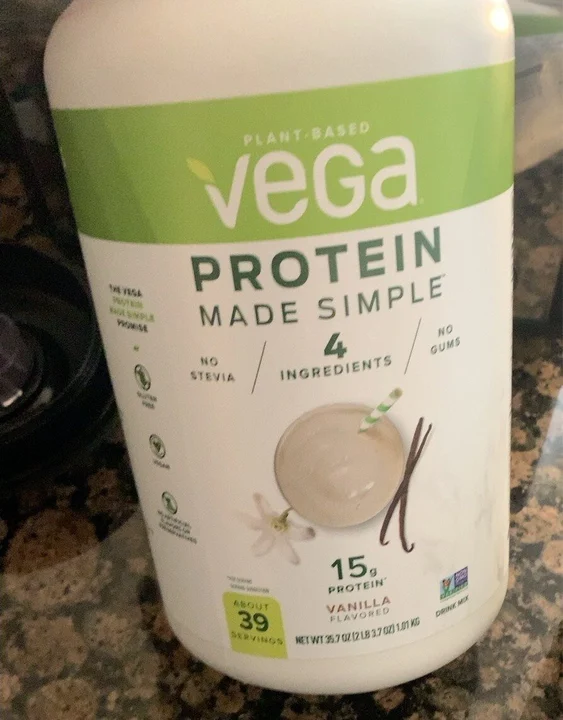 Protein powderDepends on the productchecked Nov 16, 2026
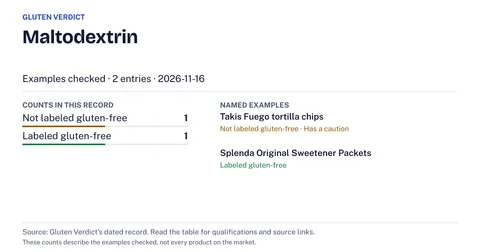 MaltodextrinNaturally gluten-freechecked Nov 16, 2026
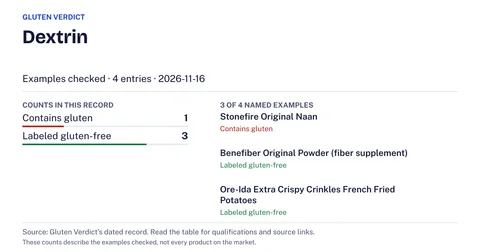 DextrinDepends on the product1 of 4 products we checked contains gluten: Stonefire Original Naanchecked Nov 16, 2026
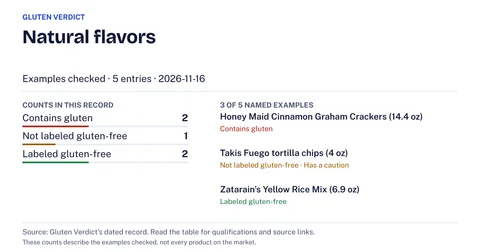 Natural flavorsDepends on the product2 of 5 products we checked contain gluten: Honey Maid Cinnamon Graham Crackers (14.4 oz) and Chex Mix Sour Cream & Onionchecked Nov 16, 2026
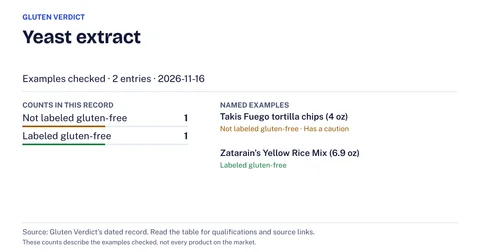 Yeast extractDepends on the productchecked Nov 16, 2026
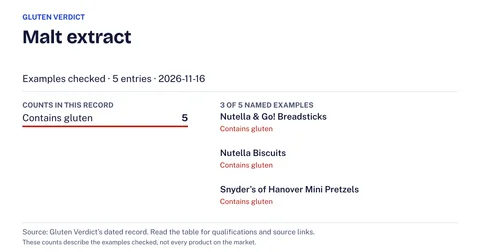 Malt extractContains glutenchecked Nov 16, 2026
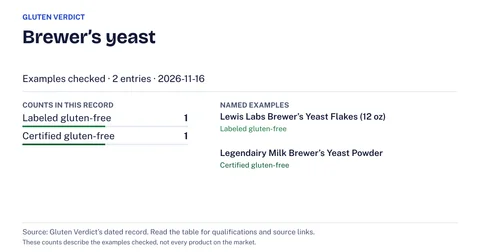 Brewer’s yeastDepends on the productchecked Nov 16, 2026
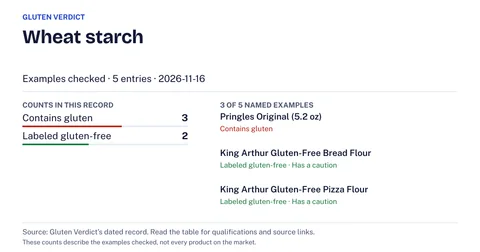 Wheat starchDepends on the product3 of 5 products we checked contain gluten: Pringles Original (5.2 oz), Jiffy Corn Muffin Mix, and Chex Mix Bold Garlic and Herbchecked Nov 16, 2026
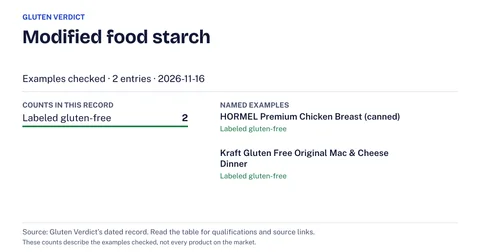 Modified food starchDepends on the productchecked Nov 16, 2026
Questions people ask
Does a supplement have to list wheat if it is in the formula?
On an FDA-regulated supplement, wheat has to be named in the Supplement Facts panel, the ingredient list or a Contains statement16, 21. For other ingredients such as fillers, binders and flavors, it has to be in the ingredient list, a Contains statement, or both1.
If the Contains line does not say wheat, is the supplement free of gluten?
Not necessarily. Barley and rye are not on FDA’s list of major food allergens2, so a Contains line does not have to name them5.
Why does my supplement have no “Other Ingredients” line?
FDA says a supplement with all its source ingredients in the panel and no other ingredients, such as excipients or fillers, does not need an ingredient statement12.
Is maltodextrin made from barley?
The NCA says the name sounds as though it were made from barley malt, but that maltodextrin does not contain barley32. Our maltodextrin verdict has the rest.
More in Medications, supplements and non-food products
 Are vitamins gluten-free? What a bottle’s claim, mark and ingredient list showWhat “gluten-free” on a vitamin bottle rests on (FDA rule, certifier listing or nothing) and how to read Other Ingredients for binders and fillers.
 How to check a medicine for gluten, from the bottle to the makerFind your exact medicine by NDC in DailyMed, read its inactive ingredients, compare refills, and ask the maker about starch names the label leaves open.
 Children’s medicines, gummies and liquids: reading the ingredients for glutenHow to read a children’s medicine, syrup or gummy for gluten: drug or supplement, which list to read, how to match it on DailyMed, and who to ask.
 Gluten in medications: what the label, DailyMed and a pharmacist can showFDA’s gluten-free food rule does not cover drugs. Use the ingredient list, DailyMed, the maker and a pharmacist, and know what each can show.
 What gluten wording on an over-the-counter medicine box meansFind the inactive-ingredient line in Drug Facts and see what each kind of gluten wording on an OTC medicine box has behind it, from silence to a mark.
 Gluten in lipstick, lip balm, shampoo and other cosmeticsWhat celiac organisations say about gluten in lipstick, lip balm, shampoo and creams, what the FDA rule covers, and which ingredient names to check.
All 13 guides in Medications, supplements and non-food products
Related guides
 Who regulates a gluten-free claim on pills, cosmetics, toothpaste and pet foodWhich products FDA’s 20 ppm gluten-free rule covers, and what a gluten-free line on a medicine, cosmetic, toothpaste or pet food rests on.
 How to read a US food label for glutenWhere gluten shows up on a US food label: the gluten-free claim, the Contains line, the ingredient list and may-contain lines, and what each means.
 Wheat, barley and rye on an ingredient list: the names to look forLook up wheat, barley and rye names on a US ingredient list, from durum to malt, and sort each as contains gluten, depends on the maker, or lookalike.
 Where wheat, barley and rye hide in processed food: 15 places to checkFifteen processed foods where wheat, barley or rye turn up, the label step that catches each, and what US allergen law does and does not flag.
Sources
- [1, 7, 11, 16, 17, 18, 19, 20, 21, 22, 23, 39, 47] US Food and Drug Administration, Questions and Answers Regarding Food Allergens, Including the Food Allergen Labeling Requirements of the Federal Food, Drug, and Cosmetic Act (Edition 5): Guidance for Industry, checked Nov 17, 2026.
- [2] US Food and Drug Administration, Frequently Asked Questions: Food Allergen Labeling Guidance for Industry, checked Nov 17, 2026.
- [3, 4, 9, 12, 13, 14, 34] US Food and Drug Administration, Dietary Supplement Labeling Guide: Chapter V. Ingredient Labeling, checked Nov 17, 2026.
- [5, 26, 27, 33, 35, 36, 45] Gluten Intolerance Group, Advanced Label-Reading Tips, checked Nov 17, 2026.
Read on 2026-11-17: the list headed “Barley-Derived Sources of Gluten” names malt, malt extract, malt flavoring and malt syrup; malt vinegar; barley malt; brewer’s yeast (traditionally, when it’s a byproduct of beer brewing); and beer, ale and lager (unless specifically brewed gluten-free).
Read on 2026-11-17: the list headed “Wheat-Derived Sources of Gluten” names wheat starch (unless specifically processed/certified gluten-free, as some EU products are), seitan, farina, semolina, durum, spelt, einkorn, emmer, triticale, bulgur, couscous, graham flour, vital wheat gluten, wheat bran, wheat germ, panko breadcrumbs and hydrolyzed wheat protein, among others.
- [6, 8] US Food and Drug Administration, Dietary Supplement Labeling Guide: Chapter IV. Nutrition Labeling, checked Nov 17, 2026.
- [10, 37, 38, 43, 44] Gluten Intolerance Group, Beauty Supplements (educational bulletin), checked Nov 17, 2026.
- [15] US Food and Drug Administration, Food Allergies, checked Nov 17, 2026.
- [24] Electronic Code of Federal Regulations (eCFR), 21 CFR 101.91 Gluten-free labeling of food, checked Nov 17, 2026.
- [25, 28, 41, 42] US Food and Drug Administration, Questions and Answers on the Gluten-Free Food Labeling Final Rule, checked Nov 17, 2026.
- [29, 30] National Celiac Association, Modified Food Starch, checked Nov 17, 2026.
- [31] National Celiac Association, Is dextrin gluten free?, checked Nov 17, 2026.
- [32] National Celiac Association, Maltodextrin, checked Nov 17, 2026.
- [40] National Institute of Diabetes and Digestive and Kidney Diseases (NIDDK), Definition & Facts for Celiac Disease, checked Nov 17, 2026.
- [46] Gluten Intolerance Group, Are “natural flavors” a concern if I’m gluten-free?, checked Nov 17, 2026.