Are vitamins gluten-free? What a bottle’s claim, mark and ingredient list show
Short answer
A “gluten-free” claim on a vitamin bottle falls under the same FDA definition as food, which requires any unavoidable gluten to be below 20 parts per million3, 1. The claim is voluntary4, and the Celiac Disease Foundation says dietary supplements are not required to disclose gluten9. Check these in order:
- The claim itself: on a supplement it is held to FDA’s definition, and a food that bears it without meeting the definition is deemed misbranded5, 6.
- A certifier’s mark: GFCO counts a product as certified only if it is on GFCO’s list and its package carries the mark14.
- “Other Ingredients”: when some ingredients are named in the Supplement Facts panel, the rest are listed under that heading21, and FDA counts binders, fillers and excipients as ingredients18. The Gluten Intolerance Group says gluten can be found in vitamin and mineral supplements, and in natural and herbal ones can come from added grains or grain-derived ingredients23.
- Still unclear: the Gluten Intolerance Group suggests checking with your pharmacist or the maker26.
Part of Medications, supplements and non-food products, 13 guides
Key points
- FDA says its gluten-free rule applies to dietary supplements and sets requirements for the voluntary use of the claim3, 4.
- The rule states its limit as a concentration: below 20 mg of gluten per kg of the product1.
- GFCO says its standard is no more than 10 ppm gluten, and that a listed product is certified only if its package carries the mark16, 15.
- The Gluten Intolerance Group says gluten in a pill or capsule could be a fiber or binding agent, and that supplement fillers may contain gluten24, 25.
What FDA’s “gluten-free” rule means on a supplement bottle
FDA says its gluten-free regulation applies to FDA-regulated packaged foods, including dietary supplements3. Any product bearing a “gluten-free” claim must comply with 21 CFR 101.915.
The definition has an ingredient part and a gluten-level part. Among the ingredients it excludes is a gluten-containing grain itself2; and any unavoidable gluten must be below 20 ppm, which the rule states as below 20 mg of gluten per kg of the product1. An ingredient made from a gluten grain and processed to remove gluten, such as wheat starch, counts only if the finished product stays under 20 ppm7.
The claim is voluntary: FDA says the regulation establishes requirements for its voluntary use4. A food that carries the claim and fails the definition is deemed misbranded6.
If a gluten-free supplement lists wheat, the rule requires a statement that “The wheat has been processed to allow this food to meet the Food and Drug Administration (FDA) requirements for gluten-free foods”8.
What a bottle’s gluten wording rests on
A bottle falls into one of three situations. The table says who stands behind each and what to check next.
| What the bottle shows | Who stands behind it | What to do next |
|---|---|---|
| “Gluten-free” in the maker’s own wording | The maker, under FDA’s rule5 | Read Other Ingredients as well; the Celiac Disease Foundation advises choosing supplements specifically labeled gluten-free where possible and reviewing ingredient lists12. |
| A certifier’s mark such as GFCO | The certifier, on its own standard: GFCO’s is no more than 10 ppm16 | Look the product up on the certifier’s list; on the GFCO Product Finder a product on the list whose package lacks the mark is not certified15. |
| No gluten wording | Nobody has made a claim. The Celiac Disease Foundation notes dietary supplements are not required to disclose gluten9 | Read the full label. The Gluten Intolerance Group says that for supplements neither labeled nor certified gluten-free, you should always read the label to know what ingredients are used13. |
On testing, the Celiac Disease Foundation says supplement makers are not required to test products for gluten10. The same page says some vitamins and minerals may contain gluten in inactive ingredients or become contaminated during manufacturing11.
The Gluten Intolerance Group says it can vouch only for supplements certified by its own GFCO program13; that is the charity’s statement about its own program, not a ranking of other marks.
What the GFCO finder lists under “vitamin”
We searched the GFCO Product Finder for “vitamin” on 2026-11-17 and read the first page of results17. A listing alone is not certification15.
| Brand | Products listed |
|---|---|
| Country Life | Vitamin D3 Gummies, Vitamin B12 Gummies, Vitamin D3 10,000 IU, Quercetin + Vitamin D317 |
| Herbaland | Prenatal Vitamins, Kids Multivitamins, Womens’ Multivitamin17 |
| Pure Encapsulations | O.N.E. Multivitamin, Vitamin D3 VESIsorb, Vitamin C Chewables, Vitamin D3 & K2, Vitamin K w/D3, Vitamin D3 400 IU17 |
| Truvani | Organic Vitamin C, Organic Vitamin D317 |
| Genexa | Infants’ Vitamin D17 |
| Nutri-Rich | Vitamin K2 MK717 |
| Vegan Life Nutrition | Vitamin C capsules17 |
| O Positiv | FLO PMS Vitamin Capsule17 |
This is a dated snapshot of one search, not a list of recommendations, and listings change. Search the finder again for the exact product and size you hold.
Reading Supplement Facts and “Other Ingredients” together
Under FDA’s labeling guide, the word “ingredient” also covers substances such as binders, colors, excipients, fillers, flavors and sweeteners18.
Ingredients that are sources of dietary ingredients may be listed inside the Supplement Facts panel, as in “Calcium (as calcium carbonate)”, and then need not be repeated in the ingredient list19. The list that follows is headed “Other Ingredients” when some ingredients were identified inside the panel21, and it runs in descending order by weight22.
If every source ingredient sits in the panel and there are no excipients or fillers, FDA says no ingredient statement is needed20. So read both places: the panel for the sources, and Other Ingredients for what binds and fills the tablet, capsule or gummy.
Binders, fillers and grain-derived ingredients to look at
The Gluten Intolerance Group says gluten can be found in herbal, vitamin and mineral supplements, and that in natural and herbal supplements it can be in the form of added grains, grain grasses or ingredients derived from gluten-containing grains23. For a pill or capsule, it says gluten could be a fiber or binding agent24. It adds that many supplements use excipients, or fillers, which may come from wheat or from a gluten-free source such as corn25.
| Name in Other Ingredients | What the source says |
|---|---|
| Maltodextrin | GIG says maltodextrin can be derived from corn, potato, rice and wheat27, and that the finished powder has no gluten proteins even when derived from gluten-containing grains28. That is GIG’s view; our verdict page shows how other organizations treat it. |
| Dextrin and modified food starch | Our verdict pages show what the charities and FDA say about each. |
| Wheat starch | GIG says whether wheat starch is gluten-free depends on how extensively it is processed29. On a gluten-free claim the rule counts it only if the finished product stays under 20 ppm7. |
| Brewer’s yeast | GIG says brewer’s yeast is likely to be sourced from beer during brewing and contain wheat or barley gluten30. |
| “Starch” with no source named | The label does not say the grain, which is a question for the maker. |
Protein powders are another supplement; our protein powder verdict shows what the makers’ pages said on the date we read them. Wheat-free is not the same as gluten-free26.
A single nutrient: the vitamin E example
The Gluten Intolerance Group answers one common worry directly: it says vitamin E is gluten-free, and that confusion arises because vitamin E is sometimes derived from wheat germ oil31. It says the wheat germ oil used to make it is highly processed and is free of gluten protein32.
The pages cited in this guide do not address vitamin D or B12 on their own, so the guide makes no claim about either. They point to the binders, fillers and capsule contents listed above, and to the claim or mark on the bottle.
The 20 ppm rule and the trial amounts, kept apart
Two numbers get mixed up. FDA’s rule is a concentration in the product: below 20 mg of gluten per kg1. A 2007 trial reported daily amounts: one multicenter, double-blind, placebo-controlled study of 49 adults with biopsy-proven celiac disease, treated with a gluten-free diet for at least two years, assigned them to take a capsule containing 0, 10 or 50 mg of gluten daily for 90 days33, 34. Its authors concluded that ingestion of contaminating gluten should be kept lower than 50 mg per day in the treatment of celiac disease35.
We do not convert between the two. A concentration becomes a per-capsule amount only with the weight of the capsule, and this is one trial of 49 adults. What a given amount means for one person is a question for the person’s own care team.
Questions to put to the maker or a pharmacist
The Gluten Intolerance Group suggests checking with a pharmacist or the maker when the ingredient list leaves doubt26. Questions that fit what the sources describe:
- Is the product labeled “gluten-free” under FDA’s definition, or certified by a certifier whose list I can check?5, 14
- What is the source of each binder, filler or starch in Other Ingredients?25
- Does any ingredient come from wheat, barley, rye or an ingredient derived from them?23
- Does the maker test the finished product for gluten? The Celiac Disease Foundation says makers are not required to test10.
Check each new bottle, and read the date on any statement you are given.
Verdicts in this guide
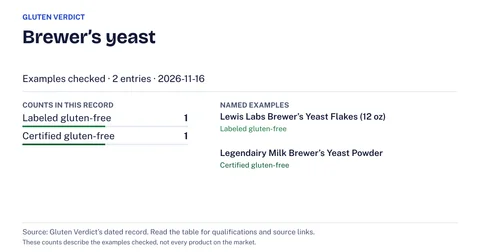 Brewer’s yeastDepends on the productchecked Nov 16, 2026
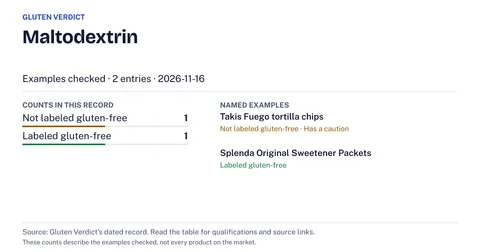 MaltodextrinNaturally gluten-freechecked Nov 16, 2026
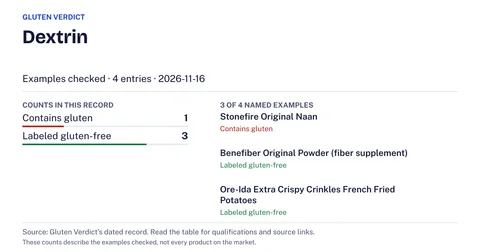 DextrinDepends on the product1 of 4 products we checked contains gluten: Stonefire Original Naanchecked Nov 16, 2026
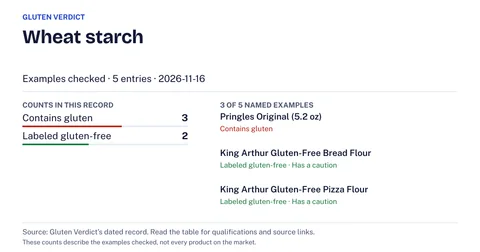 Wheat starchDepends on the product3 of 5 products we checked contain gluten: Pringles Original (5.2 oz), Jiffy Corn Muffin Mix, and Chex Mix Bold Garlic and Herbchecked Nov 16, 2026
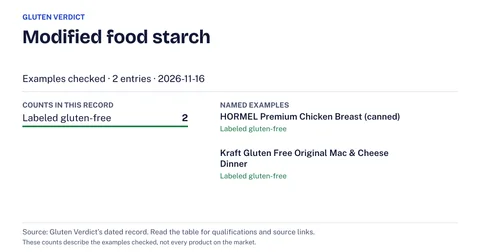 Modified food starchDepends on the productchecked Nov 16, 2026
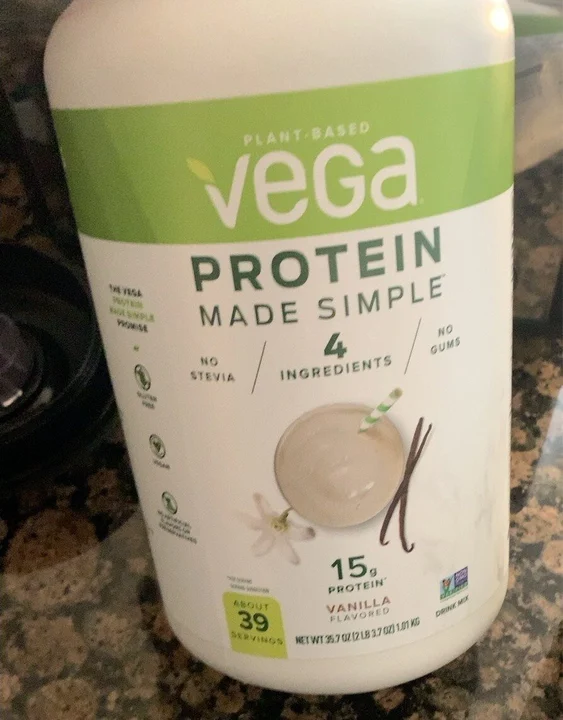 Protein powderDepends on the productchecked Nov 16, 2026
Questions people ask
Do multivitamins contain gluten?
Some can. The Gluten Intolerance Group says gluten can be found in herbal, vitamin and mineral supplements23, and the Celiac Disease Foundation says some vitamins and minerals may contain gluten in inactive ingredients11. The bottle’s Other Ingredients and any claim or mark show which case you are in.
Does a gluten-free claim on a supplement mean it was tested?
The claim must meet FDA’s definition5, but the Celiac Disease Foundation says supplement makers are not required to test products for gluten10.
Is a product on the GFCO list certified?
Only if its package also carries the certification mark; GFCO says a listed product without the mark is not certified15.
Is wheat-free the same as gluten-free on a supplement?
No. The Gluten Intolerance Group says wheat free is not the same as gluten-free26.
More in Medications, supplements and non-food products
 How to check a medicine for gluten, from the bottle to the makerFind your exact medicine by NDC in DailyMed, read its inactive ingredients, compare refills, and ask the maker about starch names the label leaves open.
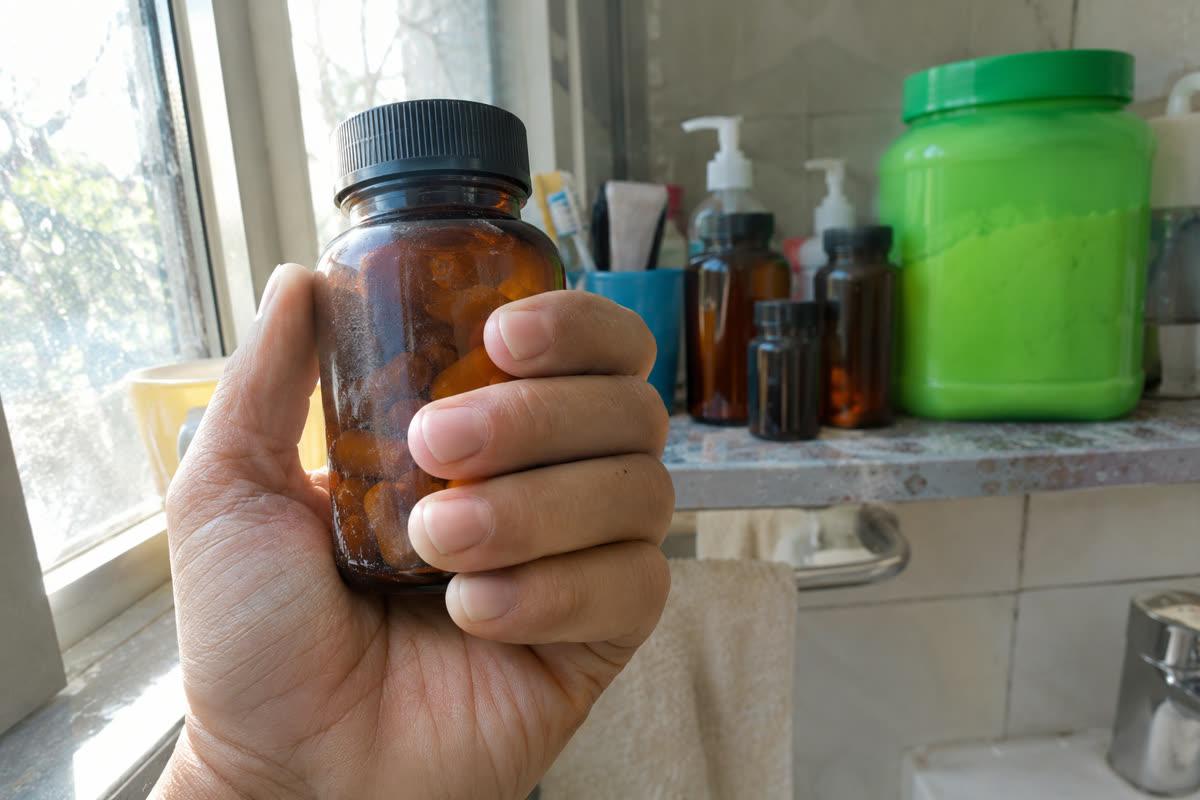 How to read a supplement label for glutenWhere gluten can hide on a US supplement label: the Supplement Facts panel, the Other Ingredients list and the allergen line, and what each leaves out.
 Gluten in medications: what the label, DailyMed and a pharmacist can showFDA’s gluten-free food rule does not cover drugs. Use the ingredient list, DailyMed, the maker and a pharmacist, and know what each can show.
 What gluten wording on an over-the-counter medicine box meansFind the inactive-ingredient line in Drug Facts and see what each kind of gluten wording on an OTC medicine box has behind it, from silence to a mark.
 Children’s medicines, gummies and liquids: reading the ingredients for glutenHow to read a children’s medicine, syrup or gummy for gluten: drug or supplement, which list to read, how to match it on DailyMed, and who to ask.
 Who regulates a gluten-free claim on pills, cosmetics, toothpaste and pet foodWhich products FDA’s 20 ppm gluten-free rule covers, and what a gluten-free line on a medicine, cosmetic, toothpaste or pet food rests on.
All 13 guides in Medications, supplements and non-food products
Related guides
 Supplements for celiac disease: what guidelines test first, and what we found on gut-repair claimsWhat celiac guidelines ask clinicians to test, how supplements follow a result, and which gut-repair claims we found no celiac trial for.
 Prenatal vitamins and gluten: how to check the label and the maker’s statementHow to read a prenatal vitamin’s Other Ingredients list and gluten claim, what to ask the maker, and where folic acid and iron advice comes from.
 Wheat, barley and rye on an ingredient list: the names to look forLook up wheat, barley and rye names on a US ingredient list, from durum to malt, and sort each as contains gluten, depends on the maker, or lookalike.
 Nutrient deficiencies in celiac disease: what the guidance names for checkingWhich nutrients a celiac guideline and a charity's clinician page name for checking, where reported deficiency figures differ, and questions to bring.
Sources
- [1, 2, 6, 7, 8] Electronic Code of Federal Regulations, 21 CFR 101.91: Gluten-free labeling of food, checked Nov 17, 2026.
- [3, 4, 5] US Food and Drug Administration, Questions and Answers on the Gluten-Free Food Labeling Final Rule, checked Nov 17, 2026.
- [9, 10, 11, 12] Celiac Disease Foundation, Gluten in Medicine, Vitamins and Supplements, checked Nov 17, 2026.
- [13, 23, 24] Gluten Intolerance Group, Are Your Medications and Supplements Gluten-Free?, checked Nov 17, 2026.
- [14, 15, 17] GFCO (Gluten Intolerance Group), GFCO Product Finder: vitamin, checked Nov 17, 2026.
Read on 2026-11-17: the first page of results for the search “vitamin” on the GFCO Product Finder lists 25 entries. Nutri-Rich: Vitamin K2 MK7. Herbaland: Prenatal Vitamins (US and Canada), Prenatal Vitamins Case, Kids Multivitamins, Womens’ Multivitamin. Truvani: Organic Vitamin C, Organic Vitamin D3. Country Life: Vitamin D3 Gummies (two entries), Vitamin B12 Gummies, Vitamin D3 10,000 IU (two entries), Quercetin + Vitamin D3. Genexa: Infants’ Vitamin D. Pure Encapsulations: O.N.E. Multivitamin, ONE MULTIVITAMIN 30'S, Vitamin D3 VESIsorb, Vitamin C Chewables, VITAMIN D3 & K2 120'C, Vitamin D3 & K2 60 Ct, VITAMIN K W/D3 60'S UK, VITAMIN D3 400 IU 120'S. Vegan Life Nutrition: VITAMIN C 120 CAPSULES. O Positiv: FLO PMS Vitamin Capsule.
- [16, 27, 28, 29, 30] Gluten Intolerance Group, Are Maltose, Maltodextrin, Glucose Syrup, Yeast Extracts, and Wheat Starch Gluten-Free? (2021), checked Nov 17, 2026.
- [18, 19, 20, 21, 22] US Food and Drug Administration, Dietary Supplement Labeling Guide, Chapter V: Ingredient Labeling, checked Nov 17, 2026.
- [25, 26] Gluten Intolerance Group, Supplementing a Gluten-Free Diet, checked Nov 17, 2026.
- [31, 32] Gluten Intolerance Group, Is vitamin E gluten-free? (GIG FAQ, October 14, 2019), checked Nov 17, 2026.
- [33, 34, 35] PubMed, Catassi et al. 2007, gluten threshold trial in celiac disease (Am J Clin Nutr), checked Nov 17, 2026.