What gluten wording on an over-the-counter medicine box means
Short answer
FDA’s December 2017 draft guidance says it has not set criteria for “gluten-free” statements on oral drug products, so gluten wording on an over-the-counter box for an oral medicine is the maker’s own statement1, 35. Four kinds of wording, and what stands behind each:
- Nothing about gluten: only the required “Inactive ingredients” line in the Drug Facts panel is there to read2.
- “Contains no ingredient made from a gluten-containing grain (wheat, barley, or rye)”: the wording FDA recommends, which it reads as the maker knowing that no ingredient was derived directly or indirectly from those grains3, 4.
- “Gluten-free”: the maker’s own claim, with no FDA criteria behind it for oral drug products and, in 2017, no analytical test method FDA was aware of as validated to detect or quantify gluten in finished drug products at the low levels at which it would generally be expected, if at all1, 5.
- A certification mark: what that certifier’s own program covers; the GFCO page on who may apply does not name medicines6.
Part of Medications, supplements and non-food products, 13 guides
Key points
- The Inactive ingredients line is required in the Drug Facts panel of an OTC product, and for an OTC product that is not also a cosmetic the names are in alphabetical order2.
- For a nonprescription oral drug, FDA’s draft places a voluntary gluten statement outside the Drug Facts label, so read the rest of the box too7.
- FDA says its recommended wording does not describe a drug as gluten-free, because it has not established criteria for gluten-free statements on oral drug products1.
- FDA says the more highly processed starch-derived and fermentation-derived ingredients do not carry a botanical source such as wheat in their established names, so the list alone cannot always answer the question8.
- One brand name can carry different lists and different wording: the two TUMS labels we read on DailyMed differ in both9, 10.
Where the inactive-ingredient line is on the box
An over-the-counter (OTC) medicine carries a Drug Facts panel on the outside container or wrapper of the retail package, or on the immediate container label when there is no outer package11. FDA says its regulation puts the information on all OTC labels in the same order12. One of the headings is “Inactive ingredients”, which FDA describes as substances such as binders, colors or flavorings13.
- Find the box headed “Drug Facts”. When it runs onto another panel, the top of that panel reads “Drug Facts (continued)”14.
- Read down to the heading “Inactive ingredients”. The rule asks for the established name of each inactive ingredient, and for an OTC product that is not also a cosmetic, alphabetical order2.
- Check each name against the table further down this page. Our gluten scanner flags words that name wheat, barley, rye, malt or oats in a photo of the label or in pasted text; it cannot tell you the grain behind a name such as “modified starch”.
Gluten wording is a separate matter. FDA’s draft guidance says a voluntary gluten statement on a nonprescription oral drug product should be visible at the time of purchase and appear on the immediate container label and carton labeling in a location outside the Drug Facts label7. So look at the front, back and side panels as well.
Supplements follow different rules. FDA says the Drug Facts requirements do not apply to dietary supplements, which are regulated as food products and carry a Supplement Facts panel15.
Why “gluten-free” on a medicine has no FDA definition behind it
The Gluten Intolerance Group (GIG) says medications, prescription or over the counter, are not included in the FDA gluten-free labeling regulation that applies to FDA-regulated food products16.
What FDA has done for oral drug products is recommend wording. Its December 2017 draft guidance recommends that makers that wish to make a statement about gluten use, when truthful and substantiated, “Contains no ingredient made from a gluten-containing grain (wheat, barley, or rye)”17, 3. FDA says that statement does not describe a drug as gluten-free, because it has not established criteria for gluten-free statements on oral drug products1. FDA’s consumer page on medications and gluten describes the same recommendation18.
The document we read is a draft. It says that when finalized it will represent FDA’s current thinking, and that it is not binding on FDA or the public19. Check the date on any FDA page you rely on.
What it means when the box says nothing about gluten
Silence is not a statement: a box with no gluten wording tells you nothing either way, and you are left with the ingredient list. For oral drug products as a group, FDA’s consumer page says:
- The majority of orally administered drug products either contain no gluten or virtually no gluten20.
- Based on information available to it, FDA was aware of no oral drug product marketed in the United States with wheat gluten or wheat flour intentionally added as an inactive ingredient, and it would expect any such product to list it21.
- FDA had identified very few oral drugs that contain wheat starch as an ingredient22.
- In the very rare cases where gluten may be present, FDA estimated, based on drug formulation information, that wheat starch and other wheat-derived ingredients would contribute no more than 0.5 mg gluten to a unit dose of an oral drug product23.
Those are FDA’s statements about oral drug products in general, on a page marked as current as of 12/12/201755, not about the box in your hand. FDA’s page adds that if the list of ingredients does not mention wheat gluten or wheat flour, the product should not contain gluten in an amount that would harm a typical (non-refractory) individual with celiac disease24. In the draft guidance, FDA says that if wheat gluten were an added ingredient and the labeling did not disclose it, it would consider whether the product is misbranded25.
Names on the list that do not name their grain
This is where silence is hardest to read. FDA’s draft guidance says a wheat-derived ingredient that is the subject of a monograph in an official compendium must use the monograph title as its established name where no official name has been designated under section 508 of the FD&C Act, so wheat starch is listed as “wheat starch” and not “starch”26. But FDA says the more highly processed starch-derived and fermentation-derived ingredients do not carry a botanical source such as wheat in their established names8.
| Name on the line | What the draft guidance says |
|---|---|
| wheat starch | FDA believed it is added to oral drug products only very rarely, and that other starch sources, such as corn and potato, are more common27. It must be listed as wheat starch26. |
| Modified starch, pregelatinized starch, sodium starch glycolate (our page: modified food starch) | Listed by FDA among ingredients potentially derived from wheat starch28. FDA also says the starch used for these is often corn or potato starch, not wheat starch29. |
| maltodextrin, dextrates, dextrose, maltose, sorbitol, xylitol, maltitol, mannitol (our page for dextrin) | Named by FDA as starch hydrolysates and related ingredients that fall in the same potentially-wheat-derived category30. |
| Citric acid, ethanol | FDA says some ingredients, including citric acid and ethanol, may be produced by fermentation53. If the fermentation medium includes wheat or wheat-derived ingredients, an ingredient may, depending on how it is purified, contain small amounts of gluten31. FDA adds that it is unlikely gluten (or any protein) would be present in ethanol purified by distillation using good manufacturing practices54. |
| corn starch | One of the starch sources FDA says is more commonly used in pharmaceutical products than wheat starch27. |
A name you cannot place is a reason to look the product up, not a verdict. Our ingredient pages cover many of these names.
The kinds of wording, and what stands behind each
| Wording on the box | What stands behind it | What it does not tell you |
|---|---|---|
| Nothing about gluten | The required Inactive ingredients line2. FDA points to that line, and to DailyMed, as the places to find a product’s ingredients32. | Whether a listed ingredient came from wheat, barley or rye when its name does not say (table above)8. |
| “Contains no ingredient made from a gluten-containing grain (wheat, barley, or rye)”, or close to it | FDA’s recommended wording. FDA reads it to mean the maker knows no ingredient was derived directly or indirectly from wheat, barley or rye4, and says substantiation should include a written commitment from ingredient suppliers33. | That the finished product was tested for gluten. FDA says the recommended statement does not describe a drug as gluten-free1. |
| “Gluten-free” | The maker’s own claim. FDA has not established criteria for gluten-free statements on oral drug products1, had not decided whether such a statement should mean no intact gluten or also no gluten peptides34, and says firms are responsible for the truthfulness of their gluten-related statements35. | What the maker checked. For statements other than the recommended one, FDA says the supporting information could vary by product36. |
| “Gluten-free” read as “tested” | In 2017 FDA was not aware of analytical test methods validated to detect or quantify gluten in finished drug products at the low levels at which it would generally be expected to be present, if at all5. A scoping review reports that many makers who believed their products were devoid of gluten did not certify or test the gluten-free status of the final products37. | Whether any test was run. Only the maker can say. |
The review also describes a 1998 US survey in which only 5 out of 100 pharmaceutical companies reported having a policy for producing gluten-free products38. That survey is old, so treat it as history, not as a count of today’s makers.
A maker’s statement is where to start asking, not where to stop. GIG says most drug makers do not clearly label products or packaging with gluten content39, and that if you have doubts, you can consult your pharmacist and/or check with the maker40.
What a certification mark on a medicine box covers
A certification mark stands for the certifier’s own program, not for an FDA definition. GIG’s GFCO program says it certifies physical products displaying its mark, not brands or facilities41. Its page on how it certifies food describes one part of its standard: if any gluten above 10ppm is detected in a product or its ingredients, GFCO-certified brands must provide those results to the GFCO team immediately, before the product leaves the production facility42.
On who may apply, the GFCO page names “food, beverages, nutritional products, supplements, or personal care items” and does not mention medicines or drugs6. GIG’s page on medications and supplements says it can only vouch for the gluten-free status of GFCO-certified supplements43.
For a mark on a medicine box, three things are worth asking: which certifier it is, whether that certifier’s standard covers medicines, and whether its own product listing includes this exact product. The box cannot answer them; the certifier’s pages can.
Store brand, name brand, same active ingredient
Two boxes can share an active ingredient and still differ in what else is inside. FDA’s draft guidance, discussing generic drugs approved on an abbreviated application, says differences in labeling between a generic and its reference product may reflect permissible differences in the formulation, such as permissible differences in inactive ingredients44. A brand name does not fix the list either: FDA says OTC makers sometimes change products or labeling, and many OTC medicines have similar brand names with different active ingredients45.
One brand name, two labels
On 2026-11-17 we read two DailyMed labels from one maker, Haleon. The TUMS ULTRA label lists inactive ingredients by flavor, none of them dextrin or maltodextrin, and its label text includes the line “Gluten-Free”9. The TUMS Chewy Bites Strawberries and Cream label has an Inactive ingredients line that includes corn starch, dextrin and maltodextrin, and its label text has no gluten wording at all10. We draw no conclusion about gluten from either label. The point is that two boxes under one brand name carry different lists and different wording. Our pages on dextrin and maltodextrin cover those two names.
Checking one box end to end
- Read the Inactive ingredients line on the box and mark any name from the table above2.
- Look at the rest of the box for gluten wording. For a nonprescription oral drug, FDA’s draft places a voluntary statement outside the Drug Facts label7.
- Find the NDC on the outside packaging46. It identifies the labeler, product and trade package size47.
- Search DailyMed by NDC, drug name or manufacturer48. It holds the most recent labeling companies have submitted to FDA49. FDA says the product name and manufacturer on the label should match the product you are holding50.
- Compare DailyMed’s inactive ingredients with the box. DailyMed’s Advanced Search can also search by inactive ingredient51.
- If a name or a line of wording is still unclear, GIG names the pharmacist and the maker40. FDA encourages makers to have accurate information on the sources of their ingredients available to answer questions52.
For prescription labels, refills and more on each route, our guides on gluten in medications and on how to check a medicine for gluten go further, and there is a separate guide for children’s liquids and gummies.
Where our pages help
Our verdict pages cover foods and ingredients: every verdict, A to Z and the ingredient pages. For a medicine, the statement that counts is the maker’s, for the exact product, which is why this page sends you to DailyMed and the maker rather than to a list.
Verdicts in this guide
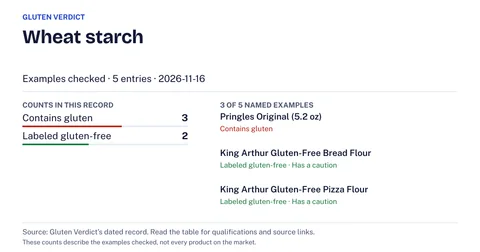 Wheat starchDepends on the product3 of 5 products we checked contain gluten: Pringles Original (5.2 oz), Jiffy Corn Muffin Mix, and Chex Mix Bold Garlic and Herbchecked Nov 16, 2026
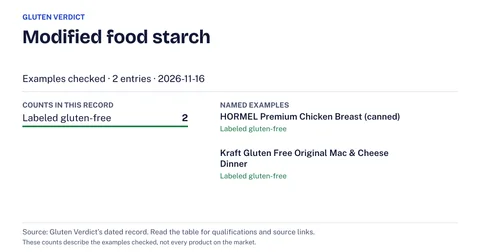 Modified food starchDepends on the productchecked Nov 16, 2026
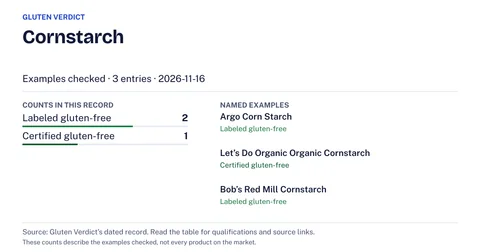 CornstarchNaturally gluten-freeBuy it labeled gluten-freechecked Nov 16, 2026
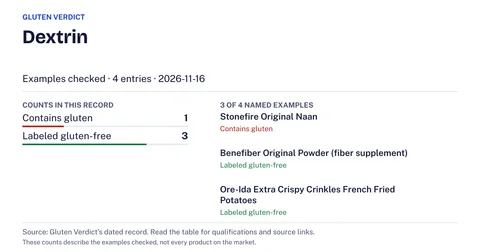 DextrinDepends on the product1 of 4 products we checked contains gluten: Stonefire Original Naanchecked Nov 16, 2026
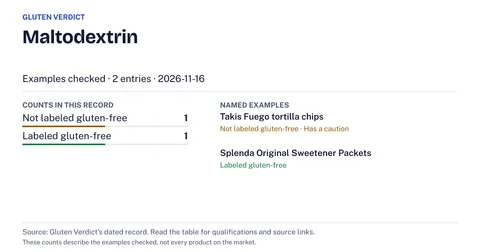 MaltodextrinNaturally gluten-freechecked Nov 16, 2026
Questions people ask
Does “gluten-free” on a medicine box mean it was tested?
No FDA rule says so. FDA’s draft guidance says it has not established criteria for gluten-free statements on oral drug products1 and that in 2017 it was not aware of analytical test methods validated to detect or quantify gluten in finished drug products at the low levels at which it would generally be expected, if at all5. Ask the maker what its statement rests on.
Where is the inactive-ingredient list on an OTC box?
Under the heading “Inactive ingredients” in the Drug Facts panel2. FDA also points to DailyMed for the label of the exact product32.
Do store-brand and name-brand versions have the same inactive ingredients?
Not necessarily. FDA’s draft guidance notes permissible differences in inactive ingredients between a generic drug and its reference product44. Compare each box’s own list.
More in Medications, supplements and non-food products
 How to check a medicine for gluten, from the bottle to the makerFind your exact medicine by NDC in DailyMed, read its inactive ingredients, compare refills, and ask the maker about starch names the label leaves open.
 Gluten in medications: what the label, DailyMed and a pharmacist can showFDA’s gluten-free food rule does not cover drugs. Use the ingredient list, DailyMed, the maker and a pharmacist, and know what each can show.
 Are vitamins gluten-free? What a bottle’s claim, mark and ingredient list showWhat “gluten-free” on a vitamin bottle rests on (FDA rule, certifier listing or nothing) and how to read Other Ingredients for binders and fillers.
 How to read a supplement label for glutenWhere gluten can hide on a US supplement label: the Supplement Facts panel, the Other Ingredients list and the allergen line, and what each leaves out.
 Children’s medicines, gummies and liquids: reading the ingredients for glutenHow to read a children’s medicine, syrup or gummy for gluten: drug or supplement, which list to read, how to match it on DailyMed, and who to ask.
 Gluten in lipstick, lip balm, shampoo and other cosmeticsWhat celiac organisations say about gluten in lipstick, lip balm, shampoo and creams, what the FDA rule covers, and which ingredient names to check.
All 13 guides in Medications, supplements and non-food products
Related guides
 Nutrient deficiencies in celiac disease: what the guidance names for checkingWhich nutrients a celiac guideline and a charity's clinician page name for checking, where reported deficiency figures differ, and questions to bring.
 A gluten-free label that lists wheat or wheat starch: what it meansHow a US pack can say gluten-free and still list wheat starch or “wheat”, the statement FDA requires, and what to ask the maker.
 Wheat, barley and rye on an ingredient list: the names to look forLook up wheat, barley and rye names on a US ingredient list, from durum to malt, and sort each as contains gluten, depends on the maker, or lookalike.
 Prenatal vitamins and gluten: how to check the label and the maker’s statementHow to read a prenatal vitamin’s Other Ingredients list and gluten claim, what to ask the maker, and where folic acid and iron advice comes from.
Sources
- [1, 3, 4, 5, 7, 8, 17, 19, 25, 26, 27, 28, 29, 30, 31, 33, 34, 35, 36, 44, 53, 54] US Food and Drug Administration, Gluten in Drug Products and Associated Labeling Recommendations (draft guidance, December 2017), checked Nov 17, 2026.
- [2, 11, 14] eCFR, 21 CFR 201.66 Format and content requirements for over-the-counter (OTC) drug product labeling, checked Nov 17, 2026.
- [6, 41, 42] Gluten Intolerance Group, GFCO, How Does GFCO Certify Gluten-Free Food?, checked Nov 17, 2026.
Read on 2026-11-17: the sentence that says who may apply to have products certified names “food, beverages, nutritional products, supplements, or personal care items”; the page does not mention medicines or drugs.
- [9] Haleon US Holdings LLC (via DailyMed), DailyMed label: TUMS ULTRA (calcium carbonate) chewable tablets, checked Nov 17, 2026.
Read on 2026-11-17 (DailyMed label text for TUMS ULTRA, Haleon, version 21 listed as published Sep 30, 2026): the Drug Facts text has “Inactive ingredients” lines by flavor, for Assorted Fruit “adipic acid, corn starch, FD&C blue #1 lake, FD&C red #40 lake, FD&C yellow #5 (tartrazine) lake, FD&C yellow #6 lake, flavors, mineral oil, sodium polyphosphate, sucrose, talc”; neither dextrin nor maltodextrin is named in any of them; and the label text includes a line reading “Gluten-Free” just before the “Principal Display Panel – Assorted Fruit” entry.
- [10] Haleon US Holdings LLC (via DailyMed), DailyMed label: TUMS Chewy Bites Strawberries and Cream (calcium carbonate) chewable tablets, checked Nov 17, 2026.
Read on 2026-11-17 (DailyMed label text for TUMS Chewy Bites Strawberries and Cream, Haleon, version 3 listed as published Nov 02, 2026): the “Inactive ingredients” line reads “acacia, beeswax, carnauba wax, citric acid, coconut oil, corn starch, corn syrup, dextrin, FD&C red no. 40, FD&C red no. 40 aluminum lake, FD&C yellow no. 5 aluminum lake (tartrazine), maltodextrin, medium-chain triglycerides, natural and artificial flavors, pharmaceutical ink, phosphoric acid, propylene glycol, purified water, shellac, sodium benzoate, sorbic acid, sorbitol, soy lecithin, sucrose, titanium dioxide, vegetable oil”; the word “gluten” does not appear anywhere in the label text.
- [12, 13, 15, 45] US Food and Drug Administration, The Over-the-Counter Drug Facts Label, checked Nov 17, 2026.
- [16, 39, 40, 43] Gluten Intolerance Group, Are Your Medications and Supplements Gluten-Free?, checked Nov 17, 2026.
- [18, 20, 21, 22, 23, 24, 32, 50, 52, 55] US Food and Drug Administration, Medications and Gluten, checked Nov 17, 2026.
Read on 2026-11-17: the footer of the page reads “Content current as of: 12/12/2017”.
- [37, 38] Systematic Reviews (PubMed Central), Gluten in pharmaceutical products: a scoping review, checked Nov 17, 2026.
- [46, 47, 48, 51] US National Library of Medicine, DailyMed help: search and NDC codes, checked Nov 17, 2026.
Read on 2026-11-17: the Advanced Search help lists “INACTIVE INGREDIENT” among the types of information that can be searched, described as “Inactive Ingredients contained in the drug”.
- [49] US National Library of Medicine, DailyMed home page: About DailyMed, checked Nov 17, 2026.