Probiotics and celiac disease: what reviews say and how to check the label
Short answer
The 2020 meta-analysis reported that probiotics may improve GI symptoms but rated the certainty of its evidence very low to low20, 19, and Coeliac UK says there is not enough evidence to recommend probiotics for people with coeliac disease2. Whether a particular probiotic contains gluten is a separate question, answered from the bottle:
Part of Medications, supplements and non-food products, 13 guides
Key points
- The 2020 meta-analysis found 6 trials eligible for quantitative analysis and rated the certainty of its evidence very low to low18, 19.
- The Celiac Disease Foundation says there is no evidence-based research to support probiotics treating celiac disease symptoms, and Coeliac UK says there is not enough evidence to recommend them10, 2.
- In the UK, probiotics are classed as food supplements, and Coeliac UK says some could contain gluten7, 6.
- GFCO says a product is considered certified if it appears on its list and carries one of its marks32.
What do published reviews say about probiotics in celiac disease?
Two systematic reviews with meta-analysis, from 2020 and 2023, pooled clinical trials of probiotics in celiac disease18, 15. A 2020 review in the American Journal of Gastroenterology found 6 randomized trials with 279 participants eligible for quantitative analysis, and reported that the overall certainty of the evidence ranged from very low to low18, 19. Its authors concluded that probiotics may improve gastrointestinal symptoms and that high-quality clinical trials are needed20. The same abstract reports no difference in GI symptoms when different questionnaires were pooled38. A correction to that article was published in 202121.
A 2023 review in Clinical and Experimental Medicine screened 7,234 articles; 14 were included in its qualitative analysis and 5 in its quantitative analysis15. Its authors wrote that probiotics might alleviate gastrointestinal symptoms and immune response and improve dysbiosis, and that high-quality clinical trials are needed to increase the level of evidence16. It reported no increase in adverse events compared with placebo17.
For children, a 2021 systematic review included four randomized trials22, all with patients receiving Bifidobacterium strains37. Its authors called for larger multicentre studies with longer follow-up23.
Read these as limits on what is known, not as a recommendation. All three reviews call for better or larger studies16, 20, 23.
What do celiac charities say?
Coeliac UK, the UK charity, says there is very little evidence to support health claims made about probiotics and prebiotics in general1. It adds that although some studies suggested probiotics have some positive effects on symptoms, there is not enough evidence to recommend probiotics in people with coeliac disease2.
The Celiac Disease Foundation (US) said in 2015 that there is no evidence-based research to support the ability of probiotics to treat celiac disease symptoms, while many patients take them believing they promote gut health10. In a 2021 post on a national survey, it reported that roughly one-third of celiac patients said they used probiotics for perceived health benefits, despite the lack of evidence that probiotics are an effective treatment for celiac disease symptoms13. The survey drew on 1,160 patient responses14.
NIDDK’s page on eating, diet and nutrition in celiac disease does not mention probiotics36.
Probiotic, prebiotic, synbiotic: what the words mean
| Term | What it is |
|---|---|
| Probiotic | Live bacteria or yeast thought to have health benefits when consumed as a food supplement or added to foods such as yogurt3 |
| Prebiotic | A source of food for the gut bacteria; found in plant foods such as asparagus, artichokes, tomato, garlic and onions, and can be manufactured and added to foods or supplements4 |
| Synbiotic | A combination of probiotics and prebiotics5 |
In the UK, Coeliac UK says probiotics and prebiotics are classed as food supplements rather than medicine7. That matters for the label check below.
Can a probiotic contain gluten?
Some can12. Coeliac UK says some over-the-counter probiotics and prebiotics could contain gluten, so it is important to always check the label6. Gluten Intolerance Group (GIG) says gluten is more prevalent in supplements than in medications24, and that in natural and herbal supplements it can come from added grains, grain grasses or ingredients derived from gluten-containing grains26. For a pill or capsule, GIG says gluten could be a fiber or binding agent27.
In 2015 the Celiac Disease Foundation noted that probiotics are regulated as a dietary supplement rather than a biological product, so there is little, if any, requirement to validate gluten purity or content before marketing11. It also reported that Columbia University researchers bought 22 of the most popular probiotic brands and tested their gluten composition: 12 contained a detectable level of gluten, and of those 12, eight were labeled gluten-free, with two exceeding the FDA gluten-free labeling standard12. That was one test of 22 brands reported in 2015, and the Foundation’s post names no brands, so it cannot be used to judge any product sold today.
How to check a probiotic for gluten, step by step
- Look for a “gluten-free” claim. In the US, FDA’s gluten-free rule applies to FDA-regulated packaged foods, including dietary supplements28. A food bearing the claim must have any unavoidable gluten below 20 parts per million30.
- Read the ingredient list and “other ingredients” line anyway. GIG’s advice for supplements is to look for products that are certified or labeled gluten-free, or to read the ingredients carefully25.
- If the bottle carries a certification mark, check it against the certifier’s directory. GFCO says a product is considered certified if it appears on its list and carries one of its marks32; a listed product whose packaging has no mark is not certified33. The directory has categories for “Enzymes or Probiotics” and “Nutritionals or Supplements”34.
- For a fermented product, such as yogurt or beer, FDA says fermentation is not considered a process to remove gluten and conventional tests may not accurately detect gluten in fermented foods29. Where no scientifically valid test method is available because the food is fermented, the rule requires makers of foods bearing the claim to keep records demonstrating adequate assurance of, among other things, that the food was gluten-free before fermentation and that the maker evaluated its processing for gluten cross-contact31.
Coeliac UK says some countries in Europe sell probiotics and supplements with the Crossed Grain Trademark, which it describes as showing products have been through extra checks on gluten content and manufacturing39, 40. It says that, as of our reading on 2026-11-17, no probiotics, prebiotics or supplements manufactured in the UK carry it8.
Probiotic foods and drinks: what our verdicts show
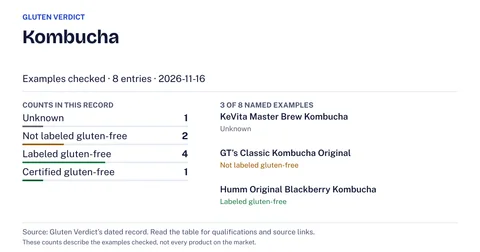
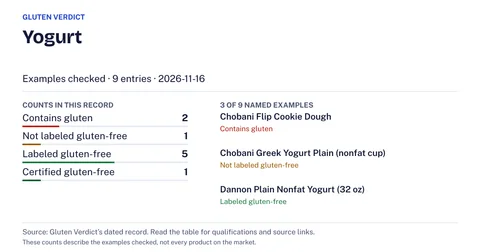
Two fermented foods related to this topic are in our verdicts. Yogurt is a case where the flavor and the mix-ins decide, and kombucha varies by product, with hard kombucha singled out for a label check. Both pages show what each maker’s own pages said and the date we read them.
What this page does not do
It does not rank probiotic brands, recommend a strain or dose, or say that a probiotic will help or will not help any person. Those are questions for a clinician. The research above is a summary of what the reviews and charities report, and new trials may change it.
Who to ask about probiotics
Coeliac UK says anyone considering food supplements for coeliac disease should speak to their local healthcare team9. NIDDK says a doctor or registered dietitian can help with what to eat and drink35. For the gluten question on a particular bottle, the maker’s own label, claim and certification are the places to check.
Verdicts in this guide
Questions people ask
Do probiotics help celiac disease?
The 2020 meta-analysis reported that probiotics may improve gastrointestinal symptoms, rated the certainty of its evidence very low to low and called for better trials19, 20; the 2023 review said probiotics might alleviate GI symptoms16. Coeliac UK says there is not enough evidence to recommend them2.
Are probiotics gluten-free?
Not always. Coeliac UK says some over-the-counter probiotics could contain gluten, so the label has to be checked6.
Does FDA’s gluten-free rule cover probiotic supplements?
FDA says its gluten-free rule applies to FDA-regulated packaged foods, including dietary supplements28.
Does fermentation remove gluten?
No. FDA says fermentation is not considered a process to remove gluten29.
More in Medications, supplements and non-food products
 Supplements for celiac disease: what guidelines test first, and what we found on gut-repair claimsWhat celiac guidelines ask clinicians to test, how supplements follow a result, and which gut-repair claims we found no celiac trial for.
 Gluten and vaccines: how to read the ingredient information yourselfFind a vaccine’s FDA package insert and ingredient list, see what two inserts name, and learn what the lists cannot show.
 Gluten-digesting enzyme pills: what the trials found and what the labels sayWhat the Gluten Intolerance Group says about enzyme pills, what published trials measured, and how to read a capsule's label wording.
 How to read a supplement label for glutenWhere gluten can hide on a US supplement label: the Supplement Facts panel, the Other Ingredients list and the allergen line, and what each leaves out.
 How to check a medicine for gluten, from the bottle to the makerFind your exact medicine by NDC in DailyMed, read its inactive ingredients, compare refills, and ask the maker about starch names the label leaves open.
 Gluten in lipstick, lip balm, shampoo and other cosmeticsWhat celiac organisations say about gluten in lipstick, lip balm, shampoo and creams, what the FDA rule covers, and which ingredient names to check.
All 13 guides in Medications, supplements and non-food products
Related guides
 Are vitamins gluten-free? What a bottle’s claim, mark and ingredient list showWhat “gluten-free” on a vitamin bottle rests on (FDA rule, certifier listing or nothing) and how to read Other Ingredients for binders and fillers.
 The gut microbiome and celiac disease: what studies have measuredWhat studies have measured about gut bacteria in celiac disease, what probiotic trials found, and what guidelines say, so you can sort a claim.
 What to eat after a celiac diagnosis: what the sources document and what they do notBone broth, collagen, glutamine or plain staples? What NIDDK, ACG and celiac charities document after a diagnosis, and what no page we read names.
 Vitamin D with celiac disease: reading a result and checking a supplement for glutenWhat a vitamin D blood result measures, the published reference levels and upper intake level, and how to check a supplement label for gluten.
Sources
- [1, 2, 3, 4, 5, 6, 7, 8, 9, 39, 40] Coeliac UK, Probiotics and prebiotics, checked Nov 17, 2026.
- [10, 11, 12] Celiac Disease Foundation, Probiotics, Your Friend or Foe? (2015), checked Nov 17, 2026.
- [13, 14] Celiac Disease Foundation, Study on Probiotic Use in Celiac Disease Utilizes iCureCeliac Data (2021), checked Nov 17, 2026.
- [15, 16, 17] PubMed, The effects of probiotics on gastrointestinal symptoms and microbiota in patients with celiac disease: a systematic review and meta-analysis on clinical trials (Clin Exp Med 2023), checked Nov 17, 2026.
- [18, 19, 20, 21, 38] PubMed, Probiotics for Celiac Disease: A Systematic Review and Meta-Analysis of Randomized Controlled Trials (Am J Gastroenterol 2020), checked Nov 17, 2026.
Read on 2026-11-17: PubMed lists a correction for this article, “Correction to: Probiotics for Celiac Disease: A Systematic Review and Meta-Analysis of Randomized Controlled Trials”, Am J Gastroenterol 2021;116(9):1968 (PMID 34240715); the record gives no detail of what was corrected.
- [22, 23, 37] PubMed, The role of probiotics in the immune response and intestinal microbiota of children with celiac disease: a systematic review (Rev Paul Pediatr 2021), checked Nov 17, 2026.
- [24, 25, 26, 27] Gluten Intolerance Group, Are Your Medications and Supplements Gluten-Free?, checked Nov 17, 2026.
- [28, 29] US Food and Drug Administration, Questions and Answers on the Gluten-Free Food Labeling Final Rule, checked Nov 17, 2026.
- [30, 31] eCFR, 21 CFR 101.91 Gluten-free labeling of food, checked Nov 17, 2026.
- [32, 33, 34] Gluten Intolerance Group, GFCO, GFCO Product Finder, checked Nov 17, 2026.
Read on 2026-11-17: the product finder’s category list includes “Enzymes or Probiotics” and “Nutritionals or Supplements”.
- [35, 36] National Institute of Diabetes and Digestive and Kidney Diseases, Celiac Disease: Eating, Diet, and Nutrition, checked Nov 17, 2026.
Read on 2026-11-17: no mention of probiotics anywhere on the page “Celiac Disease: Eating, Diet, and Nutrition”.