Wheat-dependent exercise-induced anaphylaxis (WDEIA): a wheat allergy that needs a co-factor
Short answer
WDEIA is a wheat allergy in which reactions, sometimes anaphylaxis, occur when wheat is eaten together with a co-factor such as exercise, NSAIDs or alcohol52. Allergy & Anaphylaxis Australia says exercise-induced anaphylaxis should be diagnosed and managed by an allergy specialist27, ASCIA says celiac disease is not an allergy6, and Mayo Clinic says signs of anaphylaxis are a medical emergency33.
Part of Celiac diagnosis, testing and gluten sensitivity, 25 guides

Key points
- WDEIA is a wheat allergy, not celiac disease: celiac disease is autoimmune, is not an allergy, and does not depend on exercise30, 6.
- A reaction occurs when wheat is eaten together with a co-factor such as exercise, and ASCIA says the exercise can include low-impact activity such as walking52, 4.
- Diagnosis rests on history and allergy testing, which can include blood testing for omega 5 gliadin; a negative provocation test does not by itself rule it out13, 66.
- Epinephrine is the first-line treatment for anaphylaxis, and antihistamines never take its place31, 50.
- Gluten-free and wheat-free are not the same instruction for everyone with WDEIA: ASCIA describes different diets for different people, and ACAAI notes that a gluten-free claim covers rye and barley too11, 42.
What is wheat-dependent exercise-induced anaphylaxis?
A 2023 review describes wheat-dependent exercise-induced anaphylaxis (WDEIA) as an IgE-mediated food allergy, with symptoms ranging from intermittent urticaria (hives) to severe anaphylaxis, that occurs when wheat is eaten together with an augmenting co-factor such as exercise, non-steroidal anti-inflammatory drugs (NSAIDs) or alcohol52.
ASCIA, the professional body of allergy specialists in Australia and New Zealand1, calls the wider group food-dependent exercise-induced anaphylaxis (FDEIA) a rare disorder and says WDEIA is its most common cause2, 3. AAAAI, the US allergy academy, says exercise can rarely cause anaphylaxis, that it does not follow every exercise session, and that in some cases it happens only after eating certain foods before exercise44.
The wheat and the co-factor are both part of the picture. A 2023 review of FDEIA says patients can exercise, or eat the trigger food, separately without any allergic reaction65. ASCIA says that in people with confirmed WDEIA, wheat eaten without exercise or another co-factor within two to four hours usually does not cause symptoms, though some people can have anaphylaxis after wheat without any known co-factor9. Mayo Clinic describes it as a form of wheat allergy in which some people develop symptoms only if they exercise within a few hours after eating wheat32.
How it differs from celiac disease and from other wheat allergy
| Condition | What the sources say |
|---|---|
| Celiac disease | An autoimmune disease: antibodies are produced in response to gluten, causing inflammation and damage to the lining of the small intestine30. ASCIA says it is not an allergy and does not depend on exercise or other co-factors6. |
| Wheat allergy | An IgE-mediated reaction to proteins in wheat, with typical allergy symptoms of the skin, gut and airways, and anaphylaxis in some people29. ASCIA says anaphylaxis to wheat can occur without exercise or other co-factors5. |
| WDEIA | A wheat allergy in which reactions, from hives to severe anaphylaxis, occur when wheat is eaten together with a co-factor such as exercise, NSAIDs or alcohol52. |
ACAAI adds that “gluten allergy” is a misleading term, commonly confused with wheat allergy or sometimes celiac disease40. It also notes that some digestive symptoms of wheat allergy overlap with those of gluten sensitivity or celiac disease, which is why it calls an accurate diagnosis crucial39.
What sets a reaction off besides wheat?
ASCIA says co-factors can lower a person’s threshold for FDEIA reactions7. Besides exercise, its list is alcohol, heat (a hot bath, or being outside on a hot day) and NSAIDs such as aspirin and ibuprofen8. Allergy & Anaphylaxis Australia lists more that may lead to symptoms with less exercise: infections, lack of sleep or tiredness, hot and humid weather, alcohol, spicy food, pollen season for people allergic to pollen, and hormones when a person has their period21.
How much exercise counts varies. ASCIA says it can include low-impact activity such as walking4. Allergy & Anaphylaxis Australia says some people can react to everyday activity such as lifting boxes, housework or rushing to a bus stop20.
The time window also differs between pages. Allergy & Anaphylaxis Australia describes the food triggering anaphylaxis when eaten up to approximately 6 hours before exercise, or sometimes even 4 hours after it19. ASCIA’s own advice uses at least four hours before and after15, 16. Treat these as descriptions of the condition, not as a rule for any one person: an allergist sets the plan.
One retrospective study of 132 adults with omega-5 gliadin allergy (another name for WDEIA) at four UK centres58, 59 found the commonest co-factors were exercise (80%), alcohol (25%) and NSAIDs (9%), and that 11% had no identifiable co-factor61. For food allergy in general, AAAAI lists co-factors that may raise the likelihood or severity of a reaction: illness with fever, exercise, extreme heat, certain medications such as NSAIDs, and menstruation51.
What a reaction looks like, and why it is an emergency
AAAAI’s list of anaphylaxis symptoms includes breathing symptoms (among them wheezing, shortness of breath, throat tightness, hoarse voice and trouble swallowing)45 and skin symptoms (hives, swelling, itch, warmth, redness, rash)46. It names low blood pressure, breathing difficulty and loss of consciousness as the most dangerous, and says to seek medical care immediately by calling 911 if any of these occur, particularly after eating47.
Allergy & Anaphylaxis Australia says allergic symptoms may start mild or moderate and progress rapidly22. AAAAI says symptoms can go away and return a few hours later, which is why it advises staying under medical observation for as long as the reaction continues48.
Mayo Clinic: if someone shows signs of anaphylaxis, call 911 or your local emergency number; anaphylaxis is a medical emergency that requires immediate care33. This guide reports what the societies say. It cannot tell you whether a reaction you had was anaphylaxis, or what to do about your own.
How allergists diagnose it
ASCIA says that when someone has hives or anaphylaxis when they exercise, usually not every time, their doctor may test for WDEIA12. Skin or blood allergy testing to wheat, rye and barley, and blood testing for omega 5 gliadin, a wheat protein, can help confirm the diagnosis13.
The 2023 review says the diagnosis is established from the patient’s history combined with a serum IgE profile, skin testing, basophil activation tests and challenge tests with co-factors54. In most cases, patients are identified by sensitization to ω5-gliadins in the gluten fraction of wheat, but ω5-gliadin-negative subtypes are often difficult to diagnose53.
A separate 2023 review of FDEIA says diagnosis relies on history and provocation testing carried out within a supervised hospital environment, and that positive symptoms and signs during testing confirm FDEIA while negative outcomes do not preclude it66. Allergy & Anaphylaxis Australia notes that FDEIA can be difficult to diagnose, that a food diary is sometimes used, and that a blood test is often done23.
Delay was common in one UK study of 132 adults: 40% of patients had a diagnostic delay of 1 to 5 years and 29% a delay of more than 5 years60. The same study found that the level of IgE to omega-5 gliadin does not predict how severe reactions are62.
How the wheat-allergy blood test differs from the celiac screen
ACAAI describes the wheat-allergy blood test as looking for immunoglobulin E antibodies to wheat protein, and says a blood test that looks for different antibodies can be used to screen for celiac disease38. The two tests look for different antibodies. AAAAI advises seeing an allergist after an anaphylactic reaction to get a proper diagnosis49.
What treatment and emergency planning look like
These are the elements the societies and reviews describe, attributed to each. They are not instructions for any one person; ASCIA says people with confirmed WDEIA can learn to manage it with the help of their clinical immunology/allergy specialist14.
- Epinephrine. FARE and ACAAI both call epinephrine the first-line treatment for anaphylaxis31, 41. AAAAI says antihistamines never take the place of epinephrine50.
- Carrying it. ASCIA says people with confirmed WDEIA are generally advised to carry their adrenaline (epinephrine) devices and their ASCIA Action Plan for Anaphylaxis at all times17. A 2023 review says all patients should have an emergency set for self-treatment including an adrenaline autoinjector, and receive adequate instruction57. Mayo Clinic says people at risk of a severe reaction to wheat may need to carry two shots35.
- After using it. Mayo Clinic says emergency medical care is essential for anyone who has an anaphylactic reaction to wheat, even after an injection of epinephrine34.
- Planning around exercise. ASCIA’s advice includes avoiding wheat and related products such as spelt, triticale or semolina for at least four hours before exercise, including unexpected exercise like running for a bus15, avoiding exercise for at least four hours after eating them16, and considering not exercising alone if the triggers are hard to avoid or uncertain18. Allergy & Anaphylaxis Australia suggests exercising with a friend or group who know about the allergy and the emergency treatment25 and stopping at the first sign of symptoms26.
Diet matters, but the evidence is attributed, not general. In the UK study, people who followed a gluten-free diet and those who avoided wheat in combination with exercise had the largest reductions in later reactions, of 67% and 69%63. Even so, its authors say antihistamines and an epinephrine autoinjector must always be prescribed because one-third of patients kept having reactions despite dietary advice64. The 2023 review says individual dietary counselling is the central pillar of management56, and that a completely wheat-free diet is a possible option but appears to promote tolerance less than continued regular consumption of gluten-containing cereals in the absence of co-factors55. The diet is a decision for individual counselling56, not a rule this page can set.
Wheat-free, gluten-free and what the label tells you
The sources do not give one diet for everyone with WDEIA. ASCIA says omega 5 gliadin affects most people with WDEIA and that avoiding gluten-containing foods avoids all foods with that protein10. It says other parts of wheat affect some people, who need a strict wheat-free diet (including avoiding wheat glucose) before any exercise; they usually need to avoid only wheat and related products such as spelt, triticale and semolina, though some may also need to avoid rye and barley11.
ACAAI makes a related point about wheat allergy in general: a product marketed as “gluten-free” must also be free of rye and barley, so people who must avoid only wheat may be limiting themselves42. It also says nobody managing a food allergy should rely on a “free from” label instead of reading the whole ingredient label43.
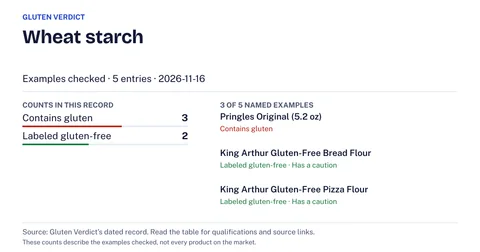
Two US label rules answer different questions. One way US allergen law has makers name a major food allergen is a “Contains” line printed after or next to the ingredient list67, and wheat is on the law’s list of major food allergens68. FDA’s gluten-free definition is about the amount of gluten: it allows an ingredient such as wheat starch that has been processed to remove gluten, as long as the food stays under 20 parts per million69. Our wheat starch verdict shows how we treat that ingredient, and wheat-free versus gluten-free labels compares the two claims.
Questions to bring to an allergist
Everything above is what allergy societies, a clinic and reviews say, and it cannot replace an examination. These items come from what the sources say a visit covers.
- A record of each reaction. Allergy & Anaphylaxis Australia suggests writing down what happened up to 6 hours before and 4 hours after the reaction (food, drinks, medicines and other possible co-factors) and bringing the notes24.
- Mayo Clinic’s list of what to prepare: symptoms (including any that seem unrelated to an allergy), family history of allergy and asthma, and medicines, vitamins or supplements36.
- Mayo Clinic’s sample questions include whether the symptoms are likely due to an allergy, whether allergy tests are needed, whether to see an allergist, and whether to carry epinephrine37.
- Whether blood testing for omega 5 gliadin is part of the work-up, which ASCIA says can help confirm the diagnosis13.
- Whether a supervised challenge test is used, which the 2023 FDEIA review says is done in a supervised hospital setting and that a negative result does not preclude the diagnosis66.
- Which foods, drugs and activities count as co-factors in your case, and whether the diet should be wheat only or also rye and barley11.
Verdicts in this guide
Questions people ask
Can WDEIA happen without exercise?
ASCIA says some people with confirmed WDEIA can have anaphylaxis after eating wheat without any known co-factor9. In the UK study of 132 adults, 11% had no identifiable co-factor61.
Is WDEIA the same as a gluten allergy?
No. ACAAI calls “gluten allergy” a misleading term, commonly confused with wheat allergy or sometimes celiac disease40. WDEIA is a form of wheat allergy52.
Does a negative test rule it out?
One 2023 review says ω5-gliadin-negative subtypes of WDEIA are often difficult to diagnose53, and another says that in provocation testing negative outcomes do not preclude FDEIA66. Only an allergist can interpret results.
Is it lifelong?
Allergy & Anaphylaxis Australia says it is not known how long exercise-induced anaphylaxis persists or whether people can grow out of it28.
More in Celiac diagnosis, testing and gluten sensitivity
 Wheat allergy tests vs celiac tests: which test answers which conditionWhich test answers which condition: celiac antibodies and biopsy versus wheat IgE, skin prick and food challenge, as ACG, NIAID, FARE and NIH say.
 Celiac disease vs gluten intolerance: three conditions, three diagnosesHow celiac disease, non-celiac gluten sensitivity and wheat allergy differ in mechanism, diagnosis and diet, with a source behind every point.
 How celiac disease is diagnosed, step by stepFrom blood test to biopsy or no-biopsy diagnosis: what US, European and UK guidelines say, where they differ, and what they say about eating gluten first.
 How non-celiac gluten sensitivity is diagnosed: the Salerno criteriaWhat counts as a diagnosis of non-celiac gluten sensitivity: the exclusions, the Salerno criteria steps and what a blinded gluten challenge involves.
 Diagnosing celiac disease in children without a biopsy: what the ESPGHAN guideline requiresThe conditions ESPGHAN sets for diagnosing celiac disease in a child without a biopsy, what must be confirmed first, and how US guidance differs.
 Questions to bring to a gastroenterologist when celiac disease is suspectedQuestions for a celiac disease appointment: what to bring, what the sources say about diet before testing, and what to ask about the biopsy and follow-up.
All 25 guides in Celiac diagnosis, testing and gluten sensitivity
Related guides
 Wheat-free, gluten-free and “no gluten ingredients”: what each label statement covers“Wheat-free”, “gluten-free” and “made with no gluten-containing ingredients” are three different statements. What each covers, and what to check.
 What gluten does in the gut: celiac disease, wheat allergy and gluten sensitivity comparedHow celiac disease, wheat allergy and non-celiac gluten sensitivity differ in the gut, and why testing comes before cutting out gluten.
 A gluten-free label that lists wheat or wheat starch: what it meansHow a US pack can say gluten-free and still list wheat starch or “wheat”, the statement FDA requires, and what to ask the maker.
 What in wheat bothers people if it is not gluten?The non-gluten candidates for wheat symptoms (fructans, ATIs, wheat allergy), the trial or review behind each, and what limits it.
Sources
- [1, 2, 3, 4, 5, 6, 7, 8, 9, 10, 11, 12, 13, 14, 15, 16, 17, 18] Australasian Society of Clinical Immunology and Allergy (ASCIA), Wheat Dependent Exercise Induced Anaphylaxis: Frequently Asked Questions, checked Nov 17, 2026.
Read on 2026-11-17: the ASCIA answer to Q 2 lists, as co-factors besides exercise, alcohol; heat, such as a hot bath or being outside on a hot day; and nonsteroidal anti-inflammatory drugs (NSAIDs) such as aspirin and ibuprofen.
- [19, 20, 21, 22, 23, 24, 25, 26, 27, 28] Allergy & Anaphylaxis Australia, Exercise-induced anaphylaxis, checked Nov 17, 2026.
Read on 2026-11-17: under “Other cofactors may lead to symptoms being triggered with less exercise”, the list names infections (viral or bacterial); lack of sleep or tiredness; hot environmental temperature (high heat and humidity); alcohol; spicy food; pollen (seasonal exposure in those allergic to pollen); and hormones (when a person has their period).
- [29, 30, 31] Food Allergy Research & Education (FARE), Wheat allergy, checked Nov 17, 2026.
- [32, 33] Mayo Clinic, Wheat allergy: symptoms and causes, checked Nov 17, 2026.
- [34, 35, 36, 37] Mayo Clinic, Wheat allergy: diagnosis and treatment, checked Nov 17, 2026.
Read on 2026-11-17: under “Preparing for your appointment”, the list headed “To prepare for your appointment, make a list that includes:” names symptoms, including any that may seem unrelated to an allergy; the family’s history of allergy and asthma; and medicines, vitamins or supplements taken.
Read on 2026-11-17: the list of questions to ask at the appointment includes “Are these symptoms likely due to an allergy?”, “Will I need allergy tests?”, “Should I see an allergist?” and “Do I need to carry epinephrine in case of anaphylaxis?”
- [38, 39, 40, 41, 42, 43] American College of Allergy, Asthma & Immunology (ACAAI), Wheat and gluten allergy, checked Nov 17, 2026.
- [44, 45, 46, 47, 48, 49] American Academy of Allergy, Asthma & Immunology (AAAAI), Anaphylaxis, checked Nov 17, 2026.
- [50, 51] American Academy of Allergy, Asthma & Immunology (AAAAI), Epinephrine myths vs facts, checked Nov 17, 2026.
- [52, 53, 54, 55, 56, 57] PubMed (J Dtsch Dermatol Ges, 2023), Faihs et al.: Wheat-dependent exercise-induced anaphylaxis: subtypes, diagnosis, and management, checked Nov 17, 2026.
- [58, 59, 60, 61, 62, 63, 64] PubMed (J Allergy Clin Immunol Pract, 2018), Kennard et al.: Omega-5 gliadin allergy (wheat-dependent exercise-induced anaphylaxis) in 132 adults, checked Nov 17, 2026.
- [65, 66] PubMed (Foods, 2023), Srisuwatchari et al.: Food-dependent exercise-induced anaphylaxis, an updated review, checked Nov 17, 2026.
- [67, 68] US Food and Drug Administration, Food Allergen Labeling and Consumer Protection Act of 2004 (FALCPA), checked Nov 17, 2026.
- [69] US Food and Drug Administration, Questions and Answers on the Gluten-Free Food Labeling Final Rule, checked Nov 17, 2026.