What gluten does in the gut: celiac disease, wheat allergy and gluten sensitivity compared
Short answer
Three different conditions get called a gluten problem, and they have different pathophysiologies32. NIDDK says celiac disease isn’t diagnosed on symptoms alone10 and that doctors don’t recommend starting a gluten-free diet before diagnostic testing, because the diet can affect test results12. GIG says gluten sensitivity is diagnosed only after celiac disease, wheat allergy and other possible causes have been ruled out23.
- Celiac disease is an immune disorder triggered by gluten that damages the small intestine1.
- Wheat allergy is an immune reaction to proteins in wheat, and NIDDK says it does not cause long-term damage to the small intestine19, 3.
- Non-celiac gluten sensitivity means symptoms after gluten-based or wheat-based foods without celiac disease or wheat allergy, and NIDDK says gluten sensitivity does not damage the small intestine26, 2.
Part of Gut science, healing and treatment research, 11 guides

Key points
- NIDDK describes celiac disease as damaging the small intestine; it says gluten sensitivity does not, and that wheat allergy does not cause long-term damage1, 2, 3.
- Wheat allergy involves IgE antibodies and, in GIG’s description, reacts within minutes to a few hours; celiac disease is autoimmune19, 20, 17.
- For non-celiac gluten sensitivity, a 2025 Lancet review cites the absence of biomarkers, calls it a diagnosis of exclusion and says the precise trigger of symptoms remains unclear30, 27.
- NIDDK says doctors don’t recommend starting a gluten-free diet before diagnostic testing, because the diet can affect test results12.
- The US “gluten-free” rule sets a limit of less than 20 parts per million of gluten, and FDA’s rule allows an ingredient such as wheat starch that was processed to remove gluten when the food stays under that limit37, 40.
Three conditions that get called a gluten problem
Wheat can set off several different immune-mediated reactions32. A StatPearls review of wheat allergy lists IgE-mediated wheat allergy, non-IgE-mediated hypersensitivity, and the distinct disorders celiac disease and non-celiac gluten sensitivity. It says they have different pathophysiologies and that telling them apart supports appropriate management32.
Gluten is a protein found naturally in wheat, barley and rye1. Wheat allergy is an immune reaction to wheat proteins19. The Gluten Intolerance Group (GIG) notes that a person with a wheat allergy must avoid eating any form of wheat but does not have trouble tolerating gluten from non-wheat sources21.
The sections below follow what each condition is reported to do in the body, using NIDDK, GIG, the American College of Gastroenterology (ACG), FDA, a Lancet review and a StatPearls review. This page reports what those sources say. It does not diagnose anything: a clinician decides which condition, if any, applies.
What celiac disease does to the lining of the small intestine
NIDDK describes celiac disease as a chronic digestive and immune disorder that damages the small intestine, triggered by eating foods containing gluten1. The ACG defines it as a permanent immune-mediated response to gluten in wheat, barley and rye, characterized by small bowel injury and the presence of specific antibodies14.
At the tissue level, GIG says the reaction to gluten causes inflammation and villous atrophy, or flattening, of the cells lining the small intestine, which can lead to malabsorption of nutrients18. FDA says that for Americans with celiac disease, consuming gluten causes damage to the lining of the small intestine, which prevents absorption of vital nutrients36.
Gluten is one part of the picture
NIDDK says celiac disease almost always occurs in people who have one of two groups of gene variants, DQ2 and DQ8. About 30 percent of people have DQ2 or DQ8, but only about 3 percent of those people develop celiac disease5. NIDDK also says that consuming gluten triggers the abnormal immune system response that causes the disease6.
Why symptoms alone do not settle it
NIDDK says symptoms of celiac disease vary widely and may come and go7, and that people with celiac disease who have no symptoms can still develop complications over time if they do not get treatment8. It also says celiac disease isn’t diagnosed on symptoms alone, because some symptoms resemble those of other digestive disorders such as irritable bowel syndrome or lactose intolerance10.
The treatment ACG describes is strict adherence to a gluten-free diet with lifelong medical follow-up16. NIDDK adds that symptoms typically improve after a person begins a gluten-free diet and may return if a person consumes small amounts of gluten9.
What wheat allergy does, and why it is a different kind of reaction
GIG describes wheat allergy as an immune reaction to any of the hundreds of proteins in wheat, in which B-cells send out immunoglobulin E (IgE) antibodies to “attack” the wheat19. It says the reaction happens very fast, within minutes to a few hours, with a range of symptoms from nausea, abdominal pain, itching and swelling of the lips and tongue to trouble breathing or anaphylaxis, a life-threatening reaction20. The StatPearls review says reactions can range from mild symptoms to life-threatening anaphylaxis33.
NIDDK draws the line with celiac disease this way: in both cases the immune system reacts to wheat, but wheat allergies do not cause long-term damage to the small intestine3. GIG puts the difference in the type of immune response: celiac disease is autoimmune, while wheat allergy involves an immune, not autoimmune, response17.
GIG also says a person can have a wheat allergy and have celiac disease or non-celiac gluten sensitivity too21. For wheat allergy, GIG describes treatment as removing all forms of wheat from the diet22. The StatPearls review covers the use and limitations of skin-prick testing, serum specific IgE testing, component-resolved diagnostics and oral food challenges34.
What non-celiac gluten sensitivity shows in the gut, and what is still unsettled
A 2025 Lancet review defines non-coeliac gluten sensitivity (NCGS) as people who report intestinal and extraintestinal symptoms related to eating gluten-based or wheat-based foods, in the absence of coeliac disease or wheat allergy26. NIDDK says that, unlike celiac disease, gluten sensitivity does not damage the small intestine2.
What causes the symptoms is unsettled. The Lancet authors write that the precise trigger of symptoms in NCGS remains unclear27. GIG says the biological processes responsible remain undefined17.
The Lancet review says definitive diagnosis of NCGS remains elusive due to the absence of biomarkers, and that it remains a diagnosis of exclusion30, and GIG says celiac disease, wheat allergy and other possible causes of symptoms must be ruled out first23.
On the numbers, the Lancet review reports that approximately 10% of adults worldwide self-report gluten or wheat sensitivity, and that meta-analyses suggest that, during controlled challenge studies, 16-30% of these individuals have symptoms specifically triggered by gluten. It adds that methodological variability, including fermentable carbohydrates in challenge preparations, limits interpretation28. Its authors write that current evidence suggests fermentable carbohydrates and nocebo effects contribute considerably to symptom generation in many cases29.
For management, the Lancet authors write that approaches should balance dietary modification with recognition of psychological factors while ensuring nutritional adequacy31.
The three side by side
| Celiac disease | Wheat allergy | Non-celiac gluten sensitivity | |
|---|---|---|---|
| Type of reaction | Autoimmune17 | Immune, not autoimmune; IgE antibodies17, 19 | Biological processes undefined17 |
| Small intestine | Damaged: villous atrophy, or flattening, of the lining cells18 | No long-term damage3 | NIDDK says gluten sensitivity does not damage it2 |
| What follows eating the trigger | Symptoms vary widely and may come and go; some people have none7, 8 | Reaction within minutes to a few hours, up to anaphylaxis20 | Symptoms like celiac disease’s, such as abdominal pain and tiredness2 |
| How it is diagnosed | Blood tests, then a small-intestine biopsy in most patients11, 15 | Allergy testing, covered in the StatPearls review34 | By exclusion: celiac disease and wheat allergy ruled out first; no biomarker30, 23 |
| Treatment as the sources describe it | A strict gluten-free diet with lifelong follow-up16 | Removing all forms of wheat22 | Removing gluten, per GIG22; the Lancet review adds nutritional adequacy and psychological factors31 |
Why the diagnosis comes before the diet
NIDDK says doctors don’t recommend starting a gluten-free diet before diagnostic testing, because a gluten-free diet can affect test results12. GIG calls proper diagnosis the key and names this as the most important reason not to start a gluten-free diet before being tested24. For celiac disease it adds that a patient must consume a gluten-containing diet for accurate diagnosis25.
NIDDK says the blood tests show levels of certain antibodies that are often higher than normal in people who have untreated celiac disease13.
NIDDK also says many people who have celiac disease have not been diagnosed, and that experts estimate about 2 million people in the United States, and about 1 percent of people around the world, have it4.
What the US gluten-free label rule covers
FDA’s gluten-free labeling rule specifies what the claim means on a food label, and the claim is voluntary35. A food that carries it must contain less than 20 parts per million (ppm) of gluten37. FDA says this is the lowest level that can be reliably detected in foods using scientifically validated methods, and that most people with celiac disease can tolerate foods with very small amounts of gluten37. It says the definition was intended to provide a reliable way for people with celiac disease to avoid gluten38.
The rule sets a limit on gluten in the food37. Under it, a food can contain an ingredient derived from a gluten-containing grain and processed to remove gluten, such as wheat starch, as long as that use does not result in 20 ppm or more gluten in the food40. Wheat as an allergen is handled separately: FDA lists wheat among the major food allergens41 and says labels must identify the food source names of all major food allergens used to make the food42.
For a step-by-step read of a package, see How to read a US food label for gluten.
Which guide to read next
- How to read a package for wheat, barley, rye and malt: How to read a US food label for gluten.
- To look up a food, start at every verdict, A to Z. FDA lists breads among the foods that typically contain gluten39; see our verdicts on bread and wheat flour.
Verdicts in this guide
 BreadContains glutenchecked Nov 16, 2026
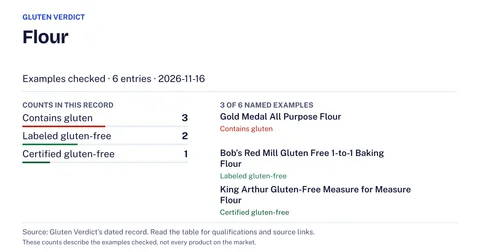 FlourContains glutenchecked Nov 16, 2026
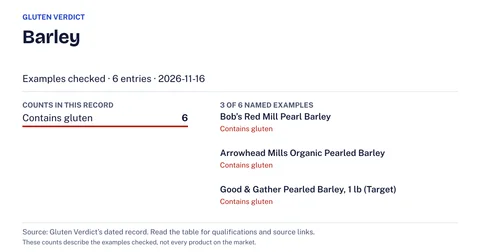 BarleyContains glutenchecked Nov 16, 2026
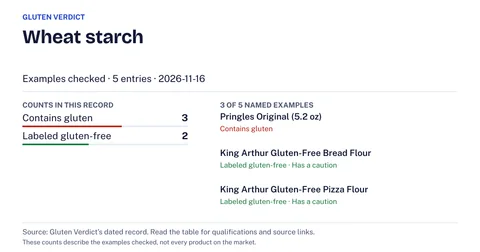 Wheat starchDepends on the product3 of 5 products we checked contain gluten: Pringles Original (5.2 oz), Jiffy Corn Muffin Mix, and Chex Mix Bold Garlic and Herbchecked Nov 16, 2026
Questions people ask
Does gluten damage the gut in everyone?
NIDDK describes small-intestine damage as part of celiac disease1. It says gluten sensitivity does not damage the small intestine2 and that wheat allergies do not cause long-term damage to it3.
Is non-celiac gluten sensitivity real?
The Lancet review describes it as people who report symptoms related to eating gluten-based or wheat-based foods without celiac disease or wheat allergy, and says the precise trigger remains unclear26, 27. It also says the diagnosis is one of exclusion30.
Can someone have more than one of these conditions?
GIG says a person can have a wheat allergy and also have celiac disease or non-celiac gluten sensitivity21.
Is a gluten-free label the same as wheat-free?
Not under FDA’s rule, which sets a limit on gluten. It allows an ingredient such as wheat starch that has been processed to remove gluten, as long as that use does not result in 20 ppm or more gluten in the food40.
More in Gut science, healing and treatment research
 How celiac disease damages the small intestine, step by stepThe steps from gluten to blunted villi in celiac disease: the genes, the immune response, how damage is graded and which test shows which step.
 How long celiac healing takes: symptoms, antibodies and the gut liningWhat studies report on how long symptoms, blood antibodies and the intestinal lining take to recover on a gluten-free diet, and what to ask your care team.
 Leaky gut and gluten: what the studies measured, and in whomIs “gluten causes leaky gut” true? Sort the claims by evidence: cell and biopsy studies, trials in people, zonulin tests, and what to ask a test seller.
 Can someone with celiac disease eat gluten again?What NIDDK, the ACG guideline and studies say about eating gluten again with celiac disease, why feeling well is not healing, and who runs a challenge.
 How much gluten causes damage: what dose studies show and what 20 ppm meansWhat dose studies in celiac disease measured, how 20 ppm converts to milligrams for a real portion, and what FDA’s limit is and is not.
 What happens when you stop eating gluten, condition by conditionWhat a gluten-free diet does in celiac disease, dermatitis herpetiformis, wheat allergy, gluten sensitivity and with no diagnosis, with the trials.
All 11 guides in Gut science, healing and treatment research
Related guides
 Celiac disease vs gluten intolerance: three conditions, three diagnosesHow celiac disease, non-celiac gluten sensitivity and wheat allergy differ in mechanism, diagnosis and diet, with a source behind every point.
 Celiac disease symptoms in adults: what the sources list and who gets testedDigestive and non-digestive celiac symptoms as NIDDK, ACG and Coeliac UK list them, who guidelines say to test, and why gluten stays in the diet first.
 Celiac Blood Tests: What tTG-IgA, Total IgA, DGP and EMA Each CheckWhat tTG-IgA, total IgA, EMA and DGP check, why total IgA is drawn with tTG-IgA, when back-up tests are used, and why gluten stays in the diet first.
 What gluten is, which grains carry it and what “gluten-free” meansA plain definition of gluten, the grains that carry it, look-alike words such as malt and wheat starch, and what a US gluten-free label means.
Sources
- [1, 2, 3, 4] National Institute of Diabetes and Digestive and Kidney Diseases, Definition & Facts for Celiac Disease, checked Nov 17, 2026.
- [5, 6, 7, 8, 9] National Institute of Diabetes and Digestive and Kidney Diseases, Symptoms & Causes of Celiac Disease, checked Nov 17, 2026.
- [10, 11, 12, 13] National Institute of Diabetes and Digestive and Kidney Diseases, Diagnosis of Celiac Disease, checked Nov 17, 2026.
- [14, 15, 16] PubMed (Am J Gastroenterol), American College of Gastroenterology Guidelines Update: Diagnosis and Management of Celiac Disease (abstract), checked Nov 17, 2026.
- [17, 18, 19, 20, 21, 22, 23, 24, 25] Gluten Intolerance Group, Celiac Disease, Non-Celiac Gluten Sensitivity or Wheat Allergy: What is the Difference?, checked Nov 17, 2026.
- [26, 27, 28, 29, 30, 31] PubMed (Lancet), Non-coeliac gluten sensitivity (Lancet review, abstract), checked Nov 17, 2026.
- [32, 33, 34] PubMed (StatPearls), Wheat Allergy (StatPearls, abstract), checked Nov 17, 2026.
- [35, 36, 37, 38, 39] US Food and Drug Administration, Gluten and Food Labeling, checked Nov 17, 2026.
- [40] US Food and Drug Administration, Questions and Answers on the Gluten-Free Food Labeling Final Rule, checked Nov 17, 2026.
- [41, 42] US Food and Drug Administration, Food Allergies: What You Need to Know, checked Nov 17, 2026.