Wheat-free, gluten-free and “no gluten ingredients”: what each label statement covers
Short answer
Of these three, only “gluten-free” is defined in FDA’s gluten-free rule, which requires any unavoidable gluten to be under 20 parts per million1; FDA says other terms about the absence of gluten are judged case by case2. “Wheat-free” does not settle rye, barley or spelt19, and “made with no gluten-containing ingredients” describes the ingredients: FDA says not to assume such a food meets the gluten-free rule unless the label also says gluten-free9.
Part of Label reading and gluten-free claims, 17 guides
Key points
- FDA defines “gluten-free”, and its three equivalents “free of gluten”, “without gluten” and “no gluten”, as a claim with requirements1, 2. Its gluten-free Q&A never uses the phrase “wheat-free”13.
- The Celiac Disease Foundation says products labeled wheat-free are not necessarily gluten-free and may still contain spelt, rye or barley-based ingredients19.
- A statement such as “made with no gluten-containing ingredients” is allowed if it is truthful and not misleading, but it is not the gluten-free claim9.
- A food can be gluten-free and still not be wheat-free: gluten-free wheat starch is permitted in foods labeled gluten-free15.
- Where only the weaker statement appears, the ingredient list and the maker’s own page are the next stop.
Three statements, side by side
The three statements sit in the same place on a pack and read as if they were close. What the sources say about each is not.
| Statement on the pack | What the sources say it covers | Who defines it | What it leaves open |
|---|---|---|---|
| “Gluten-free” (also “free of gluten”, “without gluten”, “no gluten”) | On foods FDA regulates8: no gluten-containing grain as an ingredient, no ingredient derived from one that was not processed to remove gluten, no gluten-removed ingredient whose use results in 20 parts per million or more gluten in the food, and any unavoidable gluten under 20 parts per million1. The three other phrases carry the same requirements2. | FDA; use of the claim is voluntary3 | Meat, poultry, certain egg products and most alcoholic drinks follow USDA or TTB labeling rules instead8 |
| “Wheat-free” | The Celiac Disease Foundation says such products are not necessarily gluten-free and may still contain spelt, rye or barley-based ingredients19. | Not on FDA’s gluten-free Q&A, which does not use the phrase13 | Rye, barley and spelt ingredients19 |
| “Made with no gluten-containing ingredients” | A statement about the ingredients, which FDA allows if it is truthful and not misleading9. | Not the gluten-free claim: unless the label also says gluten-free, FDA says consumers should not assume the food meets the claim’s requirements9 | Gluten that arrives by cross-contact, which FDA describes12; see the survey below |
“Gluten-free”: what the claim obliges the maker to
This is the one of the three that FDA’s rule attaches a number to. Any unavoidable gluten in a food labeled gluten-free has to be under 20 parts per million1, and the food cannot be intentionally made with a gluten grain, or an ingredient from one that was not processed to remove gluten, in any amount4.
The claim is voluntary3. A maker is not required to test for gluten, but it is responsible for making sure a food bearing the claim complies5. FDA says it enforces the rule through sampling, inspections, label reviews and follow-up on complaints6.
A certification logo is a separate thing from the claim. FDA lets a maker print one if its use is truthful and not misleading, and it does not endorse any particular certification program7.
Wheat can appear on a gluten-free pack. The Gluten Intolerance Group says a gluten-free claim may sit on a label with a “Contains: wheat” statement, or with wheat in the ingredient list, only if the wheat-derived ingredient was processed to remove gluten to a level that complies with FDA’s definition25. So a food can be gluten-free without being wheat-free.
“Wheat-free”: what it says and what it leaves out
The Celiac Disease Foundation puts it directly: products labeled wheat-free are not necessarily gluten-free, and they may still contain spelt (which it calls a form of wheat), rye or barley-based ingredients19. It repeats the point on its label-reading page15.
The allergen law treats the grains differently. The list of major food allergens in the 2004 law (FALCPA) includes wheat; barley and rye are not on it14. The Foundation notes that a lack of allergen labeling does not mean a product is gluten-free, and that barley and rye are not among the allergens that have to be listed16. Our guide to the Contains line goes through what that line does and does not cover.
The Gluten Intolerance Group adds that gluten is not a top allergen in the US, which makes it easy for gluten to “hide” behind other names in ingredient lists27.
A wheat-free label can also matter for a different reason. The same group notes that wheat-derived ingredients processed to remove gluten can be present in gluten-free products yet may still be problematic for wheat-allergic consumers26. That is an allergy question, which this guide does not cover.
“No gluten ingredients” and similar ingredient statements
FDA answers this one by name. Neither the gluten-free rule nor its general labeling rules prohibit a statement like “made with no gluten-containing ingredients” or “not made with gluten-containing ingredients”, provided it is truthful and not misleading; but unless the label also bears a gluten-free claim, consumers should not assume the food meets all FDA requirements for that claim9.
For similar wording, such as “made with gluten-free ingredients”, which that answer does not name, FDA says other terms about the absence of gluten are judged case by case2. The question to ask of the pack stays the same: does it also carry the claim itself?
Why the ingredient list is not the finished food
FDA describes how gluten reaches grains, legumes and seeds that are naturally free of gluten: crop rotation and shared harvesting equipment, transport equipment and storage silos often bring gluten-containing grains into contact with them12.
One survey measured the effect. Its authors list a US Food and Drug Administration center as their affiliation29 and tested 275 foods labeled gluten-free and 186 foods without a gluten-free label and without wheat, rye or barley on the ingredient label22. Of the 275, 3 were mislabeled against the 20 ppm threshold; of the 186, 36 had more than 20 ppm by at least one test kit, and 19 of those had more than 100 ppm23. The authors also report that oats in the non-labeled foods were strongly correlated with a positive result24.
Read that with its limits. It is one survey, published in 2015, and its comparison group was defined by the ingredient list and the absence of a claim, which is close to, but not the same as, foods carrying a “no gluten ingredients” statement22.
The National Celiac Association draws a practical conclusion from the risk: it recommends that processed foods, and naturally gluten-free grain products such as cereal and flours, carry a gluten-free label because they have a high risk of cross-contact with gluten21.
Examples from our verdicts
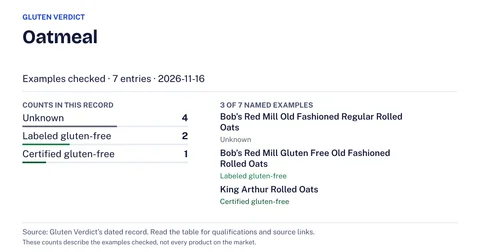
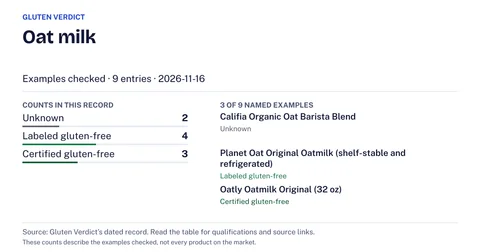
- Oatmeal and oat milk: oats are a grain other than wheat, rye or barley, and oats labeled gluten-free must contain less than 20 ppm10, 11. The Celiac Disease Foundation advises that people with celiac disease always choose oats with a gluten-free label18. A pack of oats with no gluten-free claim resembles the non-gluten-free-labeled group in the survey above, where oats were strongly correlated with a positive result24.
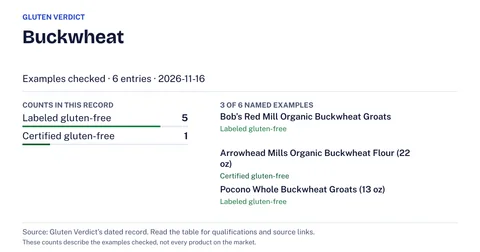
- Buckwheat: the name has “wheat” in it, but FDA says any grain other than wheat, rye, barley or their hybrids can be labeled gluten-free if unavoidable gluten is under 20 ppm10.
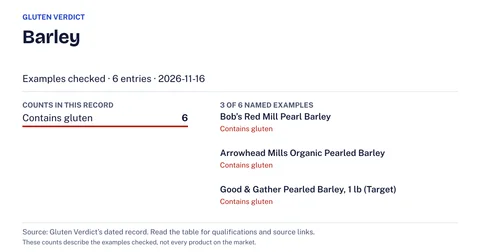
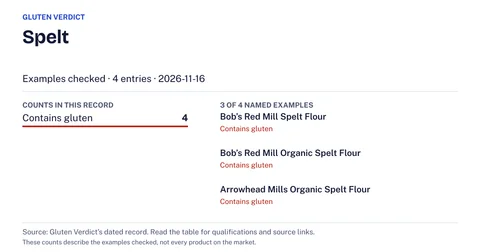
- Barley and spelt: a wheat-free statement does not rule out barley, rye or spelt ingredients19.
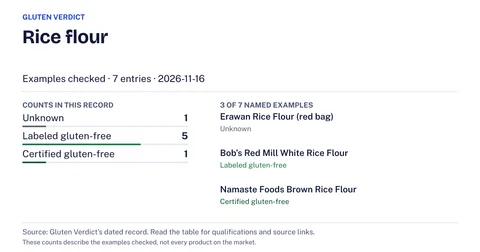
- Rice flour: rice is a grain FDA says can be labeled gluten-free10, and the National Celiac Association still recommends a gluten-free label on flours and cereals21.
- Bread: our page separates the loaves we checked by what each maker’s page and label say, which is the comparison this guide is about.
What to check when only the weaker statement appears
- Read the whole ingredient list. For a product not labeled gluten-free, the National Celiac Association lists six words to watch for: wheat, rye, barley, malt, brewer’s yeast and oats20.
- Do not stop at the Contains line: barley and rye are not among the allergens that have to be listed16.
- Look for the gluten-free claim itself, on the pack or on the maker’s page. A certification logo may also appear, though FDA does not endorse any program7.
- If there is no claim, the Celiac Disease Foundation’s advice is to read the ingredients label thoroughly17. The Gluten Intolerance Group adds that you can call the company to ask about its protocols and its cross-contact risks28.
- For oats, look for a gluten-free label18.
Our gluten scanner looks for these names in a photo of a label or in pasted text, and for the packaged foods we have checked, each verdict shows what the maker’s pages said and when we read them: start at every verdict, A to Z. The package in your hand has the final word.
Verdicts in this guide
 BarleyContains glutenchecked Nov 16, 2026
 SpeltContains glutenchecked Nov 16, 2026
 BuckwheatNaturally gluten-freeBuy it labeled gluten-freechecked Nov 16, 2026
 Rice flourNaturally gluten-freeBuy it labeled gluten-freechecked Nov 16, 2026
 OatmealDepends on the productchecked Nov 16, 2026
 BreadContains glutenchecked Nov 16, 2026
 Oat milkDepends on the productchecked Nov 16, 2026
Questions people ask
Is wheat-free the same as gluten-free?
No. The Celiac Disease Foundation says products labeled wheat-free are not necessarily gluten-free and may still contain spelt, rye or barley-based ingredients19.
Can a food labeled gluten-free contain wheat?
It can when the wheat-derived ingredient was processed to remove gluten to a level that meets FDA’s gluten-free definition, according to the Gluten Intolerance Group25.
Does “made with no gluten-containing ingredients” mean the food meets FDA’s gluten-free rule?
Not by itself. FDA says that unless the label also bears a gluten-free claim, consumers should not assume the food meets the claim’s requirements9.
More in Label reading and gluten-free claims
 The Contains line names wheat, not barley or rye: what US allergen labels coverWhat the US allergen Contains line covers, why it names wheat but not barley or rye, and which ingredient-list names stand in for them.
 Certified or naturally gluten-free: when a seal mattersWhich naturally gluten-free foods are worth buying with a claim or seal: produce, grains, flours, oats and processed foods, with FDA rules and test data.
 How to read a US food label for glutenWhere gluten shows up on a US food label: the gluten-free claim, the Contains line, the ingredient list and may-contain lines, and what each means.
 Vegan, organic, non-GMO, natural and keto labels do not mean gluten-freeVegan, organic, non-GMO, natural, plant-based and keto labels describe other things. What each claims, and which gluten claim or source to check instead.
 How to check whether a packaged food is gluten-freeA four-step check for one packaged food: the claim, the ingredient and allergen lines, the maker’s dated page and the certifier’s directory.
 A gluten-free label that lists wheat or wheat starch: what it meansHow a US pack can say gluten-free and still list wheat starch or “wheat”, the statement FDA requires, and what to ask the maker.
Related guides
 The FDA gluten-free rule: what 21 CFR 101.91 requires and what 20 ppm measuresWhat FDA’s gluten-free rule requires, which claim words it covers, what 20 ppm means for a portion of food, and how FDA checks that a claim holds.
 Gluten-free at Sprouts: the collection, bulk bins and wording that is not a claimWhat Sprouts says about gluten on its own pages, how its collection and bulk bins differ from a package claim, and what organic or wheat-free leaves open.
 Wheat, barley and rye on an ingredient list: the names to look forLook up wheat, barley and rye names on a US ingredient list, from durum to malt, and sort each as contains gluten, depends on the maker, or lookalike.
 Spelt, farro, Kamut, bulgur, couscous and freekeh: wheat under other namesWhich shop and menu names are wheat: spelt, farro, Kamut, einkorn, bulgur, couscous, freekeh and more, and what FDA’s rules say about them.
Sources
- [1, 2, 3, 4, 5, 6, 7, 8, 9, 10, 11, 12, 13] US Food and Drug Administration, Questions and Answers on the Gluten-Free Food Labeling Final Rule, checked Nov 17, 2026.
Read on 2026-11-17: the page text never uses the phrase “wheat-free”; it defines “gluten-free” and answers questions on related label statements, among them “made with no gluten-containing ingredients”.
- [14] US Food and Drug Administration, Food Allergen Labeling and Consumer Protection Act of 2004 (FALCPA), checked Nov 17, 2026.
- [15, 16, 17, 18] Celiac Disease Foundation, Label Reading & the FDA, checked Nov 17, 2026.
- [19] Celiac Disease Foundation, Sources of Gluten, checked Nov 17, 2026.
- [20, 21] National Celiac Association, No gluten-free label (Can I eat a product that is not labeled gluten free but does not contain ingredients with gluten?), checked Nov 17, 2026.
Read on 2026-11-17: under “If something is not labeled GF watch out for these six words on the label:” the page lists wheat, rye, barley, malt, brewer’s yeast and oats.
- [22, 23, 24, 29] Food Chemistry (PubMed), Gluten detection in foods available in the United States - a market survey (Sharma, Pereira, Williams, 2015), checked Nov 17, 2026.
- [25, 26] Gluten Intolerance Group, Do All Wheat Mentions on Food Labels Mean Not Gluten-Free?, checked Nov 17, 2026.
- [27, 28] Gluten Intolerance Group, Advanced Label-Reading Tips, checked Nov 17, 2026.