What in wheat bothers people if it is not gluten?
Short answer
A 2025 narrative review names fructans (a fermentable carbohydrate16) and amylase-trypsin inhibitors, or ATIs (pest-resistance molecules in wheat19), as non-gluten components implicated as potential triggers1. One double-blind trial found fructans, not gluten, raised symptom scores2, 7, but a 2025 scoping review found no direct evidence currently linking wheat fermentable carbohydrates or ATIs to symptoms of non-celiac wheat sensitivity3. Celiac disease and wheat allergy are separate conditions13, and the Gluten Intolerance Group says both have to be ruled out before gluten sensitivity is diagnosed4.
Part of Gluten basics and myths, 13 guides

Key points
- Non-celiac wheat sensitivity means symptoms after wheat in someone with neither celiac disease nor wheat allergy5; it remains poorly characterized and lacks diagnostic markers6.
- A 2025 narrative review names fructans and ATIs as the non-gluten wheat components particularly implicated as potential triggers1; a 2025 scoping review found no direct evidence currently linking wheat fermentable carbohydrates, ATIs or other components to NCWS symptoms3.
- The 2018 trial found overall symptom scores significantly higher after fructans than after gluten, and gluten and placebo did not differ2, 7. A 2013 trial found gluten-specific effects in only 8% of participants after FODMAP reduction8.
- The ATI evidence comes from cells, mice and biopsies9; a 2022 review says validation by human studies is warranted10.
- Wheat allergy is a separate condition13; diagnosis of IgE-mediated wheat allergy is based on history, specific IgE to wheat and oral food challenges12.
Three different conditions share one trigger food
Celiac disease, wheat allergy and non-celiac wheat sensitivity are the three main categories of wheat-related disorders13. Non-celiac wheat sensitivity (NCWS) is characterized by a symptomatic response to wheat and related grains in the absence of celiac disease or wheat allergy5. NCWS remains particularly poorly characterized, owing to unclear pathophysiology and a lack of diagnostic markers6.
Papers use two names for it. Some say non-celiac gluten/wheat sensitivity (NCG/WS), a condition of intestinal and extraintestinal symptoms attributed to gluten without celiac disease or wheat allergy14; others say NCWS5. This guide says NCWS and keeps each study’s own wording when it describes a trial.
The Gluten Intolerance Group adds that NCGS is neither an IgE (allergic) reaction nor an autoimmune one15. That leaves the question this guide takes up: if gluten is only part of the picture, what else in wheat could be involved?
The candidates side by side
| Candidate | What it is | Evidence found | Main limit |
|---|---|---|---|
| Fructans | A fermentable carbohydrate, one of the FODMAPs16 | One double-blind crossover trial of 59 people: fructans scored higher than gluten, and gluten did not differ from placebo2, 7, 17 | A 2025 review says the one controlled study of fermentable carbohydrates it found used carbohydrates not derived from wheat18 |
| Amylase-trypsin inhibitors (ATIs) | Pest-resistance molecules in wheat19 | Cells, biopsies and mice9; no eligible human study of ATIs as an NCWS trigger18 | Much of the knowledge is in vitro and animal; human studies are warranted10 |
| Wheat germ agglutinin (WGA) and glyphosate | Two further compounds a 2020 review names16 | The 2025 scoping review's abstract says no eligible study assessed ATIs or other wheat-related compounds as potential NCWS triggers, and does not name WGA or glyphosate18 | Listed as compounds that may be involved, in a review16 |
| Gluten itself | A protein in wheat, rye and barley20 | Of 16 double-blind placebo-controlled studies, 8 reported a greater response to gluten than control18 | Evidence called inconsistent and undermined by methodological limitations3 |
| Wheat allergy (a separate condition) | An immune reaction to any of the hundreds of proteins in wheat11 | Diagnosis of IgE-mediated wheat allergy rests on history, specific IgE to wheat and oral food challenge12 | Outside the NCWS definition, which excludes it5 |
The 2018 fructan result and the 2025 scoping review’s conclusion sit side by side here without being reconciled. The table lists what the abstracts say; it ranks nothing.
FODMAPs and fructans: what the trials did and did not separate
Skodje and colleagues (2018)
Skodje and colleagues ran a double-blind crossover challenge in 59 people who followed a self-instituted gluten-free diet and in whom celiac disease had been excluded21. The diets contained gluten (5.7 g), fructans (2.1 g) or placebo, concealed in muesli bars, for 7 days22.
Mean overall scores on the GSRS-IBS symptom scale were 33.1 after gluten, 38.6 after fructans and 34.3 after placebo17. Scores after fructans were significantly higher than after gluten (P = .049), as were bloating scores (P = .003)2. Gluten and placebo did not differ7.
The counts are mixed: 13 people had their highest overall score after gluten, 24 after fructans and 22 after placebo7. The abstract gives the fructan dose and says it was concealed in muesli bars22; it does not say whether the fructans came from wheat.
Biesiekierski and colleagues (2011 and 2013)
In 2011, Biesiekierski and colleagues ran a double-blind placebo-controlled rechallenge in people with irritable bowel syndrome, celiac disease excluded, whose symptoms were controlled on a gluten-free diet23. Symptoms were not adequately controlled in 13 of 19 on gluten and 6 of 15 on placebo24. The authors concluded that non-celiac gluten intolerance “may exist” but the trial gave no clue to the mechanism25.
Their 2013 trial tested 37 people with NCGS and irritable bowel syndrome, without celiac disease26. Symptoms improved on reduced FODMAP intake, then worsened to a similar degree on gluten or whey protein, and gluten-specific effects appeared in only 8% of participants8. In a 3-day rechallenge the gluten-specific effects were not reproduced and an order effect was observed27. The authors found no evidence of specific or dose-dependent effects of gluten in people on low-FODMAP diets28.
What the designs could not separate
- The 2013 trial tested gluten only after FODMAP reduction, in people with irritable bowel syndrome8, 26.
- The 2018 trial enrolled people already on their own gluten-free diet, and each challenge lasted 7 days21, 22.
- A 2025 review of the field found significant limitations and inconsistencies across studies in participant selection, challenge protocols and data reporting29.
- The same review says the one controlled study of fermentable carbohydrates it found tested carbohydrates not derived from wheat, and that no direct evidence currently links wheat fermentable carbohydrates to NCWS symptoms3, 18.
Amylase-trypsin inhibitors: cell and animal results
ATIs are widely consumed in cereal foods and have been implicated in adverse reactions to wheat, including allergy and intestinal responses linked to celiac disease and NCWS30. Junker and colleagues identified two of them, CM3 and 0.19, as strong activators of innate immune responses in monocytes, macrophages and dendritic cells19.
In that work ATIs engaged the TLR4-MD2-CD14 complex and released proinflammatory cytokines in cells from celiac and non-celiac patients and in celiac patients’ biopsies, and mice lacking TLR4 or its signaling were protected from responses to oral ATIs9. The paper’s own conclusion was about celiac disease, with other immune disorders as a possibility31.
A 2022 review says much of what is known about ATIs’ biological effects comes from studies in vitro and in animal models, and that validation by human studies using processed foods as commonly consumed is warranted10. The 2025 scoping review found no eligible study that assessed ATIs as an NCWS trigger18.
Gluten stays on the list, and so do other components
The 2025 scoping review found 16 double-blind placebo-controlled studies, 8 of which reported a greater symptomatic response to gluten than the control18. It calls the evidence for gluten inconsistent and undermined by methodological limitations3.
A 2020 review describes NCG/WS as an “umbrella term” for a variety of conditions in which gluten is likely not the only factor32. It names fructans, ATIs, wheat germ agglutinin and glyphosate as other compounds that may be involved16. Coeliac New Zealand puts it more simply: some problems with cereals relate to sugars, some to gluten, and others to other proteins33.
Wheat allergy is a different condition with its own tests
Wheat allergy is an immune reaction to any of the hundreds of proteins in wheat11. IgE-mediated reactions are immediate, involve wheat-specific IgE antibodies and can be life-threatening34. In its account of wheat allergy, a 2025 review says the majority recover during adolescence35.
Diagnosis of IgE-mediated wheat allergy is based on the medical history, detection of specific IgE to wheat and oral food challenges12. The Gluten Intolerance Group says a person with wheat allergy must avoid any form of wheat but has no trouble tolerating gluten from non-wheat sources, and that a person can have a wheat allergy and also celiac disease or NCGS36.
On a US label, “gluten-free” and wheat can appear together38. FDA’s definition covers an ingredient derived from wheat that has been processed to remove gluten, with wheat starch as its example, as long as the food does not reach 20 parts per million of gluten37. A food made with such wheat that carries the claim and declares wheat has to carry a disclaimer that the wheat was processed38. See how to read a US food label for gluten and our wheat starch page.
Why “it is not gluten” does not settle it
A 2025 narrative review reports that self-reported rates of NCWS are high in the general population (often above 10%), while double-blind placebo-controlled challenge studies confirm the diagnosis in only a minority of cases (typically below 30%)39. The same review says management mainly involves eliminating wheat and gluten, with a low-FODMAP diet proven effective as an adjunctive treatment40.
The 2025 scoping review concludes that the existing evidence is insufficient to justify restricting specific components of wheat in the management of NCWS3. A 2020 review’s authors place a low-FODMAP diet first for people whose symptoms relate more to FODMAPs than to gluten or wheat, and second-line for those with self-reported gluten/wheat-related symptoms who do not respond to a gluten-free diet41.
These are the reviewers’ statements, not advice from us.
What the NIDDK, charities and reviews say about ruling things out first
- The NIDDK says doctors most often use blood tests and small-intestine biopsies to diagnose or rule out celiac disease, and do not recommend starting a gluten-free diet before diagnostic testing because the diet can affect results42.
- The Gluten Intolerance Group says that diagnosing gluten sensitivity first requires ruling out celiac disease, wheat allergy and other possible causes of symptoms4.
- Coeliac New Zealand says to be screened for coeliac disease and checked by a GP to exclude other important conditions first43.
- A 2025 review says diagnosing NCWS requires excluding other disorders and complex dietary challenge protocols, such as the Salerno Experts’ Criteria, that are impractical for routine clinical use44.
The 2020 review’s authors add that a personalized approach, regular follow-up and the help of a skilled dietician are mandatory45.
Where our verdicts fit
Our verdicts answer one question: whether a food contains gluten grains or carries a gluten-free claim we could read. They do not report a food’s fructan or ATI content, and they are not a wheat-allergy assessment. Our verdict pages for common wheat foods arebread, pasta, flour, spelt, sourdough, crackers, cereal and wheat starch.
Verdicts in this guide
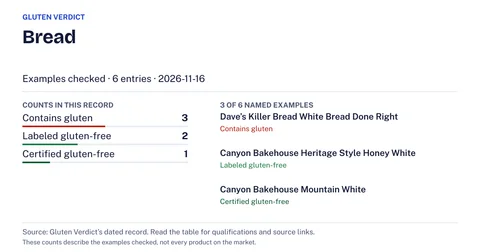 BreadContains glutenchecked Nov 16, 2026
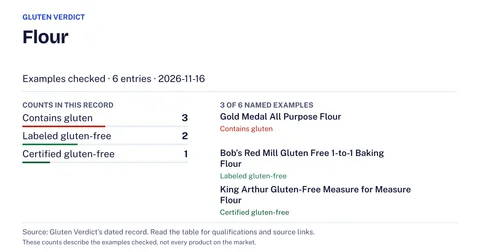 FlourContains glutenchecked Nov 16, 2026
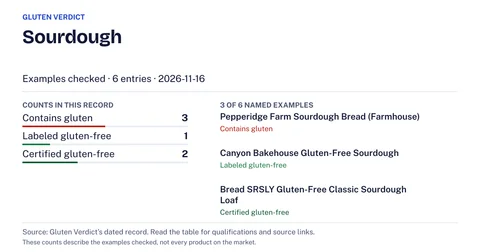 SourdoughContains glutenchecked Nov 16, 2026
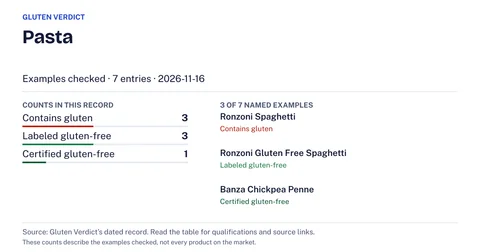 PastaContains glutenchecked Nov 16, 2026
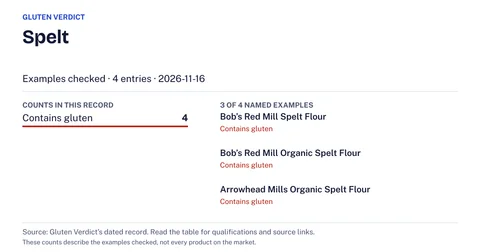 SpeltContains glutenchecked Nov 16, 2026
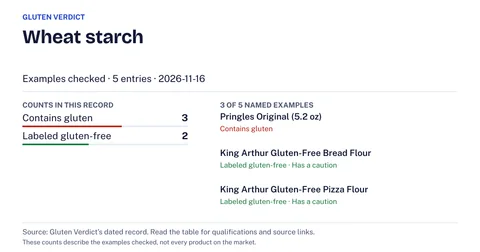 Wheat starchDepends on the product3 of 5 products we checked contain gluten: Pringles Original (5.2 oz), Jiffy Corn Muffin Mix, and Chex Mix Bold Garlic and Herbchecked Nov 16, 2026
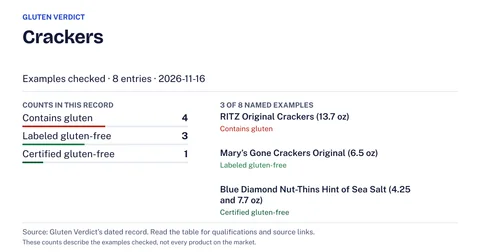 CrackersDepends on the product4 of 8 products we checked contain glutenchecked Nov 16, 2026
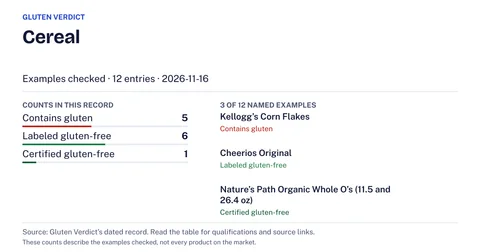 CerealDepends on the product5 of 12 products we checked contain glutenchecked Nov 16, 2026
Questions people ask
Is non-celiac wheat sensitivity the same as celiac disease?
No. The Gluten Intolerance Group describes NCGS as neither an IgE reaction like wheat allergy nor an autoimmune reaction like celiac disease15.
Is there a test for non-celiac wheat sensitivity?
A 2025 review says NCWS lacks diagnostic markers6. A 2025 narrative review adds that diagnosis requires excluding other disorders and complex challenge protocols such as the Salerno Experts’ Criteria, which are impractical for routine clinical use44.
Can someone have a wheat allergy and celiac disease at the same time?
Yes. The Gluten Intolerance Group says a person can have a wheat allergy and also celiac disease or NCGS36.
Did the fructan trial show wheat is fine for people with sensitivity?
No. It compared gluten, fructans and placebo in 59 people21, 22, and fructans scored higher than gluten2. Its abstract does not say whether the fructans came from wheat, and a 2025 scoping review found no direct evidence currently linking wheat fermentable carbohydrates to NCWS symptoms3.
More in Gluten basics and myths
 Did modern wheat get worse? What the variety studies show on glutenWhat studies of old and modern wheat varieties show on gluten, and what they say about spelt, einkorn and ancient wheats and celiac disease.
 Glyphosate, lectins and “wheat belly”: three wheat claims checkedWhere the glyphosate, wheat lectin and “wheat belly” claims come from, what the reviews found, and what NIDDK and FDA’s gluten-free rule say.
 Fine on bread in Europe? What it does and does not showWhat a trip where bread felt fine does and does not show about celiac disease, and how EU and US gluten-free label rules compare.
 Spelt, Kamut, Durum and Einkorn: Every Kind of Wheat Has GlutenDurum, semolina, spelt, einkorn, kamut, farro: which wheat words on a US label count as gluten, and what the FDA rule and the sources say about each.
 What gluten is, which grains carry it and what “gluten-free” meansA plain definition of gluten, the grains that carry it, look-alike words such as malt and wheat starch, and what a US gluten-free label means.
 Why gluten problems seem more common: what the evidence separatesGluten problems seem everywhere. Studies separate three things: cases found, cases that exist, and people avoiding gluten.
Related guides
 Celiac disease vs gluten intolerance: three conditions, three diagnosesHow celiac disease, non-celiac gluten sensitivity and wheat allergy differ in mechanism, diagnosis and diet, with a source behind every point.
 Wheat-free, gluten-free and “no gluten ingredients”: what each label statement covers“Wheat-free”, “gluten-free” and “made with no gluten-containing ingredients” are three different statements. What each covers, and what to check.
 Gluten-free and low FODMAP: what to check when symptoms continueHow gluten and FODMAPs differ, what guidelines list for persistent symptoms on a gluten-free diet, and FODMAP ingredients to look for on labels.
 How non-celiac gluten sensitivity is diagnosed: the Salerno criteriaWhat counts as a diagnosis of non-celiac gluten sensitivity: the exclusions, the Salerno criteria steps and what a blinded gluten challenge involves.
Sources
- [1, 39, 40, 44] International Journal of Molecular Sciences (via PubMed), Maimaris et al., 2025, abstract, checked Nov 17, 2026.
- [2, 7, 17, 21, 22] Gastroenterology (via PubMed), Skodje et al., 2018, abstract, checked Nov 17, 2026.
- [3, 5, 18, 29] American Journal of Gastroenterology (via PubMed), An et al., 2025, abstract, checked Nov 17, 2026.
- [4, 11, 15, 20, 36] Gluten Intolerance Group, Celiac Disease, Non-Celiac Gluten Sensitivity or Wheat Allergy: What is the Difference? (educational bulletin, updated December 2023), checked Nov 17, 2026.
- [6, 13, 35] Seminars in Immunology (via PubMed), Størdal and Kurppa, 2025, abstract, checked Nov 17, 2026.
- [8, 26, 27, 28] Gastroenterology (via PubMed), Biesiekierski et al., 2013, abstract, checked Nov 17, 2026.
- [9, 19, 31] Journal of Experimental Medicine (via PubMed), Junker et al., 2012, abstract, checked Nov 17, 2026.
- [10, 30] European Journal of Nutrition (via PubMed), Geisslitz et al., 2022, abstract, checked Nov 17, 2026.
- [12, 34] Journal of Asthma and Allergy (via PubMed), Wheat allergy: diagnosis and management (Cianferoni, 2016), abstract, checked Nov 17, 2026.
- [14, 16, 32, 41, 45] Nutrients (via PubMed), Is Gluten the Only Culprit for Non-Celiac Gluten/Wheat Sensitivity? (Mumolo et al., 2020), abstract, checked Nov 17, 2026.
- [23, 24, 25] American Journal of Gastroenterology (via PubMed), Biesiekierski et al., 2011, abstract, checked Nov 17, 2026.
- [33, 43] Coeliac New Zealand, Non-coeliac Gluten Sensitivity, checked Nov 17, 2026.
- [37, 38] US Food and Drug Administration, Questions and Answers on the Gluten-Free Food Labeling Final Rule, checked Nov 17, 2026.
- [42] National Institute of Diabetes and Digestive and Kidney Diseases (NIDDK), Diagnosis of Celiac Disease, checked Nov 17, 2026.