Wheat allergy tests vs celiac tests: which test answers which condition
Short answer
Celiac disease and wheat allergy are different conditions10, and the sources describe separate tests for each:
- Celiac disease: a blood test for TTG IgA antibodies taken while eating gluten, then biopsies of the small intestine to confirm, in the American College of Gastroenterology (ACG) guideline1, 2.
- Wheat allergy: Stanford’s allergy center names skin prick tests, IgE antibody levels and oral food challenges3; the NIAID-sponsored expert panel, writing about food allergy in general, says a thorough history is very important but not diagnostic alone29, and calls the double-blind placebo-controlled food challenge the gold standard4.
- Both at once: the Gluten Intolerance Group (GIG) says a person can have a wheat allergy and celiac disease6.
Part of Celiac diagnosis, testing and gluten sensitivity, 25 guides

Key points
- The antibodies differ: Stanford’s allergy center says celiac disease produces IgA or IgG antibodies, not the IgE antibodies that go with wheat allergy11.
- NIAID’s food allergy guidelines say they do not discuss celiac disease, so an allergy guideline is not a celiac guideline38.
- A positive skin prick test or IgE blood test alone does not make a food allergy diagnosis, according to the NIAID panel and FARE30, 32, 34.
- NIDDK says doctors don’t recommend starting a gluten-free diet before celiac testing, because the diet can affect test results18.
- GIG says a gastroenterologist usually diagnoses celiac disease and an allergist usually completes the testing for an IgE food allergy such as wheat allergy12, 13.
Two different immune reactions to wheat
ACG defines celiac disease as a permanent immune-mediated response to gluten present in wheat, barley and rye7. FARE describes it as an autoimmune disease in which antibodies are produced in response to gluten, with inflammation and damage to the lining of the small intestine8. Wheat allergy is a different mechanism: FARE describes an IgE-mediated reaction to proteins in wheat9.
Mayo Clinic says the two are sometimes confused but are different conditions10.
| Celiac disease | Wheat allergy | |
|---|---|---|
| Type of immune reaction | Autoimmune5 | An immune but not autoimmune response; IgE-mediated5, 9 |
| Antibodies | IgA or IgG11 | IgE11 |
| What the reaction involves | Inflammation and damage to the lining of the small intestine8 | Skin, gastrointestinal tract and respiratory symptoms, and anaphylaxis in some people9 |
| Who usually makes the diagnosis (GIG) | A gastroenterologist12 | An allergist13 |
| The diet the sources describe | A gluten-free diet for life14 | Avoiding any form of wheat; GIG says a person with wheat allergy does not have trouble tolerating gluten from non-wheat sources15 |
Mayo Clinic says wheat allergy symptoms are likely to appear within minutes to hours after eating something containing wheat16. NIDDK says celiac disease isn’t diagnosed based on symptoms alone17.
What celiac testing looks for
The ACG guideline starts with a blood test for TTG IgA antibodies, taken while the person eats a regular gluten-containing diet, plus a total IgA measurement if IgA deficiency has not been checked before1. The total IgA measurement looks for IgA deficiency; if it is present, ACG says an IgG serology (commonly DGP and/or TTG) should be measured20.
An elevated TTG IgA leads to an upper endoscopy with biopsies of the duodenum19, and ACG recommends those biopsies to confirm the diagnosis in children and adults2. Even a negative blood test does not always end the work-up: ACG says that when the likelihood is high, endoscopy with biopsy should be considered despite negative serology21.
- In children, ACG’s testing algorithm lists nonbiopsy criteria: a high TTG IgA (more than 10 times the upper limit of normal) with a positive endomysial antibody (EMA) in a second blood sample, only if the family agrees with a no-biopsy strategy22.
- A genetic test looks for the DQ2 and DQ8 gene variants. NIDDK says that without them celiac disease is very unlikely23, but having them does not mean celiac disease, since most people with these variants do not develop it24.
NIDDK says doctors don’t recommend starting a gluten-free diet before diagnostic testing, because the diet can affect test results18. More on the blood work in our celiac blood test guide.
What wheat allergy testing looks for
Mayo Clinic lists a physical exam, a detailed medical history and some tests25. The NIAID-sponsored panel, writing about food allergy in general rather than wheat alone, says a thorough history is very important but cannot be diagnostic by itself29. Stanford’s allergy center names three tools for wheat allergy: skin prick tests, IgE antibody levels and oral food challenges3.
- Skin prick test: tiny drops of purified allergen extracts, including wheat protein extracts, are pricked onto the skin, on the forearm or upper back26. The NIAID panel says a positive result correlates with IgE bound to skin mast cells, and recommends the test to identify foods that may provoke IgE-mediated reactions, but not as a diagnosis on its own31, 30.
- Blood test for specific IgE: Mayo Clinic says it may be ordered when a skin condition or certain medicines prevent a skin test27. The NIAID panel says it detects allergic sensitization and is not diagnostic alone33, 32.
- Oral food challenge: the suspected food is eaten under monitoring, starting with a small amount and increasing28. The NIAID panel calls the double-blind placebo-controlled version the gold standard4.
The word that matters is sensitization. FARE says a positive skin prick or IgE blood test can show the immune system recognizes a food without the person having symptoms, so these tests alone cannot confirm a food allergy34. The NIAID panel adds the other direction: negative skin tests occasionally occur in IgE-mediated food allergy, so a highly suggestive history calls for further evaluation, for example a physician-supervised food challenge35. It also recommends against routine total serum IgE for diagnosing food allergy36.
Because a challenge can trigger a reaction, FARE says it is typically performed by experienced allergists in medical facilities equipped to manage emergencies37.
Which test answers which question
| Test | Condition | What it answers |
|---|---|---|
| TTG IgA (with total IgA) | Celiac disease | Whether celiac antibodies are present; taken while eating gluten1 |
| Duodenal biopsy at endoscopy | Celiac disease | The confirming test in the ACG guideline2 |
| DQ2 / DQ8 gene test | Celiac disease | NIDDK: without the variants celiac disease is very unlikely; having them does not mean celiac disease23, 24 |
| Skin prick test | Wheat allergy | Whether food-specific IgE is bound to skin mast cells (the NIAID panel writes about foods in general); not diagnostic alone31, 30 |
| Wheat-specific IgE blood test | Wheat allergy | Whether allergic sensitization is present (Mayo: a blood test screening for antibodies to common allergens, including wheat proteins27); not diagnostic alone33, 32 |
| Supervised oral food challenge | Wheat allergy | Whether eating the suspected food causes a reaction28; the NIAID panel calls the double-blind placebo-controlled version the gold standard4 |
| Total serum IgE | Food allergy in general | The NIAID panel recommends against routine use for diagnosis36 |
Can a person have both?
GIG says a person can have a wheat allergy and also have celiac disease or non-celiac gluten sensitivity (NCGS)6. GIG also says that before NCGS can be diagnosed, celiac disease, wheat allergy and other possible causes must first be ruled out39; our celiac vs gluten intolerance guide covers that third condition.
Mayo Clinic adds that a person with wheat allergy might also be allergic to barley, oats and rye, and that unless other grains are involved, the wheat-free diet is less restrictive than a gluten-free diet40.
Who does which test, and what order the sources give
Both sources name history. NIDDK says doctors use medical and family history, a physical exam and test results, among other things, to look for signs that a person might have celiac disease and should be tested41; the NIAID panel says a thorough history is very important for focusing the food allergy work-up29.
After that the paths divide by specialty. GIG says a gastroenterologist usually diagnoses celiac disease and an allergist usually completes the testing for IgE food allergy12, 13. Mayo Clinic says a person may be referred to an allergist for certain diagnostic tests42. The GIG page does not give an order for running the celiac and allergy work-ups against each other44; that is a question for the treating clinician.
For the allergy visit, Mayo Clinic lists the kind of questions to expect, for example how soon after eating symptoms appear43.
What changes at the label and in the diet
The US 2004 allergen labeling law’s definition of a major food allergen lists wheat45. FARE says wheat must appear in plain language on packaged foods sold in the US, in the ingredient list or in a Contains statement46. Barley and rye are not in that definition45, but ACG describes celiac disease as a response to gluten in wheat, barley and rye7; see the Contains line and wheat, barley and rye.
The two diets are not the same list. FARE’s avoid list for wheat allergy names, among others, seitan, spelt, flour, semolina and wheat starch48. Mayo Clinic says gluten-free foods may also be free of grains a person with wheat allergy can eat, so sticking to them may needlessly limit the diet47. Our verdicts answer the gluten question, not the allergy question: see seitan, spelt, flour, bread and wheat starch, and wheat-free vs gluten-free labels.
FARE says it is important to work with a physician to determine an accurate diagnosis49.
Verdicts in this guide
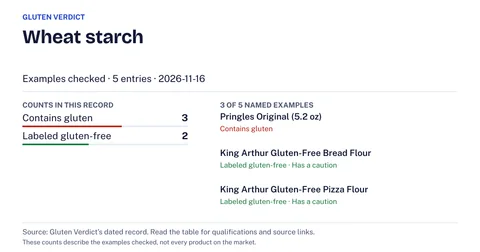 Wheat starchDepends on the product3 of 5 products we checked contain gluten: Pringles Original (5.2 oz), Jiffy Corn Muffin Mix, and Chex Mix Bold Garlic and Herbchecked Nov 16, 2026
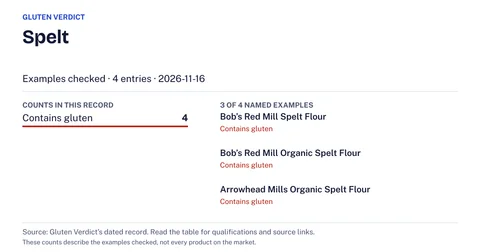 SpeltContains glutenchecked Nov 16, 2026
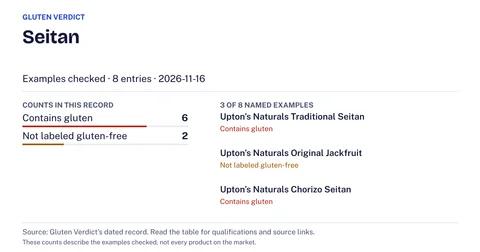 SeitanContains glutenchecked Nov 16, 2026
 BreadContains glutenchecked Nov 16, 2026
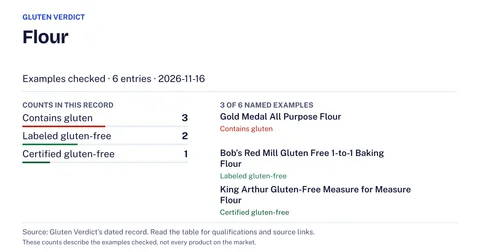 FlourContains glutenchecked Nov 16, 2026
Questions people ask
Can a celiac blood test detect wheat allergy?
The celiac blood test measures TTG IgA1, while wheat allergy involves IgE antibodies9. Stanford’s allergy center says celiac antibodies are IgA or IgG rather than IgE11.
Does a positive wheat IgE test mean a wheat allergy?
Not on its own: the NIAID panel says sIgE tests alone are not diagnostic of food allergy32, and FARE says a positive test can show sensitization without symptoms34.
Does going gluten-free first affect testing?
For celiac disease, NIDDK says it can: doctors don’t recommend starting a gluten-free diet before diagnostic testing because the diet can affect test results18.
Who performs an oral food challenge?
FARE says experienced allergists, typically in medical facilities equipped to manage emergencies37.
More in Celiac diagnosis, testing and gluten sensitivity
 Celiac disease vs gluten intolerance: three conditions, three diagnosesHow celiac disease, non-celiac gluten sensitivity and wheat allergy differ in mechanism, diagnosis and diet, with a source behind every point.
 Wheat-dependent exercise-induced anaphylaxis (WDEIA): a wheat allergy that needs a co-factorWhat allergy societies say WDEIA is, how it is diagnosed, how it differs from celiac disease, and why an allergist and emergency plan matter.
 How a gluten challenge works before celiac testingWhat named celiac sources say about the amount and length of a gluten challenge before testing, side by side, and why a clinician plans it.
 Bloated after bread or pasta? Why the celiac blood test comes before cutting glutenWhy bloating after bread or pasta cannot name its cause, why celiac blood tests come before a gluten-free diet, and what to ask a clinician.
 At-home celiac and gluten sensitivity tests: what they can and cannot showWhat home celiac antibody kits, IgG food panels, stool and genetic tests can and cannot show, and what a result still needs from a clinician.
 Positive celiac blood test but a normal biopsy: what doctors call potential celiac diseaseWhat celiac guidelines say when antibodies are positive but the biopsy looks normal: potential celiac disease, other causes, and the follow-up described.
All 25 guides in Celiac diagnosis, testing and gluten sensitivity
Related guides
 Celiac Blood Tests: What tTG-IgA, Total IgA, DGP and EMA Each CheckWhat tTG-IgA, total IgA, EMA and DGP check, why total IgA is drawn with tTG-IgA, when back-up tests are used, and why gluten stays in the diet first.
 How non-celiac gluten sensitivity is diagnosed: the Salerno criteriaWhat counts as a diagnosis of non-celiac gluten sensitivity: the exclusions, the Salerno criteria steps and what a blinded gluten challenge involves.
 What gluten does in the gut: celiac disease, wheat allergy and gluten sensitivity comparedHow celiac disease, wheat allergy and non-celiac gluten sensitivity differ in the gut, and why testing comes before cutting out gluten.
 What in wheat bothers people if it is not gluten?The non-gluten candidates for wheat symptoms (fructans, ATIs, wheat allergy), the trial or review behind each, and what limits it.
Sources
- [1, 2, 7, 19, 20, 21, 22] American College of Gastroenterology (ACG), ACG Guidelines Update: Diagnosis and Management of Celiac Disease, checked Nov 17, 2026.
- [3, 11] Stanford Medicine, Sean N. Parker Center for Allergy and Asthma Research, Wheat Hypersensitivities, checked Nov 17, 2026.
- [4, 29, 30, 31, 32, 33, 35, 36, 38] NIAID-sponsored Expert Panel (NIH), Guidelines for the Diagnosis and Management of Food Allergy in the United States, checked Nov 17, 2026.
- [5, 6, 12, 13, 14, 15, 39, 44] Gluten Intolerance Group (GIG), Celiac Disease, Non-Celiac Gluten Sensitivity or Wheat Allergy: What is the Difference?, checked Nov 17, 2026.
Read on 2026-11-17: the passage under the heading “Do I have celiac disease, non-celiac gluten sensitivity, or wheat allergy?” says who usually diagnoses each condition (a gastroenterologist for celiac disease, an allergist for IgE food allergy such as wheat allergy) and gives no order in which to do the celiac and allergy tests.
- [8, 9, 46, 48, 49] Food Allergy Research & Education (FARE), Wheat Allergy, checked Nov 17, 2026.
Read on 2026-11-17: the list headed “Avoid foods that contain wheat or any of these ingredients:” names, among others, bread crumbs, couscous, durum, farro, flour (with its types), pasta, seitan, semolina, spelt, vital wheat gluten and wheat (bran, durum, germ, gluten, grass, malt, sprouts, starch).
- [10, 16, 40] Mayo Clinic, Wheat allergy: Symptoms and causes, checked Nov 17, 2026.
- [17, 18, 23, 24, 41] National Institute of Diabetes and Digestive and Kidney Diseases (NIDDK), Diagnosis of Celiac Disease, checked Nov 17, 2026.
- [25, 26, 27, 28, 42, 43, 47] Mayo Clinic, Wheat allergy: Diagnosis and treatment, checked Nov 17, 2026.
- [34, 37] Food Allergy Research & Education (FARE), National Indicator Report on Food Allergy (2026), checked Nov 17, 2026.
- [45] US Food and Drug Administration, Food Allergen Labeling and Consumer Protection Act of 2004 (FALCPA), checked Nov 17, 2026.