A gluten-free label that lists wheat or wheat starch: what it means
Short answer
A US pack can carry a gluten-free claim and the word “wheat” together when the wheat-derived ingredient, such as wheat starch, was processed to remove gluten and the food has less than 20 parts per million (ppm) of gluten1, 5. On a food FDA regulates, FDA then requires an asterisked statement on the label that the wheat has been processed to meet its gluten-free requirements2. Whether to eat such a food is the reader’s decision, Gluten Free Watchdog says, and it suggests asking the maker how the wheat starch is tested3, 4.
Part of Label reading and gluten-free claims, 17 guides

Key points
- A wheat-derived ingredient is allowed in a food labeled gluten-free only if it was processed to remove gluten and the food has less than 20 ppm of gluten; FDA’s own example is wheat starch5.
- On an FDA-regulated pack, “wheat” beside a gluten-free claim must be followed by an asterisk that points to a statement that the wheat has been processed to meet FDA’s gluten-free requirements, or the label is deemed misbranded2.
- The National Celiac Association (NCA) considers maltodextrin gluten free regardless of its starting material and glucose syrup gluten free even when derived from wheat6, 7; for wheat starch, NCA ties the answer to the label and GIG to how the starch is processed8, 9.
- FDA does not require makers to test their ingredients or finished foods labeled gluten-free, so the maker is the one to ask how the wheat starch is checked10.
Why “gluten-free” and “wheat” can sit on one pack
Two separate US rules put these two statements on one pack. Allergen law has the maker name wheat when the food contains it, for example in a Contains line printed right after or next to the ingredient list11, and wheat counts when an ingredient contains protein derived from it12. The gluten-free rule asks a different question: which ingredients the food uses and whether the finished food has less than 20 ppm of gluten5.
So a pack can name wheat as an allergen and still qualify as gluten-free1. Gluten Intolerance Group (GIG) gives the condition: a gluten-free claim may appear beside “Contains: wheat”, or beside wheat in the ingredient list, only if the wheat-derived ingredient has been processed to remove gluten to a level that meets FDA’s definition, less than 20 ppm1.
For what a Contains line leaves out, see the Contains line guide; for the rule behind the claim, see FDA’s gluten-free labeling rule.
What FDA requires when a wheat-derived ingredient is used
FDA’s rule sorts wheat-derived ingredients two ways. One that has not been processed to remove gluten, such as wheat flour, cannot be in a food labeled gluten-free. One that has been processed, with wheat starch as FDA’s example, is allowed unless using it puts 20 ppm or more gluten into the food, and any unavoidable gluten must also be below 20 ppm5. FDA adds that a gluten-free food cannot be intentionally made with an ingredient derived from a gluten grain that was not processed to remove gluten13.
One more requirement applies on the label itself. In the regulation’s words, the word “wheat” in the ingredient list or in the Contains statement has to be followed immediately by an asterisk (or other symbol) that refers to a matching symbol close to the ingredient statement, and the matching symbol has to introduce this sentence2:
“The wheat has been processed to allow this food to meet the Food and Drug Administration (FDA) requirements for gluten-free foods.” A food with the gluten-free claim and the wheat declaration but without this statement is deemed misbranded2.
| On the pack | What it means |
|---|---|
| Gluten-free claim, “wheat” or “Contains wheat”, and the asterisked statement | The maker is stating that the wheat has been processed so the food meets FDA’s gluten-free requirements2. The claim still means less than 20 ppm of gluten in the food5. |
| Gluten-free claim and “wheat” or “Contains wheat”, but no asterisked statement | The label is deemed misbranded under 21 CFR 101.91(b)(3)2. FDA says labeling concerns may be reported to it14. |
| “Wheat starch” in the ingredients, with no gluten-free claim and no certification mark | GIG says wheat starch in a product that is neither certified nor labeled gluten-free is a concern and should be avoided15. |
| A may-contain or shared-facility line beside a gluten-free claim | FDA does not prohibit both on one label when the advisory statement is truthful and not misleading16. GIG notes that such statements are voluntary17. |
FDA’s rule does not apply to foods whose labeling USDA or TTB regulates, which generally means meat, poultry and certain egg products for USDA18.
How to read the pack, step by step
- Find the word “wheat”. The regulation looks for it in the ingredient list or in a separate “Contains wheat” statement2.
- Look for an asterisk or other symbol right after it2.
- Find the matching symbol near the ingredient statement and read the sentence that follows it2.
- Look for the gluten-free claim or a certification mark. The table above gives GIG’s view of wheat starch with neither15.
- If the statement is there and you want the maker’s test details, go to the questions below.
Wheat starch, glucose syrup, dextrose, maltodextrin and dextrin are not treated alike
The two US celiac charities we read do not treat these wheat-derived ingredients the same way. Where we have a verdict page for an ingredient, the last column links to it.
| Ingredient on the pack | What the charities say | Our verdict page |
|---|---|---|
| Wheat starch | NCA: it depends. Food containing wheat starch that is not labeled gluten free should not be eaten because it can contain high levels of gluten, while a labeled gluten-free food may contain it if the food has less than 20 ppm of gluten8. GIG: whether it is gluten-free depends on how extensively it is processed9. | Wheat starch |
| Glucose syrup, glucose | NCA lists glucose syrup among the ingredients it considers gluten free even when derived from wheat7. GIG says that even when the source of glucose is wheat, no protein of any sort, including gluten, remains in the final product19. | Glucose syrup |
| Dextrose | NCA: dextrose is another word for glucose and is considered gluten free regardless of the starting material20. | No page yet |
| Maltodextrin | NCA: considered gluten free regardless of the starting material6. GIG: the product is a white powder of sugar chains with no gluten proteins, even when derived from gluten-containing grains21. | Maltodextrin |
| Dextrin | NCA: dextrin from wheat should be avoided unless the product is labeled gluten free22. | Dextrin |
| “Starch” on its own | NCA: on an FDA-regulated food the single word “starch” means cornstarch23. On USDA-regulated foods it may mean cornstarch or wheat starch24. | Modified food starch |
The allergen rule turns on protein. FDA’s allergen guidance says an ingredient derived from a major allergen is not subject to the allergen labeling requirements when it contains no protein derived from that allergen25. Under that guidance, an ingredient shown to contain no wheat protein does not by itself trigger a wheat declaration25. For a closer look at the sweeteners, see maltodextrin, dextrin and glucose syrup made from wheat.
Wheat starch: what GIG and Gluten Free Watchdog say
GIG says a certified gluten-free product can contain wheat when the wheat has been processed to remove all protein. Its example is wheat starch, which would need to be tested to meet GIG’s 10 ppm threshold26. It adds that not all wheat starch is gluten-free, and that certification by GFCO requires 10 ppm or less, against FDA’s less than 20 ppm for the claim27.
Gluten Free Watchdog (GFWD) says wheat starch is an allowed ingredient in foods labeled gluten-free in the US28. In its 2023 update, the highest level it found in its commissioned testing in labeled gluten-free wheat starch and in gluten-free foods containing it was 17 ppm by the competitive R5 ELISA and 6 ppm by the sandwich R5 ELISA29. For wheat starch not labeled gluten-free, it says the gluten may be well above 20 ppm30.
GFWD’s opinion is that wheat starch used in gluten-free products should be tested with both the sandwich and the competitive R5 ELISA, unless the supplier confirms that hydrolytic enzymes are not used in making water-washed wheat starch31. Its bottom line on labeled gluten-free foods containing wheat starch is that eating them is your decision3.
GFWD also reports what GFCO told it by email on August 1, 2023: wheat starch in certified products must be water washed only and must test no higher than 5 ppm of gluten by sandwich ELISA32.
What to ask the maker
FDA’s rule does not require manufacturers to test their starting ingredients or finished foods labeled gluten-free, though they are responsible for meeting it10. The maker is therefore the one who can say how the check is done. Questions that follow from the sources above:
- Which ingredient carries the wheat? The ingredient list says which one; the asterisked statement says the wheat has been processed so the food meets FDA’s gluten-free requirements2.
- How is the wheat starch tested for gluten, and has the supplier confirmed that no hydrolytic enzymes are used in making the water-washed wheat starch? GFWD suggests asking about both4.
- Is the finished product certified, and to what level? GIG says certification by GFCO requires 10 ppm or less of gluten27.
GFWD’s page also lists replies it collected from GFCO and several makers; they differ in which tests the maker says it uses and in whether hydrolytic enzymes are used, and they date from 2023 and 2024, so a maker’s answer today may differ33. Our guide to asking a manufacturer about gluten has the wider list of questions.
Wheat allergy is a separate question
GIG says wheat-derived ingredients can be highly processed to remove gluten and be present in gluten-free products but may still be problematic for wheat-allergic consumers34. NCA says many food allergy specialists and organizations recommend avoiding glucose syrup made from wheat for those with a wheat allergy, which it distinguishes from celiac disease35.
Verdicts in this guide
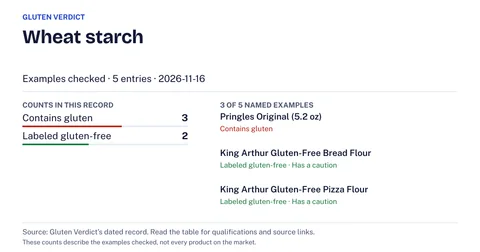 Wheat starchDepends on the product3 of 5 products we checked contain gluten: Pringles Original (5.2 oz), Jiffy Corn Muffin Mix, and Chex Mix Bold Garlic and Herbchecked Nov 16, 2026
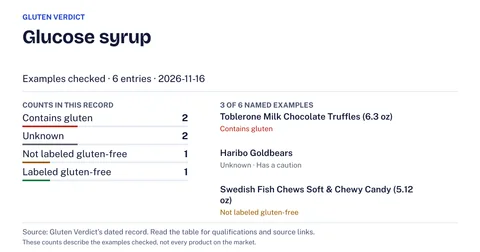 Glucose syrupNaturally gluten-free2 of 6 products we checked contain gluten: Toblerone Milk Chocolate Truffles (6.3 oz) and Darrell Lea Original Black Licorice (7 oz)checked Nov 16, 2026
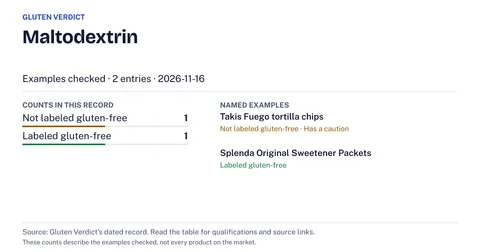 MaltodextrinNaturally gluten-freechecked Nov 16, 2026
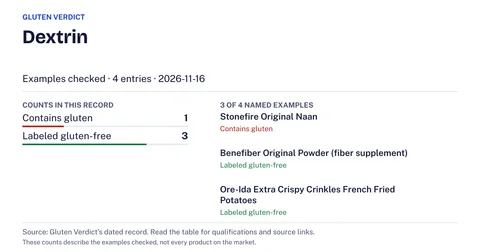 DextrinDepends on the product1 of 4 products we checked contains gluten: Stonefire Original Naanchecked Nov 16, 2026
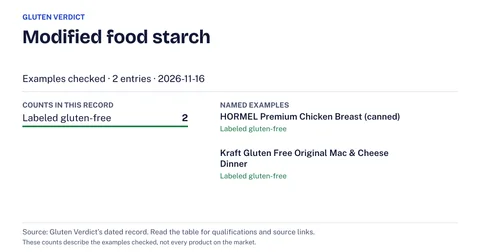 Modified food starchDepends on the productchecked Nov 16, 2026
Questions people ask
Can a food labeled gluten-free contain wheat?
Yes, when the ingredient made from wheat was processed to remove gluten and the food has less than 20 ppm of gluten1. FDA’s own example of such an ingredient is wheat starch5.
What does the asterisk next to “wheat” on a gluten-free pack mean?
It points to a statement FDA requires: “The wheat has been processed to allow this food to meet the Food and Drug Administration (FDA) requirements for gluten-free foods”2.
Can a gluten-free food also say “may contain wheat”?
Yes. FDA does not prohibit a voluntary advisory statement such as “made in a facility that also processes wheat” beside a gluten-free claim if it is truthful and not misleading16.
More in Label reading and gluten-free claims
 How to check whether a packaged food is gluten-freeA four-step check for one packaged food: the claim, the ingredient and allergen lines, the maker’s dated page and the certifier’s directory.
 The FDA gluten-free rule: what 21 CFR 101.91 requires and what 20 ppm measuresWhat FDA’s gluten-free rule requires, which claim words it covers, what 20 ppm means for a portion of food, and how FDA checks that a claim holds.
 How to read a US food label for glutenWhere gluten shows up on a US food label: the gluten-free claim, the Contains line, the ingredient list and may-contain lines, and what each means.
 When a gluten-free label looks wrong: what to keep, who to tell, where to lookFound wheat, barley or malt in a food labeled gluten-free? What to keep, whom to tell, which US agency takes the report, and where recalls are listed.
 “Low gluten”, “gluten removed” and “gluten friendly” on a labelWhat “low gluten”, “gluten removed” and “gluten friendly” mean on a US label, which phrases FDA or TTB define, and what to ask the maker.
 The Contains line names wheat, not barley or rye: what US allergen labels coverWhat the US allergen Contains line covers, why it names wheat but not barley or rye, and which ingredient-list names stand in for them.
Related guides
 What to ask a food maker about gluten, and how to read the replyHow to write to a food maker about gluten: what to include, questions that get a usable answer, and how to sort the reply.
 Maltodextrin, dextrin and glucose syrup made from wheat: what the label rules sayWhat US label law, FDA and the two US celiac charities say about wheat-made maltodextrin, dextrin and glucose syrup, and how to confirm one.
 Hydrolyzed protein, yeast extract and wheat starch on a US food labelWhich grain is behind hydrolyzed protein, yeast extract and wheat starch, what a US label must name, and what to ask the maker.
 Wheat, barley and rye on an ingredient list: the names to look forLook up wheat, barley and rye names on a US ingredient list, from durum to malt, and sort each as contains gluten, depends on the maker, or lookalike.
Sources
- [1, 15, 17, 27, 34] Gluten Intolerance Group, Wheat Mentions on Gluten-Free Food Labels (April 2021), checked Nov 17, 2026.
- [2] Electronic Code of Federal Regulations, 21 CFR 101.91 Gluten-free labeling of food, checked Nov 17, 2026.
- [3, 4, 28, 29, 30, 31, 32, 33] Gluten Free Watchdog, Wheat Starch in Gluten-Free Foods in 2023: An Update from Gluten Free Watchdog, checked Nov 17, 2026.
Read on 2026-11-17: the page lists replies from GFCO, Schar, King Arthur, Molino, Original Sunshine and Caputo, and notes that DiGiorno had not responded; the entries are dated August 2023 to July 2024; the replies differ in which gluten tests the maker says it uses and whether hydrolytic enzymes are used in making the wheat starch.
- [5, 10, 13, 14, 16, 18] US Food and Drug Administration, Questions and Answers on the Gluten-Free Food Labeling Final Rule, checked Nov 17, 2026.
- [6, 8, 20, 22, 23, 24] National Celiac Association, Ingredients People Question (reviewed August 2022), checked Nov 17, 2026.
- [7, 35] National Celiac Association, Glucose syrup from wheat in a gluten-free product (revised September 2, 2026), checked Nov 17, 2026.
Read on 2026-11-17: the list headed “The following are considered gluten free even when derived from wheat:” names citric acid, distilled alcohols, distilled vinegar and glucose syrup.
- [9, 21] Gluten Intolerance Group, Are Maltose, Maltodextrin, Glucose Syrup, Yeast Extracts, and Wheat Starch Gluten-Free? (2021), checked Nov 17, 2026.
- [11] US Food and Drug Administration, Food Allergen Labeling and Consumer Protection Act of 2004 (FALCPA), checked Nov 17, 2026.
- [12, 25] US Food and Drug Administration, Questions and Answers Regarding Food Allergens, Including the Food Allergen Labeling Requirements (Edition 5), checked Nov 17, 2026.
- [19] Gluten Intolerance Group, Glucose from wheat or corn (GIG FAQ, October 14, 2019), checked Nov 17, 2026.
- [26] Gluten Intolerance Group, Can an item that contains wheat be certified gluten-free? (GIG FAQ), checked Nov 17, 2026.